Modern B2B buying is complex, digital, and non‑linear—especially for global companies sourcing from China. Learn the key stages, decision factors, and how marketplace platforms like Looperbuy streamline sourcing, reduce risk, and improve buyer experience across the entire journey.
A modern B2B buying process is long, non‑linear, and digital‑first—and for global buyers sourcing from China, platforms like Looperbuy can remove huge friction around sourcing, inventory, and logistics.
Table of Contents
Understanding the Modern B2B Buying Process
The B2B buying process is the set of steps a company follows to identify a business need, evaluate suppliers, and purchase a solution. Compared with B2C, it is longer, involves more stakeholders, and carries higher financial and operational risk. [impresee]
Today, this journey is largely digital‑driven: buyers research online, expect self‑service tools, and often complete most of their evaluation before talking to a salesperson. For cross‑border procurement from China, this means platforms that centralize suppliers, pricing, and logistics can dramatically streamline decision‑making and execution. [rapyd]
> As someone who has worked with international B2B manufacturers and sourcing teams, I see the buying process less as a funnel and more as a loop—buyers constantly move back and forth between research, validation, and internal approvals before they place and repeat orders.
Key Stages of the B2B Buying Cycle
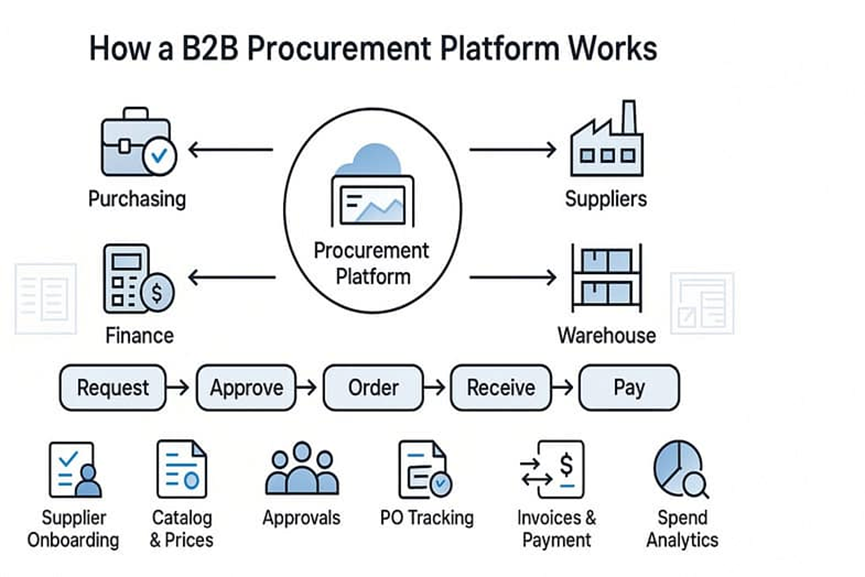
Although no two buying journeys are identical, most follow a consistent sequence of stages. For clarity, we’ll combine insights from established models and modern marketplace practice: [impresee]
1. Need identification and requirement definition
2. Information research and solution exploration
3. Shortlisting and supplier comparison
4. Internal alignment, negotiation, and decision
5. Implementation and onboarding
6. Post‑purchase evaluation and relationship building
7. Ongoing usage, renewal, and re‑evaluation
1. Identifying the Need and Defining Requirements
The process starts when an initiator inside the company spots a problem or opportunity—stockouts, high landed costs, quality issues, or the need for new product lines. [impresee]
From there, teams translate this into concrete requirements: target specifications, compliance needs, budget ranges, lead times, and acceptable risk levels. In international sourcing, this often includes Incoterms, customs duties, and warehouse constraints, especially for businesses wanting to avoid over‑stocking and local storage costs. [zjxw.hqcswzx]
2. Researching Information and Exploring Solutions
Once requirements are clearer, buyers start deep research. They: [impresee]
– Search online for suppliers, platforms, and product catalogs
– Read case studies, technical sheets, and compliance documentation
– Talk to peers, consultants, or industry groups
– Benchmark total cost of ownership (TCO) across options
Modern buyers expect self‑education opportunities—blogs, guides, and videos that help them understand sourcing models, shipping options, and risk scenarios before they ever talk to sales. International SEO and localized content play a critical role here, because buyers in different regions search with different phrases and expectations. [novicell]
3. Comparing Suppliers and Shortlisting Options
The next stage is about comparison and risk reduction. Buyers narrow their list based on price, quality, delivery reliability, digital capabilities, and service. [impresee]
Common evaluation criteria include:
– Product quality, certifications, and test reports
– Transparent pricing, including logistics and hidden fees
– Lead times, MOQs, and flexibility for small test batches
– Platform capabilities: order tracking, digital invoicing, and multi‑channel access [rapyd]
– Supplier reputation and responsiveness [impresee]
A multi‑vendor marketplace model—similar to how B2B marketplaces aggregate suppliers—helps buyers compare options in one interface instead of emailing dozens of factories. When a platform like Looperbuy pre‑screens Chinese suppliers and centralizes offers, it effectively “compresses” this comparison step and reduces internal workload. [zjxw.hqcswzx]
4. Decision‑Making, Negotiation, and Internal Alignment
In B2B buying, multiple stakeholders are involved: initiators, buyers, decision‑makers, finance, operations, and end users. Many organizations now have 6–10 decision‑makers participating in approvals.
Internally, they must agree on:
– Final supplier or platform choice
– Contract terms and SLAs
– Payment terms and credit limits
– Compliance, data security, and risk controls [impresee]
For Chinese sourcing, finance and operations often scrutinize FX risk, customs processes, and inventory models. Here, a platform that offers consolidated payment, transparent fees, and integrated logistics can significantly lower perceived risk and shorten the approval cycle. [zjxw.hqcswzx]
5. Implementation, Fulfillment, and Onboarding
Once the deal is signed, attention shifts to implementation and first orders. This includes: [impresee]
– Setting up buyer accounts and user roles
– Connecting catalogs, SKUs, or APIs
– Placing pilot orders and verifying quality
– Integrating digital invoicing and accounting systems [rapyd]
In e‑commerce and marketplace‑driven models, buyers expect features such as real‑time order tracking, automated notifications, and self‑service document access (invoices, packing lists, certificates). When sourcing from China via an intermediary platform, onboarding also includes clarifying returns, dispute resolution, and after‑sales support. [quickcreator]
6. Post‑Purchase Evaluation and Relationship Building
After implementation, buyers evaluate whether the solution delivered the promised value: performance, quality, support responsiveness, and cost savings. This step is critical, because it determines whether the supplier becomes a long‑term partner or a one‑off experiment. [impresee]
Leading B2B buyers measure:
– On‑time delivery rate and defect rate
– Accuracy of documentation and labeling
– Responsiveness to issues or change requests
– Flexibility for product changes or new SKUs
When a platform consistently meets expectations, buyers are more willing to shift additional volume, add new product lines, or centralize more suppliers through the same ecosystem. [rapyd]
7. Ongoing Usage, Retention, and Re‑Evaluation
B2B buying is not strictly linear anymore: buyers loop back to earlier stages when they reassess suppliers, add product categories, or respond to market shocks. [impresee]
Common triggers for re‑evaluation include:
– Significant price increases or FX movements
– Quality incidents or regulatory changes
– New category needs (e.g., adding eco‑friendly packaging)
– Internal changes in procurement policy
Digital marketplaces and sourcing platforms that offer dynamic pricing, flexible logistics, and multi‑channel access are well positioned to keep buyers engaged over multiple cycles. [rapyd]
How the B2B Buying Process Is Changing in the Digital Era
B2B buying has undergone major structural shifts driven by digitalization, buyer expectations, and global supply chains. These shifts are especially visible in cross‑border sourcing. [impresee]
From Linear to Non‑Linear Journeys
Historically, B2B buying was portrayed as a straight funnel: awareness → consideration → decision. Today, buyers move back and forth across stages, revisiting research, validation, and internal approvals multiple times.
This non‑linearity is amplified by:
– Multiple internal stakeholders entering at different stages
– Continuous access to new information and alternative suppliers online [impresee]
– Global disruptions forcing rapid re‑evaluation of existing partners
Rising Expectations for Personalization and B2C‑Level Experience
B2B buyers now expect experiences similar to their personal shopping: personalized catalogs, recommendations, and seamless checkout. They want: [impresee]
– Personalized pricing and discounts based on volume and history
– Tailored product recommendations based on previous orders [impresee]
– Omnichannel access to the same account and cart across devices [rapyd]
For platforms like Looperbuy, this means designing the experience so that a German Amazon seller, a US Shopify brand, and a UK wholesale distributor can all see relevant SKUs, localized information, and suitable shipping options from within one unified interface. [novicell]
Increased Complexity and Number of Decision‑Makers
Purchasing decisions now involve more stakeholders, more data, and more risk controls. Governance, compliance, and ESG considerations often shape the choice of suppliers and logistics partners, not just price. [quickcreator]
Digital platforms that centralize documentation, certifications, and policy pages—and maintain them with regular updates and audits—signal reliability and help buyers satisfy internal compliance requirements. [quickcreator]
Factors That Influence B2B Buying Decisions
Multiple layers of factors influence how B2B organizations choose suppliers and platforms. Understanding these helps you design better digital experiences and content. [impresee]
Environmental and Market Factors
External conditions shape budgets, risk appetite, and priorities:
– Macroeconomic trends and FX volatility
– Geopolitical risks and trade policies
– Industry‑specific regulations and standards [impresee]
In cross‑border sourcing, buyers are particularly sensitive to tariffs, customs rules, and logistics disruptions, which is why transparent landed‑cost modeling and flexible routing options are strong differentiators. [zjxw.hqcswzx]
Organizational and Process Factors
Internal structure and processes determine how fast decisions can be made and how suppliers are evaluated. Key dimensions include: [impresee]
– Procurement policies and vendor onboarding rules
– Budget cycles and approval thresholds
– ERP/CRM integration requirements
If your platform integrates easily with existing systems and supports digital document workflows, you reduce friction and fit more naturally into buyers’ established processes.
Interpersonal and Attitude‑Based Factors
Even in B2B, decisions are shaped by relationships and individual attitudes. Buyers may prioritize:
– Price and value for money
– Quality and durability over short‑term savings
– Relationship strength and perceived partnership potential
Transparent communication, proactive issue handling, and real‑time support are often what turn a functional vendor into a trusted long‑term partner. [rapyd]
Roles and Stakeholders in the B2B Buying Process
A single B2B purchase can involve initiators, users, buyers, influencers, gatekeepers, and decision‑makers. Each sees different risks and metrics of success.
– Initiator: Flags the need (e.g., operations manager seeing stockouts or high defect rates).
– User: The team that will actually use or resell the products—warehouse teams, e‑commerce managers, or store operators.
– Buyer/Procurement: Manages RFPs, negotiation, and contracts, focusing on process and compliance. [impresee]
– Decision‑maker: Senior leadership or finance approving budget and risk.
– Influencers: Technical, legal, or quality experts whose input can veto or accelerate decisions.
– Gatekeepers: Control access to information and vendors, such as procurement coordinators.
From a content and UX perspective, your website needs to speak to all of these roles: high‑level business value for executives, detailed specs for technical teams, and practical workflows for day‑to‑day users. [shopify]
How B2B Marketplaces and Platforms Optimize the Buying Process
Marketplace‑based solutions are increasingly used to centralize suppliers, automate workflows, and personalize experiences across the B2B buying cycle. [impresee]
Centralization and Automation
A multi‑vendor marketplace brings multiple suppliers into one environment, enabling buyers to:
– Search and compare products from many vendors in a single interface
– Automate quotes, approvals, and recurring orders
– Manage documents, invoices, and contracts digitally
Research shows that automation of purchasing workflows reduces errors, increases productivity, and enhances customer satisfaction. In cross‑border trade, automation also helps handle shipping documents, customs paperwork, and consolidated billing, which are major pain points for overseas buyers. [zjxw.hqcswzx]
Personalization, Dynamic Pricing, and Logistics Flexibility
Advanced B2B platforms use personalization engines and dynamic pricing to tailor offers and discounts based on client segments, order volumes, and historical data. They also provide: [impresee]
– Customized payment terms and digital invoicing options [rapyd]
– Multiple shipping modes and warehouses to optimize delivery times and costs
– Transparent lead times and stock availability
For international sellers working with Chinese supply chains, the ability to offer dropshipping and just‑in‑time fulfillment directly from Chinese warehouses means they can reduce or even eliminate local storage and over‑stocking. [zjxw.hqcswzx]
Where a Platform Like Looperbuy Fits into the B2B Buying Journey
For global sellers and B2B buyers sourcing from China, a specialized platform can simplify multiple stages of the buying process at once. [zjxw.hqcswzx]
From the buyer’s perspective, a platform like Looperbuy can:
– Aggregate reliable Chinese suppliers with pre‑screened products and quality baselines [zjxw.hqcswzx]
– Offer dropshipping and centralized fulfillment, so overseas businesses avoid heavy inventory and warehouse costs [zjxw.hqcswzx]
– Simplify payments, invoicing, and multi‑currency handling, reducing administrative overhead and FX risk
– Provide end‑to‑end visibility over orders and logistics, which supports internal reporting and forecasting
From a content strategy perspective, your articles should map each platform capability to a specific stage and pain point in the B2B buying process, using concrete examples and anonymized case stories to demonstrate real‑world outcomes. [quickcreator]
> Ready to simplify your global sourcing?
> If you’re evaluating Chinese suppliers and want to avoid inventory risk, explore how a marketplace‑driven model can centralize sourcing, fulfillment, and logistics for your business.
> Create a free Looperbuy account, explore curated Chinese suppliers, and test your first orders without committing to bulk inventory.
FAQs on the B2B Buying Process
1. How long does a typical B2B buying process take?
Timelines vary by industry and deal size, but B2B buying cycles are generally much longer than B2C, often spanning weeks or months due to research, multi‑stakeholder approvals, and contractual negotiations. [impresee]
2. Why is the B2B buying process more complex than B2C?
B2B purchases involve higher budgets, more risk, and multiple decision‑makers, which leads to more rigorous evaluation, negotiation, and long‑term relationship considerations than typical consumer purchases. [impresee]
3. How do digital marketplaces change B2B buying?
They centralize suppliers, automate workflows, and provide real‑time information, reducing manual steps, errors, and time‑to‑order, while enabling better comparison and personalization. [impresee]
4. What is the biggest friction point B2B buyers face today?
Many buyers struggle with non‑linear journeys—information overload, internal alignment, and fragmented systems—leading to delays and abandoned initiatives. Digital platforms that simplify approvals, documentation, and logistics can greatly reduce this friction. [impresee]
5. How can content help move buyers through the B2B buying process?
High‑quality, structured content—such as implementation guides, comparison checklists, case studies, and FAQs—supports self‑education, answers objections, and helps different stakeholders build consensus around a solution. [sana-commerce]
References
– Virto Commerce. “B2B Buying Process Understanding: Steps, Examples, and Differences from B2C.”[impresee]
– Origami Marketplace. “The B2B Buying Process: Key stages and changes.”[origami]
– Ghost. “B2B SEO platforms compared: What actually works?”[ghost]
– Shopify. “B2B 电商:示例和起步指南.”[shopify]
– QuickCreator. “EE-E-A-T Best Practices for E-Commerce Stores in 2025.”[quickcreator]
– Sana Commerce. “The complete guide to SEO for manufacturers.”[sana-commerce]
– Novicell. “International SEO for B2B: How to Start an Effective Strategy.”[novicell]
– Rapyd. “17 Indispensable Best Practices for B2B eCommerce.”[rapyd]
– Impresee. “Optimize the buying process in B2B e-commerce.”[impresee]
– Looperbuy coverage example (Chinese article on sourcing from China).[zjxw.hqcswzx]

-700x490.png)