Understanding the difference between dealers and distributors is critical for global B2B sellers. This guide explains their roles, responsibilities, advantages, and risks, and provides a practical decision framework to choose the right partners for your supply chain and market expansion.
When I started helping overseas brands source from China and scale their B2B operations, one question came up again and again: “Should we work with a distributor or build a dealer network?”
Choosing between dealers and distributors is not just a terminology issue. It directly affects your cash flow, inventory risk, pricing, customer experience, and market expansion speed. In this guide, I’ll walk through the practical differences between dealers and distributors, share real-world examples from global sourcing, and give you a decision framework you can use in your own business.
Table of Contents
Core definitions: dealer vs distributor
What is a dealer?
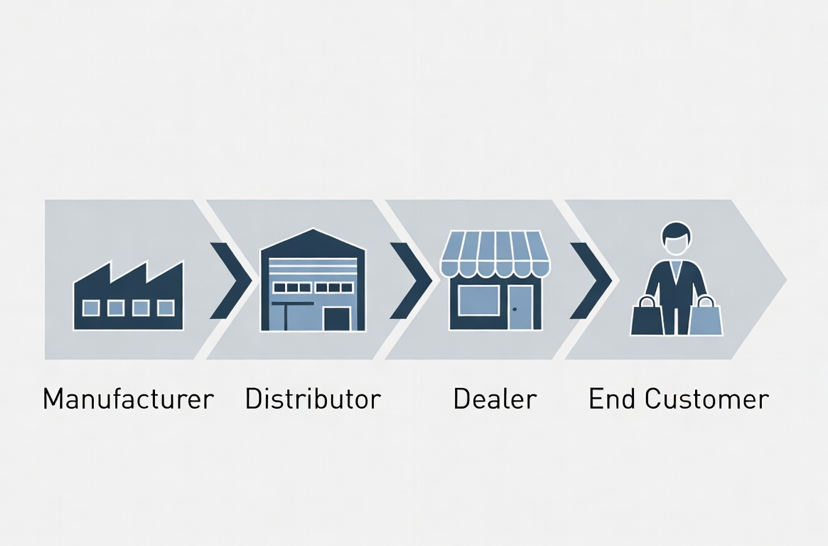
A dealer is the link closest to the end customer. A dealer buys products from manufacturers or distributors and resells them to end users or small businesses at retail or near-retail prices.
Typical dealer characteristics:
– Position in the supply chain: Near the end customer.
– Customer focus: Local or niche markets, high-touch service.
– Channel type: Physical store, specialized B2B showroom, or online shop.
– Typical industries: Automotive, electronics, machinery, industrial equipment, and consumer goods.
Dealers often differentiate themselves not by stocking many brands, but by knowing the product deeply, managing local relationships, and giving hands-on support.
What is a distributor?
A distributor sits between the manufacturer and the dealer or retailer. It buys in bulk from manufacturers and handles large-scale distribution, warehousing, and logistics for a certain territory or sector.
Typical distributor characteristics:
– Position in the supply chain: Between manufacturer and dealers/retailers.
– Primary function: Bulk purchasing, warehousing, territory coverage, supply reliability.
– Channel type: B2B relationships with dealers, retailers, and sometimes big end customers.
– Typical industries: Industrial supplies, electronics components, automotive parts, FMCG, and professional equipment.
Many distributors operate under formal distribution agreements, often with semi‑exclusive or exclusive rights in a region, plus minimum sales or inventory requirements.
Key differences that impact your business
Rather than repeating textbook comparisons, let’s break down differences that actually matter when you’re sourcing from China or scaling B2B sales.
Position in the supply chain and territory
– Distributor:
– Buys in bulk from manufacturers.
– Often has regional or national coverage.
– May hold exclusive rights for a brand in a territory.
– Dealer:
– Buys from distributors or directly from manufacturers.
– Focuses on local or niche markets.
– May or may not have exclusivity; often carries multiple competing brands.
Practical implication: If you need fast penetration in multiple cities or countries, you want a distributor network. If you’re building a premium brand that needs carefully managed customer experience, you’ll rely more on strong dealers.
Inventory ownership and risk
– Dealers usually own the inventory they buy. They assume the risk of unsold stock and need to balance assortment versus turnover.
– Distributors also buy and own goods in bulk, but they typically hold much larger stock levels to support multiple dealers and retailers, taking on higher financial risk in exchange for volume margins.
For global sourcing, this matters because:
– If your distributor over‑stocks and demand drops, they may push for discounting or renegotiation.
– If dealers under‑stock, you face lost sales and longer lead times.
Pricing power and profit margins
– Dealers buy at wholesale and sell at retail. Their margin per unit is often higher, but constrained by MSRP, competition, and local purchasing power.
– Distributors earn thinner margins per unit but offset that with high volume and value‑added services (logistics, credit terms, marketing support).
If you’re a manufacturer or brand owner, your pricing waterfall typically looks like:
> Manufacturer → Distributor (bulk discount) → Dealer/Retailer → End customer
Each layer expects a margin. Choosing fewer layers (e.g., distributor selling directly to big accounts) can improve competitiveness, but you may lose localized customer support.
Customer interaction and after‑sales service
– Dealers are your front‑line. They:
– sell to end customers,
– handle demonstrations, installation, and basic troubleshooting,
– manage warranty claims from customers.
– Distributors focus on:
– stocking spare parts,
– supporting dealers with training and technical materials,
– coordinating advanced service or regional service centers.
If your product is complex, high‑ticket, or safety‑critical (machinery, automotive, medical devices), you must design clear roles and escalation paths between distributors and dealers.
Pros and cons of working with dealers
From a manufacturer or brand perspective, partnering with dealers has very specific advantages and challenges.
Advantages of dealer partnerships
– Direct access to end customers
Dealers are closer to the real user. They gather feedback on performance, pricing sensitivity, and competitor moves more accurately than many surveys.
– Stronger local relationships
Good dealers know the local market: key buyers, procurement habits, payment culture, and regulatory nuances. This can be critical when entering new regions or industries.
– Higher perceived service quality
Because dealers often provide personalized support, customers feel the brand is “close to them,” especially in industries like automotive, equipment, and industrial supplies.
Challenges and limitations
– Fragmented coverage
A strong dealer in one city doesn’t automatically help you in another. Building dealer networks is time‑consuming.
– Performance variability
Your brand’s reputation may depend heavily on how each dealer behaves. Poor customer service or stock management by a dealer can damage your brand.
– Operational overhead
Managing many dealers means more contracts, training sessions, marketing support, and performance monitoring.
Pros and cons of working with distributors
Distributors are often the backbone of a global supply network, especially when you’re sourcing from manufacturing hubs like China.
Advantages of distributor partnerships
– Wider and faster market reach
A capable distributor already has a network of dealers and retail accounts. Plugging into that network can accelerate expansion without building your own infrastructure from scratch.
– Supply chain efficiency
Distributors manage logistics, warehousing, and bulk transportation. This reduces your operational complexity and can improve delivery lead times.
– Strategic collaboration
With formal distribution agreements, you can coordinate promotions, product launches, and technical training more easily across regions.
Challenges and limitations
– Reduced control over end‑customer experience
Distributors’ priorities may tilt toward volume and profitability, not necessarily brand storytelling or premium service.
– Channel conflicts
Some distributors carry multiple brands in the same category, potentially favoring whichever offers better margins or sales support at a given time.
– Dependency risk
If one distributor dominates a large territory and suddenly changes strategy or experiences financial issues, your sales can drop sharply.
How global B2B sellers should choose: dealers vs distributors
From my experience working with export‑focused manufacturers and digital sourcing platforms, the choice is rarely “dealer or distributor.” It’s usually how to orchestrate both in a way that supports your business model.
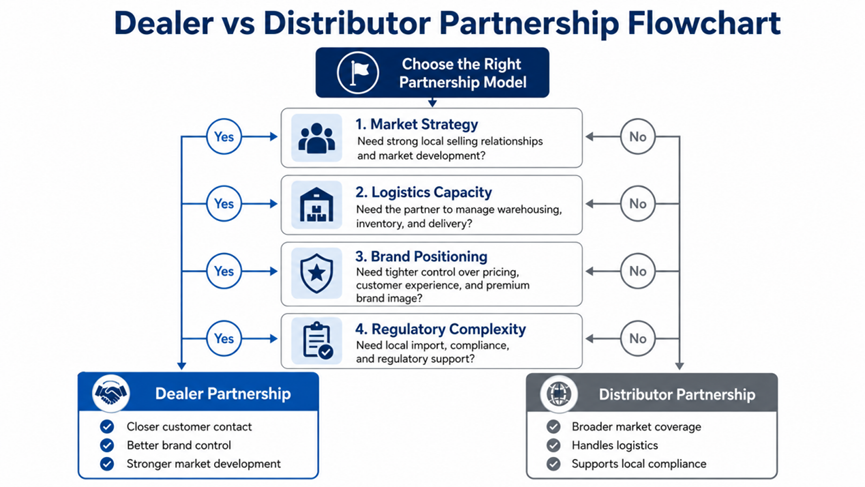
Step‑by‑step decision framework
1. Define your market entry strategy
– If you’re targeting many small B2B buyers across multiple regions, distributors with existing networks are often more efficient.
– If you’re selling high‑value or highly customized solutions, prioritize a smaller number of highly capable dealers.
2. Assess your capacity for logistics and support
– Limited internal logistics ability? Work closely with distributors.
– Strong internal support team? You can manage more direct dealer relationships and even supply some larger accounts yourself.
3. Clarify your brand positioning
– Mass‑market, price‑sensitive products: leverage distributors for reach and cost optimization.
– Premium, service‑intensive products: invest in selective dealers and more oversight.
4. Evaluate regulatory and technical complexity
– In heavily regulated sectors (automotive, safety equipment, healthcare), ensure distributors can handle documentation, certifications, and compliance, while dealers manage correct usage and local training.
5. Align contracts with your growth goals
– Distribution agreements should include territory, exclusivity (if any), performance metrics, marketing commitments, and support responsibilities.
– Dealership agreements should set expectations around service levels, stocking, pricing adherence, and brand representation.
Real‑world examples from different industries
Automotive and machinery
In automotive and heavy machinery, it’s common to see:
– National or regional distributors managing import, bulk logistics, and parts stock.
– Authorized dealers running showrooms, sales teams, and service centers.
This structure balances coverage and customer intimacy. If you’re exporting automotive parts or CNC machinery from China, you’ll typically:
– Appoint a master distributor for a region.
– Let that distributor build and support a network of specialized dealers for end‑user service.
Electronics and consumer goods
For electronics and fast‑moving consumer products:
– Distributors focus on warehouse‑to‑retail flows, promotional coordination, and channel pricing.
– Dealers act as retailers or specialized resellers who influence local consumer choices and provide basic tech support.
Here, the key risk is channel conflict. You must align your online sales, distributors, and local dealers to avoid undercutting each other.
How digital sourcing platforms complement dealers and distributors
Modern B2B sourcing platforms that aggregate Chinese suppliers are changing how global sellers work with dealers and distributors. Instead of handling every factory relationship directly, international businesses are increasingly:
– Using platforms to discover and validate manufacturers.
– Combining platform‑enabled sourcing with regional distributors who take care of bulk import and downstream logistics.
– Letting local dealers or resellers focus on market education, demonstrations, and after‑sales care.
For many global sellers, this hybrid model delivers:
– Lower inventory risk through flexible sourcing and, where available, dropship or smaller batch options.
– Reduced administrative burden on payments and logistics.
– Faster experimentation with new product lines before committing to big distribution contracts.
Practical checklist before signing with a dealer or distributor
Use this checklist in your next negotiation round:
1. Market coverage
– Which territories and segments are clearly defined?
– What existing dealer or retail relationships does the distributor already manage?
2. Service and support capability
– For distributors: warehousing capacity, lead times, spare parts planning, and technical support resources.
– For dealers: trained staff, service tools, and local customer response times.
3. Reporting and transparency
– Can they share sell‑through data, inventory levels, and promotional results regularly?
4. Digital readiness
– How do they integrate online sales, digital catalogs, and customer communication channels?
5. Conflict and escalation mechanisms
– How are pricing conflicts or underperforming territories handled?
– What happens if a dealer or distributor fails to meet agreed KPIs?
FAQs: dealers and distributors
1. Are dealers and distributors the same as wholesalers?
No. A wholesaler typically buys in bulk and resells to other businesses without deep channel management or long‑term territorial responsibilities. Distributors act as structured partners with broader logistics and market‑development roles, while dealers focus on selling to end users.
2. Can a distributor sell directly to end customers?
Yes. In some markets, large distributors sell directly to big corporate accounts or online buyers, especially for standardized products. However, they usually still rely on dealers or retailers for localized service and smaller customers.
3. Why do manufacturers use both distributors and dealers instead of going direct?
Because building local presence everywhere is costly and slow. Distributors and dealers bring existing networks, infrastructure, and local knowledge, allowing manufacturers to scale faster with less capital investment.
4. What should be in a distributor agreement?
Typical elements include territory and exclusivity, sales targets, inventory obligations, marketing commitments, service responsibilities, and mechanisms for conflict resolution or termination.
5. How do I avoid channel conflicts between distributors and dealers?
You need clear pricing rules, transparent communication, and defined roles. For example, you might limit direct online discounting, protect key accounts, and regularly review promotions and margins with both distributors and dealers to keep incentives aligned.
References
1. Global Sources. “Dealers vs Distributors: What’s the Differences?” – Role definitions, responsibilities, and strategic comparison of dealers and distributors, including advantages and disadvantages and channel considerations. [globalsources]
2. Inc. Magazine. “Distributorships and Dealerships” – Industry overview of how distributors and dealers collaborate in machinery, automotive, and mechanical goods. [inc]
3. Finale Inventory. “Understanding Vendor vs Dealer vs Distributor in Inventory Management” – Clarifies inventory ownership and risk between dealers and distributors.[finaleinventory]
4. YouTube Lecture. “Differences between Dealer and Distributor” – Summarizes comparative points such as investment level, territory, risk, and profit margins. [youtube]
5. Credlix. “Distributor vs. Dealer: Key Differences in the Supply Chain Network” – Table‑based comparison of distributor and dealer roles, purchase volume, market coverage, and primary functions. [credlix]
6. Global Sources. “Manufacturers vs. Distributors vs. Wholesalers vs. Retailers” – Definitions and role distinctions across supply chain participants. [globalsources]
7. Klemchuk LLP. “Distinguishing Between Distributors and Dealers” – Legal and contractual perspective on distributor and dealer agreements, exclusivity, and territory rights. [klemchuk]
-700x490.jpeg)