Discover why growing brands compare factory sourcing with traditional wholesale. Learn how product control, delivered costs, quality checks, and flexible fulfillment affect the decision—and follow a practical pilot plan to decide which model fits your best-selling products.
Factory sourcing gives fast-growing brands more control over product specifications, unit economics, and replenishment than traditional wholesale. But a lower factory quote is not automatically a better deal. The right decision depends on delivered cost, product quality, cash commitment, and whether the fulfillment process can keep pace with demand.
If you run a growing online brand, you may recognize the turning point: a product is selling well, but your wholesaler cannot change its packaging, explain a component change, or give you a dependable restock date. Factory sourcing brings your team closer to the people who make the product. A sourcing and fulfillment partner can help manage that relationship without requiring your team to coordinate every supplier, warehouse, and shipment alone.
Table of Contents
Factory Sourcing vs. Traditional Wholesale
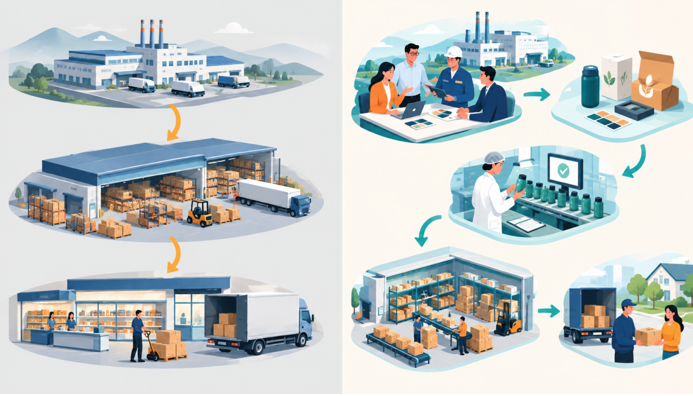
Traditional wholesale means buying finished goods from a distributor or wholesaler that has already selected and stocked them. You usually get a straightforward order process and faster access to available inventory. You also inherit the wholesaler’s assortment, specifications, pricing, and stock constraints.
Factory sourcing means procuring goods from a manufacturer, either directly or through a sourcing platform. It describes where the product originates—not necessarily who invoices you, inspects it, or ships it. Ask any provider to explain those roles rather than assuming “factory direct” means there are no service fees or intermediaries.
| Decision factor | Traditional wholesale | Factory sourcing |
| Product specification | Usually fixed | May be negotiable before production |
| Branding | Limited to available options | Custom labels, packaging, or design may be possible |
| Initial availability | Often available from existing stock | May require sampling and production time |
| Order quantity | Set by wholesaler terms | Depends on the factory and requested changes |
| Quality oversight | Largely managed by the distributor | Brand can define approval and inspection requirements |
| Operating workload | Generally lower at the outset | Higher unless a partner coordinates the work |
Neither model wins every time. The question is whether additional product control justifies the lead time, cash commitment, and coordination required for a particular SKU.
Why Growing Brands Choose Factory Sourcing
Delivered Cost Matters More Than Unit Price
A wholesaler charges for useful work: selecting products, holding stock, and making goods available quickly. Buying closer to the manufacturer may reduce some layers of cost once demand is consistent. Yet factory price is not delivered cost.
Use the same scope when comparing quotes:
> Delivered unit cost = product price + allocated sampling and inspection + packaging + freight + duties and taxes + payment fees + fulfillment + expected defect and return costs.
Add your team’s sourcing time where it is material. Compare the same quantity, product specification, destination, shipping method, and delivery terms. The clarify how specified delivery costs, risks, and obligations are allocated between buyer and seller. A factory-gate quote and a delivered quote are not like-for-like prices.
Product Changes Can Strengthen the Brand
Wholesalers help brands test established products. They are less useful when the brand needs to change the product itself. Working with a capable manufacturer may make it possible to adjust materials, dimensions, colors, instructions, labels, or packaging.
Consider an online home-organization brand whose customers repeatedly find an item difficult to assemble. Instead of only rewriting its listing, the brand could ask a manufacturer to test clearer instructions and better-protected packaging. It would then approve a revised sample and check the first production run. This is an illustrative scenario, not a reported LooperBuy customer result.
Customization has a cost. Printed packaging, new tooling, testing, and higher minimum orders may outweigh the benefit at low volume. Prioritize changes that solve a documented customer problem or support a credible price premium.
Factory Access Makes Quality Feedback More Useful
A brand that knows who makes its product can define measurable standards: materials, dimensions, color tolerances, labeling, packaging integrity, and acceptable defects. It can connect return reasons to production batches and investigate whether a design or process change is needed.
Before ordering, establish four approval points:
– Who signs off on the preproduction sample?
– Who checks the production batch, and against which written criteria?
– How are defects recorded and shared?
– What happens if the goods fail inspection?
Do not treat a basic warehouse check as a full product test or factory audit. LooperBuy describes its optional warehouse inspections as checks of basic product condition, quantity, and packaging before international shipping; buyers should confirm the scope needed for their product.
Better Visibility Supports Replenishment
A local wholesaler may ship faster from stock. A factory relationship may give a brand better insight into production capacity, material constraints, and the next available production slot. A growing business needs to measure both speed and reliability.
For each important SKU, track when production is confirmed, when it finishes, when goods reach the consolidation point, and when customers receive them. Compare actual dates with promised dates across multiple orders. The World Bank’s Logistics Performance Index likewise examines the speed and reliability of cross-border supply chains.
What Recent Trade Data Tells Brands
The U.S. Census Bureau reported seasonally adjusted retail e-commerce sales of $340.2 billion in Q2 2026, or 17.1% of total U.S. retail sales. That does not establish how many brands use factory sourcing. It does show the scale of the online channel in which product decisions and fulfillment performance matter.
Supply chains also face changing conditions. In January 2026, UN Trade and Development reported that nearly two-thirds of global trade takes place within value chains being reshaped by geopolitical tensions, industrial policy, and new technologies. For a brand, the practical response is to document suppliers, compare routes, and avoid basing customer promises on one untested fulfillment plan—not to assume any single sourcing country must be abandoned.
A Practical Test of Sourcing Costs
Suppose a brand sells a desk accessory for $30. The figures below are hypothetical: they demonstrate a comparison method, not typical prices or guaranteed savings.
| Cost per delivered unit | Wholesale route | Factory-sourced route |
| Product purchase | $12.00 | $8.00 |
| Packaging and inspection | Included | $0.80 |
| Freight, duties, and handling | $1.50 | $3.20 |
| Fulfillment and expected returns | $4.50 | $4.50 |
| Total modeled cost | $18.00 | $16.50 |
| Contribution before advertising and overhead | $12.00 | $13.50 |
The modeled factory-sourced route improves contribution by $1.50 per unit, or $1,500 across 1,000 delivered units. But add $2 per unit for urgent shipping and that apparent advantage disappears. New tooling, staff time, and financing costs could also change the result.
Run the comparison under normal demand, a sales spike, and a delayed shipment. If a factory minimum leaves six months of unsold goods, wholesale may be the safer choice despite its higher unit price.
Factory Sourcing and Dropshipping
Factory sourcing and dropshipping answer different questions. The first concerns where a product comes from. The second concerns how an order is fulfilled. Shopify describes dropshipping as selling without handling inventory or shipping, while noting that the retailer remains responsible for customer service and order tracking.
A brand can source through a factory network and use a partner to ship orders to customers. That may reduce the need for its own warehouse or large speculative purchases. It does not promise zero inventory commitment: custom production may still require a deposit, a minimum quantity, or storage.
presents itself as a China sourcing platform offering manufacturer connections, OEM/ODM options, warehousing, order consolidation, and cross-border shipping. Its website says it sources from Chinese platforms including 1688, Taobao, Tmall, and JD. Before committing, ask which services apply to your specific SKU, where goods will be held, whether storage costs apply, and who owns any unsold stock.
A sensible progression is to test a standard product with limited stock exposure, move a proven seller to a documented factory specification, then negotiate production and replenishment terms. Keep a ready-to-ship alternative for urgent orders if its higher cost is worthwhile.
A Six-Step Factory Sourcing Pilot
1. Define the product. Record the customer problem, materials, dimensions, packaging, destination markets, expected monthly volume, and target delivered cost.
2. Identify the actual producer. Ask whether each candidate manufactures the item, subcontracts production, or coordinates purchases from other suppliers.
3. Compare complete offers. Request written details on minimum order quantity, samples, production timing, inspection, payment, shipping, and the agreed delivery term and named place.
4. Approve a representative sample. Check it against a written specification, including materials, dimensions, labeling, packaging, and the customer’s unboxing experience.
5. Run a controlled order. Record inspection findings, actual dispatch and delivery times, defects, and customer complaints before expanding volume.
6. Review against wholesale. Compare delivered cost, on-time delivery, return reasons, cash tied up, and staff hours—not just the purchase price.
Keep the approved sample and specification under version control. A new material, component, or factory can make an earlier approval unreliable. Agree in writing on how substitutions, delays, and rejected goods will be handled.
When Traditional Wholesale Still Wins
Factory sourcing is a tool, not a badge of sophistication. Wholesale may be better when demand is unproven, a small quantity is needed immediately, the product needs no differentiation, or a distributor’s local stock and support are especially valuable.
Many brands benefit from a hybrid model: use wholesale for assortment tests and urgent replenishment, then evaluate factory sourcing for proven products that justify proprietary packaging or design changes. Make the decision SKU by SKU rather than switching an entire catalog at once.
Before scaling, map responsibilities as carefully as costs. In the United States, the importer of record must exercise reasonable care when making customs entry. For applicable regulated general-use consumer products made overseas, the U.S. Consumer Product Safety Commission says the importer must issue the required General Certificate of Conformity. Requirements differ by product and destination, so confirm them before production and seek qualified advice where needed.
Ask in writing: Who is the importer of record? Who verifies applicable product rules? Who pays duties? Who owns tooling and designs? Who handles damaged deliveries and returns? A sourcing partner may coordinate these tasks, but the brand still needs to understand its own responsibilities.
Build a Sourcing System
Fast-growing brands prefer factory sourcing when it helps them improve a proven product and manage repeat demand at a sustainable delivered cost. The best strategy is rarely factory *or* wholesale across every item. It is a sourcing mix that protects quality, cash flow, availability, and the customer experience.
Ready to test a proven SKU? Send LooperBuy your product specification, monthly volume, destination markets, and current delivered-cost benchmark. Request an itemized sourcing and fulfillment proposal covering samples, inspection, minimum orders, storage, shipping, and each party’s responsibilities before you commit.
Frequently Asked Questions
1. Is factory sourcing always cheaper than wholesale?
No. Freight, duties, inspection, tooling, fulfillment, and unsold stock can erase a lower factory price. Compare delivered cost and cash exposure at the same order volume.
2. Can a small brand use factory sourcing?
Sometimes. Minimum orders vary by product and supplier. Standard goods may be easier to test in small quantities than items requiring custom materials or packaging.
3. Does factory sourcing require my own warehouse?
No. A fulfillment partner may store and dispatch goods. You may still have to pay for production or commit to an agreed quantity, so check the commercial terms.
4. How is a factory different from a trading company?
A factory manufactures goods; a trading company coordinates or purchases goods from producers. Either can be useful if you know who makes the item and who is accountable for changes and defects.
5. What should I check before a bulk order?
Approve a representative sample, confirm the written specification and packaging, define inspection criteria, and establish any applicable product-testing and documentation requirements.
6. When should I keep a wholesaler?
Keep one when demand is uncertain, local stock prevents missed sales, or its speed and support outweigh a higher unit price. A hybrid approach lets you retain that flexibility.
References
1. U.S. Census Bureau, “[Quarterly Retail E-Commerce Sales Report],”
2. UN Trade and Development, “[Global Trade Update: Top Trends Redefining Global Trade in 2026],”
3. International Chamber of Commerce, “[Incoterms® 2020].”
4. World Bank, “[World Bank Releases Logistics Performance Index 2023],”
5. Shopify Help Center, “[Dropshipping].”
6. U.S. Customs and Border Protection, “[Importing into the United States: A Guide for Commercial Importers].”
7. U.S. Consumer Product Safety Commission, “[General Use Products: Certification and Testing].”
8. LooperBuy, “[B2B China Sourcing Platform & Dropshipping Solutions].”