Compare Shopify and BigCommerce for dropshipping beyond monthly price. Explore current plans, payment-provider fees, sales thresholds, supplier checks, and cross-border fulfillment. Use a practical margin example and launch checklist to choose a storefront that works with your real sourcing process.
Choosing between Shopify and BigCommerce for dropshipping is not simply a contest between two storefront builders. Your decision affects payment costs, supplier workflows, shipping promises, and the margin left after every order. If you source products from China, the best platform is the one you can connect to a dependable purchasing and fulfillment process—not necessarily the one with the lowest advertised subscription.
Both platforms let you build an online store without holding stock yourself. Neither removes your responsibility to answer customers, resolve returns, or check that a supplier can deliver what your product page promises. The comparison below focuses on the questions a merchant should settle *before* importing a large catalog.
*Pricing checked September 30, 2026. Prices shown are USD rates published on the platforms’ pricing pages; verify regional terms and checkout fees before subscribing.*
Table of Contents
Shopify vs BigCommerce: The Quick Decision
| Decision factor | Shopify | BigCommerce |
| Entry plan, billed annually | Basic: $29/month | Core: $29/month |
| Entry plan, paid monthly | Basic: $39/month | Core: $39/month |
| Next annual tiers | Grow: $79/month; Advanced: $299/month | Growth: $79/month; Scale: $299/month |
| Entry-plan growth threshold | No equivalent plan threshold shown on Shopify’s pricing page | Core lists up to $30,000 trailing-12-month GMV, then an automatic upgrade |
| Payment-provider issue to check | A third-party transaction fee may apply when using an external provider | An Open Payment Provider Fee may apply when using a provider outside its embedded-provider list |
| Most useful starting question | Does the available app or workflow handle my supplier’s real order process? | Can I use the payment provider and catalog workflow I want at the expected GMV? |
The subscription figures and plan terms come from the platforms’ published pricing pages. “No equivalent threshold shown” is not a promise that Shopify has no other plan conditions. Both payment-fee answers depend on the provider, plan, and transaction.
My practical recommendation: Start your comparison with one target product, one destination country, and one payment provider. Build the same order journey on each platform. A polished demo store tells you less than a successful test order and an accurate landed-cost calculation.
What Each Platform Actually Handles
Shopify: A storefront with many app-based workflows
Shopify provides the storefront, checkout, product management, and access to apps for extending store operations. Its pricing page lists integrations with thousands of apps. That range can be useful when you need a particular sourcing or fulfillment workflow—but an available app is not proof that *your* supplier’s stock, variants, prices, and tracking will synchronize correctly.
For a new merchant, I would test the connection from product listing through delivery status before paying for multiple subscriptions. Find out whether the supplier receives orders automatically, whether an out-of-stock variation is blocked, and whether tracking reaches the customer without manual copying.
BigCommerce: Built-in commerce tools with provider choices
BigCommerce’s current Core pricing page lists features including a built-in blog, product ratings and reviews, real-time shipping quotes, and reporting tools. It also describes multi-currency options and a range of payment providers. These may reduce the need for an additional app in a particular setup, but you still need to map each required function against the plan you intend to buy.
BigCommerce also has dropshipping suppliers and integration options. The meaningful question is not whether a platform *supports dropshipping* in general. It is whether your chosen supplier can exchange usable product, stock, order, and tracking data with your store—or whether your team has a workable manual process.
Neither platform is your supplier
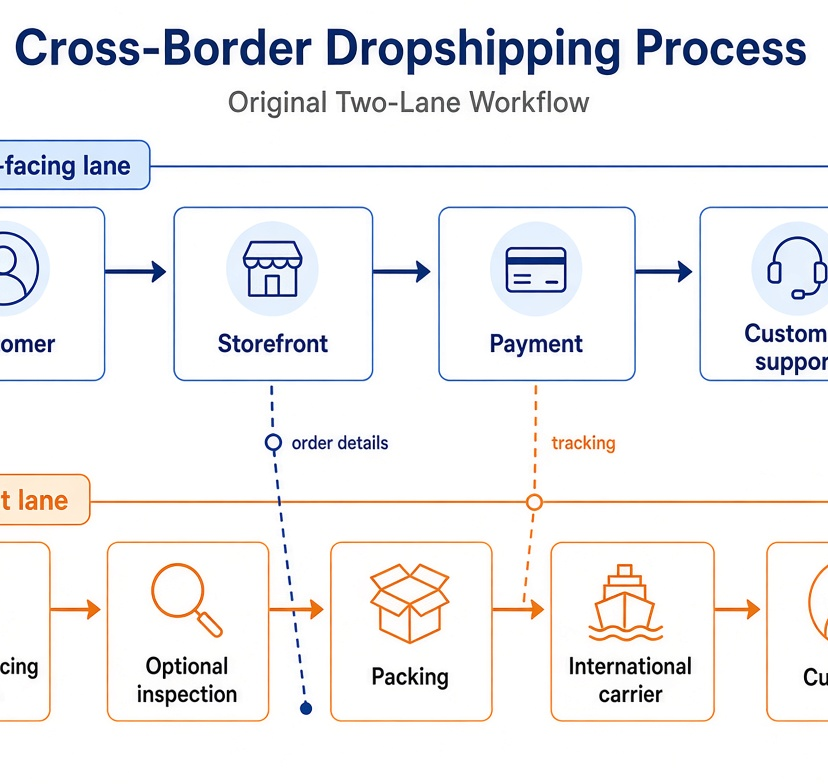
A storefront accepts the customer’s order. A sourcing partner helps secure the product and arrange fulfillment. Confusing those roles leads to optimistic delivery estimates and unclear responsibility when something goes wrong.
LooperBuy describes its services as China product sourcing, order management, warehouse inspection options, consolidation, and cross-border delivery support. Its website lists Shopify among integrated partners; it does not establish, from the pages reviewed here, a verified BigCommerce integration or confirm exactly which Shopify functions synchronize. Ask for a live workflow demonstration before treating either connection as automatic.
Pricing: Compare the Whole Order
The older comparison lists plans such as Shopify Lite and BigCommerce Standard, Plus, and Pro. Those labels and prices are unsuitable as a current buying guide. Shopify now displays Basic, Grow, and Advanced at $29, $79, and $299 per month when billed annually; its monthly-payment prices are $39, $105, and $399. BigCommerce displays Core, Growth, and Scale at the same annual effective monthly rates and the same three monthly-payment prices.
Trial terms have changed too. Shopify’s pricing page currently advertises three days free followed by a promotional offer, while BigCommerce states that its trial lasts 15 days. Promotions can change, so budget using the normal price you expect to pay after any offer ends.
Check fees beyond the subscription
On Shopify, an eligible store using Shopify Payments generally avoids the additional third-party transaction fee on orders processed through Shopify Payments, but still pays applicable card-processing rates. External-provider transactions can incur an additional Shopify fee; its US pricing table lists 2% on Basic, 1% on Grow, and 0.6% on Advanced. Shopify’s help documentation also describes exceptions and other circumstances in which the fee can apply, so check the rules for your store.
Eligibility matters. Shopify Payments is available only to qualifying businesses in supported countries and categories. If your business cannot use it, model the cost of an available third-party gateway *before* choosing a plan.
BigCommerce’s current pricing page says orders processed through its listed Embedded Payment Providers have no additional Open Payment Provider Fee. On self-service plans, orders using an Open Payment Provider can incur a separate fee: its table lists 2% on Core, 1% on Growth, and 0.6% on Scale. Payment processing charges are separate. Therefore, “BigCommerce has no transaction fees” is too broad for a current comparison.
Watch the BigCommerce growth thresholds
BigCommerce says Core automatically upgrades after $30,000 in trailing-12-month GMV, and Growth after $100,000. Its Scale plan starts with a $33,333-per-month GMV allowance and lists a 0.9% overage rate above that amount. BigCommerce explains that its threshold calculation uses its defined GMV measure rather than simply the sales total in your own spreadsheet. Forecast the likely plan change, not only your launch-month bill.
A Dropshipping Margin Example
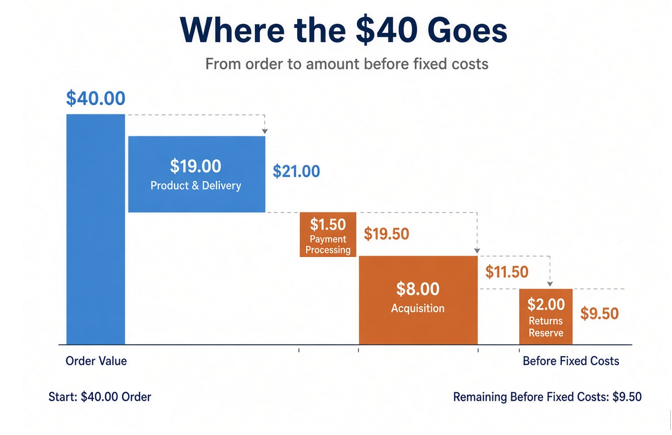
Illustrative scenario, not a quoted platform bill: Suppose a merchant sells an accessory for $40. The item costs $12, international fulfillment costs $7, payment processing averages $1.50, advertising costs $8 per acquired order, and a reserve for returns and defects is $2.
| Item | Amount per order |
| Customer payment | $40.00 |
| Product and delivery | −$19.00 |
| Payment processing | −$1.50 |
| Customer acquisition | −$8.00 |
| Returns and defects reserve | −$2.00 |
| Contribution before subscription and any extra provider fee | $9.50 |
If this order also attracts a 2% platform/provider-related fee on the $40 amount, that is another $0.80, leaving $8.70 before fixed costs. The example is arithmetic, not a claim that every merchant on either entry plan pays that fee. It demonstrates why a small percentage matters: the relevant comparison is $0.80 against the order’s $9.50 contribution, not just against its $40 selling price. Actual fee bases and eligibility must come from your provider agreement and platform settings.
Use this worksheet for three products: your cheapest item, your typical order, and a heavy or high-return item. Add software subscriptions, currency conversion where relevant, and any duties your business absorbs. A platform that looks equally priced at $29 per month can produce a different result once those costs are included.
How to Vet a China Sourcing Workflow
A larger app marketplace does not repair a weak supplier process. Before you upload hundreds of SKUs, ask the same operational questions of every sourcing service. BigCommerce recommends researching suppliers’ pricing, minimum-order requirements, support, and fulfillment fit; Shopify advises ordering samples to inspect quality, packaging, and the shipping experience.
1. Request an exact SKU quotation. Specify material, dimensions, color, packaging, quantity, and destination. Ask what is included in the product and shipping prices.
2. Order a sample to a real destination. Record the time from payment to dispatch, the carrier’s scan history, the product condition, and the final presentation.
3. Confirm inventory behavior. Ask when stock changes reach the store, how substitutions are approved, and what happens after an order for an unavailable item.
4. Map the order handoff. Determine whether orders transfer by app, API, spreadsheet, or manual entry. Test variants, address changes, cancellation, and duplicate-order prevention.
5. Agree on exception handling. Document who investigates a missing parcel, who pays for reshipment, where returns go, and what evidence is needed for a defect claim.
6. Check compliance before listing. For regulated or branded goods, obtain the documentation your destination market and sales channels require; do not assume a supplier listing provides it.
LooperBuy’s site says it offers sourcing from Chinese platforms, basic warehouse inspection, optional inspection services, consolidation, and logistics choices. Those are capabilities worth testing against the checklist—not grounds to promise that every SKU is verified, every shipment is faster, or every order saves a fixed percentage. The site also says refunds depend on supplier policies and order status.
Shipping, Returns, and Customer Trust
Show the full delivery window
For cross-border dropshipping, tell customers processing time and transit time separately. If the product needs sourcing or inspection before dispatch, a carrier’s transit estimate alone is not a delivery promise. Shopify’s shipping-policy guidance also recommends explaining shipping origin when relevant, separate parcels, tracking, duties, and responsibility for lost or delayed orders.
A useful product-page statement might read: “Orders are prepared after purchase. Estimated processing: [verified range]. Estimated transit after dispatch: [verified range]. Import charges: [state who pays].” Replace every bracket with observed or contractually supported information. Show the same terms near checkout so customers do not discover the full timeline after paying.
Decide who handles the difficult order
The merchant remains the customer’s point of contact even when a supplier ships the parcel. Before launch, write down the response path for a damaged item, an incorrect variant, and a parcel with no tracking movement. Shopify’s supplier guidance recommends understanding return terms in advance, while BigCommerce notes that suppliers may use return merchandise authorizations and may charge additional fees.
This matters especially for low-priced products. A return across borders may cost more than the item’s recoverable value. Decide when to request a return, when to replace the product, and when to refund without asking the customer to ship it back. Do not publish a generous return promise until you know which party pays for it.
A Five-Step Platform Test
Rather than choosing from feature lists alone, run a small, documented trial:
1. Build one comparable product page on each platform, with identical variants, images, delivery terms, and pricing.
2. Connect the intended payment method. Check availability for your business location and note the actual fee schedule.
3. Run a paid test order. Trace the order from checkout to the sourcing partner and confirm how stock and tracking updates return.
4. Trigger an exception. Ask how each workflow handles an unavailable size, changed address, or requested cancellation.
5. Score the outcome. Compare contribution margin, manual touches per order, clarity of shipping information, and time needed to resolve a support request.
Select the platform that passes your *actual* order journey with fewer costly workarounds. For a merchant sourcing from China, supplier reliability and an honest delivery promise can matter more than a small difference in theme-building convenience.
Which Platform Should You Choose?
Choose Shopify when its available supplier workflow fits your operation, your payment setup is economical, and you value its range of app-based options. Check every recurring app charge and test the integration rather than assuming it works because an app listing exists.
Choose BigCommerce when its built-in tools and available payment-provider arrangement suit your catalog and operations. Model its GMV-based plan changes and verify whether your preferred provider is classified as embedded or open.
In either case, choose the sourcing process separately. If your priority is accessing Chinese products without committing to large amounts of inventory, use the checklist above to evaluate LooperBuy’s sourcing, inspection, and fulfillment options for your specific products and destination markets. Request a SKU-level quote and run a sample order before connecting a full catalog.
Frequently Asked Questions
1. Is Shopify or BigCommerce cheaper for a new dropshipping store?
Their advertised US entry-plan subscription prices currently match: $29 per month when billed annually or $39 when paid monthly. Your real cost depends on payment setup, apps, expected sales, and BigCommerce’s GMV thresholds.
2. Does BigCommerce charge transaction fees?
Its pricing page lists no additional Open Payment Provider Fee for orders processed by its specified Embedded Payment Providers. Eligible orders through Open Payment Providers can incur a separate fee on self-service plans, and payment processing still costs money.
3. Can I dropship products from China on either platform?
You can operate a dropshipping store on either platform, but the supplier-to-store workflow must be checked individually. Confirm how listings, stock, orders, tracking, and returns are handled before assuming automation.
4. Does LooperBuy have a Shopify or BigCommerce integration?
LooperBuy’s website lists Shopify among integrated partners. The reviewed material does not verify the exact Shopify sync functions or establish a BigCommerce integration, so request a demonstration for the workflow you intend to use.
5. Do I need to order samples if a supplier offers inspection?
Yes. An inspection can help identify problems before dispatch, while a delivered sample also lets you assess packaging, shipping time, and the experience your customer will actually receive.
6. Who handles returns in a dropshipping business?
Your store should provide the customer-facing policy and support. The supplier’s rules determine what can happen behind the scenes, so agree on return authorization, destination, postage, refunds, and replacements before selling.
References
1. Doba, “[Shopify or BigCommerce for Dropshipping? Pricing + Features Compared].”
2. Shopify, “[Pricing Plans].”
3. Shopify Help Center, “[Pricing Plans and Billing Overview].”
4. Shopify Help Center, “[Supported Countries for Shopify Payments].”
5. BigCommerce, “[Pricing and Plan Information].”
6. Shopify, “[15 Dropshipping Tips for a Successful Business].”
7. Shopify, “[How to Create a Shipping Policy].”
8. BigCommerce, “[Finding Dropshipping Companies & Suppliers for Your Ecommerce Store].”
9. LooperBuy, “[B2B China Goods Sourcing E-Platform].”