Discover how to find profitable dropshipping niche products through customer research, supplier vetting, sample checks, and destination-specific cost planning. Use a practical product scorecard and small-scale test to build a focused China-sourced offer without relying on hype or guesswork.
Finding profitable dropshipping niche products is not about spotting the loudest trend. It is about identifying a specific buyer, solving a recurring problem, and delivering the product at a cost and speed that leave room for profit. For sellers sourcing from China, the best opportunity is often a focused collection of useful products—not a store filled with unrelated “winners.”
This guide shows you how to research a niche, compare products, vet a sourcing partner, calculate contribution margin, and run a small test before committing more money. The goal is not to predict a bestseller with certainty. It is to reject weak ideas early and give promising ones a fair, measurable trial.
Table of Contents
What Makes a Dropshipping Niche Profitable?
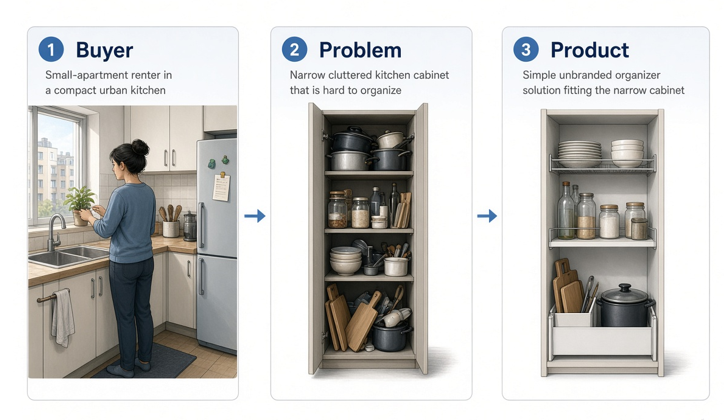
A niche is a defined group of buyers with a shared need. “Home organization” is broad. “Space-saving storage for renters in small apartments” is more specific: it suggests a customer, a constraint, and a way to explain the product’s value.
A promising niche usually has five characteristics:
– Clear demand: Buyers already look for ways to solve the problem.
– A demonstrable benefit: A photo or short video can show what changes after using the product.
– Manageable delivery: The item is practical to package, ship, and replace.
– Room for differentiation: You can improve the offer through selection, instructions, packaging, bundles, or service.
– Viable economics: Expected selling price covers the full cost of acquiring and serving a customer.
These are screening criteria, not guarantees. A popular item may be too expensive to advertise. A lightweight item may generate costly returns because its dimensions are unclear. Judge the entire offer, not just the supplier’s unit price.
Start With a Buyer and a Problem
Write a one-sentence hypothesis before opening a product catalog: “I want to help [buyer] solve [problem] with [type of product].”
For example: “I want to help apartment renters organize narrow kitchen cabinets without drilling holes.” That sentence points you toward measurable product requirements: dimensions, mounting method, weight capacity, material, and installation instructions. It also helps you reject products that look attractive but do not fit the buyer’s situation.
Read community discussions, customer reviews, and product questions. Look for repeated complaints rather than isolated praise. If buyers repeatedly mention weak adhesive, confusing sizing, or difficult installation, those details can shape both your supplier brief and your product page.
Validate Interest Without Mistaking It for Sales
Use Google Trends to compare relevant terms in the countries you plan to serve. Check several time ranges so a seasonal peak does not look like steady growth. A Trends score is normalized relative search interest on a 0–100 scale; it is not a count of searches or proof that shoppers will buy.
Next, inspect competing listings. Note the price range, shipping promises, review complaints, and ways sellers explain the product. Meta’s Ad Library can show active ads and reveal how competitors present an offer, but an active ad does not establish that the product is profitable.
Record your observations in a simple sheet. For each idea, write down the buyer, problem, competing offers, likely selling price, delivery concerns, and one reason your version would be better.
How to Shortlist Dropshipping Products
Once you have a niche, compare products against the same criteria. Avoid changing the rules simply because one item looks exciting on social media.
| Product factor | A promising sign | A reason to investigate further |
| Customer benefit | Easy to explain and demonstrate | Depends on vague or exaggerated claims |
| Specifications | Size, material, and use are clear | Buyers may misunderstand fit or compatibility |
| Shipping | Packaging protects the item at a workable cost | Fragile, bulky, or easily damaged |
| Supplier evidence | Samples and consistent specifications are available | Unclear materials or changing variants |
| Expansion potential | Related accessories or bundles make sense | No credible reason to buy again |
| Compliance | Requirements can be identified and documented | Safety or labeling questions remain unanswered |
Begin with a short list of three to five candidates. Ask how each item will appear in a customer’s hands, not just in a supplier photo. Can buyers understand its size? Does it require assembly? Could the packaging create disappointment? Is the advertised use supported by the actual product?
Treat Regulations as a Product-Selection Filter
Product requirements vary by destination and category. Before listing an item, identify applicable safety, labeling, intellectual-property, and import requirements. Ask the supplier for the relevant product specifications and documentation; do not assume a marketplace listing is sufficient evidence.
This matters especially when a product’s appeal depends on a claim about safety, performance, or suitability for a particular user. If you cannot substantiate the claim or determine who handles required documentation, choose a simpler first product. A modest-looking item with reliable specifications is often easier to sell responsibly than an impressive item with unresolved obligations.
Calculate Profit Before You Test Demand
A supplier quote is only the beginning of your cost calculation. For each target country, request a quote that separates the item price, packaging, shipping method, and any available service charges. Confirm how duties and taxes will be handled and who is responsible for paying them.
Use this working formula:
Contribution per order = selling price − product cost − packaging − shipping − applicable duties and taxes − payment fees − expected return and replacement cost − acquisition cost.
The result is an estimate, not an accounting profit figure. It does not automatically cover software, labor, or other overhead. Still, it tells you whether a test has a plausible economic path.
Consider a hypothetical product sold for $39. Costs are $8 for the item, $1 for packaging, $7 for shipping, $3 for duties and taxes, $1.50 for payment processing, $2 for expected returns, and $10 to acquire the customer. Estimated contribution is $6.50 per order. If acquisition cost rises to $17, that same order loses $0.50 before overhead.
Illustrative figures only: replace every number with your own supplier quotes, carrier terms, destination-specific charges, payment rates, and test results. Do not use a universal “three-times-cost” rule as a substitute for this calculation.
New Section: Check Import Costs by Destination
Cross-border sellers should not assume that a low-value parcel enters duty-free. U.S. Customs and Border Protection states that products of China ceased to qualify for duty-free de minimis treatment effective May 2, 2025. For U.S.-bound orders, check the current rules and obtain a shipment-specific cost estimate before setting prices.
The same product can have different economics in different markets. Build a separate cost line for each destination rather than applying one global margin. Also confirm what customers will see at checkout and whether they could face charges on delivery. An unexpectedly expensive arrival can turn an apparently profitable sale into a support or refund problem.
Vet Suppliers With Evidence, Not Promises
The original six-step guide rightly emphasizes ordering samples. Keep that step, but evaluate the service around the product too: a good sample cannot compensate for unreliable stock updates or unclear responsibility when an order fails.
Send every shortlisted supplier the same questions:
1. What are the exact material, dimensions, weight, and available variants?
2. Can you provide a sample that matches the version customers will receive?
3. What are the processing steps before carrier handoff?
4. Which shipping options serve each target market, and how is tracking shared?
5. How are stock changes, damaged goods, wrong items, and lost parcels handled?
6. What are the costs for custom packaging, inserts, or product changes?
7. Which documents support any product or compliance claims?
Order a sample to an address in your target market when practical. Inspect the item, packaging, instructions, and tracking experience. Record the dispatch date and delivery date separately: the time before carrier handoff is different from transit time. Repeat the check if you change the product variant, supplier, packaging, or route.
Define the Failure Process
Before launch, agree on who does what when an order goes wrong. Create a written workflow for stockouts, dispatch delays, damaged arrivals, and return requests. Set out the evidence required—such as order details and product photographs—and when each party should respond.
Your customer bought from your store, so the customer-facing resolution remains your responsibility. In the United States, the FTC says sellers need a reasonable basis for stated shipment times. If a seller cannot ship on time, its rules require an appropriate delay notice and customer consent or a prompt refund, depending on the circumstances. The FTC specifically notes that using a drop-shipper does not transfer the seller’s responsibility under that rule.
That is why a supplier’s estimated transit time should not become an unconditional promise on your product page. First verify processing, routing, and your ability to communicate delays.
Run a Small Test and Learn From It
Launch with one lead product and a few closely related alternatives. Your first objective is to learn whether the offer attracts the right buyer and survives real-world fulfillment—not to build the largest possible catalog.
Prepare a product page that answers practical questions in the order customers are likely to ask them: What does it do? Will it fit or work for me? What exactly arrives? How much will I pay? When will it ship? What happens if it is unsuitable? Use original sample photos or accurately licensed supplier assets, and show dimensions and limitations plainly.
Make your returns page accessible without a login. State the return window, condition requirements, method, fees, and refund process. If you use Google Merchant Center, keep the policy there consistent with the policy on your site; Google’s guidance calls for clear, conspicuous return information and supports product-specific exceptions.
Measure the Whole Customer Journey
Set a test budget you can afford and keep a daily record of traffic, product-page engagement, checkout starts, orders, acquisition cost, delivery issues, and refund requests. Review the sequence, not only the final sale count.
If people click an ad but leave the product page, examine the offer, price, imagery, and shipping information. If they start checkout but do not finish, check whether total cost or delivery expectations change at that point. If orders arrive but complaints are frequent, fix the product or fulfillment process before increasing traffic.
Treat these as diagnostic clues, not automatic verdicts. A small test can be noisy. Change one major element at a time so you can tell whether the next result improved for a meaningful reason.
Build a Niche You Can Grow
The strongest next product is often an answer to a question your first customers already asked. If they need another size, a complementary accessory, or clearer installation instructions, that feedback is more useful than an unrelated viral-products list.
For Looperbuy sellers, a disciplined workflow is straightforward: define the buyer, shortlist China-sourced products, request comparable quotes, inspect samples, calculate destination-specific costs, and test the offer before expanding it. Sourcing and dropshipping can reduce the need to hold inventory, but they do not remove the work of checking quality, communicating clearly, or managing customers.
Ready to evaluate a niche? Bring Looperbuy your target market, product specifications, expected selling price, and shortlisted items. Request sample, sourcing, and shipping details, then use the checklist above to decide what deserves a small-scale launch.
Frequently Asked Questions
1. What is a good dropshipping niche for a beginner?
Start with a buyer group and problem you can describe precisely. A suitable first niche has products with clear specifications, manageable shipping, and a benefit you can demonstrate without unsupported claims. Its viability still depends on your actual costs and customer response.
2. How do I know whether a niche has enough demand?
Compare search interest, recurring customer questions, competing listings, and results from a controlled test. Google Trends shows relative interest rather than absolute search volume or sales, so use it alongside other evidence.
3. Can I sell a product before ordering a sample?
You can research and build a draft listing, but a sample is a valuable check before taking customer orders. It helps you verify the variant, dimensions, packaging, and whether your description matches what buyers will receive.
4. Are low-priced products always easier to sell?
No. A low selling price can leave too little room for shipping, duties, payment fees, returns, and customer acquisition. Compare estimated contribution per order rather than judging opportunity by price alone.
5. Who handles returns in a dropshipping arrangement?
The supplier may inspect or receive returned goods under your agreement, but you must give customers a clear process and resolve their store order. Agree on damage evidence, return addresses, fees, and refund timing before launch. For U.S. sellers, a fulfillment partner also does not remove the seller’s obligations under the FTC shipping rule.
6. How many products should I launch at once?
A lead product plus a small set of related options is easier to explain, photograph, and evaluate than a large unrelated catalog. Expand after you understand which buyer questions and fulfillment issues recur.
References
1. Doba, “[Find High-Profit Dropshipping Niche Products: 6-Step Guide].”
2. Google Trends Help, “[FAQ about Google Trends data].”
3. Meta Transparency Center, “[Meta Ad Library tools].”
4. U.S. Customs and Border Protection, “[Executive Order – Tariff on De Minimis Shipments from China].”
5. Federal Trade Commission, “[Business Guide to the FTC’s Mail, Internet, or Telephone Order Merchandise Rule].”
6. Google Merchant Center Help, “[Set up your return policies for Shopping ads and cost-free listings].”