In the rapidly evolving landscape of B2B e-commerce, intuition is no longer a viable strategy for scaling. As a B2B sourcing platform—like LooperBuy—that connects international buyers directly with Chinese manufacturers, the ability to track the right data is the difference between stagnation and hyper-growth.
For platform leaders, understanding b2b website KPIs (Key Performance Indicators) is essential to optimizing the end-to-end user experience, from product discovery to global logistics. This guide reframes essential metrics through the lens of a global one-stop sourcing platform, ensuring you can turn raw data into a competitive advantage.

Table of Contents
Understanding the B2B Metrics Landscape
Many platforms conflate “metrics” with “KPIs.” To maintain a professional, expert-driven approach, we must distinguish between the two.
- eCommerce Metrics: These are granular, operational data points (e.g., page load speed, individual search query volume). They provide immediate, tactical insights into the health of your digital storefront.
- B2B Website KPIs: These are strategic benchmarks tied directly to your core business goals, such as Gross Merchandise Value (GMV) or Customer Lifetime Value (CLV). They measure long-term health and the efficacy of your growth strategies.
The Strategic Hierarchy
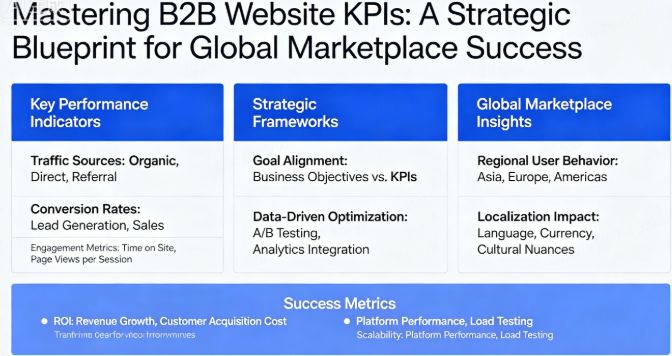
| Feature | Metrics (Operational) | KPIs (Strategic) |
|---|---|---|
| Focus | Granular data | Business objectives |
| Tool Usage | Daily/Weekly troubleshooting | Monthly/Quarterly planning |
| Purpose | Immediate optimization | Long-term growth tracking |
Critical B2B Website KPIs for Global Sourcing Platforms
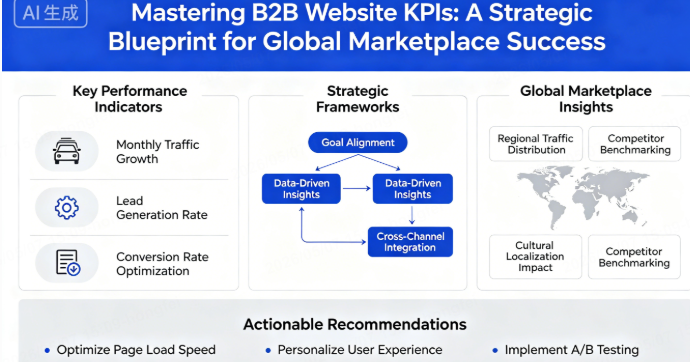
For a global B2B marketplace, focus on KPIs that reflect the complexity of cross-border trade, including logistics, manufacturer reliability, and buyer loyalty.
1. Gross Merchandise Value (GMV)
GMV is the total value of all goods sold through your platform over a specific period. For a B2B sourcing site, it is the primary indicator of your platform’s scale and market penetration.
2. Customer Acquisition Cost (CAC)
In the international B2B space, CAC includes not just ad spend, but also the costs associated with sales outreach and trade show attendance. Keep a close eye on this; if your acquisition costs exceed the expected profit from early-stage orders, your growth model is unsustainable.
3. Customer Lifetime Value (CLV)
CLV estimates the total revenue you can expect from a single buyer. Since B2B relationships are typically long-term, maximizing CLV via repeat purchasing is far more cost-effective than constant acquisition.
4. Conversion Rate (by Segment)
Break down your conversion rates by buyer region or industry segment. If international wholesalers are dropping off at the checkout phase, it may indicate friction in your international shipping or payment processes.
Expert Insights: Beyond Traditional Metrics
To truly outperform competitors, you must incorporate metrics that reflect the unique nature of global sourcing.
New Metric 1: Logistics Efficiency Index (LEI)
Global platforms like LooperBuy rely on smooth logistics. Track the average time from order confirmation to shipment and customs clearance. High lead times are a primary driver of churn in international B2B procurement.
New Metric 2: Supplier Responsiveness Score (SRS)
For a sourcing platform, your suppliers are your inventory. Measure the average time taken by Chinese manufacturers to respond to RFQs (Requests for Quote). A responsive seller base is a critical asset.
New Metric 3: Repeat Order Ratio (ROR)
In B2B, the first order is often a “test.” The ROR measures how many buyers return for subsequent orders. A growing ROR is the strongest proof of your platform’s value proposition and service reliability.
Actionable Strategies for Data-Driven Growth
Improving your b2b website KPIs requires a loop of measuring, analyzing, and acting.
- Segment Your Data: Never look at aggregate numbers alone. Segment metrics by buyer location, industry, and order frequency.
- Automate Reporting: Utilize dashboards that integrate directly with your ERP or CRM. Manual reporting is prone to error and too slow for real-time decision-making.
- Conduct Cohort Analysis: Group customers who signed up in the same month and track their behavior over time to see if your latest platform updates are actually increasing their lifetime value.
Conclusion
Successfully scaling a B2B sourcing platform demands more than just a wide product catalog. It requires a laser focus on the metrics that define sustainable growth. By tracking the b2b website KPIs outlined here—especially those tailored for global logistics and manufacturer reliability—you can optimize your platform to provide unparalleled value to international brands and wholesalers.
References
- Virto Commerce: 14 Essential eCommerce Metrics & KPIs for 2024 1
- Harvard Business Review: The One Number You Need to Grow (NPS Overview) 2
Frequently Asked Questions (FAQ)
Q: How often should I review my B2B website KPIs?
A: Operational metrics should be reviewed weekly, but strategic KPIs like CLV and NPS should be reviewed monthly or quarterly to detect trends.
Q: What is the most important metric for a new B2B marketplace?
A: Initially, focus on Conversion Rate and Customer Acquisition Cost (CAC) to ensure your platform is viable. Once you have traffic, shift focus to Repeat Order Ratio (ROR) and GMV.
Q: Why does my CLV:CAC ratio matter?
A: It indicates your business efficiency. A healthy ratio (ideally 3:1 or higher) means your revenue from customers is significantly higher than the cost of acquiring them, proving scalability.
Q: Can I track these metrics if I have limited data?
A: Start with the basics: GMV and CAC. As you grow, implement more sophisticated tracking like churn rates and buyer-to-seller ratios.
Q: How can I improve my Conversion Rate?
A: Simplify your navigation, optimize search functionality, provide transparent pricing, and ensure your checkout process supports international payment methods.
Summary: This comprehensive guide offers a strategic framework for managing B2B website KPIs, specifically tailored for global sourcing platforms. It distinguishes between operational metrics and strategic indicators, introduces unique logistics and responsiveness metrics, and provides actionable steps to optimize long-term growth and user experience.
Hot tags: B2B e-commerce strategy, B2B website KPIs, global sourcing platform, B2B conversion rate, customer lifetime value, B2B supply chain optimization, B2B digital transformation, procurement metrics, B2B marketplace growth, cross-border trade analytics.