Compare private label vs. white label dropshipping for ecommerce growth. Learn the differences in branding, product control, startup cost, margins, supplier risk, and fulfillment. Use a practical hybrid strategy to test products, validate demand, and build a distinctive global brand.
Choosing between private label and white label dropshipping is not simply a sourcing decision. It determines how much control you have over your product, customer experience, cash flow, and long-term brand value.
For global ecommerce sellers sourcing from China, both models can reduce the need to hold inventory, run a warehouse, or manage individual shipments. The better option depends on one question: Are you validating demand quickly, or building a product brand that competitors cannot easily copy?
> Quick answer: Choose white label dropshipping to test a market fast with ready-made products. Choose private label dropshipping when you have proof of demand and want deeper product control, stronger differentiation, and more room to build a lasting brand.
Table of Contents
What Is White Label Dropshipping?
White label dropshipping means selling a supplier’s existing, ready-made product under your own business name. The supplier produces and fulfills the item, while you typically customize visible elements such as a logo, label, product insert, or outer packaging.
The underlying product is usually not exclusive. Other merchants may buy the same item, apply their own branding, and sell it to similar customers. This is why white label is often the fastest route from product idea to online store.
For example, imagine you sell ergonomic desk accessories. You find an existing adjustable laptop stand, add a branded sleeve and thank-you card, create product photos for remote workers, and let the supplier ship each paid order directly to the customer. You have created a branded offer without developing a new product from scratch.
White label dropshipping is especially useful when you need to:
– Test a niche before committing significant capital.
– Launch seasonal, trend-led, or utility products quickly.
– Offer a broader catalog without purchasing stock in advance.
– Focus resources on product pages, customer acquisition, and support.
– Learn which products, price points, and customer messages convert.
The trade-off is clear: speed comes with less control. Because competitors can access similar products, sellers must differentiate through positioning, bundles, content, packaging, reliable delivery, and post-purchase support. Shopify similarly distinguishes white label products as generic items branded for the seller, while noting that other businesses can sell the same underlying product.
What Is Private Label Dropshipping?
Private label dropshipping takes branding further. You work with a manufacturer or sourcing partner to create a product for your brand according to defined specifications, then the supplier fulfills orders directly to customers.
Depending on the category and supplier, customization can include:
– Materials, components, colors, dimensions, or functions.
– Product formulas or ingredient combinations where permitted.
– Branded retail packaging and protective shipping materials.
– Labels, barcodes, inserts, instruction manuals, and bundles.
– Product quality standards and inspection requirements.
A private label product should solve a recognizable customer problem in a more specific way than a generic catalog item. For example, instead of selling a standard pet grooming brush, you could develop a version with a particular grip, pin density, color system, travel case, and instructional insert for owners of long-haired cats.
The strategic advantage is differentiation. A carefully specified product is harder to compare directly with a marketplace listing, which can reduce price-only competition and give the brand stronger pricing power. Private-label dropshipping combines this product customization with direct fulfillment, so the seller does not necessarily need to pack and ship every order personally.
However, private label is not risk-free. You may face product-development time, sample costs, packaging setup fees, minimum order quantities, and more detailed quality-control work. A supplier’s ability to dropship a product does not eliminate the need to manage specifications, testing, compliance, and customer expectations.
Private Label vs. White Label: Key Differences
| Decision factor | White label dropshipping | Private label dropshipping |
| Product base | Existing, ready-made product | Product developed or materially customized for your brand |
| Exclusivity | Low to moderate; others may sell the same item | Higher; specifications can be exclusive by agreement |
| Branding scope | Logo, label, packaging, inserts | Product, materials, design, formula, packaging, and presentation |
| Launch speed | Usually faster | Usually slower because of development and approvals |
| Upfront commitment | Often lower | Often higher due to samples, tooling, MOQs, or custom packaging |
| Competitive pressure | Higher, especially on price | Lower if the product solves a distinct problem |
| Best use case | Rapid testing and lean launches | Building a differentiated product line |
| Main operational risk | Commodity competition and inconsistent fulfillment | Demand forecasting, quality drift, and production lead times |
A practical distinction is this: white label changes the presentation; private label changes the offer.
That distinction matters because customers rarely stay loyal to a logo alone. They return when the product works reliably, arrives as promised, and offers a purchasing experience they trust.
Which Model Should You Choose?
Choose White Label When You Need Market Evidence
White label is a sensible starting point if you have a promising niche but have not yet proven that customers will buy. It lets you test demand before investing in custom manufacturing.
Choose it when:
– You are entering a new product category.
– Your customer persona and price point are still uncertain.
– You want to test several products or bundles at once.
– You need a lean launch with limited cash tied up in inventory.
– Your advantage comes from audience knowledge, creative marketing, or service rather than product engineering.
For example, a seller targeting apartment dwellers may test compact home-organization products under one cohesive brand. After several months, conversion data may reveal that one item consistently attracts repeat buyers and produces fewer returns. That product becomes a candidate for private-label development.
Choose Private Label When You Have a Validated Winner
Private label is more appropriate after you can explain why customers choose your offer—and why they should choose it again.
Choose it when:
– You know the product has stable demand.
– You have customer feedback revealing clear improvement opportunities.
– Your category depends on quality, trust, performance, or design.
– You can afford samples, iterations, and longer preparation time.
– You need differentiation beyond a logo and listing copy.
– You are building a focused brand rather than a broad trend catalog.
Categories such as beauty tools, pet products, home organization, wellness accessories, apparel, and specialized electronics can be strong private-label opportunities. But the category alone is not enough. The opportunity should come from a specific insight, such as “travel-friendly storage for frequent business travelers,” not merely “sell storage boxes.”
A Lower-Risk Hybrid Path
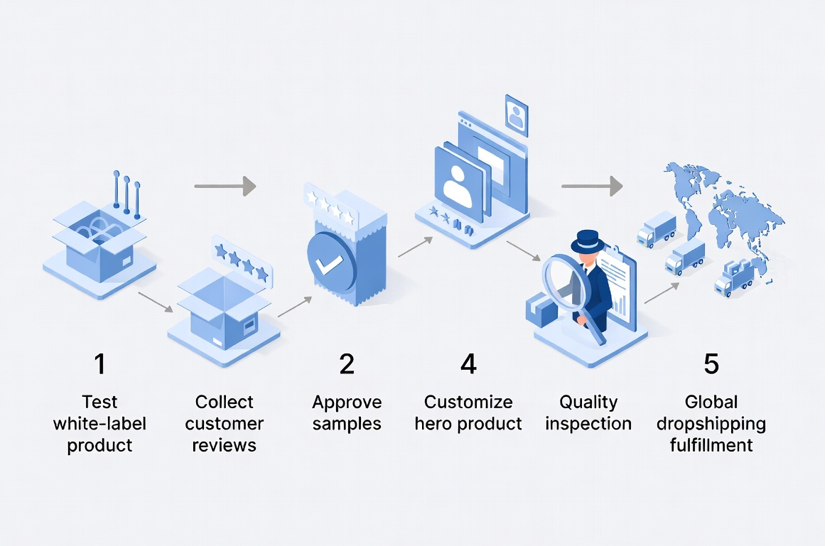
Many sellers do not need to make an all-or-nothing choice. A staged model often offers the most disciplined route:
1. Start with white label. Launch a small, tightly focused product range with branded packaging or inserts.
2. Measure actual customer behavior. Track conversion rate, return reasons, repeat purchase rate, review themes, delivery complaints, and profit after advertising.
3. Order samples from multiple suppliers. Compare product construction, packaging quality, communication, lead time, and shipping consistency.
4. Identify one hero product. Select the item with repeatable demand, manageable return risk, and a clear improvement opportunity.
5. Develop a private-label version. Upgrade one or two features that matter to customers, not cosmetic details that increase complexity without value.
6. Scale only after quality validation. Approve a production sample, document standards, and create a process for handling defects and returns.
This approach protects cash flow while giving you evidence for each bigger decision. It also avoids a common mistake: ordering a large custom batch before knowing whether the market wants the product.
Supplier Due Diligence Before You Brand Anything
Whether you use white label or private label, your supplier becomes part of your customer experience. A great storefront cannot compensate for defective products, unclear tracking, damaged packaging, or slow responses when an order goes wrong.
Before you publish a listing, ask potential suppliers for:
– Product specifications, materials, dimensions, weights, and available variations.
– Clear branding options, logo requirements, packaging costs, and setup fees.
– Sample pricing, production lead times, and restocking policies.
– Minimum order quantities for labels, boxes, and custom product changes.
– Destination-specific shipping options, tracking availability, and estimated delivery windows.
– Inspection process, defect policy, and evidence of quality checks.
– Product certifications or test reports relevant to the market and category.
– A written process for returns, lost parcels, damaged products, and replacements.
Always order samples to your target market when possible. Inspect the item as a customer would: the delivery speed, outer parcel, retail package, instructions, product performance, and any unexpected supplier branding.
This is particularly important for regulated categories. Cosmetics, supplements, children’s products, batteries, and electrical goods can trigger product-safety, labeling, import, and marketplace requirements. Do not make health, safety, sustainability, or performance claims unless you can substantiate them with appropriate documentation.
Protect Margin With a Full-Landed-Cost View
A common mistake is comparing only supplier unit prices. Your real profitability depends on the full cost of delivering an order successfully.
Use this simple planning formula:
Contribution Margin=Selling Price−(Product Cost+Branding+Shipping+Payment Fees+Returns Allowance+Customer Acquisition Cost)
For example, a $35 product may appear profitable if it costs $10 at the factory. But if branding costs $1.50, shipping costs $6, payment fees cost $1.20, returns reserve costs $2, and acquisition costs $10, the contribution margin is only $4.30.
Private label can justify a higher selling price when customization is meaningful. White label can preserve cash flow during testing. In both cases, sustainable growth depends on the margin remaining after fulfillment and customer acquisition—not the difference between retail price and product cost alone.
Build a Brand Customers Recognize
The strongest branded dropshipping businesses do not rely solely on a custom logo. They make the entire buying journey feel intentional.
Focus on:
– A narrow customer problem and a clear reason your product is better.
– Honest product pages with accurate dimensions, materials, and delivery expectations.
– Original photos or videos that show use, scale, and details.
– Packaging that protects the product and supports the brand promise.
– Fast, human support when delivery or product issues occur.
– A repeatable review-collection process that surfaces real feedback.
Research cited by Shopify reports that 64% of surveyed U.S. consumers had bought a private-label product in the previous six months, while 44% had permanently switched a staple purchase to private label. The implication is not that every branded product will succeed; it is that buyers will consider alternatives when the value, trust, and product experience are convincing.
Start Lean, Then Build What Customers Cannot Replace
White label dropshipping is the better choice when speed, flexibility, and low-risk testing matter most. Private label dropshipping is the stronger choice when you have validated demand and can invest in a product experience that competitors cannot easily replicate.
For many sellers, the most practical route is to begin with a curated white-label offer, use real customer feedback to find a winner, then move that winner into a more distinctive private-label product line.
Ready to move from product idea to reliable fulfillment? Looperbuy can help B2B sellers source Chinese products, coordinate branding requirements, manage order fulfillment, and ship directly to global customers—so your team can spend less time managing operational complexity and more time building demand.
Frequently Asked Questions
1. Is private label dropshipping the same as white label dropshipping?
No. White label usually means applying your branding to an existing, non-exclusive product. Private label generally involves a product made to your specifications or reserved for your brand, giving you more control and differentiation.
2. Can I start with white label and later switch to private label?
Yes. This is often a lower-risk path: use white label to validate demand, then use sales data and customer feedback to develop a more distinctive version of your best-performing product.
3. Do private label products always require large minimum orders?
Not always, but custom packaging, formulas, materials, and product changes often increase minimum order requirements. Request separate MOQs for the product, logo application, packaging, and fully custom development before you commit.
4. Which model has higher profit potential?
Private label can support stronger pricing when the product is clearly differentiated and trusted by customers. However, it also requires more investment and operational discipline. A white-label product with efficient fulfillment and a strong niche can still be profitable.
5. What should I check before choosing a dropshipping supplier?
Order samples, confirm product specifications, review branding options, verify delivery routes, understand defect and return handling, and request relevant compliance documents. Evaluate communication quality as carefully as unit price.
6. Can dropshipping still create a premium customer experience?
Yes. A premium experience comes from product quality, clear delivery expectations, protective packaging, consistent brand presentation, and responsive support. Dropshipping changes who fulfills the order; it does not remove the seller’s responsibility for the customer experience.
References
1. Doba. “[Private Label vs White Label Dropshipping: What’s Best for Your Ecommerce Business?]” Accessed August 7, 2026. Core comparison of customization, launch speed, investment, risk, and differentiation. [doba]
2. Shopify. “[Private Label Dropshipping: 2026 Guide + Top Suppliers]” September 18, 2025. Definitions of regular, white-label, and private-label dropshipping; consumer private-label survey findings; supplier evaluation guidance. [shopify]
3. Printful. “[Dropshipping vs. Private Label: Which Is Best for Your Business]” Accessed August 7, 2026. Operational differences among dropshipping, private label, and branded fulfillment models. [printful]