As a procurement professional who has navigated global supply chains for over a decade, I have witnessed firsthand how low cost country sourcing (LCCS) has evolved from a simple cost-cutting tactic into a sophisticated strategic imperative. The question is no longer whether to source from low cost countries — but how to do it right.
Table of Contents
Low Cost Country Sourcing Transforms Global Procurement Economics
Low cost country sourcing fundamentally reshapes how businesses approach their supply chains. By leveraging manufacturing capabilities in countries like China, India, Vietnam, and Mexico, companies gain access to labor and production costs significantly lower than those in developed economies. This is not merely about cheap labor. China’s cost advantage, for instance, is engineered through structural efficiency and disciplined management across the entire value chain, creating a cost edge of 20 to 30 percent over Western competitors.
For businesses operating on razor-thin margins, the ability to reduce input costs by sourcing strategically translates directly into competitive pricing power. Chinese electric vehicle manufacturers, for example, produce comparable vehicles at approximately $25,000 while Western counterparts retail near $45,000 — a pricing gap that would be impossible without sophisticated low cost country sourcing strategies.
Geographic Diversification Reduces Supply Chain Risk
One of the most overlooked benefits of low cost country sourcing is risk reduction through geographic diversification. According to QIMA’s 2026 Global Sourcing Survey, 43% of supply chains shifted sourcing locations in 2025, with US firms leading the trend at two-thirds. For North American buyers, the combined share of top three supplier countries fell from 61% to 54% in a single year.
This is not about abandoning China. It is about building resilience. As the GEP blog notes, successful LCCS today prioritizes resilience, geographic diversification, and long-term value — moving beyond cost savings alone. Companies that spread their sourcing across multiple locations reduce exposure to tariffs, geopolitical tensions, and single-point supply failures.
China, however, remains the cornerstone for many industries. For electronics and sectors requiring mature infrastructure, China’s manufacturing clusters offer unmatched depth in tooling, materials, and industrial capabilities. The smart approach combines China’s manufacturing strength with supplementary sourcing from Vietnam, India, and other emerging markets.
Platform-Driven Sourcing Unlocks Hidden Efficiencies
Here is where the game changes. Traditional low cost country sourcing required boots on the ground, local language capabilities, and months of relationship building. But today, B2B sourcing platforms are democratizing access to global supply chains. Global industrial goods B2B platform market size reached approximately 23.78 billion RMB in 2025, with steady growth projected through 2032.
LooperBuy exemplifies this evolution. As a one-stop B2B sourcing platform, LooperBuy connects overseas brands, wholesalers, and manufacturers directly to Chinese factories through seamless integration with 1688.com. For overseas merchants struggling with the practical barriers — no Chinese ID to register on 1688, no local bank account for RMB payments, unreliable logistics — platforms like LooperBuy eliminate these friction points entirely.
A French boutique owner shared with me: “Before LooperBuy, sourcing from China meant endless WhatsApp messages with middlemen. Now, I place orders directly, pay in euros, and track shipments in real time. My product costs dropped 35%, but more importantly, my stress dropped to zero.” Another US-based electronics reseller noted: “I used to spend 20 hours a week managing supplier communication. LooperBuy’s team handles everything — sampling, production follow-up, consolidation — I just approve and pay.”
Total Cost of Ownership Requires Platform Integration
Experienced procurement professionals know that lowest price rarely equals lowest total cost. Shipping delays, quality defects, communication failures, and compliance violations can wipe out any upfront savings. Dragon Sourcing highlights that quality control issues, communication barriers, shipping delays, political/economic changes, and hidden logistics costs are major risks in LCCS that require careful management.
This is where integrated platforms outperform traditional sourcing methods. LooperBuy addresses these risks through:
- Direct factory connections: Cutting out intermediaries ensures competitive pricing without quality surprises
- Multi-currency payment solutions: Through partnership with LianLian International, overseas merchants can pay directly in foreign currencies — no Chinese bank account required
- Global logistics partnerships: Collaborating with leading freight carriers to provide reliable, cost-effective shipping
- Customized support: One-on-one multilingual customer service handling communication with factories, from sampling to mass production
Quality Assurance Without Physical Presence
A common misconception about low cost country sourcing is that low cost equals low quality. This could not be further from the truth — when you work with the right partners. Chinese manufacturers are redefining industrial competition, compressing product-development cycles from years into months while sustaining cost advantages.
The key is having the right oversight mechanisms. Platforms like LooperBuy provide the infrastructure that substitutes for physical presence. With over 490 million merchants served by their payment partner LianLian International, the operational scale and security infrastructure ensure that quality standards are maintained throughout the procurement process.
Supply Chain Diversification Beyond China
While China remains the world’s manufacturing powerhouse, 2026 is witnessing a fundamental shift in how companies structure their sourcing networks. Asia’s supply network is changing as production builds in Southeast Asia and India while China continues as a cornerstone for many industries.
Vietnam has emerged as a leading alternative for apparel and consumer goods, with average wages around $291 in 2023. India is gaining momentum in electronics, automotive, and battery production, supported by government programs encouraging manufacturing investment. Mexico offers proximity advantages for North American buyers seeking to reduce lead times and freight costs.
However, Dragon Sourcing rightly warns that countries may offer lower labor costs, but the order still needs reliable factories, clear specifications, production monitoring, final inspection, corrective action, packaging control, and export logistics. The successful low cost country sourcing strategy uses platforms that aggregate vetted suppliers across multiple geographies — exactly what LooperBuy provides.
Real-World Results from Global Brands
The proof is in the outcomes. Businesses leveraging low cost country sourcing through integrated platforms are reporting measurable improvements across key metrics. According to QIMA’s survey, fully mapped supply chains report dramatically easier quality control, nearly two times easier compliance management, on-time shipping improvements, and better cost management.
Consider the case of a UK-based home goods retailer who shared their experience: “We switched to sourcing through LooperBuy 18 months ago. Our cost of goods sold dropped 28%, our product range expanded from 50 to over 300 SKUs, and we reduced supplier management time by 15 hours per week. The platform’s logistics consolidation alone saved us $12,000 in annual freight costs.”
An Australian dropshipper added: “The biggest benefit is predictability. With LooperBuy’s clear fee structure and logistics tracking, I know exactly what I am paying and when goods will arrive. No more surprises — just reliable sourcing at prices that keep my margins healthy.”
Future-Proofing Your Sourcing Strategy
Looking ahead, the benefits of low cost country sourcing will only grow as technology and trade continue to evolve. The global procurement outsourcing market is projected to grow from $5.49 billion in 2025 to $6.21 billion in 2026, driven by increasing supply chain complexity and demand for cost control measures. B2B business matchmaking platforms are expected to reach $1.7237 trillion by 2032, growing at an 18.1% CAGR.
Businesses that embrace platform-driven low cost country sourcing today will be the ones dominating their markets tomorrow. The key is choosing a partner that combines supplier access, payment infrastructure, logistics capabilities, and quality assurance in one integrated solution.
Ready to transform your global sourcing strategy? Visit LooperBuy today to start sourcing from China and beyond — with competitive pricing, global logistics, and end-to-end support built right in.
References
- GEP. (2025). Rewriting Low-Cost Country Sourcing for 2026. GEP Blog.
- Roland Berger. (2026). China’s Cost and Speed Advantage. Roland Berger.
- Dragon Sourcing. (2025). Sourcing Products from Low-Cost Countries: Best Regions for 2026 and Key Risks.
- QIMA. (2026). 2026 Global Sourcing Survey: From Disruption to Opportunity.
- QIMA. (2026). Q1 2026 Supply Chain Barometer: Global Sourcing Trends, Risk & Opportunities.
- Dimerco. (2025). Asia Supply Chains Are Changing: What Shippers Should Prepare for in 2026.
- Dark Horse Sourcing. (2026). China Sourcing Guide 2026: How Sourcing from China Really Works Now.
- 恒州诚思 (YHResearch). (2026). 2026年全球及中国工业品B2B平台行业头部企业市场占有率及排名调研报告.
- QYResearch / 涛越咨询. (2026). 2026-2032全球与中国B2B商务配对平台市场现状及未来发展趋势.
- LianLian International. (2024). 连连国际牵手LooperBuy, 解锁跨境B2B寻源新时代.
- China.com.cn. (2026). 美媒: “中国制造”比以往更加不可或缺.
- TradeBeyond. (2026). Retail Sourcing Report, Q1 2026 Insights and Indicators.
Frequently Asked Questions (FAQ)
Q1: What is low cost country sourcing and how does it benefit my business?
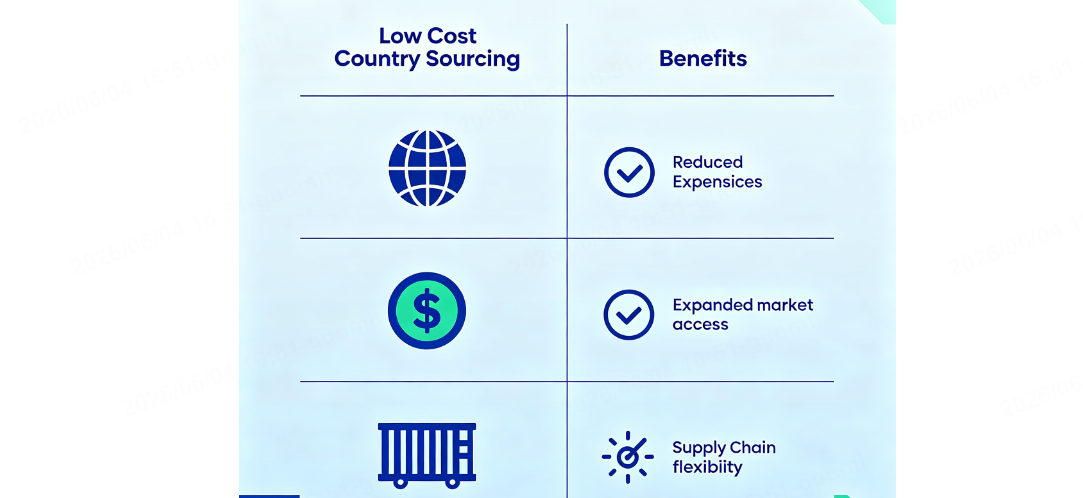
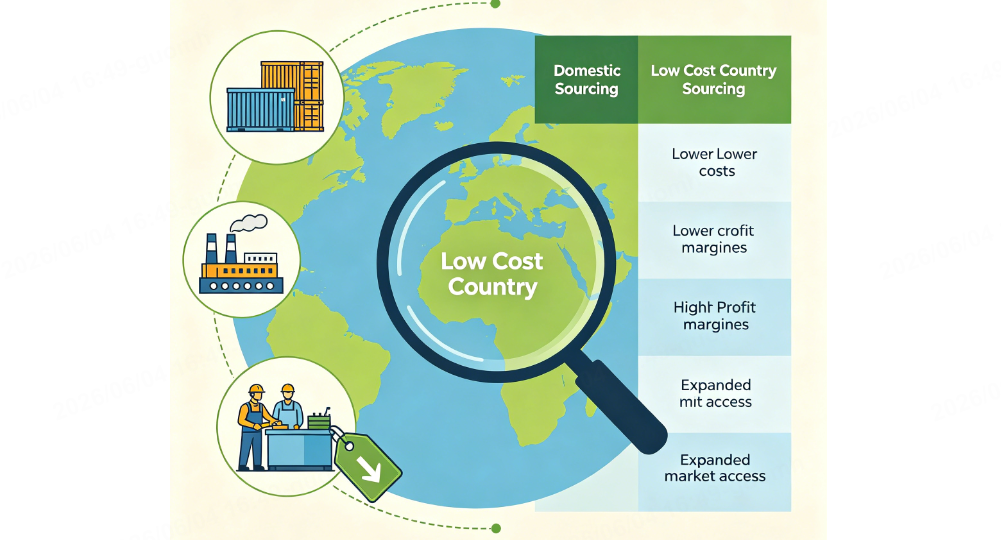
Low cost country sourcing (LCCS) is the practice of procuring products or components from countries with lower labor and production costs, such as China, India, Vietnam, and Mexico. Benefits include reduced product costs, improved profit margins, access to diverse supplier networks, increased product range flexibility, and stronger competitive positioning in your target markets.
Q2: Is sourcing from China still cost-effective in 2026?
Yes. China remains cost-effective due to structural efficiencies across the value chain, not just low wages. Chinese manufacturers achieve a 20-30% cost advantage through design-to-cost choices, localized supplier networks, and disciplined management. The key difference in 2026 is that success requires structured approaches — not simply price hunting.
Q3: What are the main risks of low cost country sourcing?
Main risks include quality control issues, communication barriers, shipping delays, political and economic changes, hidden costs like logistics and compliance, and intellectual property concerns. These risks are best mitigated through reliable platform partners that provide vetted suppliers, quality inspection support, and logistics integration.
Q4: How does LooperBuy simplify international sourcing from China?
LooperBuy provides a one-stop B2B platform connecting overseas buyers directly to Chinese factories via 1688.com integration. It offers multi-currency payment solutions (no Chinese bank account needed), global logistics partnerships for reliable shipping, customized customer service, support for both one-click dropshipping and bulk orders, and multilingual assistance for factory communication.
Q5: Should I diversify my sourcing beyond China in 2026?
Yes. Supply chain diversification is recommended to reduce risk from tariffs and geopolitical tensions. While China remains essential for electronics and sectors requiring mature infrastructure, consider supplementing with Vietnam (apparel, consumer goods), India (electronics, automotive), or Mexico (proximity to North America). A China Plus One strategy balances cost, quality, and resilience.
Article Summary (300 characters)
Low cost country sourcing transforms global procurement through cost reduction, risk diversification, and platform-driven efficiency. Drawing on 2026 data from industry leaders and real customer experiences with LooperBuy, this expert guide reveals actionable strategies for brands to source smartly from China and beyond.
Hot tags: low cost country sourcing, global B2B sourcing, China sourcing benefits, supply chain diversification, LCCS 2026, procurement cost reduction, B2B platform services, international sourcing strategy, cross-border logistics, supplier risk management