Table of Contents
Executive Summary: The Hidden Logic of Price Discrepancies
In the global e-commerce landscape, Chinese industrial hubs—such as Jinjiang for footwear, Yiwu for small commodities, and Dongguan for electronics—are the beating heart of supply chains. However, savvy cross-border sellers are often puzzled by a recurring phenomenon: why can the same product show a 3x price discrepancy on wholesale platforms?
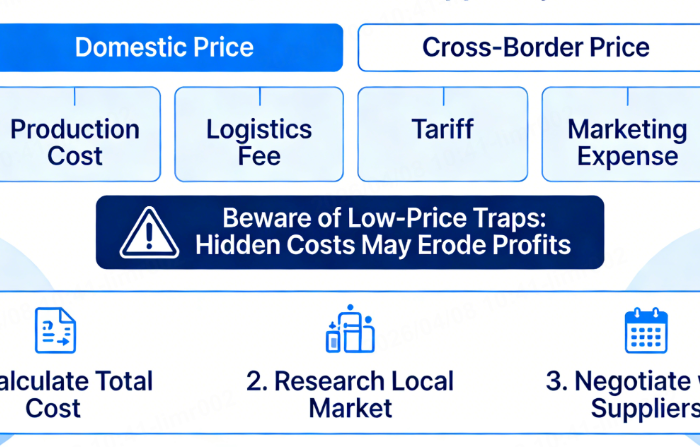
The answer is rarely found in the cost of raw materials alone. Instead, it is a complex intersection of production standards, multi-layered distribution chains, and hidden fulfillment costs that “quietly” dictate the actual profitability. This article dissects the underlying logic of these price gaps, proving that for modern cross-border sellers, the most dangerous trap is the “lowest purchase price” mentality. True competitive advantage comes from mastering the Total Cost Structure.

I. Industrial Tiering: Three Factory Systems Define the Price Floor

In mature Chinese manufacturing hubs, “identical” items are often produced by vastly different systems. The price variation is a direct reflection of the manufacturer’s investment in quality, compliance, and risk management.
- Standardized Factories (Brand/Export OEM): These factories follow rigorous Standard Operating Procedures (SOPs). They use virgin raw materials, conduct comprehensive product testing (aging, stress, and chemical safety), and possess international certifications like CE, FCC, and RoHS. Their defect rates are typically kept below 3%. Price Tier: Mid-to-High.
- Semi-Standardized Factories (Domestic Focused): These suppliers focus primarily on the domestic market. To keep prices competitive, they may use secondary-grade raw materials and rely on spot-checks rather than full-batch inspections. While functional, their consistency can fluctuate between batches. Price Tier: Mid-range.
- Small Workshops/Assembly Shops: Operating with minimal overhead, these entities often utilize recycled, remnant, or “clearance” materials. They lack structured quality control, leading to significant variations in SKU appearance and functionality. Price Tier: Low.
The Crucial Insight: Price gaps are not merely “profit margins”; they are risk premiums. Industry data from 1688 and other wholesale platforms suggests that goods from low-end workshops often suffer from return rates between 20%–35%, compared to 5%–10% for standardized products. For a cross-border seller, the “savings” on the unit price are often wiped out by the massive cost of returns, customer service labor, and negative marketplace reviews.
II. The Distribution Chain: The “Hidden” Multiplier
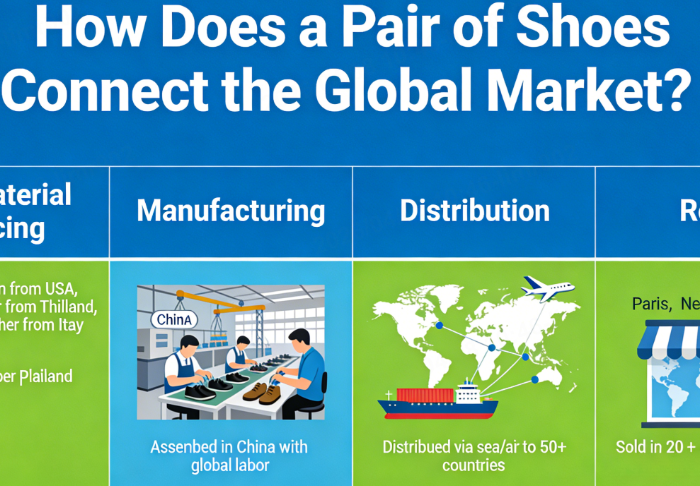
The journey from a factory floor to a cross-border seller’s warehouse is rarely direct. A common path is: Factory → Wholesaler → Secondary Distributor → E-commerce Aggregator → Terminal Seller.
Each layer in this chain adds a markup (typically 10%–30%) to cover the intermediary’s operating costs and profit. However, the greater danger is the information asymmetry. As a product moves further from the source, the seller loses control over the specific manufacturing batch. A distributor might fulfill orders with mixed stock from different factories to minimize their own costs, leading to inconsistencies that are impossible for the end-seller to track.
LooperBuy’s core value is not just “price comparison.” It is the ability to bypass these redundant layers, screen genuine primary-source factories, and ensure that the product received matches the quality standard agreed upon, effectively “flattening” the supply chain.
III. The Invisible Cost of Fulfillment: What Sellers Ignore
Many sellers fixate on the unit price (COGS) while ignoring the “hidden” logistics costs that account for 15%–30% of total expenditures. These include:
- QC and Defect Losses: Without centralized quality control, a 10% defect rate means you are essentially paying 10% more for your stock, while also risking your seller account health on platforms like Amazon or TikTok Shop.
- Logistics Errors: In common dropshipping or multi-supplier scenarios, common issues like mislabeled SKUs, incorrect quantities, or inconsistent packaging are rampant. Dealing with these requires manual intervention, double shipping costs, and often, customer refunds.
- Operational Friction: As order volume grows, the complexity of consolidating goods from various suppliers—each with different shipping times and packing standards—becomes a logistical bottleneck.
By providing centralized receiving, professional quality inspection, consolidated picking/packing, and automated order splitting, solutions like LooperBuy transform these dispersed, “invisible” costs into a predictable, structured, and scalable expense.
IV. Real-World Case Study: Transforming Profitability
Consider a cross-border home goods seller who initially optimized for the lowest purchase price.
- Initial Strategy: Sourced at ¥6.2 (35% below market average of ¥9.5). Result: 28% return rate, high customer complaint volume, and negative feedback that throttled organic traffic.
- Strategic Pivot: The seller shifted to a partner like LooperBuy to access stable, certified factories and enforced unified quality checks. Although the unit purchase price rose to ¥8.8, the return rate dropped to 7%.
The Final Result: While the product became more expensive, the total cost of ownership dropped. The seller saw a 22% increase in net gross profit per unit, stable store ratings that drove higher traffic, and the ability to scale up without fear of quality dips. As the operations manager noted, “I used to think that low price meant high profit. Now I know that returns and negative reviews were eating everything. We finally learned to look at the total cost structure, not just the price tag.”
V. Conclusion: Price Gaps are Capability Gaps
The 3x price discrepancy in Chinese industrial hubs is not a “market opportunity” to be exploited by finding the cheapest vendor; it is a manifestation of structural differences in supply chain capability.
The procurement logic for successful cross-border sellers is shifting fundamentally:
- From “Lowest Price” to “Stable Supply.”
- From “Single Transaction” to “Long-term Partnerships.”
- From “Price Comparison” to “Supply Chain Efficiency.”
Solutions like LooperBuy offer more than just a procurement channel; they provide an integrated supply chain solution that includes direct factory connectivity, multi-currency settlement, centralized quality management, and efficient fulfillment. For the modern cross-border seller, the barrier to entry is no longer capital—it is the ability to move beyond the “low-price trap” and build a resilient, efficient, and profitable supply chain infrastructure. True competitive advantage is found in total cost, not just the starting price.
Hot tags: Cross-border e-commerce supply chain, factory-direct sourcing, e-commerce logistics fulfillment, B2B dropshipping, industrial hub sourcing, supply chain cost optimization, cross-border procurement, quality control for e-commerce, international trade sourcing, e-commerce operational efficiency.