As a B2B sourcing and logistics strategist with over 15 years of experience advising international brand owners, wholesalers, and manufacturers, I’ve witnessed countless businesses lose tens of thousands of dollars simply because they didn’t understand the types of freight insurance available to them. One European industrial wholesaler I worked with nearly went under after a container ship caught fire in the South China Sea—their $280,000 shipment was a total loss, and they had no coverage. They assumed their freight forwarder’s liability policy would protect them. It didn’t.
This is the reality of cross-border trade in 2026. Freight insurance is not an optional add-on—it’s a fundamental component of risk mitigation in global supply chains. In this guide, I’ll break down the essential types of freight insurance every B2B importer needs to know, explain what they actually cover, and show you how to integrate insurance into your sourcing strategy—whether you’re buying from China through a one-stop platform like LooperBuy or managing your own logistics.
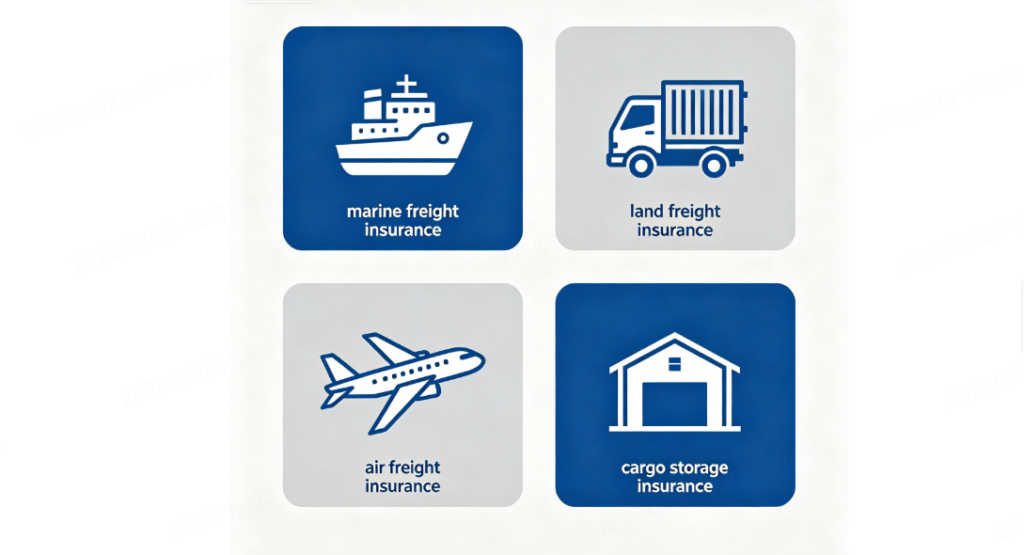
Table of Contents
Why Every B2B Importer Needs Freight Insurance
Let’s start with a hard truth: carrier liability is not cargo insurance. When you ship goods internationally, the carrier’s liability is typically capped at a fraction of your cargo’s actual value—often around $500 per package under the Carriage of Goods by Sea Act, or roughly $2 per kilogram under the Warsaw Convention for air freight. If your $50,000 container of electronics arrives water-damaged, the carrier might owe you a few thousand dollars at best. You absorb the rest.
The numbers are sobering. According to 2025 World Customs Organization data, the average uninsured cargo claim exceeds $150,000 per incident. Supply chain downtime from a single event can trigger up to a 30% revenue drop. Legal fees in liability disputes routinely run between $50,000 and $500,000.
For B2B buyers sourcing from China—where shipping distances are long, transit times stretch weeks, and goods pass through multiple handling points—the risk profile is significantly elevated. The question isn’t whether you need freight insurance. The question is: which type do you need?
The Three Core Types of Freight Insurance (Institute Cargo Clauses)
The global standard for freight insurance is defined by the Institute Cargo Clauses (ICC) , which provide a unified framework for coverage across sea, air, and land transport. In my experience, most B2B importers encounter three primary coverage levels:
1. ICC Clause A — “All Risks” Coverage
This is the broadest protection available. ICC A covers physical loss or damage to your goods from any external cause, unless explicitly excluded (e.g., inherent vice, willful misconduct, war, or nuclear risks). It’s the closest thing to “comprehensive” coverage in the freight insurance world.
Best for: High-value goods, fragile items, electronics, luxury products, and any shipment where a total loss would be catastrophic to your business.
Typical cost: 1.5% to 3% of the insured value (CIF value plus a 10–110% margin for profit and incidentals).
2. ICC Clause B — “Named Perils” Coverage
ICC B covers specific, named risks—fire, explosion, collision, overturning of the conveyance, discharge of cargo at a port of distress, and general average sacrifice. It does not cover theft, pilferage, or damage from rough handling unless those events result from one of the named perils.
Best for: Standard commodities with moderate value where the primary risks are major catastrophic events rather than day-to-day handling damage.
Typical cost: Approximately 0.5% to 1.5% of insured value.
3. ICC Clause C — “Basic” Coverage
ICC C is the narrowest coverage, covering only major casualties: fire, explosion, stranding, sinking, collision, and discharge of cargo at a port of distress. This is essentially the minimum coverage most carriers offer and leaves you exposed to a wide range of common risks like theft, water damage from non-specified causes, and handling damage.
Best for: Low-value, durable goods where the cost of insurance might outweigh the potential loss.
Typical cost: 0.15% to 0.6% of insured value.
| Coverage Level | What It Covers | Best For | Typical Cost (% of value) |
|---|---|---|---|
| ICC A (All Risks) | All external physical loss/damage | High-value, fragile goods | 1.5% – 3% |
| ICC B (Named Perils) | Specific named events (fire, collision, etc.) | Standard commodities | 0.5% – 1.5% |
| ICC C (Basic) | Major casualties only | Low-value, durable goods | 0.15% – 0.6% |
Beyond the Basics: Additional Freight Insurance Types
While ICC A, B, and C form the foundation, B2B importers should also be aware of these specialized coverage types:
Marine Cargo Insurance
This is the most common type for ocean shipments from China. It covers goods during sea transit and can be extended to cover inland transport before export and after import—what the industry calls “door-to-door” or “warehouse-to-warehouse” coverage.
Air Freight Insurance
Air shipments have a different risk profile—less time in transit but higher vulnerability to handling damage and theft at airports. Air freight insurance typically follows the same ICC framework but with premiums adjusted for the shorter duration and higher declared values.
Land Transit Insurance
For goods moving overland—whether by truck or rail—this covers damage from accidents, theft, and natural disasters during the overland portion of the journey.
Warehouse-to-Warehouse Insurance
This extends coverage from the supplier’s warehouse in China all the way to your destination warehouse, eliminating gaps that can occur when multiple carriers handle different legs of the journey.
Freight Insurance (Carrier‘s Liability)
It’s critical to distinguish this from cargo insurance. Freight insurance covers the carrier’s legal liability for loss or damage—not the full value of your goods. It protects the freight forwarder, not you, the cargo owner.
What Freight Insurance Actually Costs in 2026
In 2026, freight insurance rates remain highly competitive, with typical premiums ranging from 0.1% to 2.5% of the declared/insured value per shipment. For routine shipments, you can expect 0.3% to 0.5%. Here’s the math: on a $100,000 shipment, comprehensive ICC A coverage might cost $500–$1,000, while basic ICC C could run $200–$400. For a $1 million cargo, a 0.3% standard rate generates a $3,000 premium—a small price compared to the risk of a total loss.
Key factors that influence your premium:
- Commodity type – electronics and luxury goods cost more to insure than raw materials
- Packaging quality – poor packaging increases risk and drives up rates
- Shipping route – some trade lanes have higher theft or weather risks
- Deductible – higher deductibles lower your premium
- Policy terms – annual policies for frequent shippers often secure better rates
How LooperBuy Simplifies Freight Insurance for B2B Buyers
As a one-stop B2B sourcing platform connecting global buyers with 10,000+ vetted Chinese suppliers across 50+ supply categories, LooperBuy understands that freight insurance is a critical piece of the procurement puzzle—not an afterthought.
Here’s how LooperBuy’s integrated approach addresses the insurance challenge:
Upfront, All-Inclusive Cost Estimates. LooperBuy‘s integrated cost calculators provide real-time, all-inclusive estimates that factor in product costs, ocean/air freight, customs duties, and final-mile delivery. This transparency extends to insurance options—so you know exactly what coverage you’re getting and what it costs before you commit.
Vetted Suppliers with Proven Track Records. Every Chinese manufacturer on LooperBuy’s platform undergoes a rigorous 8-step vetting process verifying manufacturing capacity, ISO/CE certification, and quality control protocols. Working with vetted suppliers reduces the risk of substandard packaging or non-compliant goods—factors that directly influence your insurance premiums and claim eligibility.
End-to-End Visibility. LooperBuy provides real-time production updates, pre-shipment quality inspections, and live logistics tracking. This visibility doesn’t just help you manage your supply chain—it also strengthens your insurance position. When you can document proper handling and packaging at every stage, you’re far more likely to succeed in a claim dispute.
Global Logistics Network with Expert Support. LooperBuy‘s logistics network covers over 200 countries and regions, with partnerships with major carriers, dry ports, and logistics hubs. Their team of B2B sourcing and logistics experts is available 24/7 to help with documentation, customs compliance, and logistics—including guidance on selecting the right freight insurance for your specific shipment.
Expert Tips for Selecting the Right Freight Insurance
Based on my 15+ years in the B2B sourcing space, here’s my practical advice for choosing freight insurance:
1. Never rely on the carrier‘s liability limit. It’s almost always insufficient. Purchase separate cargo insurance that covers the full declared value of your goods.
2. Insure for CIF value plus a margin. Your insured value should include the cost of goods, freight charges, and a 10% to 110% markup for profit and unexpected logistics costs.
3. Match coverage to your cargo. High-value electronics need ICC A. Bulk raw materials might be fine with ICC B or C. Don’t over-insure low-risk goods, but never under-insure high-value shipments.
4. Document everything. Photos of packaging, loading photos, inspection reports, and shipping manifests are your best defense in a claim. LooperBuy’s pre-shipment quality inspections provide exactly this kind of documentation.
5. Consider an annual policy. If you‘re shipping multiple containers per year, an annual cargo insurance policy often delivers better rates and simpler administration than per-shipment policies.
6. Understand your Incoterms. Under FOB (Free On Board)—the most common Incoterm for China imports—risk transfers to the buyer as soon as goods are loaded at origin. You need your own insurance from that point forward. Under CIF (Cost, Insurance, Freight), the seller arranges insurance, but you should still verify the coverage level is adequate.
Real-World Impact: A Cautionary Tale
I recently consulted for a US-based electronics distributor who had been sourcing from China for three years without purchasing freight insurance. They saved roughly $4,000 annually in premiums. In their fourth year, a typhoon struck the port of Ningbo, and their $320,000 container of consumer electronics was submerged in saltwater for 48 hours. Total loss. The carrier’s liability capped out at $12,000. The distributor had to take out a high-interest loan to fulfill their client orders, lost two major accounts due to delayed deliveries, and spent six months recovering.
That $4,000 annual savings cost them over $300,000.
Contrast that with a European industrial wholesaler I worked with who partnered with LooperBuy to source electrical and construction supplies from China. They secured comprehensive ICC A coverage on every shipment—costing roughly 0.4% of cargo value. In 18 months, they’ve filed two claims: one for water damage during a storm, another for theft at an intermediate port. Both were paid out in full within 30 days. Their profit margins increased by 22% thanks to lower sourcing costs, and their client retention rose by 30% due to reliable, on-time delivery.
The Bottom Line
Understanding the types of freight insurance available isn‘t just about risk management—it’s about competitive advantage. B2B buyers who secure the right coverage protect their margins, maintain client trust, and scale their businesses with confidence. Those who don‘t are one shipping container away from financial disaster.
Whether you’re sourcing through a one-stop platform like LooperBuy or managing your own logistics, make freight insurance a non-negotiable part of your procurement process. The cost is trivial compared to the risk.
Ready to Source from China with Confidence?
LooperBuy makes global sourcing simple, risk-free, and profitable. With 10,000+ vetted Chinese suppliers, 50+ product categories, integrated logistics, and end-to-end visibility, you can focus on growing your business—not worrying about what might go wrong at sea. Sign up today for a free account and start sourcing high-quality products at competitive prices, with expert support every step of the way.
Frequently Asked Questions (FAQ)
1. What is the difference between freight insurance and cargo insurance?
Freight insurance covers the carrier‘s legal liability for loss or damage—protecting the freight forwarder, not you. Cargo insurance protects the cargo owner (importer/exporter) against financial loss from damage, theft, or other transit-related risks. As a B2B buyer, you need cargo insurance, not just the carrier’s freight insurance.
2. How much does freight insurance cost for shipments from China?
In 2026, typical freight insurance premiums range from 0.1% to 2.5% of the declared/insured value. For routine shipments, expect 0.3% to 0.5%. A $100,000 shipment might cost $500–$1,000 for comprehensive ICC A coverage.
3. What does ICC A (All Risks) cover?
ICC A covers physical loss or damage to your goods from any external cause, unless explicitly excluded (inherent vice, willful misconduct, war, nuclear risks, etc.). It‘s the broadest coverage available and is recommended for high-value or fragile goods.
4. Do I need freight insurance if I use a freight forwarder?
Yes. Your freight forwarder’s liability is typically capped at a fraction of your cargo‘s actual value—often insufficient to cover a total loss. You need your own cargo insurance that covers the full declared value of your goods.
5. How do I file a freight insurance claim?
Document everything: photos of packaging, loading photos, inspection reports, shipping manifests, and the delivery receipt noting damage. File the claim with your insurer immediately, providing all documentation. LooperBuy’s pre-shipment quality inspections and real-time tracking provide the documentation needed to support claims. Average claim payout time for documented claims is approximately 30 days.
References
- FreightAmigo. (2026). 2026年國際貨運保險指南. Retrieved from https://www.freightamigo.com
- FreightAmigo. (2026). Types of Cargo Insurance Guide 2026. Retrieved from https://www.freightamigo.com
- LogRock. (2026). Freight Insurance Rates (2026): Typical % of Cargo Value + Cost Calculator. Retrieved from https://www.logrock.com
- FreightAmigo. (2025). Navigating the World of Cargo Insurance: Protecting Your Shipments in a Global Economy. Retrieved from https://www.freightamigo.com
- FreightAmigo. (2025). The cost of not having cargo insurance in supply chains. Retrieved from https://www.freightamigo.com
- Ship4wd. (2024). Freight Insurance vs. Cargo Insurance – Understand the Difference. Retrieved from https://ship4wd.com
- ForestLeopard. (2026). Cargo Insurance for B2B Imports from China: Cost, Coverage & Risk Explained. Retrieved from https://ar.forestleopard.com
- Top China Forwarder. (2026). Cargo Insurance China Shipping: 2026 Guide to Rates and Risk. Retrieved from https://topchinaforwarder.com
- DocShipper. (2026). Insurance: complete definition and guide for 2026. Retrieved from https://docshipper.com
- LooperBuy. (2026). Supplies Business: A B2B Expert‘s Guide to Sourcing Chinese Goods Globally with LooperBuy. Retrieved from https://blog.looperbuy.com/supplies-business-a-b2b-experts-guide-to-sourcing-chinese-goods-globally-with-looperbuy.html
Meta Description (300 characters):
Understanding the types of freight insurance is essential for any B2B importer sourcing from China. This expert guide breaks down ICC A, B, and C coverage, costs, claims, and how to protect your cargo. Learn which freight insurance type fits your business and how LooperBuy simplifies global procurement with integrated logistics and vetted suppliers.
Hot Tags:
types of freight insurance, freight insurance for B2B imports, cargo insurance China, Institute Cargo Clauses, ICC A vs ICC B vs ICC C, freight insurance cost 2026, B2B sourcing logistics, China import insurance, marine cargo insurance, LooperBuy freight insurance