Looking for the best Shopify dropshipping suppliers? This guide compares reliable supplier options, shipping speed, product quality, branding support, and practical selection tips. Learn how to choose partners that help your store grow with less risk and better customer experience.
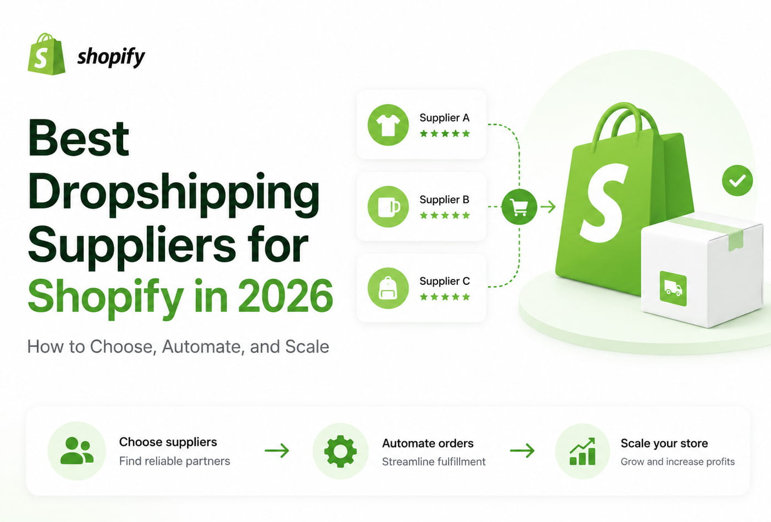
If you are building a Shopify store and want a supplier network you can trust, the real goal is not simply finding the cheapest option. The best Shopify dropshipping suppliers are the ones that help you deliver consistent quality, clear tracking, and fast fulfillment without adding unnecessary operational complexity.
In this guide, we’ll break down the strongest supplier options, what makes them dependable, how to evaluate them, and how to choose the right partner for your store’s market, budget, and growth stage. In addition, the article includes practical purchasing steps, supplier testing techniques, and user experience guidance centered on conversion rates.
Table of Contents
Why supplier choice matters
A dropshipping business only looks simple on the surface. In reality, your supplier determines the customer experience behind every order: stock accuracy, shipping speed, packaging quality, and after-sales support.
That is why the strongest Shopify stores do not chase every low-cost catalog they can find. They build around suppliers that reduce refund risk, support branded presentation, and keep order fulfillment predictable. When customers trust delivery times and product quality, they are far more likely to buy again.
What reliable suppliers do well
A reliable supplier usually shares a few traits:
– Fast and transparent shipping, especially for key markets.
– Inventory syncing, so you do not sell items that are out of stock.
– Clear dispute handling, including returns and damaged-item support.
– Product consistency, so the item customers receive matches the listing.
– Branded options, such as invoices or custom packaging, when available.
If a supplier hides shipping details, changes stock frequently, or offers vague support, that is a warning sign. In dropshipping, small operational problems quickly become brand problems.
Best Shopify supplier options
Here is a practical overview of leading Shopify dropshipping supplier options and what they are best suited for. The selection below reflects the current marketplace landscape and the supplier types commonly recommended by major ecommerce resources.
| Supplier | Best for | Shipping profile | Strengths | Trade-offs |
| Shopify Collective | Shopify brands selling to other Shopify stores | Global, depends on supplier | Verified brand network, built-in routing | Only for eligible Shopify users |
| DropCommerce | North American stores | 2–7 days in North America | Curated suppliers, branded invoicing | Smaller regional reach |
| Syncee | International stores | Global | Large supplier network, wholesale + dropshipping | More research needed to filter quality |
| AI Dropship | Fast domestic shipping | 2–7 days | US/EU suppliers, free plan | Smaller network than large marketplaces |
| DSers + AliExpress | Product testing and low-cost launches | Varies by supplier | Huge catalog, low entry cost | Shipping and quality can vary |
| Spocket | Branded stores | Fast US/EU shipping | Domestic suppliers, invoicing features | Higher pricing |
| Zendrop | Beginner-friendly automation | Fast for US inventory | Easy setup, branding support | Paid features unlock the best value |
| CJdropshipping | Scaling stores | Global with local warehouses | Sourcing, fulfillment, branding | Interface and quality can vary |
| Trendsi | Fashion stores | 2–5 business days for US stock | Apparel focus, strong product media | Narrower niche focus |
| Doba | Centralized sourcing | Global | Multi-supplier management, automation | Subscription-based |
Supplier-by-supplier insights
Shopify Collective
Shopify Collective is one of the most attractive options for eligible Shopify merchants because it connects stores with other Shopify brands. Orders are routed directly through the platform, which simplifies the workflow and reduces manual steps.
This is a strong fit if you want to build a premium-feeling store and work with recognizable brands. It is less useful if you want open-ended international sourcing or non-Shopify suppliers.
DropCommerce
DropCommerce focuses on suppliers in the US and Canada, which is valuable if your customers care about delivery speed. Shopify and other ecommerce resources consistently highlight its 2–7 day North American shipping, branded invoicing, and curated supplier base.
It is a strong choice for stores that want a cleaner, more controlled product selection than open marketplaces usually provide. The main limitation is geographic reach, so it works best for North America-oriented sales.
Syncee
Syncee stands out for breadth. It gives sellers access to a global network of brands and supports both dropshipping and wholesale-style sourcing, which makes it flexible for stores that may later move beyond pure dropshipping.
Use it when you want variety and room to test categories. Just be prepared to vet suppliers carefully, because a larger catalog also means more variation in service quality.
AI Dropship
AI Dropship is a strong fit for merchants who want fast delivery from US and EU suppliers. Current comparisons highlight its 2–7 day delivery profile and generous free-plan entry point, which makes it attractive for lean stores.
It is especially useful for stores that want to reduce delivery anxiety early in the customer journey. That said, it is better suited to sellers who value domestic speed over massive catalog depth.
DSers + AliExpress
AliExpress remains one of the largest product sources for testing new ideas, especially when paired with DSers for order automation. Shopify’s supplier guidance still lists it as a major option because of its huge catalog and low-cost access to product research.
This route is best when you need to launch quickly and validate demand with minimal upfront cost. The trade-off is shipping inconsistency, so it is not ideal for brands built around premium service promises.
Spocket
Spocket is popular with merchants who want a more polished, brand-friendly dropshipping experience. Shopify’s 2026 comparison highlights its US and EU supplier base, fast domestic shipping, and branded invoicing support.
If your audience values reliability and a more premium feel, Spocket is a strong candidate. The downside is pricing: better branding and shipping often come at a higher product cost.
Zendrop
Zendrop is built for sellers who want simplicity, automation, and branding support. It is often recommended to beginners because it reduces the friction of supplier management while still offering a strong fulfillment workflow.
It works well when you want to move fast without building a complex sourcing stack. The main drawback is that many of the best features sit behind paid plans.
CJdropshipping
CJdropshipping combines sourcing, fulfillment, and branding services in one place, making it useful for stores that want more operational control. Shopify’s comparison notes its global warehouse network and support for sourcing from marketplaces such as 1688 and Taobao.
This is a practical option for scaling stores that need more flexibility than a simple supplier directory can provide. However, product quality and shipping performance may vary, so sample testing is essential.
Trendsi
Trendsi is one of the strongest niche options for fashion, especially women’s apparel. Shopify highlights its fast US shipping, product media assets, and branding-related features, which are useful for fashion stores that depend on strong visual merchandising.
If your store is built around apparel, Trendsi can save time on product-page creation. If you sell outside fashion, it is less relevant.
Doba
Doba is a centralized sourcing platform with multiple supplier integrations and automation features. In Doba’s own updated article, the platform emphasizes its supplier network, reliability screening, and Shopify integration as part of a more controlled dropshipping workflow.
For sellers who want one interface to manage many products and suppliers, Doba can reduce operational clutter. It is especially appealing when you value supplier curation more than raw catalog size.
What changed in the market
One clear shift is that fast shipping and localized inventory matter more than ever. Shopify’s 2026 guides repeatedly emphasize North American and European fulfillment, curated supplier networks, and automated syncing as key decision factors. That signals a broader market move away from “cheap plus slow” toward “reliable plus visible.”
Another shift is that supplier choice is now part of branding. Branded invoices, private-label support, and better packaging are no longer luxury extras; they are part of the customer experience. Stores that ignore this often struggle to stand out, even if their products are good.
How to choose the right supplier
A simple selection framework works best:
1. Choose your target market first.
2. Decide your acceptable delivery window.
3. Match supplier geography to that promise.
4. Test samples before publishing products.
5. Check support response time before scaling.
6. Review shipping policies, return handling, and fees.
For example, if you sell to US customers and promise quick delivery, a supplier with US warehouses is usually a better fit than a low-cost overseas option. If your store is a product-testing lab, a broad marketplace such as AliExpress or Syncee can be more useful.
A practical testing workflow
Before you commit to any supplier, use this quick process:
– Order at least one sample.
– Test the packaging and product quality.
– Measure actual delivery time.
– Ask a support question and note the response speed.
– Check whether tracking updates are accurate.
– Confirm the return process in writing.
This process takes a little time, but it prevents far more expensive mistakes later. In ecommerce, a bad supplier can erase months of ad spend and reputation-building.
If you are building a Shopify store and want to reduce fulfillment risk while improving customer experience, start by testing two supplier types: one fast local option and one broad product-testing platform. That gives you a balanced sourcing strategy and a clearer path to scale.
For Looperbuy, the strongest message is simple: make sourcing reliable before you make it big.
FAQ
1. What are the best Shopify dropshipping suppliers for beginners?
For beginners, the easiest starting points are Zendrop, DSers + AliExpress, CJdropshipping, and Shopify Collective. They offer simpler workflows, broad product access, and lower upfront risk.
2. Which Shopify dropshipping supplier is best for fast shipping?
For fast shipping, DropCommerce, Spocket, AI Dropship, and Trendsi are often strong options because they emphasize US or EU fulfillment. Faster delivery usually comes with higher product costs, so margins should be checked carefully.
3. Is AliExpress still good for Shopify dropshipping?
Yes, but mainly for testing products and low-budget launches. It gives you huge catalog access, but shipping speed, product consistency, and supplier quality can vary widely.
4. How do I know if a supplier is reliable?
Check shipping transparency, inventory syncing, sample quality, communication speed, and dispute handling. A reliable supplier answers quickly, ships on time, and keeps product information accurate.
5. Can I use more than one supplier in my Shopify store?
Yes. In fact, many stores use multiple suppliers to reduce risk, improve shipping coverage, and test different product ranges. This is often smarter than relying on one source for everything.
References
– Shopify. “16 Best Dropshipping Suppliers for Your Store (2026).” [shopify]
– Shopify. “Best Dropshipping Sites: 11 Top Platforms Compared (2026).” [shopify]
– Supliful. “Top 10 Best Dropshipping Suppliers for Shopify in 2024.” [supliful]
– Doba. “The Most Reliable Shopify Dropshipping Suppliers In 2024.” [doba]
– IChiba Oneplatform. “Best Dropshipping Suppliers for Shopify (Trusted & Free Options in 2026).” [ichiba]

-4-700x490.jpeg)