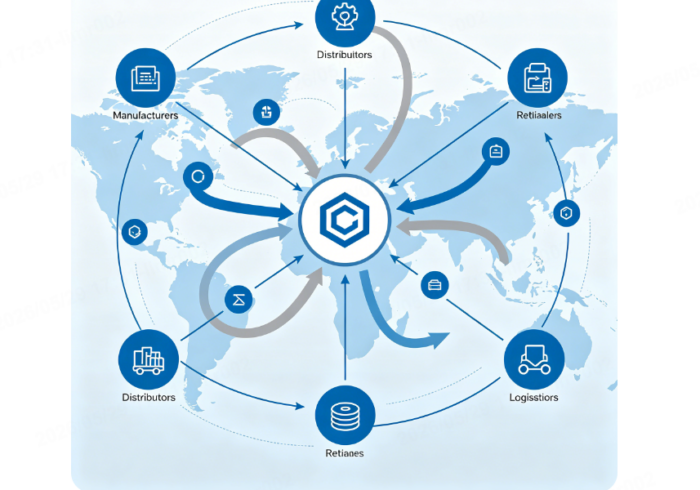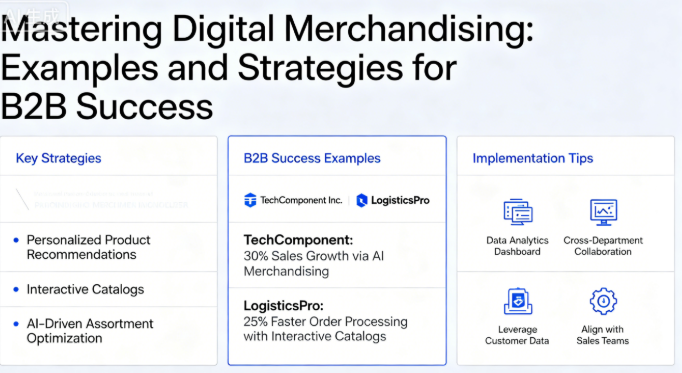
In today’s competitive B2B landscape, a website is far more than a digital brochure. It is your most valuable sales representative, operating 24/7 across borders. Digital merchandising has evolved from simple visual aesthetics into a sophisticated, data-driven science that dictates how products are presented, discovered, and purchased online.
For brands, wholesalers, and manufacturers, leveraging effective digital merchandising examples is the difference between a high-bounce-rate landing page and a high-conversion procurement portal.
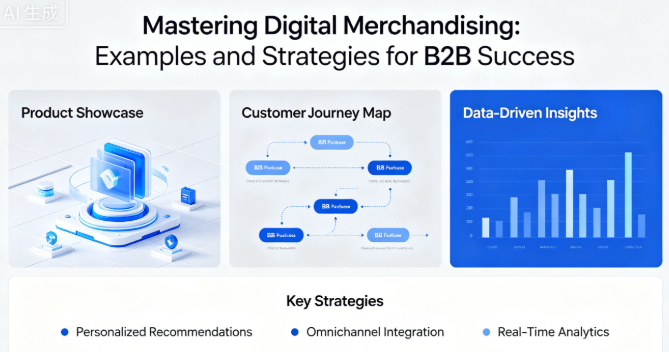
Table of Contents
What is Digital Merchandising?
Digital merchandising is the strategic application of digital technologies to optimize the presentation of products or services. Unlike traditional visual merchandising, which focuses primarily on the “look” of a physical shelf, digital merchandising integrates website design, search functionality, personalized recommendations, and data analytics to build a comprehensive, frictionless customer experience.
In the B2B space, this is crucial. Buyers are not looking for “eye candy”; they are looking for accuracy, transparency, and efficiency.
Why Digital Merchandising Matters for B2B
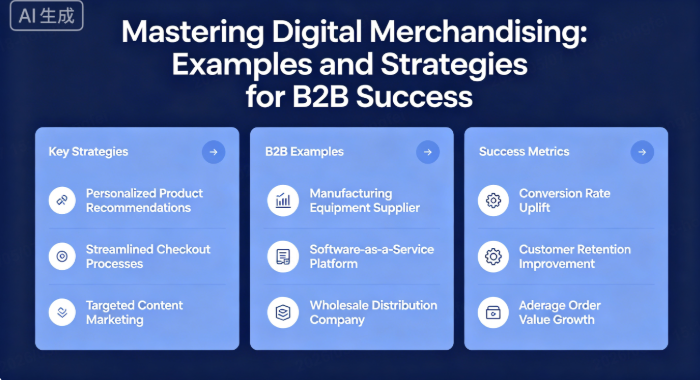
B2B buyers increasingly expect a B2C-like purchasing experience. They demand fast search, rich product data, and intuitive navigation.
- Enhanced Customer Experience (CX): Personalized interfaces reduce the friction often associated with complex B2B ordering.
- Data-Driven Decision Making: Real-time analytics allow you to see exactly which products generate interest, enabling you to optimize inventory display dynamically.
- Market Differentiation: In a crowded global market, superior presentation sets your brand apart as a premium, reliable partner.
- Operational Efficiency: Automated merchandising tools—like PIM (Product Information Management) systems—ensure that product data is consistent across all sales channels.
Proven Digital Merchandising Examples and Strategies
To truly excel, businesses must move beyond static catalogs. Here are key digital merchandising examples and tactics that drive results:
1. Personalized Product Recommendations (AI-Driven)
Leverage AI engines that analyze browsing history and purchase data. If a B2B buyer frequently purchases specific raw materials, the platform should automatically highlight compatible components or “frequently bought together” bundles.
2. Visual Storytelling and “Product Touching”
Use high-resolution 360-degree views, augmented reality (AR) for equipment sizing, or interactive exploded-view diagrams. This helps buyers “experience” the product, reducing returns and increasing purchase confidence.
3. Strategic Product Placement and Hierarchy
Just as in a physical warehouse, the items you want to push should be the most visible. Use a compelling visual hierarchy—place trending products, high-margin items, or regional best-sellers in the most prominent positions on the homepage or category pages.
4. Shoppable Content
Integrate product links directly into your educational content, blog posts, or social media updates. This reduces the number of clicks a user takes from “discovery” to “checkout.”
The LooperBuy Advantage: Streamlining Global Sourcing
For businesses navigating global B2B procurement, platforms like LooperBuy exemplify modern digital merchandising efficiency.
- Global Accessibility: By bridging the gap between global buyers and Chinese manufacturers, LooperBuy ensures that distance is no barrier to high-quality sourcing.
- Diverse Product Inventory: A wide catalog is useless without proper organization. LooperBuy utilizes advanced filtering and search algorithms that act as a digital “assistant,” helping buyers find specific categories or specs instantly.
- Logistics & Pricing Transparency: Digital merchandising isn’t just about the product; it’s about the transaction. Displaying transparent logistics costs and competitive pricing at the point of decision is a core component of successful B2B merchandising.
Implementation Guide: 5 Steps to an Effective Strategy
| Phase | Strategy | Benefit |
|---|---|---|
| 1. Define Goals | Set clear KPIs (e.g., Conversion Rate, AOV) | Keeps the team focused on ROI |
| 2. Conduct Research | Analyze competitor site navigation & gaps | Identifies your unique market advantage |
| 3. Optimize Content | Implement structured, rich product data | Improves searchability and buyer trust |
| 4. Personalize CX | Utilize AI-driven recommendations | Increases cross-selling potential |
| 5. Analyze & Refine | Review heatmaps & conversion funnels | Continuous improvement loop |
Expert Insights: Bridging the Gap
Industry experts emphasize that the future of merchandising lies in headless commerce. By decoupling the front-end (what the customer sees) from the back-end (the core commerce engine), companies can experiment with merchandising tactics—like custom landing pages for specific B2B client tiers—without disrupting the underlying inventory systems.
“Digital merchandising is not merely visual; it is the art of predictive convenience. You must show the right product, to the right buyer, at the precise moment of intent.”
Conclusion
Digital merchandising is a mandatory discipline for any B2B business aiming to scale globally. By focusing on intuitive navigation, AI-powered personalization, and transparent product presentation—as evidenced by platforms like LooperBuy—you can create an environment where buyers feel empowered and confident. Start by auditing your current site, identifying the biggest friction points, and implementing these proven strategies to watch your conversion rates climb.
Ready to streamline your global sourcing? Visit LooperBuy today to experience a platform designed for modern B2B efficiency.
References
- Virto Commerce: Digital Merchandising – Explanation, Tools, Strategies – Expert guide on core definitions and platform tools.
- Gartner Magic Quadrant for Digital Commerce – Industry standards for ecommerce platform capabilities.
FAQ
1. What is the most important element of digital merchandising for B2B?
Accurate, rich product data (PIM) is the foundation; without it, search and personalization tools cannot function effectively.
2. How do I choose the right digital merchandising tools?
Prioritize tools that integrate seamlessly with your existing ERP or PIM system. Look for “Headless” or API-first architectures for maximum flexibility.
3. Is digital visual merchandising necessary for industrial B2B?
Yes. Even for technical components, high-quality images, technical drawings, and 360-degree views significantly reduce buyer uncertainty.
4. How can I measure the success of my merchandising strategy?
Track key metrics such as Conversion Rate, Average Order Value (AOV), bounce rates on product pages, and the performance of internal site search queries.
5. How does LooperBuy simplify global B2B sourcing?
LooperBuy integrates vast product selection with efficient logistics and competitive pricing, removing the traditional friction points of international procurement.
Brief Article Summary
This article explores the evolution of digital merchandising for B2B brands, providing actionable strategies and examples. Learn how to optimize product discovery, leverage AI-driven personalization, and implement best practices to drive global sales efficiency in the competitive B2B market.
Hot tags: B2B E-commerce Strategy, Digital Merchandising, B2B Sourcing Platform, Global Procurement, Supply Chain Efficiency, Headless Commerce, AI Product Recommendations, Wholesale Distribution, B2B Customer Experience, Industrial Sourcing Solutions.