A practical guide to how B2E (business‑to‑employee) thinking is transforming B2B procurement. Learn how global sellers can use platforms like LooperBuy to centralize China sourcing, cut warehousing and logistics costs, and give internal teams a more powerful digital workspace.
As someone who has spent the last decade helping global merchants source from China and build digital procurement workflows, I’ve seen a clear shift: the platforms that win are no longer just “marketplaces” for suppliers and buyers, but employee‑centric ecosystems that make internal teams faster, safer and more aligned. In this article, I’ll unpack how B2E thinking (business‑to‑employee) is reshaping B2B procurement, and how platforms like LooperBuy help global sellers reduce inventory risk, warehousing cost and logistics complexity while keeping internal teams in control. [looperbuy]
Table of Contents
What business‑to‑employee really means today
B2E (business‑to‑employee) describes the strategies and digital tools a company uses to support, inform and empower its employees in their daily work. It started with simple intranets and HR portals and has evolved into integrated environments that combine HR systems, training, communication tools and analytics.
Modern B2E environments typically include intranet portals, onboarding sites, employee self‑service (ESS) portals, learning management systems (LMS), collaboration tools and engagement platforms. The underlying goal is simple: give employees a single, coherent digital workplace where they can access information, complete tasks and collaborate without friction.
These concepts matter far beyond HR. When you re‑imagine your B2B procurement platform through a B2E lens, you stop thinking of it only as a place to place orders and start treating it as a productivity hub for your global sourcing, merchandising and operations teams. [bigcommerce.com]
B2E, B2B and B2C: three models, one shared infrastructure
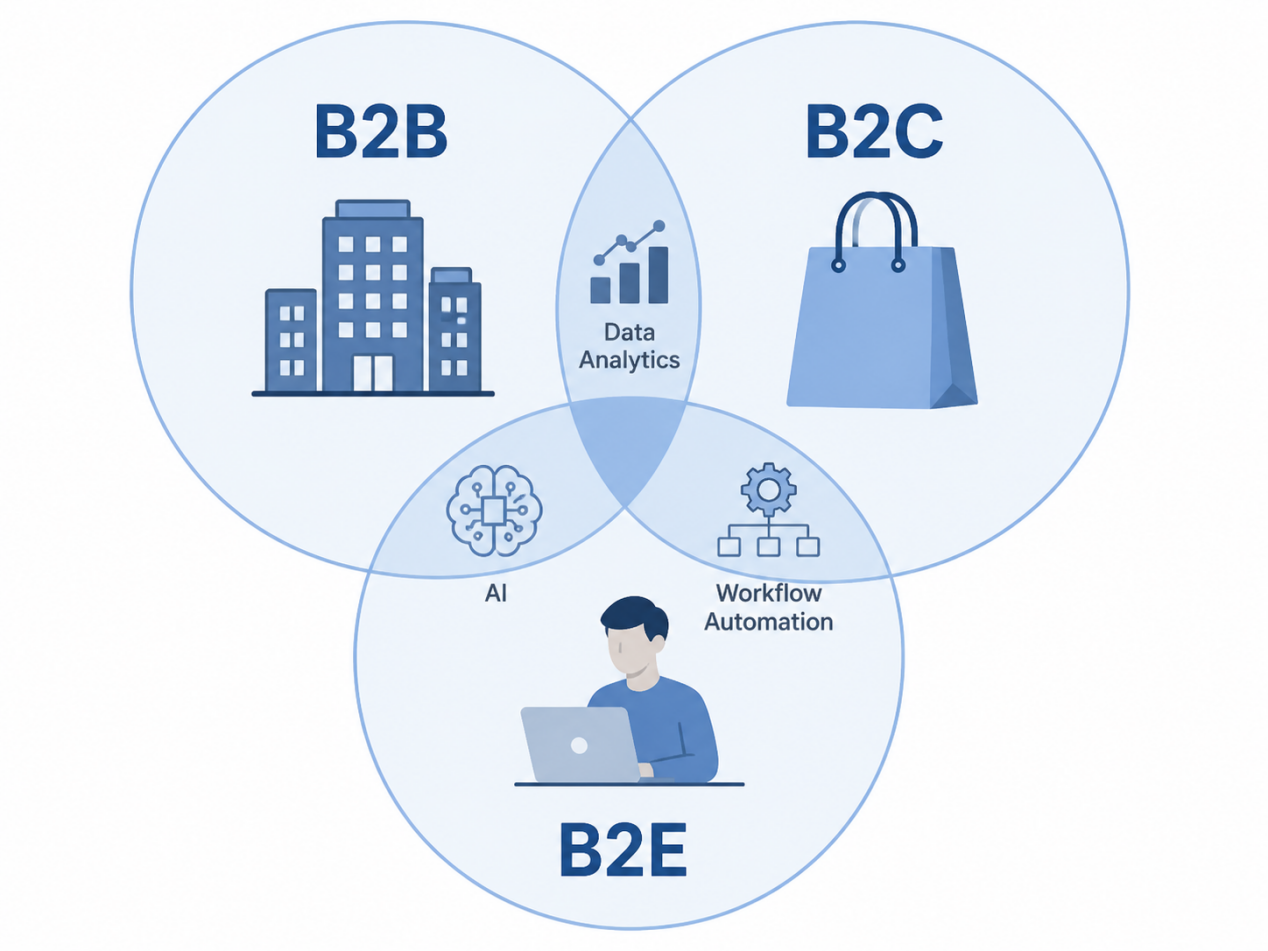
Although B2E, B2B and B2C serve different audiences, they increasingly share the same digital backbone. B2B platforms target business buyers, B2C targets end consumers, and B2E focuses on employees – but the same technologies (personalization, AI, data analytics, workflow automation) run across all three.
In B2B procurement, the most effective platforms often combine:
– B2B capabilities – catalog management, contract pricing, order workflows and payment terms for business buyers. [bigcommerce.com]
– B2C‑style experiences – intuitive search, rich product content, transparent shipping and simple checkout borrowed from consumer commerce. [smartling]
– B2E features – internal approval flows, role‑based access, training and reporting for procurement, finance and operations teams.
A cross‑border sourcing platform like LooperBuy sits at this intersection: externally it serves global merchants sourcing from China, while internally it becomes a control center for your team to manage sourcing, orders, warehousing and fulfillment in one place. [linkedin]
Core B2E solution types and what they mean for procurement
The classic B2E stack includes several solution types that can directly strengthen your procurement and sourcing workflows. When you translate them into a B2B context, they become powerful levers for margin, speed and risk management.
1. Intranet and self‑service portals for sourcing teams
Traditional employee self‑service portals allow staff to update personal data, view payroll and manage time‑off without HR intervention. In a sourcing‑driven company, the same concept can power:
– A single internal portal to access sourcing guidelines, approved supplier lists and compliance rules.
– Role‑based dashboards for buyers, operations and finance, so each team sees the data and tools they need.
– Self‑service access to standard documents (PO templates, quality checklists, packaging standards).
This reduces internal email chains and makes your sourcing decisions more consistent and auditable. [bigcommerce.com]
2. Learning management for cross‑border trade skills
LMS platforms centralize courses, webinars and training content with tracking and certification features. For companies sourcing from China or other manufacturing hubs, internal LMS content can cover:
– Product compliance and safety standards in target markets.
– Cross‑border tax and duty basics for new hires.
– How to assess factory capabilities, sample quality and production risk.
Some leading HCM suites (like SAP SuccessFactors, Workday and Zoho People) already embed this kind of training into employee journeys, showing how closely learning and operational performance are linked.
3. Collaboration and feedback tools
Chat platforms, project management tools and feedback systems are classic B2E components. In B2B procurement, they help you:
– Coordinate product sourcing cycles, sampling, pricing and launch timelines across distributed teams.
– Capture on‑the‑ground feedback from sales and customer support about product quality or recurring issues.
– Turn that feedback into structured tasks for your suppliers or sourcing partners.
When these capabilities are integrated with your external platform (for example, inside a procurement cockpit linked to LooperBuy), your employees can move from chat to action without switching systems. [looperbuy]
What leading B2E platforms teach us about employee‑centric procurement
Enterprise B2E and HCM suites such as SAP SuccessFactors, Oracle PeopleSoft, Workday, Salesforce and Microsoft Dynamics 365 share a few design principles that B2B procurement platforms can emulate.
Here is a simplified view of how those platforms position themselves and what that implies for your procurement tech stack:
| Platform | Primary focus | Key lesson for B2B procurement teams |
| SAP SuccessFactors | Comprehensive HCM, payroll, learning | Treat sourcing skills and compliance knowledge as core assets worth ongoing training and analytics. |
| Oracle PeopleSoft | Deep, configurable HR and benefits | Complex organizations need highly configurable workflows and approval chains. |
| Workday | HCM plus financials with AI | Use analytics and AI to predict demand, skills gaps and process bottlenecks. |
| Salesforce | Collaboration and learning (Chatter, Trailhead) | Blend communication, training and execution into a single environment. |
| Microsoft Dynamics 365 | ERP, CRM and HR in one family | Integration across finance, sales and procurement avoids data silos. |
These platforms show that employee productivity, data connectivity and configurability are non‑negotiable in modern enterprise software. When you evaluate or design a B2B procurement platform, you should expect the same standards:
– Unified data across sourcing, inventory, logistics and finance.
– Role‑based views for employees in different regions and functions.
– Configurable workflows, not hard‑coded one‑size‑fits‑all processes.
Why B2E thinking matters for global China sourcing
From an operations perspective, sourcing from China introduces complexity: long lead times, regulatory differences, quality variance and multiple logistics options. Without a strong B2E layer, this complexity lands directly on your team’s shoulders in the form of manual work, spreadsheets and late‑night calls. [smartbuy.alibaba]
Platforms like LooperBuy aim to remove that burden by combining supplier discovery, order execution, warehousing and global fulfillment in one environment. When your employees can manage product selection, sample requests, order status and shipping options from a single, transparent interface, you get: [linkedin]
– Lower risk of miscommunication with factories and logistics partners.
– Faster onboarding of new team members into your sourcing process.
– Clearer cost structures and margins per SKU, channel and market.
From my experience with B2B merchants, two patterns are common: teams either over‑centralize decisions in a few “hero” employees, or they decentralize without standards and lose control. A B2E‑informed platform helps strike the balance: empowering more people while enforcing consistent rules.
5 practical steps to transform your procurement into a B2E‑driven engine
Drawing on the B2E examples and enterprise platforms above, here is a practical roadmap I recommend when I work with B2B merchants building or adopting platforms like LooperBuy. [looperbuy]
Step 1: Map your internal “users” and roles
Before choosing tools, clarify who actually uses your procurement platform day to day. Typical roles include buyers, product managers, operations, finance, warehouse managers and customer service.
For each role, define:
1. What decisions they make (e.g., MOQ, shipping method, price approvals).
2. What data they need at a glance (e.g., landed cost per unit, defect rate, lead time).
3. What actions they should be able to perform without IT or management help.
This mirrors how B2E portals segment employees and tailor access, but applied to procurement flows.
Step 2: Centralize sourcing and logistics workflows
One of the core advantages of B2E solutions is reducing system‑hopping. For cross‑border sourcing, that means centralizing:
– Product sourcing (specs, images, pricing, MOQ, certification).
– Order placement and change requests.
– In‑warehouse services (inspection, bundling, labeling, repackaging).
– Global shipping options and tracking.
LooperBuy promotes this kind of centralization so your team doesn’t manage suppliers in one tool, warehouses in another and shipments in a third. The closer your internal experience is to a coherent “control tower,” the more time your team can spend on strategy instead of chasing updates. [looperbuy]
Step 3: Create internal playbooks and micro‑training
B2E practices show that organizations with strong internal learning cultures adapt faster. For procurement, translate that into:
– Short internal playbooks on how to evaluate new product opportunities.
– Micro‑courses on how to use your sourcing platform effectively.
– Regular refreshers on quality standards and documentation requirements.
Instead of leaving this to slide decks, consider integrating it as in‑context help and short videos inside the tools your team already uses, similar to how platforms like Trailhead or LMS systems embed learning.
Step 4: Use data to refine decision rules
Leading B2E and HCM suites rely heavily on analytics for workforce planning. You can take the same approach for sourcing and fulfillment by tracking:
– Average lead times by supplier, product category and shipping route.
– Return and defect rates by supplier or warehouse.
– Margin by SKU once all logistics and warehousing costs are included.
Over time, you can codify these insights as rules inside your platform (e.g., “flag suppliers with defect rates above threshold” or “suggest alternative shipping options when deadlines are tight”). This shifts your team from reactive firefighting to proactive risk management. [bigcommerce.com]
Step 5: Align incentives internally around long‑term value
Companies like Southwest Airlines and Starbucks demonstrate how employee‑focused incentives translate into customer‑facing excellence. While your context is different, the principle stands: if your sourcing and operations teams are rewarded solely on short‑term unit cost, they may unintentionally increase quality risk, delay or brand damage.
Consider combining KPIs like:
– On‑time delivery rates.
– Defect and return rates.
– Total landed cost rather than unit price only.
When your platform makes these metrics visible for individuals and teams, and your incentives support them, you create a strong internal feedback loop similar to the cultures described in well‑known B2E case studies.
How a platform like LooperBuy fits into this evolution
From the perspective of a global merchant, the value of a sourcing platform is measured in three things: clarity, efficiency and control. LooperBuy positions itself as a cross‑border sourcing and supply chain platform that connects global merchants with high‑quality Chinese suppliers, offers in‑warehouse services and handles global fulfillment from one place. [instagram]
In practice, this can support your B2E ambitions in several ways:
– Your team gets transparent product and supplier data instead of fragmented quotes and spreadsheets. [linkedin]
– You gain flexible order volumes and warehousing options that reduce the need for heavy inventory and fixed storage. [looperbuy]
– You offload logistics and after‑sales complexity while keeping visibility, so your employees focus on assortment, branding and customer relationships. [instagram]
For many B2B sellers, this combination of external supply‑chain capabilities and internal usability is what unlocks scalable growth without exponentially growing headcount.
Turn your procurement platform into your team’s favorite tool
If your team still juggles sourcing emails, supplier chats, spreadsheets and separate logistics portals, you are paying a hidden tax in time, errors and missed opportunities. A new generation of B2B platforms is closing that gap by merging sourcing, warehousing and fulfillment with employee‑centric design.
If you are exploring ways to reduce inventory risk and logistics overhead while giving your team a clearer, more powerful workspace, consider piloting a centralized China‑sourcing platform such as LooperBuy and mapping your internal B2E needs into its workflows. Start with one product line or region, measure the impact on lead time and internal workload, and then scale what works. [linkedin]
FAQs
1. What is the main goal of B2E in a procurement context?
The primary goal is to give procurement, sourcing and operations teams a unified environment that simplifies their daily work, improves visibility and reduces manual coordination across suppliers, warehouses and logistics partners. [bigcommerce.com]
2. How does a sourcing platform help reduce warehousing costs for B2B sellers?
By offering flexible storage, bundling and just‑in‑time fulfillment, a sourcing platform can help merchants avoid over‑stocking and heavy fixed warehouse contracts while still meeting delivery expectations. [looperbuy]
3. Are B2E concepts only relevant for large enterprises?
No. While early adopters were large organizations, mid‑sized and fast‑growing B2B sellers increasingly rely on similar principles—centralized portals, training and analytics—to scale without chaos. [getbalance]
4. How does LooperBuy support global teams specifically?
LooperBuy provides global merchants with access to verified Chinese suppliers, in‑warehouse services and international fulfillment, allowing distributed teams to manage sourcing and delivery from one platform instead of multiple disconnected tools. [instagram]
5. What should I prioritize if I’m just starting to digitize my procurement?
Begin by mapping roles and workflows, then centralize product and supplier data in a single platform that supports order tracking, warehousing and shipping, and finally layer in training and analytics once your core processes are stable. [bigcommerce.com]
References
– Virto Commerce. “The Ultimate B2E Guide with Solutions and Real‑World Examples.” [Link]
– LooperBuy. “B2B China Sourcing Platform & Dropshipping Solutions.” [looperbuy]
– LooperBuy Official LinkedIn Page. “LooperBuy Company Overview.” [linkedin]
– LooperBuy Instagram. “LooperBuy (@looper_official_).” [instagram]
– BigCommerce. “Optimizing B2B Procurement for the Future (2025).” [bigcommerce.com]
– Smartling. “7 Best International Ecommerce Solutions for Global Growth in 2026.” [smartling]
– SmartBuy Alibaba. “What Is the Best B2B Platform for Global Sourcing in 2024?” [smartbuy.alibaba]