Can a B2B manufacturing sourcing company help build a private label brand? Learn how supplier matching, product customization, quality control, inventory consolidation, and global fulfillment can help B2B sellers source from China, reduce operational complexity, and launch differentiated branded products.
A capable B2B manufacturing sourcing company can be one of the most practical partners for building a private label brand—especially when you want to source from China without managing every factory conversation, product inspection, packaging revision, payment process, warehouse operation, and international shipment yourself.
For many emerging retailers, marketplace sellers, wholesalers, and DTC businesses, the challenge is not simply finding a low-cost product. It is building a repeatable supply chain that delivers the right product, under the right brand, at a quality level customers will trust. A private label sourcing partner can help bridge that gap by coordinating supplier discovery, sample development, customization, quality control, inventory handling, and fulfillment.
The opportunity is substantial. U.S. retail e-commerce sales reached approximately $340.2 billion in the second quarter of 2026, accounting for 17.1% of total retail sales and increasing 12.2% year over year, reinforcing the importance of differentiated products and stronger brand ownership for online sellers.
Table of Contents
What Is a Private Label Brand?
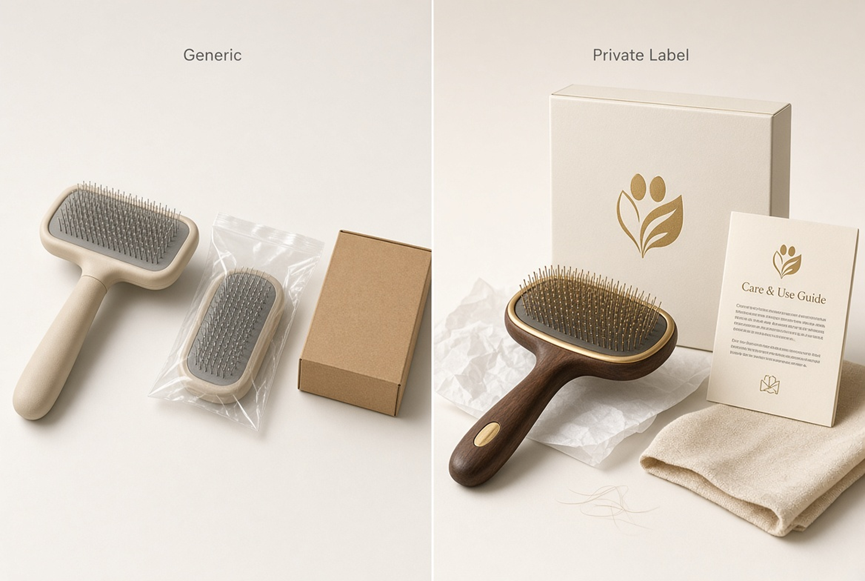
A private label brand sells products manufactured by another company but marketed under the seller’s own brand name. Instead of competing only on price with identical generic products, the seller can create a distinct offer through product features, packaging, labeling, positioning, bundles, customer service, and brand storytelling.
For example, a seller may source a standard insulated water bottle from a manufacturer, then turn it into a private label product by adding:
– A custom logo and color palette
– Branded retail packaging
– A redesigned lid or accessory
– A bundle with a cleaning brush or carrying pouch
– Product inserts, user guides, or warranty cards
– A differentiated product page and customer support experience
The manufacturer makes the item. The brand owner decides how the item should look, who it is for, what problem it solves, and how it reaches the customer.
This model can apply to a wide range of categories, including:
– Home and kitchen products
– Beauty tools and personal-care accessories
– Pet supplies
– Sports and outdoor equipment
– Consumer electronics accessories
– Office products
– Packaging materials
– Fashion accessories
– Automotive accessories
– Seasonal and gift products
A private label strategy does not always require inventing an entirely new product. In many cases, success comes from identifying an underserved customer need and improving an existing product with thoughtful customization.
Why a Sourcing Company Matters
A B2B manufacturing sourcing company can make private label development more manageable because it acts as an operating bridge between the brand and multiple suppliers.
Direct factory sourcing can work well for experienced importers. However, it often requires considerable time, local market knowledge, quality-control capability, language support, negotiation experience, and logistics coordination. A sourcing partner helps centralize these tasks.
For a growing brand, the value is often not just access to factories. It is access to a more organized decision-making process.
| Private Label Challenge | How a Sourcing Company Can Help |
| Finding suitable factories | Identifies manufacturers based on category, customization capability, MOQ, certifications, and production capacity |
| Comparing supplier quotations | Helps compare unit prices, tooling fees, packaging costs, lead times, and shipping terms |
| Communicating specifications | Converts product requirements, artwork, materials, dimensions, and packaging needs into factory-ready instructions |
| Managing samples | Coordinates prototypes, revisions, sample approvals, and pre-production confirmations |
| Maintaining quality | Arranges inspections, verifies packaging details, checks quantities, and reports defects before dispatch |
| Consolidating products | Combines goods from different suppliers into one shipment or fulfillment workflow |
| Handling international fulfillment | Supports storage, order processing, shipping, tracking, and delivery coordination |
| Reducing operational burden | Helps sellers avoid building an in-house China sourcing, warehousing, and export logistics team too early |
At Looperbuy, this type of support can be especially useful for global B2B sellers that want to reduce the cost of holding inventory, managing warehousing, processing supplier payments, or coordinating international logistics independently.
A sourcing company cannot replace the brand owner’s market judgment. It can, however, reduce execution friction so the brand owner can spend more time on product selection, positioning, customer acquisition, and retention.
From Generic Product to Brand Asset
The difference between ordinary sourcing and private label sourcing is intentionality.
A generic sourcing transaction focuses on obtaining a product at an acceptable cost. A private label project focuses on building a product that supports a long-term commercial identity.
That requires clear answers to several questions:
– Who is the product designed for?
– What specific customer problem does it solve?
– Why would a buyer choose it over established alternatives?
– Which details make it recognizably yours?
– What quality level must be achieved to protect customer reviews?
– Can the supplier reproduce the product consistently as demand grows?
– Does the item meet the compliance requirements in your target market?
A good sourcing company should help translate these commercial questions into practical supplier requirements.
For instance, “I want a premium pet grooming brush” is too vague for a factory. A stronger product brief might specify:
– Target customer: Owners of long-haired dogs and cats
– Positioning: Mid-premium home grooming tool
– Main issue to solve: Loose fur and uncomfortable pulling
– Material preference: Stainless-steel pins with rounded tips
– Branding: Laser-engraved logo on handle
– Packaging: Recyclable branded box with usage instructions
– First order target: 500 to 1,000 units
– Quality requirement: No loose pins, sharp edges, logo misalignment, or damaged packaging
– Sales channels: Amazon, Shopify store, independent pet retailers
This level of detail helps the sourcing partner identify factories that can realistically meet the brief.
Core Services That Support Brand Building
Supplier Discovery and Factory Matching
The first critical step is finding manufacturers that fit your actual business model—not simply factories with attractive product photos.
A suitable supplier should be assessed against factors such as:
– Product specialization
– Manufacturing capacity
– Customization options
– Minimum order quantity
– Sample lead time
– Production lead time
– Quality systems
– Export experience
– Communication reliability
– Material traceability
– Compliance documentation
– Willingness to support future scaling
Not every supplier is equally appropriate for every stage of a brand. A large factory with a high MOQ may offer excellent pricing but may not suit a business testing its first product. A smaller, more flexible factory may be better for early validation, even if the unit cost is slightly higher.
Industry guidance on private label sourcing emphasizes defining required supplier capabilities first, screening candidates, comparing proposals, validating samples, assessing facilities or processes, negotiating terms, and approving the final supplier only after qualification.
Product Customization and Packaging Development
A sourcing company can help manage the practical work behind customization. This may include:
– Logo application
– Custom colors
– Material choices
– Mold or tooling discussions
– Product dimensions
– Label content
– Barcode placement
– Retail packaging
– Carton marking
– Inserts and instruction manuals
– Bundled accessories
For early-stage brands, packaging is often underestimated. Yet it can strongly influence perceived value, unboxing experience, product protection, marketplace compliance, and review quality.
A branded box alone does not create a brand. But poor packaging can quickly damage one. If the product arrives scratched, crushed, incomplete, or difficult to understand, the customer will evaluate the brand—not the factory.
Quality Control Before Goods Leave China
Quality problems become much more expensive once products reach a destination warehouse or final customer. Returns, chargebacks, replacement shipments, negative reviews, and marketplace account risks can quickly erase the savings gained from a lower factory price.
A sourcing company can coordinate checks at several stages:
1. Sample inspection before production approval
2. Pre-production confirmation of materials, artwork, color, and packaging
3. During-production checks for higher-risk or larger orders
4. Pre-shipment inspection before final payment or dispatch
5. Warehouse verification when consolidating goods from several suppliers
For products with regulatory, safety, cosmetic, food-contact, electrical, or child-use implications, quality control should also include document review and appropriate testing plans.
Supplier-verification guidance recommends requesting product-specific documentation, reviewing independent audit records, conducting practical test orders, and ensuring contracts define measurable quality expectations and responsibility for failures.
Inventory Consolidation and Fulfillment
Many private label brands eventually source more than one item, accessory, or packaging component. Without coordination, a seller may receive separate deliveries from several factories and face unnecessary freight, storage, and handling costs.
A sourcing and fulfillment company can help by:
– Receiving goods from multiple suppliers
– Checking inbound quantities
– Combining products into kits or bundles
– Adding branded inserts
– Repacking orders
– Holding inventory closer to demand
– Shipping to a third-party warehouse, marketplace fulfillment center, retailer, or end customer
– Providing tracking and delivery coordination
This is particularly useful for sellers using hybrid models: keeping core inventory for fast-moving items while using smaller, more flexible replenishment cycles for testing, seasonal products, or new launches.
A Practical Private Label Workflow
Below is a structured process that can help a B2B seller move from product idea to market launch.
1. Define the Commercial Opportunity
Before requesting quotes, clarify the product’s market role.
Ask:
– Is demand stable, seasonal, or trend-driven?
– Who is the buyer?
– What price range can the market support?
– What complaints do competing products receive?
– Which feature, material, design, or service improvement could matter?
– What margin is required after product cost, shipping, marketplace fees, advertising, taxes, and returns?
A sourcing company can help with feasibility, but it should not be asked to guess your customer strategy. The brand owner should bring a clear commercial direction.
2. Create a Product Requirement Sheet
A concise requirement sheet reduces misunderstanding and speeds up supplier matching.
Include:
– Product name and category
– Reference images or drawings
– Target dimensions and materials
– Desired product functions
– Logo format and placement
– Packaging requirements
– Quantity target
– Target price range
– Destination market
– Required standards or certificates
– Target production timeline
Tip: Use measurable specifications whenever possible. “Strong material” is subjective; “304 stainless steel, 0.8 mm thickness” is easier to verify.
3. Request Quotes From Comparable Suppliers
The lowest quote is rarely the best choice by default. Compare quotations on a like-for-like basis.
Make sure each supplier quote includes:
– Unit price
– MOQ
– Sample cost
– Mold or tooling cost
– Logo and printing cost
– Packaging cost
– Carton details
– Production lead time
– Payment terms
– Incoterms
– Quality terms
– Certification or testing availability
A sourcing company can help normalize these comparisons. This matters because a supplier may offer a lower unit price while excluding packaging, labeling, inspection, or domestic delivery charges.
4. Test Samples Before Committing
Never rely only on catalog images, chat messages, or digital mockups.
Evaluate samples for:
– Material quality
– Product performance
– Weight and dimensions
– Color accuracy
– Branding placement
– Packaging durability
– Ease of use
– Odor, scratches, loose parts, or visible defects
– Compatibility with your target market’s standards
If the product will be sold online, test it as a real customer would. Open the package. Use it repeatedly. Photograph it. Compare it against competitor products. Ask several people who match your target audience for feedback.
5. Approve a Golden Sample
A golden sample is the approved reference product used to guide production and inspection.
It should capture the final decisions on:
– Materials
– Function
– Color
– Logo treatment
– Packaging
– Accessories
– Labeling
– Product dimensions
– Defect tolerance
Keep written approval records. If the factory later produces goods that differ from the accepted sample, you have a clearer basis for corrective action.
6. Build Quality and Delivery Controls
Before mass production starts, agree on:
– Acceptable defect standards
– Inspection timing
– Rework procedures
– Packaging requirements
– Delivery date
– Payment schedule
– Shipping handover point
– Remedies for material deviations or significant delays
For new suppliers, a smaller pilot order can reveal communication issues, production weaknesses, packaging problems, and logistics gaps before you place a larger purchase order.
7. Use Fulfillment to Protect Cash Flow
Private label brands often fail because they over-order too early. A product may look promising, but actual demand can be slower than forecast.
A flexible sourcing and fulfillment model can help you:
– Start with a controlled order quantity
– Reorder based on proven sales data
– Consolidate replenishment shipments
– Avoid unnecessary warehouse commitments
– Test adjacent variations before scaling
– Use direct fulfillment options where appropriate
The goal is not to eliminate inventory entirely. It is to hold inventory deliberately and avoid tying up cash in products that have not yet proven demand.
How to Choose the Right Sourcing Partner
Not all B2B sourcing companies provide the same level of support. Some focus mainly on finding products. Others provide more complete supplier management, quality coordination, warehousing, and shipping services.
Evaluate a partner using the following criteria.
| Evaluation Area | Questions to Ask |
| Category experience | Have they sourced similar products or worked with comparable manufacturing processes? |
| Supplier network | How do they identify, screen, and compare factories? |
| Transparency | Will they provide clear quotation breakdowns, progress updates, product photos, and inspection reports? |
| Quality process | What checks are completed before goods are shipped? |
| Customization support | Can they handle artwork, packaging, labels, product variations, and factory communication? |
| Logistics capability | Can they consolidate goods, store inventory, prepare orders, and coordinate international delivery? |
| Compliance support | Can they help obtain supplier documents, product test reports, or relevant certification information? |
| Communication | Is there a dedicated contact person who can respond clearly and consistently? |
| Scalability | Can the process support both small trial orders and larger repeat orders? |
Red Flags to Watch For
Be cautious if a potential partner:
– Promises unrealistically low pricing without specification details
– Avoids discussing quality standards
– Cannot explain how suppliers are verified
– Pushes for immediate full payment without sample confirmation
– Provides vague production timelines
– Refuses to share inspection evidence
– Cannot distinguish between a trading company and a manufacturer
– Gives inconsistent answers about materials, certificates, or customization
Reliable private label sourcing depends on documentation, process discipline, and clear communication—not promises alone.
What a Sourcing Company Cannot Do
A sourcing company can improve execution, but it cannot guarantee that a product will become a successful brand.
The brand owner still needs to own several strategic responsibilities:
– Product-market fit
– Brand positioning
– Pricing strategy
– Product listing quality
– Advertising and content
– Customer service
– Marketplace compliance
– Review management
– Demand forecasting
– Intellectual property strategy
Think of the sourcing company as an operational partner, not a substitute for brand building.
The strongest results usually come when both sides have defined responsibilities. The brand brings customer insight and commercial direction. The sourcing partner brings supplier access, procurement discipline, quality coordination, warehousing, and delivery execution.
A Smarter Way to Launch
For a first private label launch, avoid trying to build a large catalog immediately. Start with one focused product or a small product family that serves a clearly defined customer need.
A practical first-launch approach is:
1. Choose a product with clear demand and room for improvement
2. Create a specific product and packaging brief
3. Compare several suitable suppliers, not just the cheapest option
4. Test samples carefully
5. Place a controlled pilot order
6. Inspect quality before dispatch
7. Launch with strong product education and customer support
8. Use actual sales, return, and review data to guide the next order
This approach may feel slower than ordering a large quantity of generic products. In reality, it can reduce costly mistakes and create a stronger foundation for repeat sales.
Build Your Private Label Supply Chain With Looperbuy
A B2B manufacturing sourcing company can absolutely help build a private label brand when it provides more than product links and price quotes. The right partner supports supplier selection, customization, sample management, quality control, inventory coordination, and fulfillment—while giving the brand owner better visibility and more control over the customer experience.
For global B2B sellers, Looperbuy can help simplify China product sourcing and fulfillment so you can focus on building a differentiated brand rather than managing every operational detail alone.
Ready to turn a product idea into a market-ready private label offer? Contact Looperbuy to discuss your sourcing requirements, product customization needs, inventory plan, and global fulfillment workflow.
FAQs
1. Can a small business create a private label brand?
Yes. Small businesses can begin with a focused product, a controlled initial order, and a supplier that accepts manageable minimum order quantities. The key is to validate product demand before committing too much capital to inventory.
2. What is the difference between white label and private label?
White label products are typically standardized products that multiple sellers can brand and resell. Private label products are created or customized specifically for one retailer or brand, often with exclusive packaging, specifications, product features, or design choices.
3. How much money do I need to start a private label brand?
The required budget varies by product category, MOQ, customization level, certifications, packaging, freight, and sales channel. A simple private label launch may require only a limited test order, while products involving custom molds, regulated materials, or extensive packaging can require much more capital. Build a budget that includes samples, inspection, shipping, taxes, marketing, and a contingency reserve.
4. Should I source directly from a factory or use a sourcing company?
Direct factory sourcing can be suitable if you have reliable suppliers, product expertise, strong quality-control processes, and experience with import logistics. A sourcing company is often more practical when you need help identifying suppliers, communicating requirements, managing samples, inspecting goods, consolidating products, or fulfilling orders internationally.
5. How can I protect my private label brand when sourcing from China?
Use clear product specifications, documented artwork approvals, supplier agreements, consistent quality inspections, and formal ownership records for your trademarks and designs where applicable. Avoid sharing unnecessary proprietary information until you have assessed the supplier and established appropriate commercial protections.
6. Can a sourcing company help with custom packaging?
Yes. Many sourcing partners can coordinate packaging design specifications, box printing, labels, inserts, barcode placement, carton markings, and package assembly. Confirm the exact packaging requirements before production begins and approve a physical packaging sample whenever possible.
7. Is dropshipping suitable for private label products?
It can be suitable for testing selected products or serving international customers, but private label dropshipping requires consistent packaging, dependable inventory availability, accurate order processing, and quality checks. Brands should ensure that every customer receives the intended branded experience, regardless of fulfillment location.
References
1. U.S. Census Bureau. [Quarterly Retail E-Commerce Sales Report].
2. Umbrex. [Sourcing, Supplier Selection, and Cost Management].
3. Alibaba.com. [How to Choose the Best Private Label Wholesale Supplier].
4. U.S. Food and Drug Administration. [Importing FDA-Regulated Products].
5. European Commission. [Product Safety and Market Surveillance].
6. International Chamber of Commerce. [Incoterms® Rules].

-700x490.png)