Discover leading garment manufacturers in Bangladesh and learn how to source apparel more confidently. This practical buyer’s guide covers supplier strengths, knitwear, denim and wovenwear capabilities, quality control, responsible sourcing checks, factory verification, and flexible fulfillment options for global sellers.
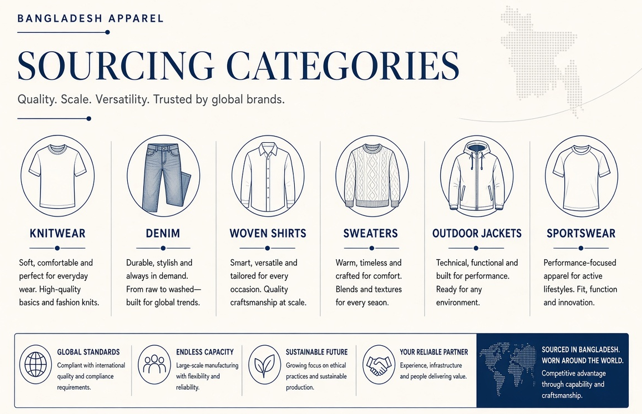
Bangladesh remains one of the world’s most important apparel-sourcing destinations for brands, wholesalers, retailers, and online sellers. For buyers evaluating garment manufacturers in Bangladesh, the opportunity is clear: deep production capacity, strong capabilities in knitwear and woven apparel, established export infrastructure, and a growing base of factories investing in safety and environmental performance.
But a “top” Bangladesh clothing manufacturer is not simply the largest factory or the supplier with the lowest quoted FOB price. In my experience working with cross-border sourcing teams, the best supplier is the one whose product specialization, capacity, compliance evidence, communication, quality-control process, and delivery model match your actual business needs.
Bangladesh’s apparel exports reached approximately US$38.82 billion in 2025, according to BGMEA export-performance data. That scale makes the country highly competitive for global buyers—but it also means supplier selection must be systematic rather than based on a catalogue, a low initial quotation, or a brand-name customer list alone.
Table of Contents
Why Bangladesh Is a Major Apparel Sourcing Hub
Bangladesh has built a global position around ready-made garments (RMG), particularly in categories where production scale, repeatability, and labor-intensive construction matter. Buyers commonly source basics, fashion knitwear, denim, shirts, outerwear, sweaters, sportswear, and private-label collections from the country.
For international buyers, the core advantage is not merely cost. It is the maturity of the production ecosystem.
Key sourcing strengths
– High-volume apparel capacity for established and repeat product lines
– Strong specialization in knitwear, woven garments, denim, sweaters, and outerwear
– Extensive experience serving international retailers and brand supply chains
– A large, export-oriented factory base with established sourcing, production, and shipping workflows
– Growing investment in green buildings, energy efficiency, and workplace-safety programs
– A supplier landscape ranging from vertically integrated groups to specialized cut-and-sew factories
The Bangladesh RMG Sustainability Council (RSC) states that its workplace-safety programs cover more than 1,800 RMG factories and include initial, follow-up, and verification inspections. This makes RSC information an important due-diligence checkpoint for buyers—but it should never replace a buyer’s own factory assessment and quality-control plan.
What Bangladesh may be best for
| Product category | Typical sourcing fit | Buyer consideration |
| T-shirts and polos | Excellent for scalable knitwear programs | Confirm fabric weight, shrinkage standards, and color consistency |
| Sweatshirts and fleece | Strong for seasonal and evergreen basics | Review brushed-fleece quality and pilling performance |
| Denim jeans and jackets | Strong supplier base and laundry capability | Approve wash samples and test repeatability by production lot |
| Woven shirts and trousers | Suitable for private label and retail programs | Clarify construction details, trim sourcing, and measurement tolerances |
| Sweaters and knit tops | Strong technical opportunity | Confirm yarn composition, gauge, hand feel, and care requirements |
| Activewear and outdoor apparel | Available through specialized suppliers | Validate technical fabric, bonding, seam, and performance-testing capabilities |
10 Notable Garment Manufacturers in Bangladesh
The following companies are frequently identified as prominent Bangladesh apparel manufacturers. This list is a starting point for supplier research, not an endorsement, ranking, or guarantee of current capacity, compliance, or willingness to accept your order. Buyers should independently validate every commercial and operational claim before placing production.
1. Beximco Fashions Limited
Beximco Fashions Limited, part of the Beximco Group, is known for woven and knit apparel for men, women, and children. The company’s export orientation and broad product mix make it relevant for buyers seeking a large-scale supplier with experience serving overseas markets.
Best-fit buyer: Retailers or established brands seeking diverse apparel categories and structured manufacturing support.
2. DBL Group
DBL Group is a diversified textile and apparel group with capabilities spanning knitwear, woven garments, sweaters, denim, and sportswear. Its broad category coverage can be useful for buyers who prefer to consolidate multiple product programs with one supplier group.
Best-fit buyer: Brands that need multi-category sourcing and may benefit from a larger, integrated manufacturing partner.
3. Epic Group
Epic Group has significant Bangladesh operations and is widely associated with woven apparel production, including shirts, trousers, jackets, and outerwear. Buyers considering structured woven programs should assess its product-development process, approved material options, and order-volume requirements.
Best-fit buyer: Fashion retailers and apparel brands with repeat woven-garment programs.
4. Ha-Meem Group
Ha-Meem Group is a large Bangladesh apparel manufacturer with production across denim, knitwear, woven garments, and sweaters. Its scale can be attractive for high-volume programs, especially where buyers need manufacturing continuity across several product categories.
Best-fit buyer: Large-volume buyers requiring denim, casualwear, or multi-season collections.
5. Nassa Group
Nassa Group is an established industrial group with garment-production capabilities across knitwear, woven garments, denim, and lingerie. Its broad manufacturing footprint may suit buyers looking for category flexibility, though each factory’s specific expertise should be reviewed separately.
Best-fit buyer: Buyers building an apparel assortment that spans basics, denim, wovenwear, and intimate apparel.
6. Pacific Jeans Limited
Pacific Jeans Limited is especially recognized for denim production. For buyers, denim sourcing requires more than evaluating the base garment: wash development, chemical management, fit consistency, abrasion placement, and color reproducibility are equally important.
Best-fit buyer: Denim labels, fashion retailers, and sellers seeking jeans, denim jackets, and denim-based collections.
7. Square Fashions Limited
Square Fashions Limited is part of Square Group and is associated with knitwear production. Knitwear buyers should investigate fabric sourcing, knitting capacity, dyeing controls, laboratory testing, and garment-finishing systems rather than judging supplier capability from finished samples alone.
Best-fit buyer: Buyers sourcing T-shirts, polos, sweatshirts, and other knit garments at scale.
8. Tusuka Group
Tusuka Group specializes in woven apparel such as shirts, trousers, jackets, and outerwear. This profile can make it relevant for buyers whose product range depends on detailed sewing, structured silhouettes, or more complex woven construction.
Best-fit buyer: Brands sourcing tailored casualwear, outerwear, and woven private-label collections.
9. Viyellatex Group
Viyellatex Group has a diverse product offering that includes knitwear, wovenwear, sweaters, and denim. It is often associated with sustainability and innovation positioning, but buyers should request current documentation rather than treating past messaging as proof of present performance.
Best-fit buyer: Brands prioritizing product diversity alongside documented environmental and social-management practices.
10. Youngone Corporation
Youngone Corporation is a South Korean multinational with major Bangladesh manufacturing operations. It is known for technical apparel, outdoor products, activewear, and performance-oriented garment programs.
Best-fit buyer: Outdoor, sportswear, and performance-apparel brands with technical quality requirements.
How to Evaluate a Bangladesh Clothing Manufacturer
A supplier’s name, buyer list, or website is only the beginning. The real sourcing work starts when you test whether that factory can repeatedly make your exact product to the required standard.
Use this six-step supplier qualification process
1. Define the product before contacting factories
Prepare a tech pack, size chart, bill of materials, fabric requirements, color references, labeling instructions, packaging specification, target order quantity, target price range, and delivery market.
2. Check category-specific capability
Ask whether the factory makes products similar to yours every month—not whether it has made one similar sample in the past. A factory strong in basic cotton tees may not be the right choice for bonded activewear or enzyme-washed denim.
3. Verify production capacity and MOQ honestly
Ask for monthly capacity by product category, current utilization, development lead time, bulk-production lead time, and minimum order quantity by color, style, and fabric.
4. Request verifiable compliance evidence
Ask for relevant audit reports, certifications, fire and building safety records, wage and working-hour policies, chemical-management procedures, and environmental documentation. Review validity dates and the exact factory address shown on every record.
5. Order a development sample and pre-production sample
A sample proves only that the factory can produce one garment. A pre-production sample confirms the approved standard for bulk manufacturing. Sign off on measurements, fabric, color, trim, print, embroidery, wash, labeling, and packaging.
6. Build quality checks into the purchase order
Specify inspection timing, acceptable quality limits, measurement tolerances, defect definitions, rework responsibilities, payment milestones, and remedies for late or non-conforming goods.
Expert insight: inspect the system, not just the sample
A polished sample can hide production risk. When I assess a supplier for a buyer, I focus on whether the factory has a repeatable system:
– Is fabric inspected before cutting?
– Are measurement points checked during sewing?
– Is there an inline quality-control process?
– Can the factory trace trims, fabric lots, and wash lots?
– Is the final inspection independent from the production team?
– Does the supplier document corrective actions after defects are found?
The goal is not to find a “perfect” factory. It is to choose a factory whose risks are visible, manageable, and contractually controlled.
Responsible Sourcing and Sustainability Checks
Bangladesh’s garment industry has continued to develop its environmental manufacturing base. BGMEA reported that Bangladesh had reached 258 LEED-certified green factories, demonstrating the country’s significant investment in green-building standards within apparel manufacturing.
However, environmental certifications alone do not establish that every product, worker condition, chemical process, or subcontractor meets your requirements. Responsible sourcing requires evidence across multiple areas.
Ask every shortlisted factory for
– The legal entity name and full production address
– Current third-party social-compliance and safety-audit documents
– RSC inspection or remediation status where applicable
– Environmental permits and wastewater-treatment information, especially for dyeing, washing, and denim processing
– Restricted-substances and chemical-management procedures
– Subcontracting policy and written approval process
– Worker grievance channels and policies on working hours, recruitment, and child labor
– Traceability records for key materials, where required by your market or brand policy
Practical rule: Do not rely on a certificate PDF sent by email without checking the issuer, scope, validity date, factory address, and whether it applies to the exact production site that will make your goods.
A Smarter Sourcing Model for Online Sellers
Traditional direct importing can work well for brands with stable demand and larger order volumes. Yet it often creates cash-flow pressure for smaller e-commerce businesses: inventory must be purchased before it is sold, stored before it is shipped, and managed across suppliers and logistics providers.
For online B2B sellers, a more flexible model can reduce operational burden:
– Source proven products or private-label goods from qualified suppliers
– Consolidate multiple SKUs into one purchasing workflow
– Use quality checks before goods enter storage
– Store only the inventory needed for near-term demand
– Ship individual orders or small batches through an integrated fulfillment process
– Track costs across procurement, packaging, fulfillment, and international logistics
This is where a sourcing and fulfillment partner such as Looperbuy can add practical value. Rather than managing supplier communication, payment coordination, warehouse handling, and cross-border order fulfillment separately, sellers can centralize key steps in one operating workflow.
For merchants testing new categories, this can lower exposure to unsold stock and reduce the complexity of coordinating several vendors. It does not eliminate the need for product validation or supplier due diligence—but it can make the execution process more manageable.
Start Sourcing With Greater Control
Bangladesh offers serious opportunities for apparel buyers, particularly in knitwear, wovenwear, denim, sweaters, casualwear, and technical garments. The strongest sourcing decisions combine product-market fit with disciplined supplier verification, documented quality standards, realistic timelines, and an inventory model suited to your cash flow.
If you’re looking to source products from China while reducing your workload in supplier coordination, warehousing, payment processing, and cross-border logistics, Looperbuy can help you build a more flexible sourcing and dropshipping workflow. Start with a clear product brief, validate suppliers carefully, and scale only after your samples, costs, and delivery process are proven.
FAQs
1. Why is Bangladesh popular for garment manufacturing?
Bangladesh is popular because it has a large export-oriented apparel industry, deep experience in knitwear and woven garments, established production capacity, and strong connections to international fashion supply chains. BGMEA’s 2025 data recorded apparel exports of approximately US$38.82 billion.
2. What types of clothing are commonly made in Bangladesh?
Bangladesh manufacturers commonly produce T-shirts, polos, sweatshirts, sweaters, woven shirts, trousers, denim jeans, jackets, outerwear, lingerie, sportswear, and private-label fashion collections. The best factory depends on the exact product construction, fabric, order size, and quality level required.
3. How do I find a reliable garment manufacturer in Bangladesh?
Start with suppliers that have proven experience in your product category. Then verify legal identity, factory address, capacity, audit records, safety information, environmental documentation, sample quality, and production-control systems. Always use written specifications and inspect pre-production and bulk goods.
4. What is a realistic MOQ for Bangladesh garment factories?
MOQ varies widely by factory, fabric, product complexity, and whether the material is custom developed. Large export factories may prefer higher volumes, while some smaller or specialized suppliers may accept lower quantities. Ask for MOQ by style, color, fabric, and size range—not just one general number.
5. Are Bangladesh garment factories sustainable?
Many Bangladesh factories have invested in energy-efficient and green-building initiatives. BGMEA reported 258 LEED-certified green factories, but sustainability should be evaluated factory by factory through current evidence on energy, water, chemicals, wastewater, waste, labor practices, and subcontracting controls.
6. Should I buy directly from a Bangladesh factory or use a sourcing partner?
Direct purchasing can suit buyers with proven demand, technical product knowledge, and the ability to manage quality control, shipping, payments, and inventory. A sourcing partner can be more practical for sellers who want coordinated procurement, consolidation, warehousing, and fulfillment—especially while testing products or managing smaller, more frequent orders.
7. What quality-control checks should I include in a garment order?
Include approved samples, measurement tolerances, fabric and trim specifications, color standards, defect definitions, labeling and packaging requirements, inspection timing, acceptance criteria, corrective-action procedures, and shipping deadlines. For denim, activewear, and technical garments, add relevant wash, performance, and durability tests.
References
1. [Global Sources — Top Garment Manufacturers in Bangladesh] — Source material for the manufacturer overview and category descriptions.
2. [Bangladesh Garment Manufacturers and Exporters Association — Export Performance] — Bangladesh apparel export figures, including 2025 data.
3. [Bangladesh Garment Manufacturers and Exporters Association — Bangladesh Reaches 258 LEED-Certified Green Factories] — Industry-reported LEED green-factory milestone.
4. [RMG Sustainability Council Bangladesh] — Information on workplace-safety programs, factory inspection activities, and verification processes.
5. [Global Sourcing Expo 2025 Dhaka — Apparel Sector] — Context on the apparel sector’s contribution to Bangladesh export revenue and green-factory development.
6. [SAGE Journals — Contesting Corporate Responsibility in the Bangladesh Garment Sector] — Academic context on governance and workplace-safety oversight in Bangladesh’s RMG industry.