
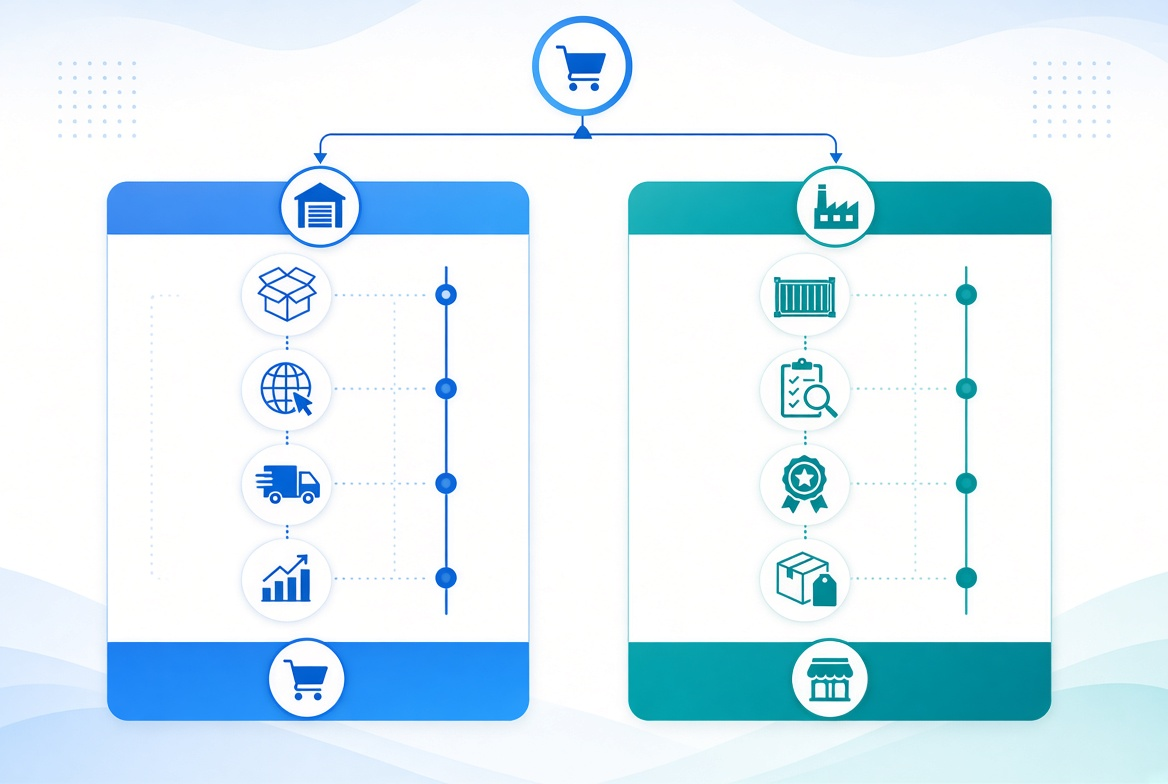
Compare an international sourcing company vs dropshipping supplier to choose the right model for your ecommerce business. Learn the differences in inventory, costs, quality control, branding, shipping, compliance, and scalability—and discover when to move from dropshipping to China sourcing.
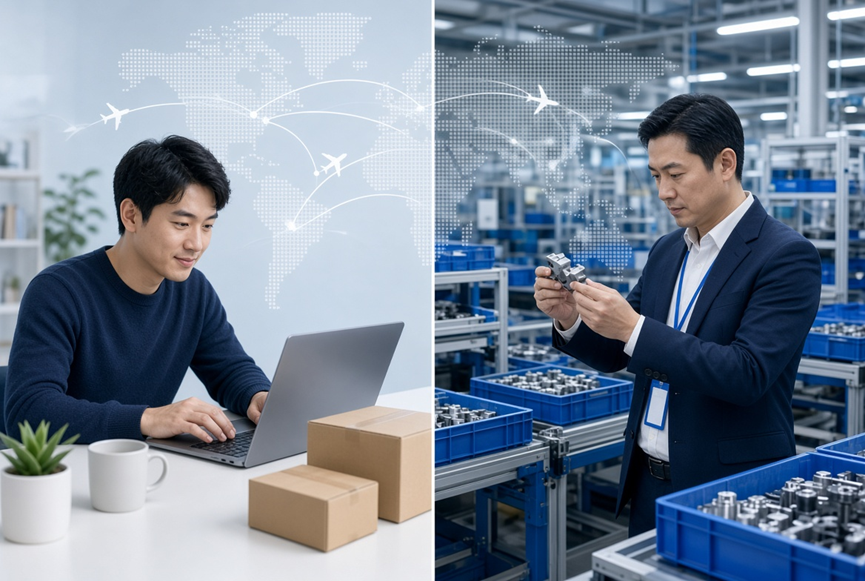
Choosing between an international sourcing company and a dropshipping supplier is one of the earliest decisions that shapes an ecommerce business’s margins, customer experience, and ability to scale. While both models can help sellers access products from China, they solve very different business problems.
A dropshipping supplier helps you sell products without buying inventory upfront. An international sourcing company helps you find, verify, negotiate with, and manage suppliers—often with more control over quality, customization, compliance, and long-term costs. For most new sellers, the right answer is not simply “one or the other.” It depends on your product validation stage, order volume, brand goals, and operational capacity.
The ecommerce opportunity remains significant: U.S. retail ecommerce sales reached an estimated $326.7 billion in Q1 2026, up 2.7% from the prior quarter on a seasonally adjusted basis. That growth creates room for new sellers, but it also raises customer expectations for reliable inventory, accurate delivery promises, quality products, and responsive service.
> Quick answer: Start with a dropshipping supplier if you are testing products with limited capital. Move toward an international sourcing company when you have validated demand, need better margins, want customized products, or require stronger quality control.
Table of Contents
What Is an International Sourcing Company?
An international sourcing company is a service provider that helps businesses source products from overseas manufacturers, wholesalers, or specialized suppliers. Its role often goes beyond finding a product listing.
A capable China sourcing company may help with:
– Supplier discovery and factory comparison
– Price negotiation based on target volume and specifications
– Product sourcing for items not found in public catalogs
– Sample coordination before large orders
– Quality inspection and defect-risk management
– Private label packaging, inserts, bundling, or logo customization
– Consolidation of products from multiple suppliers
– Freight coordination, export documentation, and fulfillment planning
In practical terms, sourcing companies are most valuable when a seller has a clear product opportunity but lacks a local team, factory relationships, language capability, or time to manage fragmented supplier communication.
An international sourcing company does not always own inventory. Instead, it operates as your sourcing and supply-chain partner. The best providers combine supplier access with transparent communication, order tracking, quality-control workflows, and logistics support.
What Is a Dropshipping Supplier?
A dropshipping supplier stores products and ships orders directly to your end customer after a purchase is made in your online store. You do not need to pre-purchase stock, operate a warehouse, or pack individual parcels yourself.
The basic workflow is simple:
1. You list a product in your ecommerce store or marketplace.
2. A customer places an order and pays you.
3. You send the order details to the supplier.
4. The supplier picks, packs, and ships the item to the customer.
5. You manage the customer relationship, marketing, pricing, and after-sales communication.
This model is appealing because it lowers the cost and risk of getting started. You can test multiple products without tying up capital in inventory. However, you still remain responsible for the customer’s experience—including product accuracy, shipping communication, refunds, and delivery promises.
For online merchants selling to U.S. consumers, shipping claims must be realistic. The U.S. Federal Trade Commission states that sellers need a reasonable basis for advertised shipping times. If a seller cannot ship within the promised period, they must notify customers, provide an updated date, and offer cancellation and refund options where required.
International Sourcing Company vs Dropshipping Supplier: Core Differences
The most important distinction is this: dropshipping is primarily a fulfillment model, while international sourcing is a supply-chain management model.
| Factor | International Sourcing Company | Dropshipping Supplier |
| Primary purpose | Finds, negotiates, manages, and improves supply | Fulfills individual customer orders |
| Upfront inventory | Usually required for bulk or customized orders | Usually not required |
| Minimum order quantity | Often applies, especially for custom products | Usually low or no MOQ |
| Product selection | Can source beyond standard catalogs | Often limited to supplier’s listed inventory |
| Custom branding | More feasible | Possible, but often limited at low volume |
| Quality control | Can include pre-production, during-production, or pre-shipment checks | Often depends on supplier’s internal process |
| Price per unit | Usually improves at higher volumes | Usually higher due to single-order handling |
| Speed to launch | Slower due to sourcing, samples, and setup | Faster for product testing |
| Best for | Established sellers, brands, wholesalers, B2B buyers | Beginners, product testers, lean ecommerce stores |
| Main business risk | Inventory commitment and supplier-management complexity | Less control over quality, stock, and delivery experience |
A dropshipping supplier can also act as a sourcing partner in some cases. For example, a full-service platform may source a product from China, store it, fulfill individual orders, and provide custom packaging after a seller reaches a reliable sales volume. This hybrid model can be especially useful for sellers moving from product testing to brand building.
When a Dropshipping Supplier Is the Better First Choice
A dropshipping supplier is generally the smarter first step when your priority is speed, low financial risk, and product validation.
Choose dropshipping first if you are:
– Launching a new ecommerce store with limited capital
– Testing demand for several products or niches
– Unsure which SKU will become a winner
– Selling trend-driven or seasonal items
– Running paid-ad tests before committing to inventory
– Operating a lean team without warehouse capacity
– Trying to avoid cash being locked into unsold inventory
For a new seller, buying 500 units before confirming demand can be risky. Imagine that you find a promising kitchen accessory and believe it will sell well. With dropshipping, you can first test product pages, pricing, creative assets, and paid traffic. If customers do not convert, you can change direction without liquidating a warehouse full of stock.
However, “low inventory risk” does not mean “no business risk.” You need to order samples, test the actual packaging, examine product quality, and place trial orders to your intended customer markets. Supplier photos and product descriptions should never be your only source of truth.
Expert insight: Treat dropshipping as a product-validation engine—not as an excuse to avoid supply-chain management. The sellers who win long term are usually the ones who use early sales data to improve sourcing, logistics, branding, and customer retention.
When an International Sourcing Company Is the Better First Choice
An international sourcing company becomes the better choice when your business needs control, not just product access.
Consider starting with a sourcing company if you already have:
– A proven product category or established sales history
– A B2B wholesale business with repeat purchase patterns
– Specific product requirements, materials, colors, or certifications
– A private-label or branded-product strategy
– A need to source from multiple Chinese factories
– Higher order volume that makes unit-cost negotiation worthwhile
– A target market where quality and compliance are critical
For example, a B2B seller supplying boutique retailers may need custom cartons, barcode labels, branded inserts, and consistent replenishment. A standard dropshipping catalog may not meet those requirements. A sourcing partner can identify suitable factories, compare quotations, coordinate samples, negotiate production terms, and arrange consolidated shipping.
This model is particularly effective when your winning product has reached stable demand. At that point, the question changes from “Can I sell this?” to “How can I improve the margin, quality, delivery reliability, and brand defensibility?”
The Hidden Cost Comparison: Cash Flow vs Total Landed Cost
Many sellers compare only the product price. That is a mistake.
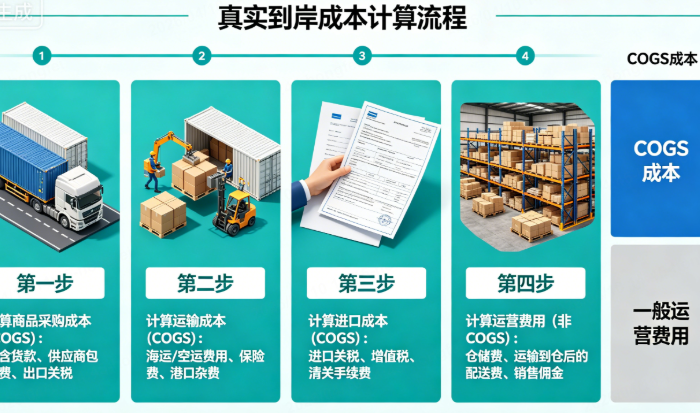
The more useful metric is total landed cost: the complete cost of getting a saleable product to the customer or fulfillment location. It may include product cost, packaging, inspection, platform fees, shipping, customs duties, storage, returns, and customer-service costs.
| Cost Area | Dropshipping Model | Sourcing Model |
| Product purchase | Paid per order | Often paid in deposits and production balances |
| Unit price | Usually higher | Often lower at volume |
| Storage expense | Minimal for seller | May require warehouse or 3PL fees |
| Packaging control | Limited at low volume | Higher control |
| Inspection cost | Often embedded or unavailable | Can be planned as a separate process |
| Shipping cost | Per-parcel international shipping can be expensive | Consolidated freight can reduce cost per unit |
| Stockout risk | Supplier inventory may change without notice | Seller carries inventory risk |
| Return cost | Can be difficult across borders | Easier with local fulfillment inventory |
A dropshipping supplier may look cheaper because there is no inventory purchase. But if your store reaches 20, 50, or 100 orders per day, individual parcel costs and weaker unit pricing can reduce profitability. At that stage, sourcing inventory in bulk and using a fulfillment partner may create a more predictable operating model.
A Practical Decision Framework for Sellers
Use the following five questions before choosing an international sourcing company or dropshipping supplier.
1. Have You Proven Product Demand?
If your product is untested, start with dropshipping or small-batch sourcing. Do not commit to large MOQs based only on competitor listings, social-media trends, or supplier claims.
If your store has stable conversion data, repeat purchases, and predictable demand, sourcing becomes more attractive.
2. Is Brand Differentiation Important?
If you sell generic products with little differentiation, dropshipping may help you launch quickly. If you want custom colors, bundles, branded packaging, improved product features, or exclusive designs, you need a sourcing-oriented model.
3. Can You Afford Inventory?
Inventory creates both an asset and a liability. It can improve margins and speed, but it also consumes cash. Your first bulk order should be based on realistic sales velocity, reorder lead time, and a downside scenario—not optimism.
4. How Sensitive Are Customers to Delivery Speed?
For some categories, customers will tolerate longer delivery windows. For gifts, urgent replacements, premium products, or competitive markets, shipping speed can directly affect conversion rate and review quality.
5. Does Your Product Need Compliance Review?
The more regulated the product category, the less suitable a “list it first and figure it out later” approach becomes. Import documentation, marking, safety rules, and product-specific requirements may apply depending on the product and destination market.
U.S. Customs and Border Protection notes that importers remain ultimately responsible for accurate entry documentation, duties, taxes, and applicable requirements—even when they use a customs broker. Products entering the United States generally need country-of-origin marking unless an exception applies.
The Best Growth Path: Test, Validate, Then Optimize
For many ecommerce sellers, the most effective answer is a staged strategy rather than a permanent choice.
Stage 1: Test Through Dropshipping
Use a dropshipping supplier to test product-market fit with controlled advertising spend. Focus on product quality, supplier responsiveness, delivery reliability, conversion rate, refund rate, and customer feedback.
Stage 2: Validate Winning SKUs
Once a product produces consistent orders, order samples from alternative suppliers. Compare material quality, packaging, pricing, lead time, and customization options. Do not assume the first supplier is the best long-term partner.
Stage 3: Source and Differentiate
Work with an international sourcing company to negotiate better pricing, improve packaging, bundle complementary products, add private-label elements, and introduce quality-control checkpoints.
Stage 4: Build a Reliable Fulfillment System
Store faster-moving SKUs in a warehouse closer to your customers when the economics make sense. Continue using dropshipping for long-tail products, test products, or markets where demand remains uncertain.
This hybrid approach protects cash flow while allowing your business to mature into a more defensible brand.
What to Ask Before Choosing a Partner
Whether you choose a China dropshipping supplier or an international sourcing company, ask these questions before committing:
1. Can you provide recent product samples before I scale?
2. What is your real processing time, excluding transit time?
3. How do you handle stockouts and price changes?
4. Can you provide product inspection photos or reports?
5. What branding, labeling, and packaging options are available?
6. Which shipping methods include trackable delivery?
7. How are damaged items, missing parcels, and returns handled?
8. Can you consolidate products from multiple suppliers?
9. What fees apply beyond the quoted product price?
10. Can you support compliance documentation when needed?
A trustworthy partner should provide direct answers, realistic timelines, and transparent pricing. Be cautious if a provider promises unusually fast shipping without explaining the origin warehouse, carrier, handling process, or tracking method.
How Looperbuy Supports Both Models
Looperbuy is designed for global B2B sellers that want to source products from China without carrying the full burden of supplier communication, storage, payment coordination, and international logistics management.
For early-stage sellers, Looperbuy can support flexible product sourcing and order fulfillment, helping reduce the need to purchase large quantities before demand is proven. For growing businesses, a more coordinated sourcing and fulfillment workflow can help sellers improve supplier selection, consolidate orders, manage product preparation, and scale operations with greater visibility.
The goal is not simply to ship products. It is to help sellers build a supply chain that fits their current stage—whether they are validating an ecommerce product, running a multi-SKU store, or serving B2B buyers across multiple markets.
Final Recommendation
Choose a dropshipping supplier first if your main goal is to test products quickly with minimal upfront inventory. Choose an international sourcing company first if you already know what you want to sell and need customized products, better purchasing terms, stronger quality control, or scalable supply-chain support.
The strongest long-term strategy is often to begin lean, validate with data, and then evolve into a sourcing-led model as volume grows. That transition can turn a generic product listing into a reliable, differentiated ecommerce business.
Ready to source products from China without managing every supplier and shipment alone? Contact Looperbuy to discuss your product category, target market, fulfillment requirements, and next-stage sourcing plan.
Frequently Asked Questions
1. Is an international sourcing company the same as a dropshipping supplier?
No. An international sourcing company helps you identify and manage suppliers, negotiate prices, arrange quality control, and coordinate production or logistics. A dropshipping supplier primarily holds inventory and ships individual orders directly to customers.
2. Can I use dropshipping and international sourcing together?
Yes. Many successful sellers test products through dropshipping first, then use a sourcing company to improve pricing, product quality, private labeling, and inventory planning once a product has proven demand.
3. When should I move from dropshipping to bulk sourcing?
Consider moving when a product generates stable sales, per-order shipping costs become too high, customers request faster delivery, or you need branded packaging and tighter quality control.
4. Do I need to order samples from a dropshipping supplier?
Yes. Ordering samples is one of the most important supplier-verification steps. It allows you to check the product itself, packaging, processing speed, tracking quality, and actual delivery experience before selling to customers.
5. Does dropshipping eliminate my responsibility for customer service?
No. Even when the supplier handles fulfillment, your business remains the seller-facing brand. You are still responsible for accurate product information, customer communication, refunds, shipping promises, and complaint handling.
6. Can a sourcing company help with product compliance?
A sourcing company can help collect documents, communicate with factories, and coordinate inspections. However, the importer and seller should independently confirm applicable rules for their target market and product category.
References
1. U.S. Census Bureau. “[Quarterly Retail E-Commerce Sales Report].” Accessed August 12, 2026. U.S. Q1 2026 ecommerce sales were estimated at $326.7 billion on a seasonally adjusted basis.
2. U.S. Federal Trade Commission. “[Selling on the Internet: Prompt Delivery Rules].” Guidance on shipping representations, delay notices, cancellations, and refunds for Internet sellers.
3. U.S. Customs and Border Protection. “[Tips for New Importers and Exporters].” Guidance on importer responsibilities, entry documentation, duties, taxes, and agency-specific requirements.
4. U.S. Customs and Border Protection. “[Marking of Country of Origin on U.S. Imports].” General guidance on country-of-origin marking requirements for imported goods.
5. International Trade Administration. “[Import Regulations].” Overview of documentation and regulatory requirements for imported products.
6. International Trade Administration. “[Special Documents].” Guidance on certifications, documentation, and importer responsibility for submitted information.
-2-700x490.png)