
Fast shipping from China is about more than carrier transit. Learn how processing, parcel size, customs, shipping choices, and destination affect dropshipping delivery—and how to test routes, protect margins, and give customers an honest order-to-door estimate.
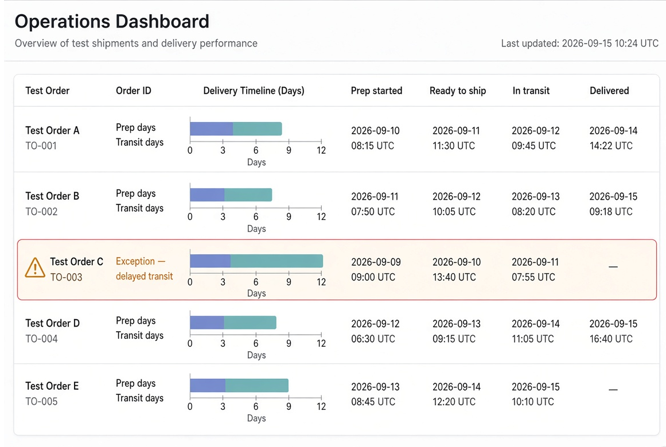
Fast shipping from China for dropshipping stores is possible, but “fast” needs a definition. A carrier’s transit estimate may start only after a supplier has sourced, checked, packed, and handed over the product. For store owners, the number that matters is order-to-door delivery time: the period from the customer’s payment to confirmed delivery. Confusing those two clocks leads to promises a shipping label cannot keep. Google’s delivery-time guidance likewise separates order cutoffs, handling time, and transit time.
If you source products from China without holding inventory, speed is a trade-off among product availability, processing, shipping service, customs readiness, destination, and cost. The practical goal is not to advertise the shortest possible journey. It is to find a repeatable route, price it correctly, and tell customers when their orders are likely to arrive.
Table of Contents
What Does “Fast Shipping” Actually Mean?
A supplier might say “5–7 days” and mean time in the carrier network. A customer will hear “5–7 days from checkout.” Those are different commitments. Before publishing a delivery claim, ask when the clock starts, whether days are business or calendar days, and whether the estimate covers the customer’s exact destination.
One 2026 analysis of 221 curated China-sourced dropshipping products reported a 13.5-day median shipping-window midpoint. In that dataset, 55.2% of products fell into an 8–14-day window, while none had a window entirely under seven days. This is useful context, not a universal forecast: the sample consists of curated supplier listings, and its figures are based on quoted windows rather than a delivery audit of every store or destination.
Carrier speed can still be impressive. DHL describes time-definite international express services, but says delivery varies by origin, destination, and service; import duties and taxes may be additional. A fast carrier therefore solves only part of the customer’s wait.
The Order-to-Door Timeline
Map a purchase through five stages:
1. Order acceptance: Payment clears and the order reaches the sourcing or fulfillment team.
2. Product preparation: The item is available, checked, packed, and labeled.
3. Carrier handoff: The parcel is physically accepted—not merely assigned a tracking number.
4. Cross-border movement: It moves through export, international transport, and import procedures.
5. Final delivery: A local carrier reaches the customer’s address.
For illustration, suppose preparation takes two business days, the chosen service quotes seven transit days, and an import exception adds one day. The customer experiences roughly ten days, subject to weekends and the way each service counts days. This is a planning example, not a Looperbuy delivery promise. Google’s guidance explicitly treats handling and transit as separate inputs when calculating an estimated delivery date.
Why China-to-Customer Delivery Times Vary
“Ships from China” does not identify a single route. A compact accessory, a bulky home item, and a product needing special handling may face different packaging, service, and clearance requirements. Even identical parcels can perform differently across countries or postal codes.
The variables worth checking before a product goes live are:
– Stock status: Does the supplier hold the exact variant, or must it be sourced after purchase?
– Dispatch cutoff: What happens to an order received late on Friday?
– Package dimensions: Will the carrier charge for size rather than physical weight?
– Destination coverage: Does the quoted service reach the customer’s area directly?
– Customs information: Are the description, value, and product classification ready?
– Tracking handoffs: Will updates continue when the parcel reaches a local carrier?
Size is an easily missed margin risk. DHL explains that express shipments can be billed using the higher of actual and *volumetric* weight. Its commonly used volumetric calculation divides the parcel’s dimensions in cubic centimeters by 5,000, though sellers should confirm the divisor for their service. A 30 × 20 × 10 cm box calculates to 1.2 kg; if the item weighs only 0.4 kg, its dimensions may drive the charge.
That is why a product photo and an item weight are not enough for a shipping quote. Ask for packed dimensions and packed weight. A slightly smaller box may change the economics without changing the product.
Which Shipping Option Fits Your Store?
The right option depends on what the buyer purchased and how much delivery speed is worth to them. Request route-specific quotes rather than treating any method’s advertised time as a universal China-to-door guarantee.
| Approach | Best fit | Main advantage | Check before offering it |
| Economy tracked parcel | Price-sensitive, lightweight products | Lower shipping spend | Full tracking, destination coverage, and the realistic delivery range |
| Dedicated cross-border parcel line | Repeatable orders to a core market | Potential balance of cost and speed | Dispatch frequency, last-mile partner, and recent lane performance |
| International express courier | Urgent or higher-value orders | Time-definite service options | Full landed cost, address coverage, and who pays import charges |
| Stock held near customers | Proven products with steady demand | Shorter final delivery route | Inventory commitment, storage, replenishment, and returns costs |
DHL’s express service information is a useful reminder that service selection and destination affect delivery, while duties and taxes need separate attention. No table can substitute for a quote tied to your product and postcode.
For a new product, direct shipment from China can limit the need to buy inventory before demand is proven. If it becomes a reliable seller, local stock may improve delivery speed—but it brings back purchasing, warehousing, and replenishment decisions. Neither model is automatically cheaper. Compare the total cost per successfully delivered order.
The 2026 Customs Reality
Fast shipping claims must account for import rules. A parcel that moves quickly through a carrier network can still encounter charges or documentation problems before delivery.
In the United States, U.S. Customs and Border Protection says the duty-free *de minimis* treatment for eligible shipments valued at or below $800 ended on August 29, 2025. Applicable duties, taxes, and fees may now apply; sellers should not build a U.S. price around an assumed blanket $800 duty-free exemption. The amount owed depends on the goods and entry circumstances.
For EU customers, the European Commission says imported goods are subject to VAT, with the Import One Stop Shop available to simplify VAT declaration and payment for qualifying imported distance sales up to €150. Separately, from July 1, 2026, the EU introduced a temporary €3 customs duty per item, calculated by tariff-classification item rather than simply by parcel, for covered low-value distance-sale consignments up to €150. The Commission lists specific exclusions, so confirm the treatment of your product and transaction rather than applying €3 indiscriminately.
Agree with your fulfillment and shipping partners on who is responsible for declaration and payment before checkout. If an import charge is left for the recipient unexpectedly, the customer’s experience may feel slow and costly even when the parcel traveled quickly.
A Better Way to Test Shipping Speed
A supplier’s best-case estimate should start a test, not end one. From a sourcing and fulfillment perspective, I would evaluate the full lane—one product, packed in its final form, sent by one service to one destination group—before making a storewide promise.
Run a Small Lane Test
1. Choose representative products. Include your likely bestseller and any bulky, fragile, or higher-value item.
2. Record the complete quote. Capture product cost, packed dimensions, shipping, potential duties or taxes, and the stated dispatch cutoff.
3. Place test orders. Use destinations relevant to your customers, including an address outside a major city if that market matters.
4. Timestamp each milestone. Record payment, readiness, carrier acceptance, customs updates, local handoff, and delivery.
5. Separate exceptions. Note stockouts, address errors, clearance requests, failed attempts, and damaged parcels.
6. Set a promise you can defend. Use observed order-to-door results by destination, not the fastest individual shipment.
For example, if a test lane produces deliveries on days 9, 10, 11, 12, and 16, “9-day delivery” describes only the best result. A displayed range should reflect the variation you can reasonably handle, with the day-16 order investigated rather than ignored. Five orders are a diagnostic start, not a statistically robust service guarantee.
Monitor What Customers Experience
Once orders are live, track four measures by product and destination: time to carrier acceptance, order-to-door time, on-time delivery rate, and shipping-related support contacts. Review them together. A lane that delivers quickly on average but repeatedly leaves buyers without a scan for several days can still create avoidable anxiety.
Do not silently move a delayed parcel into your “normal” group. Log the reason, tell the customer what you know, and check whether a supplier, carrier, or documentation step needs fixing. This turns shipping data into an operational decision rather than a marketing claim.
How to Set an Honest Delivery Promise
Put the estimated delivery range, not just “shipping time,” where buyers decide: on the product page and at checkout. State whether processing time is included, whether the estimate uses business days, and whether import charges can apply. Keep order confirmation and tracking messages consistent with the same promise.
Google’s Merchant Center guidance calculates customer-facing delivery estimates from handling and transit information and accounts for an order cutoff. Shopify’s delivery-date settings likewise combine fulfillment and transit time. These are helpful models for building a promise around the entire order journey.
A usable product-page statement might read:
> Estimated delivery to [destination]: [tested range] business days from order confirmation, including processing and transit. Tracking is sent after carrier acceptance. Import charges, where applicable, are explained at checkout.
Replace every bracket with a verified, destination-specific value. If performance differs materially by country or product, show different ranges. A single ambitious promise for a worldwide catalog is easier to write than to fulfill.
Where Looperbuy Can Add Value
For a B2B seller, the difficult work is not just finding a shipping label. It is coordinating China sourcing and order fulfillment so that stock, packing, shipping choice, and customer communication support the same delivery promise.
Looperbuy’s stated model offers China product sourcing and dropshipping fulfillment to merchants seeking to reduce the burden of holding stock, warehousing, payments, and logistics management. That model may help a seller test products without first committing to bulk inventory. It does not, by itself, prove a particular delivery speed or eliminate import costs.
Before selecting a partner—including Looperbuy—request written answers for the product and markets you sell into: What is the dispatch cutoff? Are variants confirmed in stock? What are the packed dimensions? Which carrier or parcel line is proposed? When does tracking begin? Who handles customs information, import charges, lost parcels, and returns? Compare the answers with test orders.
Want a realistic shipping plan for your store? Send Looperbuy your target products, destination countries, expected order volume, and delivery goal. Ask for a product-by-product sourcing and fulfillment quote with a clear processing window, available shipping options, tracking details, and estimated total costs before you publish a customer-facing delivery promise.
Frequently Asked Questions
1. Can dropshipping stores offer fast shipping from China?
Yes, but speed varies by product, preparation time, service, and destination. Compare order-to-door results, not carrier transit claims alone. A quoted express service still begins after the parcel is ready and accepted.
2. How long does shipping from China take for dropshipping?
There is no reliable storewide number. One analysis of 221 curated products found a 13.5-day median of quoted shipping-window midpoints, but its sample is not a guarantee for your product or customer. Test your own routes and add handling time when setting a checkout estimate.
3. Does a tracking number mean the parcel has shipped?
Not necessarily. Check for a carrier acceptance or pickup event, and distinguish it from label creation in your customer updates. Google defines handling time as ending when the carrier picks up the package.
4. Is express shipping always worth the extra cost?
No. It may suit urgent or higher-value orders, but compare the courier quote with the product margin and any import charges. DHL notes that duties, taxes, and other government charges may not be included in its shipping rate.
5. Can I promise three-day delivery without overseas stock?
Only if you have repeated, destination-specific order-to-door evidence that supports it. Do not turn a carrier’s best-case transit statement into a three-day checkout promise; product preparation and order cutoffs matter.
6. Are low-value U.S. orders still automatically duty-free?
No. CBP says the former duty-free *de minimis* treatment for eligible imports valued at or below $800 ended on August 29, 2025. Check the current treatment of the specific product and shipment.
7. What should I ask a China dropshipping fulfillment partner first?
Ask for the packed product quote and a testable delivery plan: stock status, handling window, shipping service, destination coverage, tracking milestones, import-charge responsibility, and exception procedure. Those answers let you compare total cost and customer experience—not merely the advertised transit time.
References
1. [Google Merchant Center Help, “Set up estimated delivery time”]
2. [ProductLair, “Dropshipping Shipping Times From China (Real Data)”]
4. [DHL, “What is volumetric weight and how is it calculated?”]
5. [U.S. Customs and Border Protection, “Suspending Duty-Free De Minimis Treatment for All Countries”]
6. [European Commission, “VAT One Stop Shop”]
7. [European Commission, “Guidance and legal text on temporary flat fee on low-value imports”]
8. [Shopify Help Center, “Setting up manual delivery dates”]