Worldwide sourcing solutions help global B2B sellers reduce avoidable return rates by improving supplier verification, product inspections, listing accuracy, packaging, fulfillment precision, and shipping visibility. Learn how Looperbuy supports China sourcing and international dropshipping workflows that reduce inventory risk, protect margins, and create a more reliable customer experience.
Worldwide sourcing solutions can reduce return rates by preventing the problems that cause returns before an order reaches the customer. For global B2B sellers, the most effective approach combines supplier verification, product inspection, accurate product data, protective fulfillment, and reliable cross-border shipping coordination.
Returns are often treated as a post-sale customer-service issue. In practice, many returns begin much earlier. They begin when a seller works with an unverified supplier, publishes incomplete product details, receives inconsistent inventory, or ships an item without a final quality check.
For merchants selling internationally, these issues become more expensive. A single return may involve customer dissatisfaction, refund processing, reverse logistics, damaged resale value, customs complexity, payment fees, and lost time. This is why a well-managed worldwide sourcing solution is no longer only about finding lower product prices. It is about helping sellers deliver the right product, in the right condition, with the right expectations.
Looperbuy supports global B2B sellers by sourcing products from China, coordinating fulfillment, and managing shipping processes that help businesses reduce inventory exposure and operational complexity. When sourcing, inspection, and delivery are connected in one workflow, sellers gain more control over the factors that influence return rates.
Table of Contents
Why Return Rates Matter for Global Sellers
Returns directly affect profitability, customer retention, and long-term business stability. The National Retail Federation estimated that 15.8% of retail sales would be returned in 2025. For online sales specifically, the projected return rate was higher, at 19.3%.
For a cross-border seller, the financial impact can be even larger than the original order value. The seller may need to pay for:
– Refunds or replacement items
– Original outbound shipping
– Return-label or reverse-logistics costs
– Product inspection after return
– Repackaging, restocking, liquidation, or disposal
– Customer-service labor
– Marketplace penalties or declining seller metrics
– Lost repeat-purchase opportunities
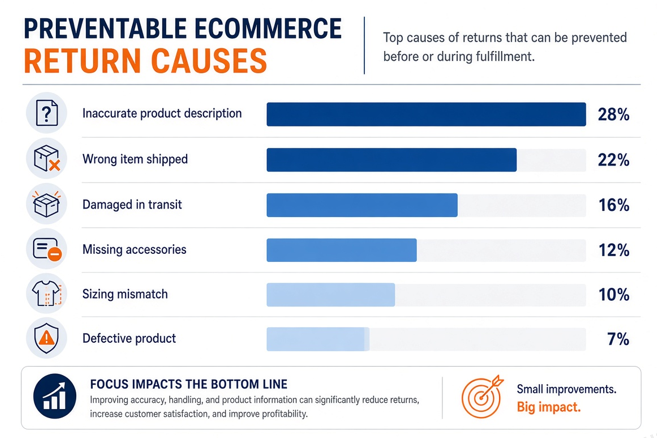
Not every return is preventable. Customers can change their minds, order too many variations, or experience circumstances beyond a seller’s control. However, a meaningful share of returns comes from preventable causes, such as inaccurate product information, defects, shipping damage, missing components, and incorrect items.
UPS identifies product defects, order errors, inaccurate product descriptions, and unclear policies as major drivers of wholesale and retail returns.
The key business question is not, “How can we eliminate all returns?” It is:
> How can we reduce avoidable returns without creating friction for legitimate customers?
Worldwide sourcing solutions address that question at the supply-chain level.
The Link Between Sourcing and Returns
A sourcing decision affects much more than unit price. It influences material consistency, product specifications, packaging quality, lead times, compliance documentation, order accuracy, and the reliability of future replenishment.
When sellers source products through fragmented channels, they may face inconsistent information from multiple factories, trading companies, warehouses, and freight providers. This creates gaps between what is listed online and what the end customer receives.
A centralized sourcing and fulfillment workflow helps close those gaps.
| Return Trigger | Root Cause in the Supply Chain | How Worldwide Sourcing Solutions Help |
| Product differs from listing | Incorrect dimensions, material claims, colors, or included accessories | Verify specifications and collect accurate product data before listing |
| Defective or damaged item | Weak factory quality control or poor handling | Add pre-shipment inspections and packaging checks |
| Wrong item received | SKU confusion, labeling errors, or fulfillment mistakes | Use standardized SKU mapping and order-verification processes |
| Item arrives damaged | Inadequate protective packaging or unsuitable shipping method | Improve packing standards and shipping selection |
| Customer expected different quality | Supplier samples did not match bulk production | Compare samples, production batches, and final goods |
| Late delivery leads to refusal | Unreliable processing times or weak logistics coordination | Improve supplier communication and track fulfillment milestones |
| Missing components | Poor kit assembly or incomplete packing | Use checklist-based inspection for bundles and multi-part products |
The best return-reduction strategy starts before product pages are published. It starts with selecting products that can be delivered consistently.
1. Supplier Verification Reduces Product Inconsistency
One of the largest risks in international sourcing is assuming that all suppliers offer the same product quality because their catalog images look similar. In many product categories, two suppliers may use nearly identical photos while offering very different materials, production standards, packaging methods, or quality-control procedures.
This is especially important for products such as:
– Apparel and footwear
– Consumer electronics and accessories
– Beauty tools and personal-care items
– Home organization products
– Kitchenware
– Pet products
– Toys and gifts
– Customized promotional products
– Fragile décor and glassware
A reliable sourcing partner can help sellers evaluate suppliers beyond the quoted price. This typically includes checking product details, production capability, communication responsiveness, order history, lead-time reliability, and available customization options.
What Should Be Verified Before Ordering?
Before adding a new product to an online store or wholesale catalog, sellers should confirm:
1. Product specifications
Confirm dimensions, weight, color options, material composition, power requirements, included accessories, and usage limitations.
2. Sample quality
Request or review samples whenever possible, particularly for high-value, customized, technical, or repeat-purchase products.
3. Production consistency
Ask whether the factory can maintain the same materials, components, packaging, and workmanship for future orders.
4. Minimum order requirements
Understand whether the supplier requires a minimum order quantity, and whether small-batch testing is available.
5. Compliance requirements
Confirm product-specific regulations for destination markets, especially for electrical goods, cosmetics, children’s products, food-contact items, and medical-adjacent products.
6. Packaging capability
Determine whether the supplier can use protective packaging suitable for international transit.
For global sellers, supplier verification is customer-experience protection. It reduces the risk of promoting products that cannot consistently meet customer expectations.
2. Product Inspection Finds Problems Before Shipping
A product can look correct in a supplier photo and still fail in the real world. Common problems include loose stitching, incorrect logos, scratched surfaces, missing adapters, incomplete kits, poor color matching, damaged retail boxes, weak seals, or incorrect labels.
This is where inspection becomes essential.
A sourcing and dropshipping service can create a practical checkpoint between the supplier and the final customer. Rather than shipping every item directly from an unknown source without review, sellers can use inspection processes to identify visible and order-related issues before dispatch.
A Practical Quality-Control Checklist
For standard B2B fulfillment, an inspection workflow may include:
– Confirming the correct SKU and variation
– Checking quantity and bundle contents
– Inspecting visible defects
– Comparing color and style against the approved listing
– Checking product dimensions or key measurements
– Testing basic functionality where appropriate
– Reviewing printed labels and barcode placement
– Checking retail packaging condition
– Confirming protective outer packaging
– Photographing exceptions for seller review
Inspection does not mean every item receives the same level of testing. The right level depends on product risk, order value, defect history, and customer expectations.
For example:
| Product Type | Recommended Inspection Priority | Why It Matters |
| Phone accessories | High | Compatibility and packaging mistakes create frequent disputes |
| Apparel | High | Sizing, color, fabric, stitching, and labeling must align with listings |
| Fragile home goods | High | Packaging quality determines transit damage risk |
| Custom-logo products | Very high | Branding mistakes may make inventory unsellable |
| Simple low-cost stationery | Moderate | Visual checks and quantity verification may be sufficient |
| Complex electronics | Very high | Functional testing and compliance checks may be required |
The purpose is simple: catch the issue at the lowest-cost point in the supply chain. Fixing an error in a warehouse is far less expensive than handling a return from another country.
3. Accurate Product Information Prevents Expectation Gaps
Many ecommerce returns happen because the product is not what the customer believed they ordered. The item may technically be correct, but the listing created the wrong expectation.
Shopify recommends accurate, complete product information—including weight, dimensions, materials, size guides, and policy details—to help customers buy with confidence and reduce avoidable returns.
For sourcing-based businesses, product content should not be copied blindly from supplier listings. Supplier titles are often short, translated poorly, or focused on factory terminology rather than buyer decision-making.
Instead, sellers should transform sourcing data into customer-ready information.
Product Details That Reduce Returns
Every product listing should clearly explain:
– Exact dimensions in relevant regional units
– Product weight and package weight
– Materials and finishes
– Color variations and possible production tolerances
– Included accessories and excluded accessories
– Compatibility requirements
– Installation, care, or usage instructions
– Safety warnings or limitations
– Size charts with measurement methods
– Product images showing scale and real-world use
– Delivery timing and tracking expectations
– Clear return eligibility and condition requirements
A useful rule is this:
> If a customer could reasonably ask a question after delivery, answer it before checkout.
For example, instead of writing:
> “Premium travel organizer with large capacity.”
Write:
> “Water-resistant polyester travel organizer with six elastic loops, one zippered mesh compartment, and a 22 × 15 × 8 cm folded size. Designed for cables, chargers, and small accessories; not suitable for full-size laptops or tablets.”
The second version gives the customer a more accurate mental picture. That reduces surprise and lowers the chance of an expectation-based return.
Product Data Is a Supply-Chain Asset
Strong product information begins at the source. GS1 notes that demand for product data has expanded as buyers, businesses, and regulators seek more current information about products, including origin and information beyond traditional labels.
For global sellers, this means product data should be managed as carefully as inventory. A dependable sourcing workflow can help collect, validate, and organize product attributes before they become public-facing claims.
4. Better Packaging Reduces Shipping-Damage Returns
A product can leave a supplier in perfect condition and still arrive damaged. International shipping often involves multiple handling points, sorting facilities, long-distance transport, and changes between carriers.
Packaging is therefore not a minor detail. It is part of the product experience.
Common Packaging Failures
– Fragile goods shipped without internal cushioning
– Cosmetics or liquids without leak protection
– Electronics packed without anti-static protection
– Apparel compressed without moisture barriers
– Multi-piece sets packed without separators
– Retail boxes shipped directly without an outer carton
– Products moving freely inside oversized packaging
– Inadequate labeling for fragile or orientation-sensitive goods
A worldwide sourcing solution can help sellers choose packaging that matches product risk and destination requirements.
For fragile products, protective measures may include:
– Bubble wrap or foam sleeves
– Molded inserts
– Double-wall cartons
– Corner protection
– Void-fill material
– Waterproof outer bags
– Tamper-evident seals
– “Fragile” or handling labels where appropriate
For high-value products, sellers may also need photo documentation before shipment. This can support customer service, carrier claims, and supplier accountability if an issue occurs.
The goal is not excessive packaging. The goal is packaging that prevents damage while controlling dimensional weight and shipping cost.
5. Fulfillment Accuracy Prevents Wrong-Item Returns
Wrong-item returns are among the most frustrating types of returns because they are often completely avoidable. A customer may have selected the correct product, but receive the wrong color, model, voltage, size, or accessory set.
This problem becomes more likely when sellers manage large catalogs, product variants, bundles, and multilingual supplier information.
A coordinated fulfillment process reduces this risk through:
– Standardized SKU naming
– Variant mapping between supplier and storefront
– Barcode or label verification
– Pick-and-pack checks
– Bundle assembly checklists
– Address validation
– Order-status visibility
– Exception handling before dispatch
For example, an electronics seller may offer the same device accessory in US, EU, UK, and AU plug versions. If plug type is not mapped accurately across the storefront, supplier catalog, warehouse system, and shipping label, customers may receive a product that cannot be used in their country.
That is not only a return risk. It is a trust risk.
Build a “Critical Attributes” List
Every product category should have a small list of attributes that must be checked before fulfillment.
| Category | Critical Attributes |
| Clothing | Size, color, fabric, gender or fit designation |
| Electronics | Plug type, voltage, model compatibility, included cable |
| Home goods | Dimensions, color, material, assembly parts |
| Beauty tools | Plug type, attachments, packaging seal, intended use |
| Auto accessories | Vehicle compatibility, mounting hardware, connector type |
| Customized goods | Logo, artwork version, spelling, placement, quantity |
This simple system can dramatically improve fulfillment accuracy, especially when working across suppliers and global markets.
6. Shipping Visibility Helps Manage Delivery Expectations
Customers do not only return products because of quality. They may refuse delivery or request refunds when delivery timing is unclear, tracking does not update, or a package appears lost.
Cross-border delivery requires realistic communication.
Sellers should avoid vague claims such as “fast worldwide shipping” unless they can consistently meet that promise. Instead, provide estimated processing and transit ranges based on destination and shipping method.
A strong fulfillment communication flow includes:
1. Order confirmation after payment
2. Processing update when sourcing or preparation begins
3. Shipment confirmation with tracking details
4. Transit notifications for major milestones
5. Delivery notification where carrier support is available
6. Support options for delayed, damaged, or incomplete deliveries
Clear delivery communication will not prevent every shipping-related return. However, it reduces uncertainty and gives customers confidence that the seller is actively managing the order.
A Return-Reduction Framework for B2B Sellers
The strongest results come from treating returns as a measurable operational issue, not simply a customer-service expense.
Step 1: Categorize Every Return
Do not use one generic “returned” label. Track the actual reason:
– Product defective
– Product damaged in transit
– Wrong item shipped
– Missing component
– Product not as described
– Incorrect size or fit
– Late delivery
– Customer changed mind
– Duplicate order
– Compatibility issue
– Customs or delivery refusal
This data helps identify which parts of the sourcing and fulfillment workflow need attention.
Step 2: Calculate Return Rate by SKU
Use this formula:
Return Rate=Number of Returned Orders÷Number of Delivered Orders×100
Track return rate by:
– Product SKU
– Supplier
– Product category
– Destination country
– Shipping method
– Customer acquisition channel
– Return reason
– Packaging type
– Order value
A catalog-wide average can hide a serious issue. For instance, a store may have a 7% overall return rate, while one supplier’s products are generating a 22% return rate because product photos or dimensions are inaccurate.
Step 3: Prioritize High-Cost Return Reasons
Focus on problems with the largest financial impact first.
| Return Problem | First Action |
| Repeated defects | Review supplier quality and add targeted inspection |
| Shipping damage | Upgrade protective packaging and review carrier choice |
| Product not as described | Rewrite listings using verified specifications and authentic photos |
| Wrong variants | Improve SKU mapping and pick-and-pack verification |
| Compatibility issues | Add clear compatibility charts and pre-purchase guidance |
| Sizing returns | Improve size charts, fit notes, and product measurements |
Step 4: Feed Learnings Back Into Sourcing
Return data should influence future purchasing decisions. If one item repeatedly generates complaints, do not only improve the refund workflow. Review the source product, supplier, packaging, listing, and shipping method.
This closed-loop process is where worldwide sourcing solutions create long-term value. Sellers can use real customer feedback to improve supplier selection, product content, and fulfillment standards over time.
How Looperbuy Supports Lower Return Risk
Looperbuy helps B2B sellers build a more controlled sourcing and fulfillment process from China to international customers. Rather than forcing merchants to independently coordinate suppliers, payments, warehousing, packaging, and shipping, a centralized service helps simplify the operational chain.
A seller can use Looperbuy to support key return-prevention activities such as:
– Sourcing products from China based on defined requirements
– Confirming product details before listing or ordering
– Coordinating supplier communication
– Managing order consolidation where appropriate
– Supporting product checks before dispatch
– Improving packaging decisions for international shipment
– Handling fulfillment and tracking workflows
– Reducing the need for sellers to hold large amounts of inventory
For sellers using a dropshipping or low-inventory model, this is particularly valuable. Less inventory does not need to mean less control. With the right sourcing workflow, merchants can validate products, protect orders, and create better customer expectations without building their own overseas warehouse operation.
Final Takeaway
Worldwide sourcing solutions help reduce return rates because they improve the decisions and quality checks that happen before an order ships. Supplier verification reduces inconsistency. Product inspection catches defects. Accurate listings prevent disappointment. Better packaging reduces transit damage. Fulfillment controls prevent wrong-item errors. Transparent shipping updates reduce uncertainty.
For global B2B sellers, reducing returns is not only about protecting margin. It is about building a dependable buying experience that encourages customers to reorder.
If you want to source Chinese products with stronger quality control, more accurate fulfillment, and less inventory risk, contact Looperbuy to discuss a sourcing and dropshipping workflow built for your target market.
FAQ
1. What is a worldwide sourcing solution?
A worldwide sourcing solution is a service or operating model that helps businesses identify suppliers, purchase products, verify quality, coordinate fulfillment, and arrange international delivery. It gives sellers more control over the supply chain without requiring them to manage every supplier and logistics provider independently.
2. How can sourcing reduce ecommerce return rates?
Sourcing reduces return rates by improving supplier quality, confirming product specifications, checking inventory before dispatch, improving packaging, and ensuring that product listings accurately describe what customers will receive. These steps help prevent avoidable returns caused by defects, wrong items, misleading details, and transit damage.
3. What are the most common preventable reasons for returns?
Common preventable reasons include damaged products, defective items, incorrect variants, missing accessories, inaccurate product descriptions, misleading size information, and shipping errors. Clear product information and quality-control processes are among the most effective ways to address these issues.
4. Should small B2B sellers inspect every product?
Not necessarily. Sellers should use a risk-based inspection plan. High-value, fragile, customized, technical, or historically problematic products need more detailed inspection. Low-risk products may only require SKU, quantity, packaging, and visible-condition checks.
5. How does dropshipping affect return management?
Dropshipping can reduce inventory and warehousing costs, but it can also create quality-control challenges if sellers have limited visibility into suppliers and fulfillment. Using a coordinated sourcing and fulfillment partner helps sellers maintain stronger control over product accuracy, packaging, and shipment tracking.
6. Can better product descriptions really lower returns?
Yes. Detailed and accurate descriptions help customers understand size, materials, compatibility, included items, limitations, and expected appearance before buying. Shopify specifically recommends complete product information, accurate sizing, and strong visuals to reduce avoidable returns.
7. How should sellers measure return-rate performance?
Measure return rate by dividing returned orders by delivered orders, then multiplying by 100. Sellers should also segment the data by SKU, supplier, product category, destination market, shipping method, and return reason. This identifies whether the issue comes from sourcing, product content, fulfillment, packaging, or delivery.
References
1. National Retail Federation. [2025 Retail Returns Landscape]
2. Shopify Enterprise. [Ecommerce Returns Management: How to Reduce Returns]
3. Shopify. [Manage Returns and Refunds]
4. UPS. [Turn the Challenges of Reverse Logistics Into Opportunities]
5. UPS and Forrester. [Crafting a Returns Policy That Creates a Competitive Advantage Online]
6. GS1. [E-commerce and Product Data]
7. Shopify Enterprise. [Product Data Enrichment for Ecommerce]