Compare Facebook Shops and Marketplace for branded selling, product testing, and China-sourced dropshipping. Learn how eligibility, checkout, shipping access, product compliance, and contribution margin affect your choice—and use a seven-step plan to test products before you scale.
If you are comparing Facebook Shops vs Marketplace, start with a question more useful than “Which one has more buyers?” Ask how customers will discover your products, where they will pay, and whether your fulfillment model can deliver what your listing promises. A branded product catalog and a local listing can both generate interest, but they demand different operations. For a seller sourcing products from China, that difference can determine whether an order becomes a repeat customer or a costly complaint.
The short answer: Facebook Shops is generally the stronger fit for building a branded, catalog-led business, provided your account and location qualify. Marketplace can help test demand for individual products, especially where the seller can meet local expectations and has access to the required selling features. Neither is a shortcut around product compliance, accurate delivery estimates, or customer service.
Table of Contents
Facebook Shops vs Marketplace at a Glance
| Decision point | Facebook Shops | Facebook Marketplace |
| Primary role | A business storefront for displaying a product catalog and collections | Individual listings where shoppers browse or search for items |
| Best-fit goal | Build a recognizable brand and present a consistent product range | Evaluate interest in specific items or serve an accessible local market |
| Setup | Commerce Manager, catalog, eligibility review, shipping settings, and a checkout URL | A listing with photos, item details, and a price; additional selling features vary |
| Customer journey | Browse products, then move to the seller’s website checkout under Meta’s current setup guidance | View a listing and use the purchasing or contact options available to that account |
| Main operational risk | Catalog accuracy and consistency between the shop and website | Assuming shipping, checkout, or commercial selling access is available everywhere |
| Cross-border sourcing fit | Potentially useful when a seller controls its website and delivery promises | Requires particular care if products are not already positioned to meet buyer expectations |
Meta describes Shops as storefronts managed through Commerce Manager. Its current setup instructions require a checkout URL that sends customers to the seller’s website. Marketplace’s basic listing flow is simpler, but shipping and checkout are not universally available. The table describes typical use cases, not guaranteed account capabilities.
How Facebook Shops Works for a Growing Brand
A Facebook Shop gives shoppers a place to explore products associated with a business. In Commerce Manager, a seller can manage a catalog, choose which products appear, feature collections, and adjust how the storefront is presented. That makes Shops more useful than a series of unrelated listings when products share an audience or a brand promise.
Consider a seller offering desk organizers, cable-management accessories, and other workspace products. A collection can show how those items fit together. Product pages can reinforce the same materials, dimensions, photography style, and service terms that customers see on the seller’s website. The opportunity is not merely to display more SKUs; it is to make the assortment easier to understand.
Check eligibility before building a catalog
A polished storefront does not guarantee approval. Meta says business sellers must meet its commerce eligibility requirements, represent their business and domain accurately, operate from a supported country, and provide accurate product information. Refund and return policies must also be clearly accessible. Meta may review a shop before it is published.
Location matters. Meta’s supported-country page distinguishes between the full Shops experience, an open beta with potentially incomplete capabilities, and countries with limited functionality. Check the commerce account’s location and available features before committing resources to a launch plan.
Treat your website as part of the shopping experience
Under Meta’s current shop setup instructions, a checkout URL takes customers from the shop to the checkout process on your website. The transition should feel continuous: the product, price, variant, availability, and delivery terms should match on both sides.
For a cross-border seller, this creates a useful discipline. If a product is attractive enough to feature in a Shop but its landed cost or delivery window cannot be stated confidently, it is not ready to promote. Resolve those details with the supplier or fulfillment partner first.
How Facebook Marketplace Works for Product Testing
Marketplace starts with an individual item rather than a curated storefront. Meta’s basic publishing steps ask the seller to add photos and item information, then publish the listing. That low-friction format can be useful for learning which product attributes prompt questions: size, color, condition, price, or availability.
But interest is not the same as viable demand. A high number of messages may reveal an unclear description or an unrealistic asking price. Track completed sales and contribution margin alongside views or inquiries. If buyers repeatedly ask whether an item is available for immediate pickup, a China-to-customer fulfillment plan may not meet their expectations.
Do not assume shipping is enabled
Marketplace shipping and checkout depend on location and account eligibility. Meta states that some shipping features are unavailable even to otherwise eligible sellers, and that shipping access may be affected by identity verification, policy issues, or excessive cancellations. Confirm the options shown in your own account before promising shipped orders.
Commercial sellers need another check. Meta’s Commerce Policies warn that businesses or people acting commercially in certain regions—including the European Economic Area, the Philippines, and India—may face restrictions on Marketplace selling. A strategy that works for one seller should not be presented as a universal playbook.
Which Products Fit Each Channel?
Choose the channel by matching the product’s buying journey to your ability to fulfill it—not by assuming that one channel is always “for dropshipping.”
| Product scenario | More sensible starting point | Why |
| Coordinated range of home accessories with consistent imagery | Shops, if eligible | Collections can make the assortment easier to browse |
| One product concept with uncertain demand | Marketplace, if commercial use is permitted | A focused listing can reveal buyer questions before broader investment |
| Item whose appeal depends on rapid local handoff | Marketplace only if you can genuinely meet that expectation | A distant supplier does not create local inventory |
| Product requiring careful variant selection or detailed policies | Shops plus a clear website product page | The buyer needs reliable specifications and checkout information |
| Product with uncertain compliance or intellectual-property rights | Neither until verified | Channel selection cannot fix a prohibited or infringing offer |
These are planning judgments, not platform guarantees. Meta’s policies apply across its commerce surfaces and prohibit categories including counterfeit goods and certain medical products. Verify the exact product, its claims, imagery, and destination-market requirements before listing it.
The Missing Calculation: Profit After Fulfillment
A product can attract attention and still be a poor business decision. Before publishing, calculate an expected contribution margin for each channel:
Selling price − product cost − shipping and fulfillment − payment or transaction costs − advertising − expected returns and support = contribution margin.
For illustration, suppose a desk accessory sells for $38. If sourcing costs $9, fulfillment $8, payment and transaction costs $2, advertising $6, and an allowance for returns and support $3, the contribution margin is $10 per order. Those figures are an example, not a benchmark or a quote from Looperbuy.
Run a second scenario with slower delivery, a higher shipping charge, or a greater return rate. If a modest change turns the margin negative, improve the offer before buying traffic. Compare the two channels using the same assumptions so that a promising inquiry count does not conceal a weak order-level result.
For China-sourced goods, ask for the landed, deliverable cost, not just the product price. Confirm processing time, shipping method, tracking availability, packaging requirements, return handling, and who responds when a parcel is delayed. Publish only the delivery estimate you can support.
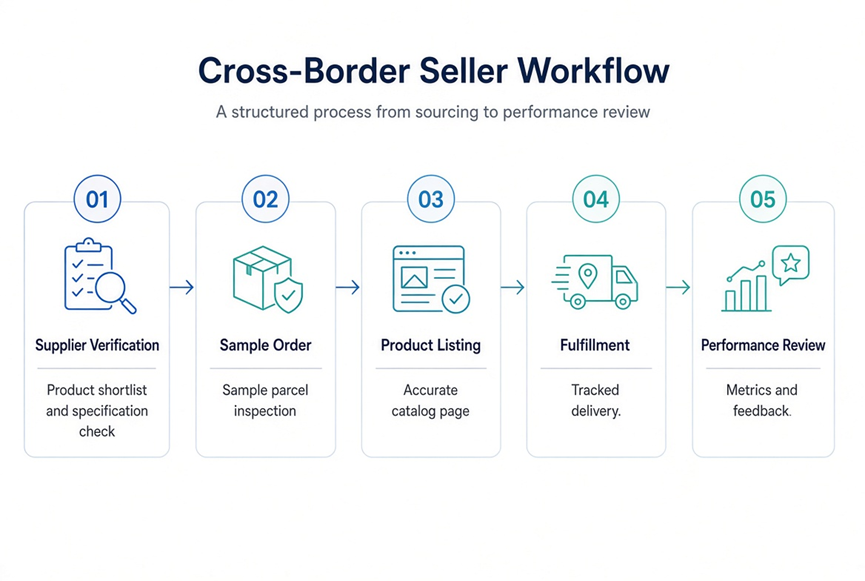
A Seven-Step Test Before You Scale
1. Confirm access. Check Shops eligibility, Marketplace commercial-use restrictions, and the shipping or checkout features actually available to your account and target market.
2. Choose a narrow product set. Start with a small group of items that serve one buyer need rather than uploading an entire supplier catalog.
3. Verify each item. Obtain accurate specifications, usable images, availability information, and evidence that the product and its claims comply with applicable rules.
4. Test fulfillment. Place a sample order to the destination market. Record dispatch time, tracking events, packaging quality, delivery time, and the process for resolving a problem.
5. Publish an honest offer. Explain dimensions, variants, total price, delivery expectations, and returns in language a buyer can understand quickly.
6. Measure outcomes. Monitor inquiries, completed orders, cancellations, delivery performance, returns, and contribution margin—not clicks alone.
7. Expand selectively. Move only products with dependable fulfillment and acceptable margins into a broader catalog or campaign.
This process also exposes a common sourcing mistake: treating “available from a supplier” as equivalent to “ready to sell.” A listing is ready only when the seller can stand behind the information and the post-purchase experience.
Can You Use Shops and Marketplace Together?
Yes—where your account and location permit it—but give each channel a distinct job. Marketplace can help you observe questions about an individual item. A Shop can organize a proven range around a consistent brand. We recommend adopting a “test-first, expand-later” strategy; however, it is important to note a key constraint: testing on the marketplace must comply with current platform rules and align with the seller’s actual fulfillment capabilities.
For example, a seller might learn that buyers ask repeatedly whether a desk organizer fits a particular drawer depth. That insight could improve product specifications, photography, and a related collection. It does not justify claiming local stock or rapid delivery when the order will ship from overseas.
Do not duplicate an offer mechanically across channels. Adapt the presentation to the buyer’s task while keeping the factual details consistent. A Marketplace listing may need an especially clear first image and concise dimensions. A Shop collection may benefit from coordinated images and a website page that explains variants and delivery.
How Looperbuy Fits the Workflow
For sellers sourcing from China, the central challenge is connecting product selection with an order experience they can reliably support. Looperbuy’s role in that workflow is sourcing and dropshipping support: helping merchants pursue product procurement and fulfillment without building a large inventory commitment upfront.
Use a prospective sourcing partner as part of your validation process, not as a reason to skip it. Ask for a product quotation, destination-specific shipping options, estimated processing and delivery windows, packaging details, tracking information, and an exception-handling process. Confirm which services are available for your products and markets before you publish customer-facing promises.
Ready to evaluate a product? Shortlist a few items, define your target country and required delivery window, then contact Looperbuy to discuss sourcing and dropshipping options. Build your Facebook offer around the terms you verify—not the fastest estimate you hope to achieve.
Frequently Asked Questions
1. Is Facebook Shops the same as Facebook Marketplace?
No. Shops is a business storefront built around a catalog and collections in Commerce Manager. Marketplace uses individual listings. The setup, presentation, and available purchase options differ.
2. Can a business sell on Facebook Marketplace?
Access is not uniform. Meta’s Commerce Policies identify restrictions that may affect people or businesses selling commercially in certain regions. Check the rules for your location and your account before using Marketplace as a business channel.
3. Can I dropship products sourced from China on either channel?
Do not assume that sourcing method alone determines eligibility. Check the relevant commerce rules, account features, product restrictions, and destination-market obligations. Whatever your fulfillment model, your pricing, availability, shipping expectations, and return information must be accurate.
4. Does a Facebook Shop let customers check out on Facebook?
Do not plan around that assumption. Meta’s current setup guidance says a Shop needs a checkout URL that moves customers to the checkout process on the seller’s website. Check the features available to your account before designing the purchase journey.
5. Is shipping available for every Marketplace seller?
No. Availability varies, and Meta notes that shipping features may be unavailable or disabled for an account. Verify access before offering a shipping-based product.
6. Which channel should a new seller try first?
Start with the channel you are eligible to use and can fulfill well. If Marketplace access and your delivery model align, a limited listing test may help answer product questions. If you already have a coherent product range, website checkout, and qualifying account, Shops may offer a better foundation for presenting the brand.
References
1. Doba, “[Facebook Shops vs Marketplace: Which is Best for Your Business?]”
2. Meta Business Help Center, “[Set up a shop on Facebook and Instagram]”
3. Meta Business Help Center, “[Commerce eligibility requirements]”
4. Meta Business Help Center, “[Supported countries for Shops on Facebook and Instagram]”
5. Facebook Help Center, “[Sell something on Facebook Marketplace]”
6. Facebook Help Center, “[Get started selling with shipping on Facebook Marketplace]” and “[Why shipping may have been disabled]”
7. Meta, “[Commerce Policies]” — product restrictions and regional cautions for commercial Marketplace activity.