Pre-order on Temu lets buyers reserve products before they are ready to ship. This guide explains how it works, why sellers use it, and what B2B buyers should check before ordering.
Pre-order on Temu means you can buy an item before it is ready for immediate shipping, usually because the product is still being produced, restocked, or prepared for launch. For shoppers, it is a way to secure in-demand products early; for sellers, it is a practical method to test demand, control inventory, and reduce the risk of overproduction.
For B2B buyers, the concept is even more useful. When sourcing products for resale, marketplace fulfillment, or seasonal campaigns, pre-ordering can help you reserve supply ahead of competitors and better coordinate cash flow, stock planning, and launch timing.
Table of Contents
What “Pre-Order” Means on Temu
A pre-order is essentially a reservation-based purchase. You place the order now, but the item ships later, once the seller completes production, replenishes inventory, or confirms availability.
On Temu, this label usually appears on products that are newly launched, limited in quantity, temporarily unavailable, or expected to return soon. In many cases, the listing should show an estimated ship date or availability window so buyers can decide whether the delay is acceptable.
The idea is simple: you secure the item in advance, then wait for fulfillment. That waiting period is the trade-off for early access, and it is often what makes pre-order attractive for products that are hard to get later.
How the Process Works
The buying experience for a pre-order item is usually similar to a normal purchase, with one important difference: fulfillment is delayed.
A typical process looks like this:
1. Select the pre-order item.
2. Choose the required options, such as size, color, style, or quantity.
3. Review the estimated ship date or delivery window.
4. Complete payment according to the listing’s checkout terms.
5. Wait for production, restocking, or preparation to finish.
6. Receive shipping updates once the item is ready to leave the warehouse.
This system is useful when a product is popular but not yet available in stock. It can also help buyers avoid missing out when supply is expected to move quickly once the item becomes available.
For buyers, the most important step is not checkout itself, but understanding the timeline before they click buy. A pre-order that fits your schedule can be valuable. A pre-order that misses your deadline can become a problem.
Why Temu Uses Pre-Orders
Temu’s pre-order model supports both buyer demand and seller planning. It is especially common in categories where timing, trend cycles, and stock availability matter.
The main reasons include:
– Demand testing, which helps sellers estimate how many units to produce.
– Inventory control, which reduces warehouse pressure and overstock risk.
– Early commitment, which allows sellers to secure orders before full launch.
– Faster sell-through, which is useful for trending or limited products.
– Launch planning, which helps sellers coordinate product release with marketing.
From a sourcing perspective, this is familiar to anyone working with manufacturers, wholesalers, or export suppliers. Many suppliers prefer to produce in batches based on demand signals, and pre-orders give them that signal early.
That makes pre-order logic especially relevant for B2B procurement teams, private label sellers, and cross-border e-commerce businesses.
Benefits for Buyers
Pre-ordering can be a smart decision when the item is worth waiting for.
The main advantages are:
– You can secure items before they sell out.
– You may get special pricing or limited-time promotions.
– You can access new launches earlier than general shoppers.
– You can plan inventory or campaign timing in advance.
– You may reduce the risk of missing a seasonal or trend-driven product.
For B2B buyers, the value is often even higher. If you are sourcing for resale or marketplace fulfillment, pre-ordering can help you lock in supply before competitors do. That is especially useful for products with strong demand curves, short trend windows, or limited manufacturing capacity.
In practical terms, pre-ordering can serve as a low-friction way to reserve supply without immediately committing to a large warehouse burden.
Risks and Trade-Offs
Pre-orders are useful, but they are not risk-free.
The biggest drawbacks are:
– Delivery is slower than standard in-stock orders.
– Ship dates may shift because of production or logistics delays.
– Product quality may be harder to verify before shipping.
– Cancellation rules may be stricter than normal orders.
– Customer expectations can be harder to manage if timelines change.
This is why pre-order should always be read as a timing commitment, not just a purchase confirmation. The item is secured, but it is not in your hands yet.
For businesses, that difference matters. If you need stock for a specific campaign, product launch, holiday season, or retail deadline, you should treat the estimated shipping date as a planning reference only. A small delay can affect sales, customer satisfaction, and fulfillment accuracy.
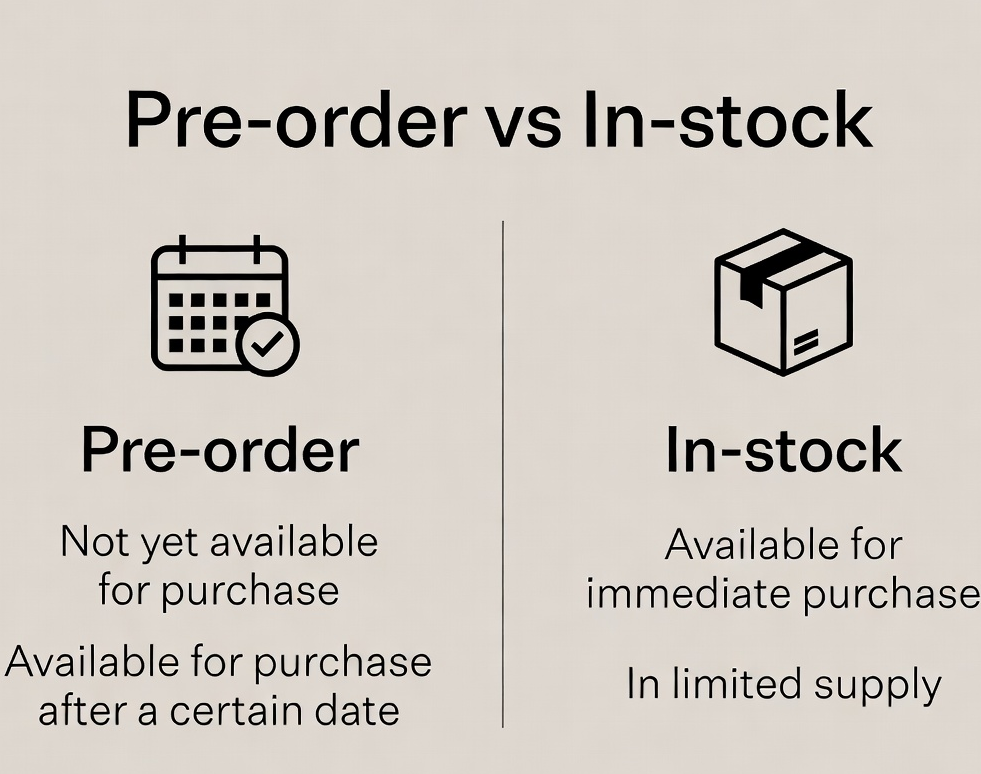
Pre-Order vs In-Stock
The difference between pre-order and in-stock is straightforward, but the implications are significant.
| Feature | Pre-Order | In-Stock |
| Availability | Not ready yet | Ready to ship |
| Shipping speed | Delayed | Faster |
| Best for | New launches, restocks, limited runs | Urgent purchases |
| Buyer risk | Higher timing uncertainty | Lower timing uncertainty |
| Seller benefit | Demand forecasting | Immediate fulfillment |
| Ideal use case | Planning ahead | Fast turnaround |
If your business depends on immediate turnover, in-stock products are usually safer. If your goal is to secure supply early, pre-order may be the better choice.
A useful rule of thumb is this: if timing is more important than price or exclusivity, choose in-stock. If exclusivity or early access matters more, pre-order may make sense.
When Pre-Order Makes Sense
Pre-order is most useful when the product has a clear demand story.
Good use cases include:
– Seasonal products before peak demand.
– New product launches with strong market interest.
– Limited-edition or fast-selling items.
– Restocked bestsellers that tend to sell out quickly.
– Test orders for market validation or private label launches.
– Products tied to a specific event, holiday, or promotional cycle.
For example, a seller preparing for a holiday campaign might use pre-order supply to secure stock before the season begins. A marketplace seller might use it to protect a product launch from stock-outs. A sourcing team might use it to validate demand before placing a larger bulk order.
In each case, pre-order is most valuable when demand is predictable and the waiting period is acceptable.
When Pre-Order Is a Bad Fit
Pre-order is not the right choice for every situation.
It is usually a poor fit when:
– You need the product immediately.
– Your event or campaign date is fixed and non-negotiable.
– You cannot tolerate shipping delays.
– The product quality has not been verified by enough reviews.
– The seller’s history is unclear.
– You need a reliable backup for urgent fulfillment.
For businesses, this is especially important. A product that arrives late can damage a launch plan or create customer dissatisfaction. That is why pre-order should be part of a broader sourcing strategy, not your only supply option.
If you are buying for a deadline, you should always build a buffer into your timeline. Even a few days of delay can matter in fast-moving e-commerce or B2B resale.
What B2B Buyers Should Watch
For B2B procurement teams, a pre-order listing should be evaluated differently from a consumer impulse purchase.
The key question is not just “Do I want this?” but also “Can my business absorb the wait?”
Important factors include:
– Lead time fit, meaning the estimated ship date must align with your sales plan.
– Cash flow impact, especially if payment is collected early.
– Demand certainty, which matters if you are stocking for a campaign.
– Supplier consistency, because repeated delays can hurt trust.
– Replacement risk, in case you need an alternative source quickly.
– After-sales support, especially if the item is for resale.
This is where a sourcing platform like Looperbuy becomes especially relevant. A B2B buyer is not just looking for products; they are looking for timing, reliability, and a supply chain that works at scale.
In practice, that means pre-order can be helpful when used strategically, but it should always be paired with a clear procurement plan.
A Practical Buyer Checklist
Before placing a pre-order, buyers should slow down and verify a few basics.
Use this checklist:
1. Read the full product description carefully.
2. Check the estimated shipping or release date.
3. Review seller ratings and order history.
4. Confirm whether cancellation is possible.
5. Understand whether payment is charged immediately or later.
6. Make sure the product fits your timeline.
7. Look for signs of promotional pricing, bundle value, or limited availability.
8. Consider whether a backup source is needed.
For bulk buyers and sourcing teams, this checklist is essential. A small delay can affect launch timing, marketplace rankings, and customer satisfaction.
One helpful practice is to compare the pre-order listing against your internal delivery deadline. If the gap is too narrow, the risk may not be worth it.
How to Read a Pre-Order Listing Properly
Many buyers focus only on price, but the real value is hidden in the fine details.
Pay attention to:
– The estimated ship date.
– Whether the listing says “pre-order,” “backorder,” or “coming soon.”
– Any notes about manufacturing lead time.
– Seller communication about delays or restocks.
– Return and cancellation terms.
– Whether stock quantity is limited.
These details tell you how trustworthy the listing is. A clear listing with transparent timing is usually more reliable than a vague one.
If the seller provides no timeline at all, that is a warning sign. In those cases, it may be better to wait or source from another supplier.
Charging and Payment Timing
One detail many buyers overlook is when payment is actually collected.
Depending on the platform and seller policy, pre-orders may be charged:
– Immediately at checkout.
– Through a temporary authorization hold.
– When the item is ready to ship.
For buyers, this matters because it affects cash flow and planning. For B2B teams, that is especially important when multiple orders are open at once.
If early payment is required, you should confirm whether the platform offers protection if the item is delayed or not delivered. If payment is delayed until shipment, the buyer has more flexibility, but should still verify that the order remains valid.
The key is to know the terms before purchasing, not after.
How Sellers Benefit from Pre-Orders
Pre-orders are not just a buyer convenience. They also help sellers operate more efficiently.
For sellers, the advantages include:
– Better demand forecasting.
– Lower risk of overproduction.
– More accurate inventory planning.
– Earlier revenue visibility.
– Stronger launch anticipation.
– Reduced storage pressure.
That is why pre-order is common in categories such as fashion, electronics, home goods, and limited-run products. It allows sellers to avoid guessing blindly and instead respond to actual demand.
In a manufacturing context, pre-order logic also supports production scheduling. If a seller knows that 500 orders are already reserved, they can plan materials, labor, packaging, and shipping more effectively.
How B2B Teams Can Use Pre-Orders Strategically
For B2B companies, pre-order is not just a shopping feature. It can be part of a larger procurement and inventory strategy.
You can use it to:
– Test demand before ordering larger quantities.
– Secure early stock for seasonal campaigns.
– Reserve trending items before they go mainstream.
– Reduce warehouse overload.
– Improve pricing by committing earlier.
– Match inventory arrival with your sales calendar.
This approach works best when you already understand your customer demand patterns. If you know that a product sells well in a certain season, a pre-order can help you prepare ahead of the curve.
It also works well when your business wants to avoid excessive inventory carrying costs. Instead of filling your warehouse with uncertain stock, you can commit earlier and wait for controlled fulfillment.
Practical Example
Imagine a retailer preparing for a summer campaign.
A summer accessory becomes popular, but the supplier only has pre-order availability. The buyer places the order in advance, confirms the estimated ship date, and aligns it with the planned campaign launch.
If the ship date fits the campaign window, the pre-order is useful. If the campaign starts before the item arrives, the order becomes a liability.
That is why pre-order is not just about availability. It is about timing, planning, and operational fit.
The same logic applies to B2B sellers, marketplace operators, and wholesale distributors.
Need reliable China sourcing without the burden of heavy inventory? Explore how Looperbuy helps B2B sellers source smarter, reduce warehousing pressure, and manage fulfillment more efficiently.
FAQ
1. What does pre-order mean on Temu?
It means the item can be purchased before it is ready to ship, usually because it is not yet in stock or is still being prepared for release.
2. Does pre-order mean I will definitely get the item?
Not always, but it usually improves your chances of getting it before it sells out. Delays or cancellations can still happen if production or supply changes.
3. Why do pre-order items take longer?
Because the seller may still need time for production, quality checks, packaging, or restocking before shipping begins.
4. Can I cancel a Temu pre-order?
In many cases, yes, but cancellation usually depends on timing and the seller’s policy. It is easier before shipping starts.
5. Is pre-order good for B2B buyers?
Yes, when you want to secure demand-driven products early and your launch schedule can absorb the wait. It is less suitable when you need immediate fulfillment.
6. Do pre-order items come with better pricing?
Often they do, because sellers may use early pricing to encourage demand and reward buyers who commit before the item is widely available.
7. How should a sourcing team evaluate a pre-order product?
Look at lead time, seller reputation, payment terms, cancellation rules, and whether the expected arrival date matches your business needs.
References
1. Global Sources Knowledge. What Does Pre-Order Mean on Temu: Your Shopping Guide. [globalsources]
2. Alibaba.com Reads. What Does Preorder Mean on Temu? [alibaba]
3. Attached source material provided by the user. [globalsources]
-1-700x490.jpeg)