Discover ten Amazon product ideas for China-sourced sellers—and learn how to test demand, calculate real margins, check compliance, and choose a reliable fulfillment workflow before you list. A practical guide for sellers who want fewer costly guesses and better product decisions.
The best products to sell on Amazon are not necessarily the products at the top of today’s bestseller list. For a seller sourcing from China, a promising product must also survive a landed-cost calculation, arrive as described, meet the destination market’s requirements, and work with your fulfillment model.
*Editorial note: The product ideas below are candidates for research, not verified current bestsellers. Examples and calculations are illustrative, not Looperbuy sales results.*
Table of Contents
What Makes a Product Worth Selling?
It is generally recommended to choose products that are compact and lightweight, priced between $25 and $50, easy to quality-control, and in demand year-round. While this advice is useful, it is not a universal rule.
A better starting question is: Can this specific product solve a customer problem at a price that covers every cost and risk? Check five dimensions:
– Demand: Do relevant searches and purchases persist beyond a short-lived trend?
– Competition: Can you offer a meaningful improvement, rather than another identical listing?
– Margin: What remains after sourcing, shipping, selling fees, advertising, and returns?
– Operational fit: Can the supplier maintain quality, stock accuracy, and delivery promises?
– Compliance: Are the product, claims, documents, and listing permitted in your target marketplace?
Amazon’s Product Opportunity Explorer can help sellers examine search behavior, competition, reviews, returns, and unmet customer needs. Amazon cautions that its insights guide decisions; they do not guarantee sales. Treat any attractive niche as a hypothesis to test.
Ten Amazon Product Ideas to Validate
Each category listed below is broken down into specific and testable product entry points. None is automatically low-competition or profitable. Actual performance depends on the marketplace, listing, supplier, price, and fulfillment method.
| Product idea | A more focused angle | Main question before launch |
| Consumer electronics | A clearly specified, non-battery accessory | Are compatibility and product documentation accurate? |
| Smart cameras | A camera with a documented setup process | Can you support connectivity questions and returns? |
| Garment steamers | A compact steamer for a defined use case | Can you verify electrical safety and shipping requirements? |
| Clothing, jewelry, and shoes | A size-specific or material-specific niche | Will sizing, authenticity, and returns erode margin? |
| Phone cases | Cases for a precisely identified device model | How will you avoid obsolete or incorrect variants? |
| Mini projectors | A projector with transparent brightness specifications | Do samples match the listing’s performance claims? |
| Beauty and personal care | A compliant, clearly labeled accessory | Do ingredients or product claims trigger restrictions? |
| LED mirrors | A size-specific mirror with protective packaging | What is the breakage rate after real-world shipping? |
| Pet fountains and supplies | A replaceable-filter fountain system | Can you supply compatible filters and handle faults? |
| Sports and outdoor gear | A compact accessory for one activity | Does its intended use raise a safety requirement? |
Electronics, Cameras, and Projectors
Electronics can appeal to buyers seeking a specific function, but specifications create expectations. A camera’s app compatibility, a projector’s brightness, and an accessory’s supported devices should be checked against a physical sample—not copied unverified from a supplier catalog. Ask for model numbers, operating instructions, packaging details, and applicable documentation before drafting claims.
For a first test, a simpler accessory may be easier to inspect than a connected device. That is an operational judgment, not a claim that accessories sell better. Amazon’s US compliance guidance makes sellers responsible for their listings and supporting documentation; it also identifies various electrical and battery-related products as subjects of specific requirements.
Apparel, Cases, and Everyday Accessories
Apparel, jewelry, shoes, and phone cases offer many ways to differentiate through fit, materials, and design. They also multiply variants. A listing with five colors and six sizes is not one simple product: it is a stock-accuracy and returns challenge across many combinations.
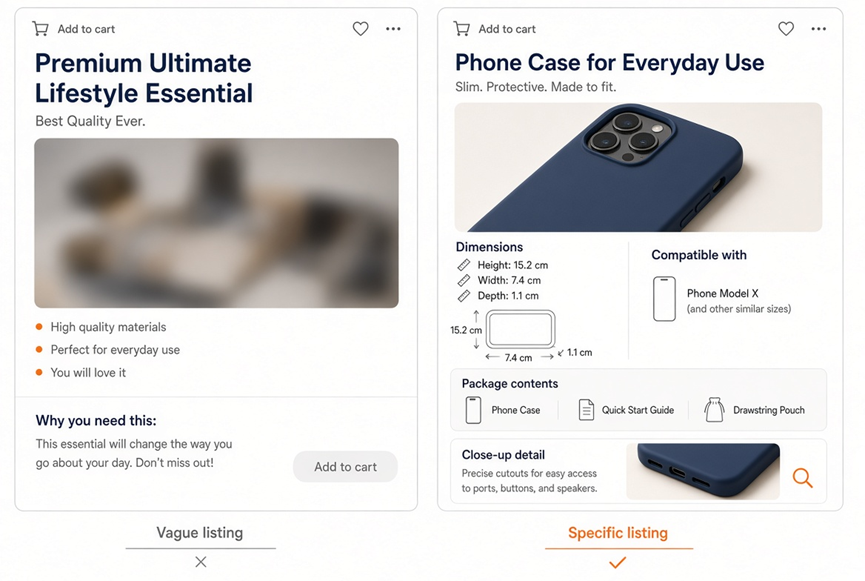
Start with a narrow customer need. For example, specify the exact phone models a case fits, photograph the cutouts, and confirm that the supplier’s labels match each variant. For apparel, build measurements from the actual sample and explain how to use them. Avoid assuming that a fashionable design—or an apparent bestseller—will preserve its demand long enough to justify a large order.
Home, Beauty, Pet, and Outdoor Products
The remaining ideas—steamers, beauty products, LED mirrors, pet fountains, and sports gear—serve different buyers, yet share a useful research method: look for recurring complaints. A leaky reservoir, unclear assembly instructions, or inadequate protective packaging may reveal a way to improve the offer.
Do not translate these opportunities into unsubstantiated performance claims unless the specific products and claims are supported by sufficient evidence. Check category and product restrictions before listing; Amazon states that an unintentional restricted-product listing can still lead to enforcement.
How to Find a Better Niche
A product list is only the beginning. Use this repeatable workflow to turn broad categories into shortlist candidates:
1. Start with a customer task. “Keep a cat’s drinking water available” is more useful than “sell pet products.” It points toward capacity, cleaning, filter replacement, and noise questions.
2. Search the target Amazon store. Record comparable products, prices, variants, stated delivery times, and common review complaints. Look at more than one listing; a single competitor may be an outlier.
3. Check niche data. In Product Opportunity Explorer, compare search and purchasing trends, saturation, reviews, and return activity where available. Seasonal spikes require a different inventory plan from steady demand.
4. Write one testable improvement. Examples include clearer sizing, a better instruction sheet, sturdier packaging, or a reliably available replacement part.
5. Request supplier evidence. Obtain samples, specifications, packing details, lead times, and relevant compliance documents. Inspect what customers will actually receive.
Amazon’s Best Sellers Rank describes sales position relative to products in a category; it is not a profit figure. Sales estimators can help frame a range of possibilities, but their outputs remain estimates. Pair demand signals with your own cost and quality checks.
This workflow also prevents a common mistake: researching a broad term such as “LED mirror” and treating every result as a direct competitor. A travel-size mirror, wall-mounted mirror, and rechargeable tabletop mirror may differ substantially in price, breakage exposure, and buyer expectations. Define the product before interpreting the data.
Calculate Profit Before You Source
A selling price is not a margin. Amazon’s referral fees vary by fee category, and its Revenue Calculator lets sellers compare estimated costs for Fulfillment by Amazon (FBA) and their own fulfillment method. Verify the applicable fees for the exact product rather than applying one percentage to an entire niche.
For an initial decision, use:
Estimated contribution per order = selling price − product cost − shipping and handling − Amazon fees − advertising allowance − expected returns allowance − other per-order costs.
Consider a hypothetical phone-case order:
| Item | Illustrative amount |
| Selling price | $24.00 |
| Product and packaging | −$5.00 |
| Shipping and handling | −$4.50 |
| Assumed marketplace fees | −$3.60 |
| Advertising allowance | −$2.50 |
| Returns and defects allowance | −$1.20 |
| Estimated contribution | $7.20 |
The $3.60 fee is an assumption for this example, not a quoted fee for phone cases. This calculation also excludes some possible costs, such as software, payment conversion, duties where applicable, or overhead. Before launch, replace every assumption with a current quote or calculator result and test what happens if shipping rises or the selling price falls.
Compare fulfillment models separately. With FBA, you purchase inventory and send it into Amazon’s network. With dropshipping, a supplier fulfills customer orders, so you may avoid buying inventory upfront but have less direct control over packing and shipping. Amazon describes using the models in combination—for example, testing a product through dropshipping before considering inventory for a faster-selling item.
Make China Sourcing Work on Amazon
For a China-sourced dropshipping product, the supplier relationship is part of the customer experience. A low unit price cannot rescue an order that arrives late, damaged, or with the wrong seller identified.
Amazon says dropshipping is allowed when its policy is followed. Its guidance calls for an agreement identifying you as the seller of record, no third-party seller references on packaging or accompanying materials, and seller responsibility for returns and customer service. An Amazon Seller Central representative further specifies the need to address packing slips, invoices, and external packaging with the supplier. Confirm the current rules for the marketplace where you sell.
Before listing a supplier-fulfilled item, run this practical check:
– Order a sample to the destination market. Inspect the product, insert, exterior packaging, and delivery experience.
– Agree on the shipment identity. Document how packing slips, invoices, and packaging will identify your business.
– Confirm stock updates. Set a process for unavailable variants and canceled orders before customers encounter them.
– Test tracking and delivery estimates. Base customer-facing promises on observed service, not the fastest quoted scenario.
– Define the returns path. Specify who receives returns, who inspects defects, and how evidence is shared.
– Keep compliance records. Confirm which documents apply to the exact item and destination before publishing claims.
If you are evaluating Looperbuy as a China sourcing and fulfillment partner, use that checklist in the first conversation. Ask for a sample-order workflow, a written packing arrangement, destination-specific shipping options, and a clear returns process. Do not assume any platform can make a noncompliant product or shipment compliant merely by handling fulfillment.
A Sensible First Launch
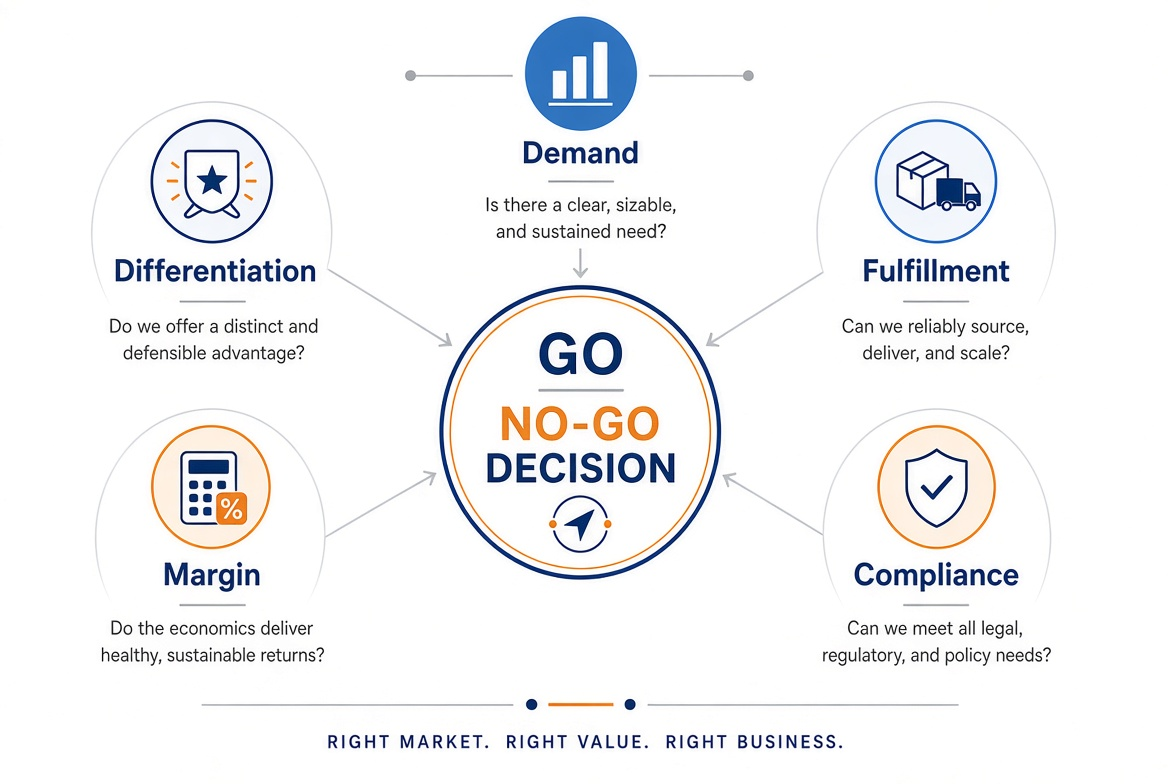
Rather than launching all ten categories, choose two or three tightly defined products. For each, complete the same research sheet: target customer, competing listings, one proposed improvement, supplier quote, sample findings, compliance questions, delivery test, and conservative per-order contribution.
Then make a go/no-go decision. Reject an idea if its margin depends on perfect shipping, if the supplier cannot provide required documentation, or if the product description cannot honestly match the sample. A failed sample is cheaper to resolve than a wave of disappointed customers.
Once live, review the signals that matter to the product: wrong-size returns for apparel, compatibility questions for phone cases, breakage for mirrors, or setup complaints for cameras. Use those findings to revise the listing, supplier specification, or packaging. The best product to sell on Amazon is often not a category you discovered once; it is an offer you can improve and fulfill consistently.
Ready to test a China-sourced product? Bring your shortlist, target marketplace, and expected selling price to Looperbuy. Request sample and fulfillment details first, then compare the resulting costs and shipment requirements before committing to a listing.
Frequently Asked Questions
1. What is the best product to sell on Amazon as a beginner?
There is no universal winner. Start with a precisely defined product you can inspect, describe accurately, source consistently, and evaluate after all fees. Use Amazon’s niche and cost tools to test the opportunity rather than selecting a product solely from a bestseller list.
2. Can I dropship products sourced from China on Amazon?
Amazon permits dropshipping within its policy framework. You must address seller-of-record identification, third-party references on shipment materials, returns, and customer service with your supplier. The product must also satisfy applicable marketplace and legal requirements.
3. Is FBA the same as dropshipping?
No. FBA requires you to purchase and send inventory into Amazon’s fulfillment network. Dropshipping typically has a supplier fulfill orders without you holding that inventory. The costs and level of control differ, so compare both models for the particular product.
4. Are lightweight products always more profitable?
No. Smaller parcels may be easier to ship, but profit still depends on sourcing cost, marketplace fees, advertising, returns, and the achievable selling price. Calculate contribution per order using the actual dimensions and fulfillment method.
5. Should I avoid electronics and beauty products?
Not necessarily. They warrant more careful checks because an item’s specifications, claims, ingredients, or safety documentation may affect whether and how it can be sold. Check the exact product’s requirements before sourcing or listing it.
6. How do I tell whether demand will last?
Review trends over time, seasonality, competing offers, customer reviews, and return activity rather than trusting one week’s ranking. Amazon’s Product Opportunity Explorer provides several of those signals, but no tool can promise future sales.
References
1. Doba, “[10 Best Products to Sell on Amazon].”
2. Amazon, “[Product Opportunity Explorer].”
3. Amazon, “[7 Free Amazon Sales Estimator Tools and How to Use Them]”
4. Amazon, “[How to Dropship on Amazon in 2025],”
5. Amazon Seller Central, “[Dropshipping Policy].”
6. Amazon, “[Standard Selling Fees].”
7. Amazon Seller Central, “[Safety, Compliance, and Product Restrictions].”