Table of Contents
Every product that reaches a customer tells two stories
One story is about how it got there—the suppliers, freight routes, warehouses, and delivery vans. The other story is about why the customer chose it over everything else.
As a B2B sourcing strategist who has spent over fifteen years helping international brand owners, wholesalers, and manufacturers navigate global procurement, I have seen countless businesses mistake one story for the other. They optimize logistics to death, yet struggle to differentiate. Or they build beautiful value propositions, only to bleed margins on fulfillment.
The confusion between value chain versus supply chain is not academic. It is the difference between moving boxes and building businesses.
The critical distinction too many procurement leaders overlook
Let me cut through the noise.
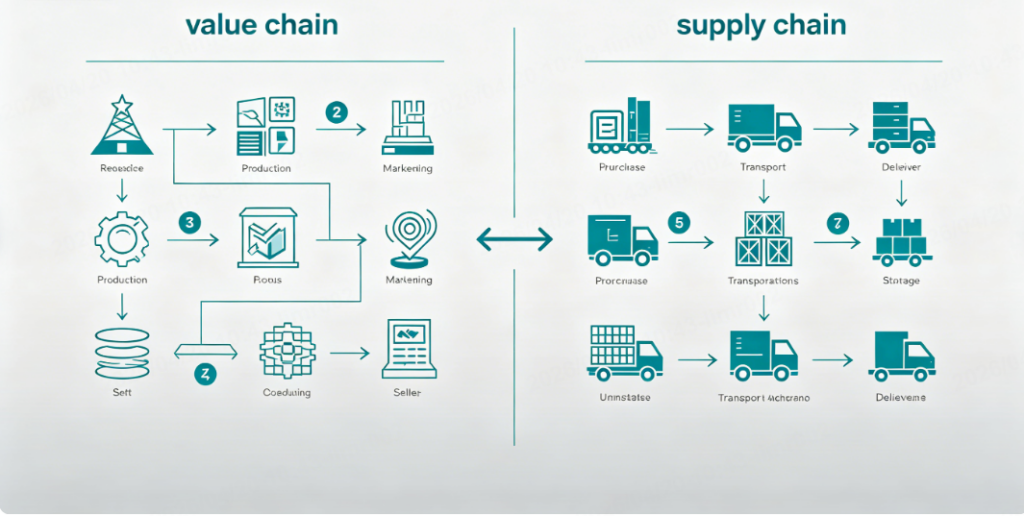
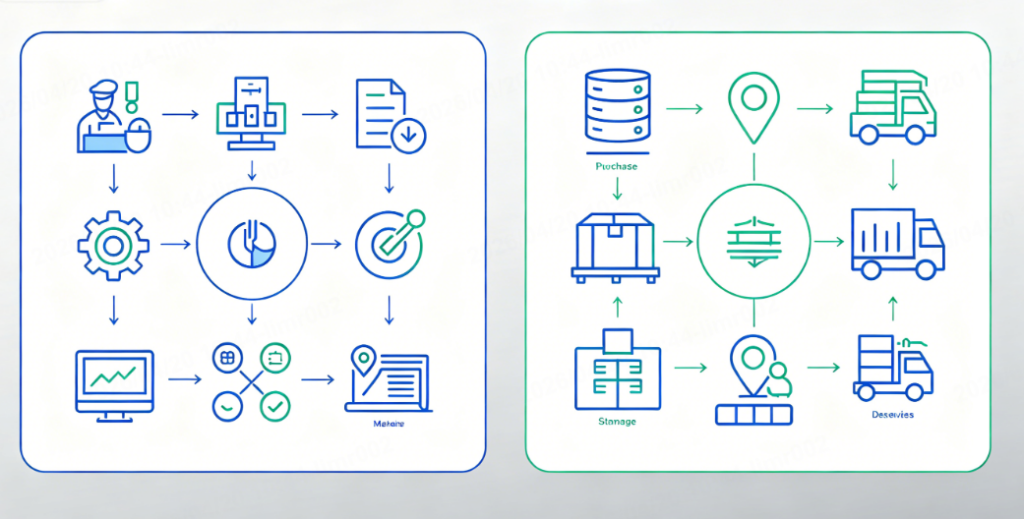
A supply chain focuses on the efficient flow of goods from raw materials to end customers—sourcing, production, warehousing, transportation, and delivery. Its goal is operational: getting the right product to the right place at the right time at the lowest possible cost.
A value chain, by contrast, asks a different question: How does each step—from product design and marketing to after-sales support—create meaningful value for the customer? Introduced by Michael Porter, the value chain framework examines both primary activities (inbound logistics, operations, outbound logistics, marketing, service) and support activities (technology, HR, procurement) to identify where competitive advantage actually lives.
Here is the truth most sourcing guides will not tell you: You cannot manage what you do not measure, and you cannot measure what you do not distinguish.
A supply chain ensures reliability. A value chain ensures relevance. One protects your margins; the other multiplies them.
But the magic happens when they work together.
Why the “value chain versus supply chain” question matters more in 2026
Global supply chains have entered an era of structural volatility. According to the World Economic Forum’s Global Value Chains Outlook 2026, three in four business leaders now prioritize resilience as a driver of growth, and competitive advantage comes from “foresight, optionality and ecosystem coordination”.
The numbers are sobering: 79% of supply chains expect costs to be a major disruption in 2026, with material, shipping, and labor pressures nearly doubling since 2024. Over 90% of US- and China-based networks were heavily hit by tariffs in 2025 alone.
In this environment, treating supply chain management as purely operational—and value chain thinking as purely strategic—is a luxury few can afford. The winners are those who embed value creation into every sourcing decision.
The sourcing paradox: more control, less guesswork
Here is where most B2B buyers get stuck.
Traditional procurement forces you into a false choice: order enough to justify logistics costs and supplier relationships, or test small and accept higher per-unit expenses and unpredictable lead times.
I have seen it happen more times than I can count. A furniture importer orders five hundred units of a new design, hoping for a hit, only to watch four hundred and twenty gather dust in a warehouse. A beauty brand tests one hundred units, sells out in three days, then faces a two-thousand-unit minimum order from their supplier—and watches demand crater after they commit.
The real pitfall of test selling is not selling nothing. It is losing control between ordering too much and ordering too little. One leads to cash tied up in dead stock. The other leads to lost revenue and broken customer trust.
The solution is not better guessing. It is a procurement model that eliminates the guess entirely.
From rigid minimums to flexible sourcing: a practical shift
What if you could start with fifty units instead of five hundred? What if, when a product took off, you could replenish two hundred units within days—without renegotiating terms or switching suppliers?
That is the difference between a rigid supply chain and an adaptive value chain.
LooperBuy’s one-stop B2B sourcing platform was built specifically to bridge this gap. By connecting global buyers with vetted Chinese suppliers, offering an unparalleled range of products, and delivering seamless global logistics, it transforms the sourcing equation.
Here is how the model works in practice:
- Low minimum order quantities (MOQs): Fifty or one hundred units are welcome. You test markets without betting the warehouse.
- Multi-supplier redundancy: The same product is sourced from multiple suppliers. One runs out? Another steps in immediately.
- Demand-based scaling: When data confirms a winner, you increase volume without finding new factories or renegotiating prices. Larger batches bring lower costs, seamlessly.
- Integrated fulfillment: Small-batch packing, sorting, and shipping are handled in-house. No more “small orders get ignored” syndrome.
This is not about chasing the absolute lowest cost. It is about controlling the biggest risk—so you can grow with confidence, not anxiety.
What global buyers are demanding right now
The 2026 sourcing landscape has shifted decisively. Buyers no longer settle for low wholesale prices alone. They want shorter lead times, frictionless customs experiences, and transparent trading.
Industry research shows that buyers using B2B digital matchmaking platforms have shortened their average procurement cycle by 30%. This efficiency gives importers the confidence to adopt flexible sourcing strategies—smaller-batch, higher-frequency restocking—which significantly reduces warehousing costs.
Meanwhile, 74% of businesses plan further digitization investments in 2026, with quality and compliance as top priorities. And 43% of supply chains shifted sourcing locations in 2025, with tariff-affected companies twice as likely to diversify—and far more likely to grow buying volumes as a result.
The message is clear: Rigid, opaque supply chains are losing ground to agile, transparent value chains.
Where supply chain ends and value chain begins—in real procurement decisions
Let me give you a concrete example.
A European home goods brand wanted to test a new line of modular shelving. Traditional sourcing would have required committing to a full container—hundreds of units—before seeing any customer response. The brand would have been guessing.
Instead, they used a flexible sourcing model: start with fifty units across three colorways, shipped via a cost-effective but faster-than-sea logistics option. Within three weeks, two SKUs showed clear demand signals. The brand increased those orders to two hundred units, shifted the high performers to ocean freight for better margins, and kept the slow movers on the flexible lane.
Within two months, they had a stable, profitable product line—without a single warehouse of dead stock.
That is the difference between a supply chain that moves goods and a value chain that creates value at every step.
Supply chain asks: “How do we ship this cheapest?”
Value chain asks: “How do we get the right information, to the right place, at the right time, to make the smartest procurement decision?”
The future of B2B sourcing belongs to the adaptable
Global value chains are being rewired by geopolitics, industrial policy, the energy transition, and technological acceleration. Volatility is no longer temporary. It is structural.
In this environment, competitive advantage belongs to those who combine operational excellence with strategic flexibility—who understand that value chain versus supply chain is not a competition but a partnership.
The best sourcing strategies do not force you to choose between efficiency and resilience, or between low cost and high value. They integrate both.
Your next step as a B2B buyer
Stop guessing. Start testing.
The smartest procurement decision you can make in 2026 is to build a sourcing model that lets you learn before you scale. That means:
- Small batches to validate demand
- Multi-supplier backup to eliminate single points of failure
- Integrated logistics that treats small orders with the same care as large ones
- Data-driven replenishment instead of gut-feel ordering
Whether you are sourcing industrial components, consumer goods, or custom manufacturing parts, the principle is the same: flexibility is not a luxury. It is a survival skill.
LooperBuy’s one-stop B2B sourcing platform is designed to deliver exactly that—giving global brand owners, wholesalers, and manufacturers direct access to China’s manufacturing ecosystem with convenient, cost-effective logistics and procurement terms that actually make sense for modern business.
The question is not whether to source from China. The question is how wisely.
References
- 12manage. (2026). Value Chain Management versus Supply Chain Management. Available at: https://www.12manage.com
- FourWeekMBA. (2026). Supply Chain In A World Driven By Bits. Available at: https://fourweekmba.com
- ISM. (2026). Understanding Value Chain vs Supply Chain Differences. Available at: https://www.ism.ws
- Rhenus Group. (2026). Seven Global Supply Chain Trends Shaping 2026. Available at: https://www.rhenus.group
- Alibaba.com. (2026). The B2B Marketplace Boom in 2026. Available at: https://www.alibaba.com
- CIFF Furniture Fair. (2026). How Click2Connect Helps Exhibitors Reach More Global Buyers All Year. Available at: https://www.cifffurniturefair.com
- World Economic Forum. (2026). Global supply chains enter era of structural volatility. Available at: https://manufacturing.economictimes.indiatimes.com
- QIMA. (2026). 2026 Global Sourcing Survey: From Disruption to Opportunity. Available at: https://www.qima.com
- Brightpearl. (2026). Value Chain vs. Supply Chain: What’s the Difference? Available at: https://www.brightpearl.com
Frequently Asked Questions (FAQ)
Q1: What is the main difference between value chain and supply chain?
A: A supply chain focuses on the operational flow of goods from suppliers to customers—sourcing, production, warehousing, and delivery. A value chain, introduced by Michael Porter, focuses on how each business activity creates value for customers and builds competitive advantage.
Q2: Why does the value chain versus supply chain distinction matter for B2B procurement?
A: Confusing the two leads to misaligned priorities. Optimizing only the supply chain can lower costs but miss opportunities for differentiation. Optimizing only the value chain can create great products that fail due to poor logistics. The strongest results come when both work together.
Q3: What are the biggest supply chain risks in 2026?
A: According to the QIMA 2026 Global Sourcing Survey, 79% of supply chains expect costs to be a major disruption, with material, shipping, and labor pressures nearly doubling since 2024. Over 90% of US- and China-based networks were heavily hit by tariffs in 2025.
Q4: How can small and medium-sized businesses source from China competitively without large MOQs?
A: Flexible B2B sourcing platforms now offer low minimum order quantities (50–100 units), multi-supplier redundancy, and integrated fulfillment. This allows businesses to test markets with minimal risk and scale based on real demand data rather than guessing.
Q5: What is the single most important procurement strategy for 2026?
A: Replace guesswork with data-driven, flexible sourcing. Test small, validate demand, then scale. Rigid, high-MOQ supply chains are losing ground to adaptive models that prioritize learning over betting.
Article introduction (approx. 300 characters):
Confused about value chain versus supply chain? As a B2B sourcing expert with 15+ years of experience, I break down the critical difference, reveal why 79% of supply chains expect major disruptions in 2026, and show how flexible procurement eliminates guesswork. Stop betting on inventory—start sourcing smarter with LooperBuy.
High-search-volume B2B keywords (Hot tags):
B2B sourcing platform, China wholesale suppliers, cross-border procurement, global supply chain management, value chain analysis, B2B e-commerce trends 2026, international logistics solutions, supply chain diversification, flexible MOQ sourcing, one-stop B2B platform