Discover how to find reliable shoe manufacturers in China for private-label, OEM, ODM, wholesale, and fulfillment projects. This practical guide covers leading footwear companies, sourcing regions, MOQ, samples, factory verification, quality control, compliance, pricing, inventory risk, and cross-border fulfillment for global B2B sellers.
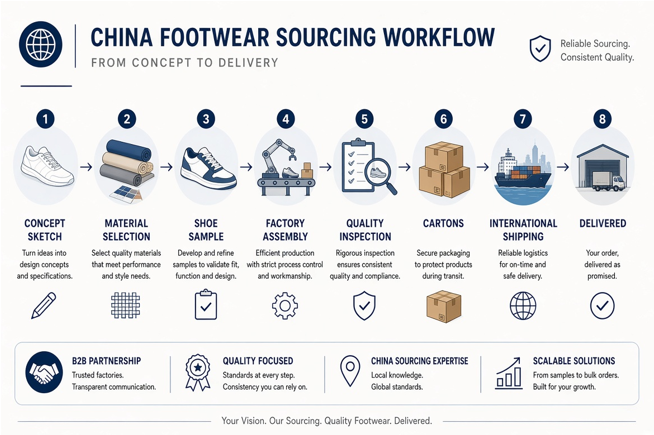
China remains one of the world’s most important footwear sourcing hubs, but choosing among shoe manufacturers in China requires more than comparing unit prices. The strongest buying decisions come from matching a factory’s product specialization, quality controls, commercial terms, compliance capability, and fulfillment model to your actual sales strategy.
For brands, wholesalers, retailers, and online sellers, China offers access to large-scale OEM and ODM footwear production across sneakers, leather shoes, sandals, work boots, children’s shoes, canvas footwear, and fashion styles. Yet the market is changing: export values have faced pressure even as China’s manufacturing ecosystem continues to offer exceptional breadth, speed, and supplier density. That makes supplier selection, sample validation, and inventory discipline more important than ever.
> Key takeaway: Do not select a shoe supplier solely because it has the lowest quote. Select the partner that can repeatedly deliver the agreed product, at the agreed quality level, with traceable materials and a workable delivery plan.
Table of Contents
Why Source Shoes From China?
China is not one single footwear cluster or one uniform type of factory. It is a deeply connected production ecosystem that brings together component suppliers, material mills, mold makers, sample rooms, assembly lines, packaging partners, inspection providers, and export logistics services.
That concentration can help buyers shorten the path from an initial product idea to a production-ready shoe.
1. Broad product and manufacturing capability
Chinese shoe manufacturers cover a wide range of categories, including:
– Athletic shoes and lifestyle sneakers
– Running shoes and basketball shoes
– Leather dress shoes and loafers
– Sandals, slippers, and EVA clogs
– Canvas shoes and vulcanized footwear
– Hiking, safety, and work footwear
– Children’s shoes and school shoes
– Private-label fashion footwear
– Eco-conscious footwear using recycled or lower-impact materials
A supplier that specializes in your category is normally more valuable than a general factory claiming to make every style. For example, a performance sneaker factory may have stronger experience with injection molding, outsole bonding, lightweight uppers, and fit testing. A leather-shoe factory may be better equipped for lasting, stitching, upper finishing, and material grading.
2. Scale remains a major advantage
China’s footwear supply chain is still highly significant in global trade. Industry reporting indicates that China exported approximately 7.42 billion pairs of footwear valued at about USD 34.5 billion in the first 10 months of 2025. This scale matters because it supports a broad supplier base, established component networks, and the ability to support both established brands and growing sellers.
However, total volume alone should not be mistaken for a guarantee of quality. The right question is not, “How many pairs can the factory make?” It is:
> “Can this factory make my specific shoe consistently, within my quality tolerance and delivery window?”
3. Flexible pathways for different business models
Buyers can use several sourcing models:
| Sourcing model | Best for | Main advantage | Main limitation |
| Ready-to-ship wholesale | Fast testing and low complexity | Faster launch | Limited differentiation |
| Private label | Sellers building a branded offer | Logo, packaging, and color customization | Existing silhouette may be shared |
| OEM | Brands with original designs or tech packs | Greater product control | Higher development cost and MOQ |
| ODM | Buyers needing design support | Factory helps develop the product | Design ownership and exclusivity must be clarified |
| Sourcing + fulfillment | E-commerce sellers minimizing inventory | Reduced warehousing and shipping complexity | Requires strong order-management coordination |
For online B2B sellers, using a sourcing and fulfillment partner can be especially practical when demand is uncertain. Instead of committing immediately to a large inventory position, sellers may be able to validate demand with smaller batches or customer orders before scaling.
Major Chinese Footwear Manufacturing Groups
The following companies are frequently recognized within China’s footwear and sportswear landscape. They represent different business models, including consumer brands, large OEM producers, and factories with strength in particular footwear categories. They should be treated as starting points for research—not automatic supplier endorsements.
| Company | Primary strength | Buyer relevance |
| Yue Yuen Industrial Holdings | Large-scale global footwear manufacturing | Relevant for major-brand-scale athletic and casual footwear production |
| Anta Sports Products | Sportswear and athletic footwear | Strong category knowledge in sports performance and lifestyle products |
| Li-Ning Company | Athletic footwear and apparel | Known for sports-oriented product development |
| Xtep International | Running and sports footwear | Relevant for athletic and mass-market sports segments |
| 361 Degrees | Sports footwear and apparel | Broad sports and lifestyle product positioning |
| Peak Sport | Basketball and athletic shoes | Notable athletic-footwear focus |
| Belle International | Fashion footwear and retail | Large footwear retail and brand footprint |
| Aokang Shoes | Leather footwear | Relevant reference point for men’s leather-shoe manufacturing |
| Kangnai Group | Leather shoes and exports | Known for traditional leather-footwear capability |
| Red Dragonfly Footwear | Leather and fashion footwear | Strong domestic footwear brand presence |
| Huili / Warrior-style canvas footwear producers | Canvas and casual shoes | Useful category benchmark for heritage-style canvas products |
| Jihua Group | Large-scale manufacturing and OEM | Relevant for institutional, workwear, and broader production capability |
Global Sources’ overview also identifies companies such as Daphne, Double Star, Camel, Feiyue, Fuzhou Bosheng Shoes, and Zhejiang-based footwear groups as notable names in China’s footwear market. The original list is useful for market mapping, but buyers should independently verify each company’s current export capability, ownership structure, product category fit, and willingness to accept external OEM or private-label projects.
Important distinction: brands are not always open OEM suppliers
A well-known footwear brand may manufacture for its own retail network, while a dedicated OEM factory may be more suitable for your private-label project. Before adding a company to your supplier shortlist, ask directly:
– Do you accept OEM, ODM, or private-label orders?
– What footwear categories do you produce in-house?
– What is your minimum order quantity by style, color, and size run?
– Can you share recent export-market experience?
– Which processes are performed internally and which are outsourced?
– Can you provide factory audit reports and product-testing documentation?
Where China’s Footwear Supply Chain Is Concentrated
Knowing the production region can make supplier research more efficient. Different footwear clusters have developed particular strengths through local labor skills, materials, equipment, and supplier relationships.
| Region | Common footwear strengths | What buyers should investigate |
| Fujian | Sports shoes, sneakers, EVA footwear, casual shoes | Outsole technology, athletic-shoe assembly, material sourcing |
| Guangdong | Fashion footwear, women’s shoes, sandals, export-oriented production | Design response speed, finishing quality, export logistics |
| Zhejiang | Leather shoes, fashion footwear, canvas shoes, casual styles | Upper materials, craftsmanship, smaller-batch flexibility |
| Wenzhou | Leather footwear and dress shoes | Lasting quality, leather sourcing, finishing consistency |
| Quanzhou and Jinjiang | Athletic footwear and sportswear ecosystems | Sports-shoe components, outsole suppliers, high-volume capacity |
| Putian | Sports and casual footwear ecosystem | Factory verification, intellectual-property controls, traceability |
A sourcing location should never replace supplier due diligence. A factory in a famous shoe-production city can still be the wrong partner if it lacks transparent quality controls, does not communicate clearly, or cannot document its material sources.
How to Choose a Reliable Shoe Manufacturer
A reliable shoe manufacturer should be evaluated through evidence, not sales language. The following framework is designed for buyers who need to reduce product, payment, compliance, and delivery risk.
Step 1: Create a complete sourcing brief
Before requesting quotations, prepare a detailed product brief. Vague requests create vague prices and unpredictable samples.
Your shoe brief should include:
– Product type and target customer
– Reference images or technical drawings
– Upper, lining, insole, outsole, and hardware materials
– Colorways and color standards
– Size range and grading requirements
– Branding placement and packaging requirements
– Target order quantity
– Target retail price and target landed cost
– Required testing or market compliance standards
– Desired production and delivery timeline
– Destination market and shipping preference
For OEM footwear, a professional tech pack is preferable. It should specify measurements, construction details, materials, colors, logo artwork, labeling, packaging, and quality expectations.
Step 2: Compare quotes on a like-for-like basis
A cheap quote can become expensive if it excludes molds, testing, packaging, freight, defect replacement, or material upgrades.
Ask every supplier to clarify:
1. Unit price at each quantity tier
2. Sample fee and sample lead time
3. Tooling or mold costs
4. MOQ by style, color, and size
5. Packaging and branding cost
6. Payment terms
7. Production lead time after sample approval
8. Incoterms, such as EXW, FOB, or DDP
9. Defect allowance and claim process
10. Testing, inspection, and compliance support
Example: Supplier A quotes USD 8.20 per pair, while Supplier B quotes USD 8.80. If Supplier A uses thinner upper material, charges separately for boxes, has a 5% defect tolerance, and cannot support third-party testing, Supplier B may offer the lower total risk and better commercial value.
Step 3: Inspect samples systematically
Never approve a sample only because it looks good in photos. Assess it as a product your customer will wear repeatedly.
Check:
– Upper-material feel, thickness, odor, and color consistency
– Stitching density, loose threads, and glue marks
– Sole bonding and edge finishing
– Toe shape, symmetry, and left/right pair consistency
– Size accuracy and fit comfort
– Flexibility and return-to-shape performance
– Insole attachment and internal finishing
– Logo accuracy and placement
– Carton strength, labeling, and barcode readiness
Create a sample scorecard with a pass/fail field for every critical feature. This makes revisions clearer and prevents subjective approval decisions.
Step 4: Verify quality systems and certifications
ISO 9001 certification can indicate that a manufacturer has established a quality-management system, but it is not proof that every shoe will meet your specification. It should be one part of a broader verification process that includes sample reviews, process checks, inspection, and documented corrective action.
Ask for evidence of:
– ISO 9001 or equivalent quality-management documentation
– Social compliance audits, where relevant to your brand
– Material test reports
– In-line and final inspection procedures
– Defect-rate targets
– Corrective-action reports for past quality issues
– Traceability for critical components and materials
For children’s footwear, buyers should assess market-specific chemical and safety requirements early. In the United States, children’s products may require testing through CPSC-accepted third-party laboratories for applicable rules. Restrictions can include lead and phthalates in relevant accessible materials or components.
Step 5: Conduct factory verification
A physical audit is ideal for larger or repeat orders. If visiting is not possible, use a credible third-party inspection company, live factory video tour, or a trusted China-based sourcing representative.
During verification, check:
– Factory address and business registration match
– Production lines and actual machinery
– In-house versus outsourced processes
– Material storage and labeling
– Sample room and development capability
– Quality-control checkpoints
– Worker conditions and safety practices
– Finished-goods storage
– Export documentation capability
– Production schedule and order-management process
Quality Control Plan for Footwear Orders
A robust quality plan should be established before bulk production—not after goods are packed.
Pre-production inspection
This stage confirms that materials, colors, logos, molds, labels, and approved samples match the purchase order.
Key checks include:
– Material swatches against the approved sample
– Outsole color and hardness
– Logo artwork and placement
– Size labels and care labels
– Packaging artwork
– Pre-production “golden sample” approval
During-production inspection
This inspection is normally conducted when a meaningful portion of the order is complete. It helps identify problems before the factory finishes every pair.
Focus on:
– Stitching and bonding consistency
– Pair matching
– Material defects
– Size grading
– Assembly accuracy
– Color consistency across batches
– Packaging readiness
Final random inspection
Before final payment or shipment release, use final random inspection based on an agreed sampling method, such as AQL. The inspection report should document defects by severity, quantity inspected, pass/fail result, photos, and corrective actions.
> Practical rule: Put the approved sample, acceptable defect levels, packaging specification, inspection timing, and remedy for failed inspection into the purchase contract.
Lower-Risk Inventory and Fulfillment Options
Traditional footwear importing often requires a large commitment: pay a deposit, wait for bulk production, ship cartons internationally, receive inventory, store it, and manage individual orders. That model can work for stable, proven products, but it can create cash-flow risk for fast-moving online sellers.
A sourcing and fulfillment workflow can offer a more flexible alternative:
1. Identify validated footwear suppliers and request samples.
2. Confirm product specifications, quality standards, and target pricing.
3. Test demand with a smaller quantity or controlled launch.
4. Hold only the inventory needed for near-term orders.
5. Use a fulfillment partner to consolidate goods, inspect products, store limited stock, and ship directly to customers or business buyers.
6. Reorder based on real sales data rather than forecasts alone.
For a platform such as Looperbuy, the value is not only finding a product. It is helping global B2B sellers coordinate China sourcing, purchasing, quality checks, inventory decisions, and cross-border fulfillment in one operational flow.
Common Mistakes to Avoid
– Choosing a factory based only on the lowest unit price
– Ordering bulk goods before approving a physical sample
– Assuming a famous brand is available for OEM production
– Failing to define materials, measurements, and packaging in writing
– Ignoring MOQ by color and size run
– Paying the full balance before final inspection
– Treating ISO certification as a substitute for product inspection
– Forgetting destination-market compliance requirements
– Underestimating shipping, duties, returns, and fulfillment costs
– Ordering too much inventory before validating customer demand
Final Thoughts
The best shoe manufacturers in China are not necessarily the largest names or the cheapest factories. They are the suppliers that can prove category expertise, communicate clearly, follow an agreed quality process, provide transparent pricing, and support the order volume your business can realistically sell.
For established importers, this may mean building a long-term OEM relationship with a specialized factory. For online sellers and growing B2B businesses, it may mean combining supplier selection with flexible procurement, quality control, and direct fulfillment to avoid unnecessary inventory exposure.
Ready to source footwear from China without carrying unnecessary stock or managing every fulfillment step alone? Looperbuy can help you identify suitable Chinese products, coordinate sourcing and purchasing, arrange quality checks, and support global delivery—so you can focus on building demand and serving your customers.
Frequently Asked Questions
1. What is the typical MOQ for shoe manufacturers in China?
MOQ varies widely based on the shoe type, materials, outsole tooling, colors, and size range. A ready-made private-label product may have a lower MOQ than a fully customized OEM shoe. Ask suppliers for MOQ by style, color, and size run rather than accepting one headline number.
2. How long does it take to manufacture shoes in China?
The timeline depends on product complexity, sample revisions, material availability, production capacity, and shipping method. A custom footwear project typically includes product development, sample approval, bulk production, inspection, and international delivery. Confirm each milestone in writing before placing an order.
3. Should I choose an OEM or ODM shoe manufacturer?
Choose OEM if you have original designs, specifications, and a defined brand vision. Choose ODM if you need a manufacturer to assist with product design or want to customize an existing factory model. In either case, clarify ownership of molds, artwork, designs, and exclusivity in the contract.
4. How can I verify a Chinese shoe factory?
Verify its business registration, factory address, production equipment, product specialization, customer references, export experience, quality procedures, and test documentation. For larger orders, arrange an on-site audit or use a qualified third-party inspection provider.
5. What quality tests should footwear buyers request?
Testing depends on the product type and destination market. Common areas include material safety, bonding strength, abrasion resistance, flex resistance, slip resistance, colorfastness, fit, durability, and chemical restrictions. Children’s shoes require particular attention to applicable safety and chemical requirements.
6. Can I source shoes from China without holding large amounts of inventory?
Yes. Many sellers begin with samples and small validation orders, then use sourcing, consolidation, storage, and fulfillment services to limit inventory exposure. This approach can reduce the capital tied up in products that have not yet proven demand.
7. Are Chinese shoe manufacturers still competitive in 2026?
Yes, particularly where buyers need supply-chain depth, diverse materials, specialized production, and scalable output. However, footwear export values faced a decline in 2025, making supplier efficiency, differentiation, quality assurance, and disciplined inventory planning increasingly important for buyers.
References
1. Global Sources. “[Top Shoe Manufacturers in China for Your Business Needs].”
2. World Footwear. “[Chinese Footwear Exports Decline in the First Quarter].”
3. APLF. “[China Footwear Industry Exports 7.42 Billion Pairs Worth $34.5 Billion in First 10 Months of 2025].”
4. Modaes. “[China Closes 2025 With a Drop in Fashion Exports Weighed Down by Garments and Footwear].”
5. Intertek. “[ISO 9001 Certification].”
6. SGS. “[ISO 9001 Certification – Quality Management Systems].”
7. Eurofins. “[Mastering US CPSIA Children’s Product Certificate: A Compliance Manager’s Guide].”