Procurement isn’t just about buying goods — it’s the engine that drives organizations. But whether you’re sourcing for a government agency or a private enterprise, the rules of the game are fundamentally different. Understanding the difference between public and private sector procurement is essential for suppliers, procurement professionals, and global buyers alike. If you’re sourcing from China, these differences directly impact your bidding strategy, compliance obligations, and supplier relationships. Let’s break down the seven most critical distinctions.
Table of Contents
Purpose and Core Objectives — Serving the Public vs Driving Profit
The most fundamental difference lies in why procurement happens in the first place.
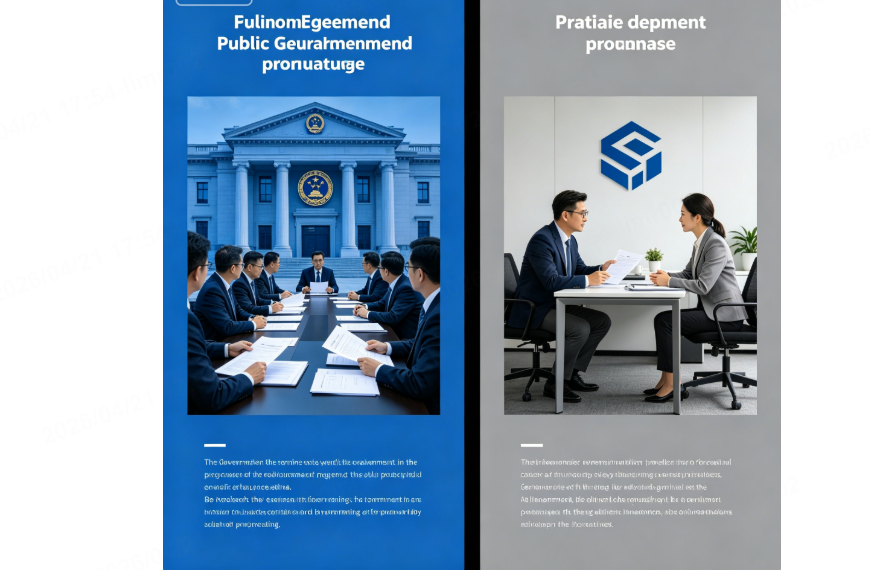
Public sector procurement is designed to support government operations and provide public services using taxpayer money [11†L12-L14]. Its primary goal is delivering value to the public — not maximizing profit. Public agencies focus on transparency, fairness, and accountability above all else.
In contrast, private sector procurement is funded by the company itself through owners and shareholders, with the core objective of optimizing cost, quality, and efficiency to enhance profitability and competitive advantage [11†L28-L36]. Every dollar saved drops directly to the bottom line.
💡 Key takeaway for global buyers: When bidding for public contracts, demonstrate how you deliver public value and compliance. When selling to private buyers, lead with cost savings, quality, and speed.
Regulatory Environment — Rigid Compliance vs Strategic Flexibility
If you’ve ever wondered why government tenders feel like navigating a maze while corporate purchases feel more like a conversation, here’s why.
Public sector procurement operates under a web of statutes, procurement regulations, and policy frameworks designed to ensure fairness, transparency, competition, and accountability [17†L35-L38]. In the UK, for example, the Procurement Act 2023 came into full force in February 2025, introducing a clearer, more flexible framework while still maintaining rigorous compliance standards [13†L5-L11]. From 1 January 2026, new threshold amounts for public contracts also took effect, governing which procurements fall under the full PA23 regime [12†L13-L15].
Private sector procurement, while still subject to commercial law and contract law, enjoys far greater autonomy in decision-making and process streamlining [8†L38-L39]. Companies can tailor procedures to their needs, use direct negotiation or selective bidding, and adjust processes rapidly [17†L20-L22].
📌 Industry insight: As Stephen Bauld, a government procurement expert, once put it: “Public sector procurement is about rules and regulations; private sector procurement is about saving money.” [0†L55-L57]
Contract Award Process — Competitive Bidding vs Negotiated Deals
This is where the difference between public and private sector procurement becomes most visible in day-to-day operations.
Aspect
Public Sector
Private Sector
Award method
Competitive bidding (tenders)
Negotiation or selective bidding
Transparency
Publicly advertised, auditable records
Internal, often confidential
Flexibility
Low — processes are standardized
High — tailor terms to needs
Speed
Slow — lengthy review cycles
Fast — agile decision-making
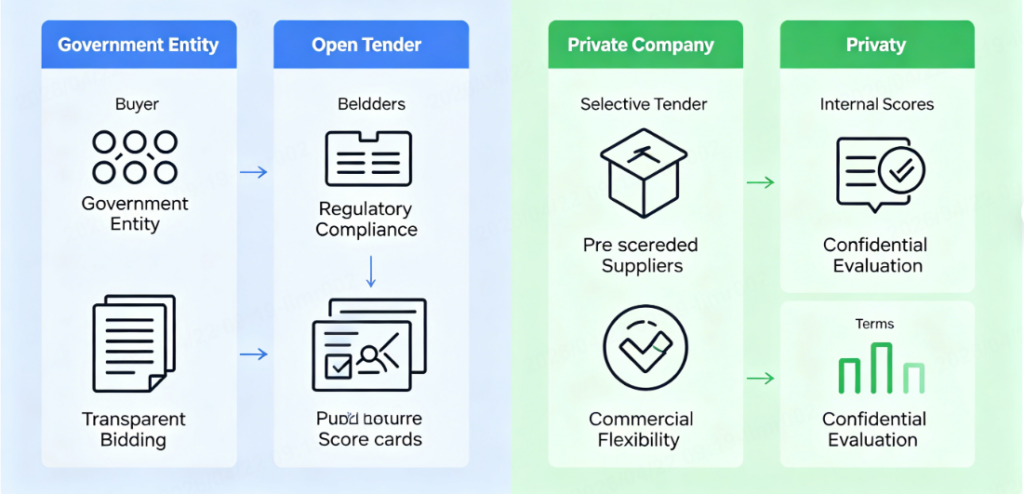
In the public sector, contracts are awarded through a formal tendering process with strict timelines, public advertisement of tenders, and predetermined evaluation criteria [17†L39-L42]. This ensures fairness but often sacrifices speed.
In the private sector, companies can negotiate directly with preferred suppliers, building long-term partnerships and tailoring contract terms to specific business needs [8†L27-L28].
Cost Management — Fixed Budgets vs Strategic Investment
Money talks — but it speaks a different language in each sector.
Public entities operate under strict budget constraints and intense financial scrutiny, necessitating thorough documentation and rigid spending controls [8†L41-L42]. The public nature of government budgeting means that interested suppliers can often determine the upset price for a proposed contract long before bidding [0†L26-L31].
Private organizations benefit from flexible budgeting, allowing them to prioritize quality, speed, and long-term value over rigid cost constraints [8†L43-L44]. Private sector procurement directors with strong negotiation skills are highly sought after and paid a premium, whereas public sector purchasing managers focus more on supervising processes and preparing reports [0†L33-L37].
📊 2026 update: According to ProcureAbility’s latest research, digital transformation and enhanced sustainability efforts now rank as the top strategic priorities for procurement leaders, with 65% of leaders listing digital transformation as their primary focus heading into 2026 .
Technology Adoption — Compliance-Driven vs Performance-Driven
Technology is reshaping procurement in both sectors — but for different reasons.
The public sector has widely adopted e-procurement systems to streamline operations, cut costs, and enhance transparency — a critical regulatory requirement [8†L29-L31]. These systems ensure that every transaction is traceable and auditable.
The private sector is increasingly turning to AI, blockchain, and analytics to drive supply chain efficiency, with expected cost reductions of up to 30% and better risk management [3†L23-L25]. Over 83% of global respondents believe AI will increase operational efficiency, while 81% expect it to automate significant elements of the procurement process [3†L33-L36].
However, AI maturity remains limited. A significant majority (72%) of procurement leaders rate their AI maturity as “moderate,” while only 6% claim to have reached an “advanced” state [15†L22-L25]. The real differentiator isn’t whether you’ve adopted AI — it’s how quickly and effectively you scale it [15†L29-L30].
Risk Management and Supply Chain Resilience
Supply chain disruption is the most pressing challenge facing procurement teams in both 2025 and 2026. Around 65% of leaders have faced shortages across key inputs in the past 12 months [15†L39-L41].
The response, however, differs:
Public sector: Must follow prescribed processes for supplier diversification, often constrained by regulations and slower decision-making cycles.
Private sector: Can rapidly pivot sourcing strategies. Studies show that companies with multi-hub sourcing strategies experience 25% fewer supply chain disruptions than those relying on a single region [20†L24-L26].
Digital procurement technologies are transforming risk management from reactive damage control to intelligence that anticipates disruption — a shift that benefits both sectors [19†L5-L6].
Scrutiny and Accountability — Public Trust vs Shareholder Value
This is perhaps the most overlooked but critical distinction.
Public sector procurement professionals are public servants, directly accountable if they fail to manage public funds properly [11†L44-L46]. Their decisions face scrutiny from legislative bodies, media, and citizens. This creates a risk-averse culture where compliance often trumps innovation.
Private sector procurement professionals answer to management and shareholders. While still accountable for results, they operate with greater confidentiality and less external oversight [11†L43-L45].
Why This Matters for Global Sourcing — A LooperBuy Perspective
Understanding the difference between public and private sector procurement isn’t just academic — it’s practical. If you’re a global buyer sourcing from China, your approach must align with your buyer’s sector.
That’s where a modern B2B sourcing platform makes all the difference.
LooperBuy, a one-stop B2B sourcing platform founded in 2024, connects global buyers directly with 1688.com — China’s largest domestic B2B marketplace, offering over 200 million SKUs at factory-direct prices [4†L28-L29]. The platform helps overseas buyers eliminate middlemen markups, ensuring transparent pricing and significantly reduced procurement costs [22†L4-L6].
Through its partnership with LianLian Global (a cross-border payment provider) and 1688.com, LooperBuy enables overseas merchants to pay Chinese suppliers in foreign currencies, streamlining international payments and accelerating the entire sourcing process [22†L10-L12].
Real user feedback: One verified user shared that after using the platform for a year, they secured their first customer from Brazil for memory products and continued to place multiple repeat orders [5†L19-L21].
Whether you’re a public agency needing compliant, traceable sourcing or a private business seeking cost-effective, agile procurement, LooperBuy’s global logistics network and diverse product range deliver low-cost, high-efficiency sourcing from China.
Looking Ahead — Trends Shaping Procurement in 2026 and Beyond
Several key trends are blurring the lines between public and private procurement:
ESG integration: 67% of global buyers now prefer suppliers with ESG credentials, and digital procurement has surged 156% since 2022 [16†L15-L18].
Digital transformation: B2B e-commerce now stands at $32 trillion, with 88% of buyers purchasing via marketplaces [16†L21-L22].
Supplier expectations: Over 50% of buyers drop suppliers who fail to respond within 24 hours [16†L16-L17].
These trends affect both sectors. Public procurement increasingly incorporates environmental sustainability and social value considerations, while private procurement embraces ethical sourcing through CSR programs [8†L47-L52].
Conclusion — Choose Your Approach, Choose Your Platform
The difference between public and private sector procurement comes down to this: compliance vs agility, transparency vs confidentiality, public service vs profit maximization. Neither is better — they’re simply different.
For global buyers, the smartest strategy is to match your sourcing approach to your sector. And for those sourcing from China, partnering with a platform like LooperBuy gives you the flexibility, transparency, and cost-efficiency you need to succeed in either environment.
Ready to optimize your global sourcing strategy? Visit LooperBuy today and discover how factory-direct pricing, global logistics, and seamless payments can transform your procurement outcomes.
Frequently Asked Questions (FAQ)
Q1: Can private sector procurement methods be applied to public sector procurement? A: Not directly. Private sector methods like direct negotiation are generally prohibited in public procurement due to transparency requirements. However, the UK’s new Procurement Act 2023 introduces more flexible frameworks for certain below-threshold contracts [13†L41-L48].
Q2: Which sector has faster procurement cycles? A: The private sector is typically much faster. Public sector procurement involves mandatory advertising periods, evaluation committees, and appeal mechanisms that can extend timelines by weeks or months [17†L49-L51].
Q3: Do I need different compliance certifications for each sector? A: Yes. Public sector contracts often require specific certifications (e.g., security clearances, environmental standards). Private sector requirements are more flexible and negotiated on a case-by-case basis.
Q4: How does LooperBuy help with public sector compliance? A: LooperBuy provides transparent, traceable sourcing records through its integration with 1688.com and LianLian Global, helping public buyers meet audit and accountability requirements while accessing competitive factory-direct pricing [22†L10-L15].
Q5: Is China sourcing still cost-effective in 2026? A: Yes. Despite tariff fluctuations, China remains a manufacturing powerhouse. Platforms like LooperBuy help buyers navigate cost pressures by eliminating intermediaries and leveraging factory-direct pricing.
Article Summary (300 characters)
This expert guide breaks down the 7 key differences between public and private sector procurement in 2026, covering regulations, contracting, cost management, technology, and risk. Includes industry data, regulatory updates, and a LooperBuy case study for global buyers sourcing from China.
High-Search-Volume B2B Keywords
B2B sourcing platform China, global procurement strategy 2026, public sector procurement compliance, private sector sourcing best practices, China factory direct sourcing, cross-border B2B e-commerce, supply chain risk management 2026, ESG procurement trends, digital procurement transformation, LooperBuy platform review
Hot tags
B2B sourcing platform China global procurement strategy 2026 public sector procurement compliance private sector sourcing best practices China factory direct sourcing cross-border B2B e-commerce supply chain risk management 2026 ESG procurement trends digital procurement transformation LooperBuy platform review