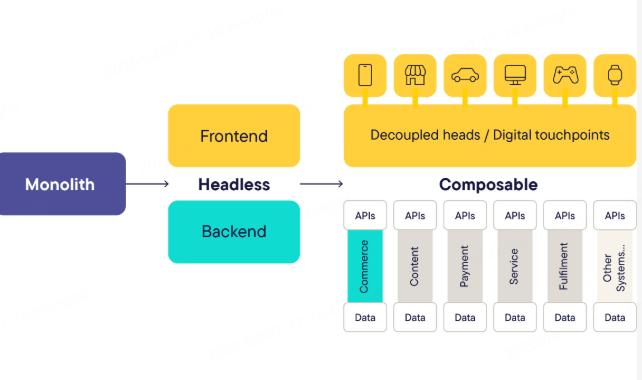
In the fast-paced world of digital commerce, organizations are constantly seeking ways to increase agility, reduce technical debt, and deliver superior customer experiences. As you explore platforms to scale your operations—like LooperBuy’s one-stop B2B sourcing platform—you will inevitably encounter three buzzwords: headless, composable commerce, and MACH architecture.
While these terms are often used interchangeably in marketing materials, they represent distinct concepts. Choosing the wrong framework based on misaligned expectations can lead to operational bottlenecks three years down the line. This guide provides a deep dive into the nuances of composable commerce vs MACH architecture, offering the strategic clarity needed to make a 5–7-year investment decision.
Table of Contents
1. Basic Concepts: Decoupling the Jargon
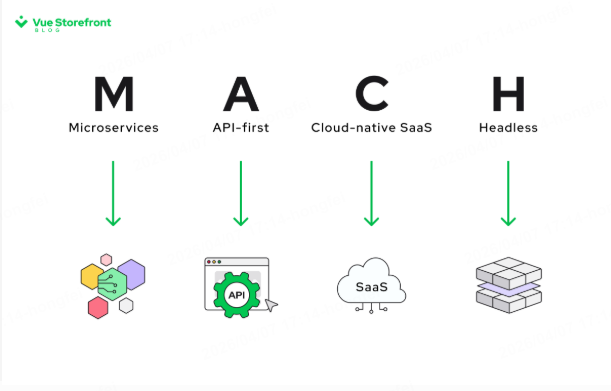
To make an informed decision, we must first strip away the marketing hype and focus on what these approaches actually change for your engineering and business teams.
| Term | Core Function | What it Doesn’t Solve Alone |
|---|---|---|
| Headless | Decouples storefront UI from the backend engine. 1 | Backend logic and operational flexibility. |
| MACH | Engineering standard (Microservices, API-first, Cloud-native, Headless). 1 | Governance, ownership, and daily manageability. |
| Composable | Strategy for assembling/swapping capabilities over time. 1 | Operational complexity without proper planning. |
2. Composable Commerce vs MACH Architecture: Strategy vs. Engineering
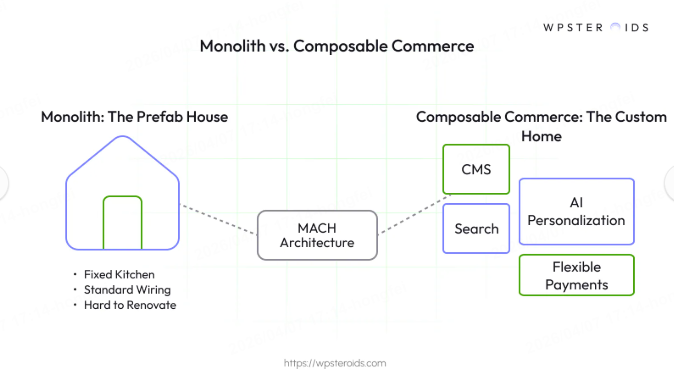
The confusion between composable commerce vs MACH architecture often stems from mixing levels of abstraction.
- Composable Commerce is a Business Strategy: It is the “what” and the “how” of your platform’s evolution. It focuses on assembling your commerce platform from independent business capabilities (catalog, search, checkout, promotions) that can be developed, scaled, or replaced individually. 1
- MACH is an Architectural Standard: It is the “underpinning” or the “how-to” of your engineering. It dictates that components must be Microservices-based, API-first, Cloud-native, and Headless. 1
Strategic Takeaway: You can implement composable commerce without being fully MACH-compliant (e.g., maintaining a legacy system as one “module”). However, MACH is often the preferred technical foundation for successful composable strategies because it ensures the system is inherently modular.
3. Why “Beyond MACH” Matters
While MACH provided a vital escape hatch from monolithic platforms, industry leaders are now shifting focus toward “Beyond MACH.” The reality is that simply adopting MACH principles does not automatically guarantee agility. 1
Key Realizations for B2B Leaders:
- Operational Complexity: A system composed of 20 independent microservices requires significantly more coordination, DevOps maturity, and regression testing than a streamlined monolith.
- The “Small Change” Trap: If your architecture is poorly governed, a “small” change in pricing logic can trigger a massive chain of cross-service coordination, effectively destroying the agility you sought.
- Governance is King: Agility is not a product of the code; it is a product of your operating model, team ownership, and API maturity.
4. Practical Selection Framework: When Should You Choose Which?
Before investing heavily, assess your business needs against these scenarios:
A. When Headless is Enough
If your primary bottleneck is storefront UX and the need for rapid channel expansion (e.g., launching new portals for different brands) while your backend logic (ERP, pricing, workflows) is stable, start with headless. It is the most approachable step toward modernization. 1
B. When to Pursue Composable + MACH
If your business is growing rapidly—requiring new markets, complex localization, or frequent changes to backend processes—composable commerce built on a MACH foundation is essential. This approach allows you to iterate on capabilities independently without forcing a full-system rewrite. 1
5. Implementation: The Phased Approach (Success Story)
For B2B platforms like yours, a “big bang” migration is a recipe for disaster. The most successful enterprises utilize a phased implementation.
- Audit & Prioritize: Identify the single biggest pain point in your current architecture.
- Decompose Incrementally: Replace or modularize one capability (e.g., Search or Catalog) at a time.
- Leverage Existing Ecosystems: Use robust, proven platforms (like Virto Commerce) that support composable strategies out-of-the-box, allowing you to integrate legacy systems where necessary. 1
Example: Standaard Boekhandel transitioned to a composable setup to manage a massive catalog increase (from 4 million to 15+ million SKUs) and integrated 207 offline stores within 11 months, proving that modularity reduces risk during rapid scaling. 1
6. Enhancing User Experience (UX) and Platform Value
To maximize the impact of your platform—whether it’s LooperBuy or a similar B2B enterprise tool—the architecture must prioritize:
- Self-Service Discovery: Ensure developers can interact with your API documentation without friction.
- Transparency: Provide clear visual maps of how different modules interact.
- Performance: A composable architecture should not sacrifice page load speed for modularity; use edge caching and modern frontend frameworks.
Are you ready to transform your B2B commerce strategy? Don’t let architectural terminology limit your growth. Focus on a platform that offers long-term manageability, not just fashionable buzzwords. [Contact our expert team today to discuss a phased migration strategy tailored to your specific scaling needs.]
References
- [1] Virtocommerce. “Composable Commerce vs MACH Architecture: A Complete Guide to Headless Evolution.” https://virtocommerce.com/blog/composable-commerce-vs-mach-architecture
FAQ (Frequently Asked Questions)
- Q: Are headless and MACH the same thing?
A: No. Headless is an architectural pattern (decoupling UI). MACH is a set of principles (Microservices, API-first, Cloud-native, Headless). Headless is a subset of the MACH framework. 1 - Q: Is composable commerce always better than a monolithic platform?
A: Not necessarily. For smaller, stable businesses, a monolith is often faster and cheaper to manage. Composable adds significant operational complexity that only pays off when the business requires high-frequency changes. 1 - Q: Will moving to a MACH architecture eliminate vendor lock-in?
A: It reduces lock-in to a single platform, but it can trade that for “ecosystem lock-in”—where you are dependent on a complex web of service contracts, API integrations, and internal governance. 1 - Q: Can I transition to composable commerce gradually?
A: Yes, it is highly recommended. Successful transitions occur in phases, replacing or modularizing one capability at a time rather than attempting a high-risk, all-at-once migration. 1 - Q: Why do some MACH-compliant programs feel slow?
A: Often because they lack a strong operational model. Without clear governance on who owns which service and how changes are sequenced, the overhead of managing multiple services can slow down delivery compared to simpler architectures. 1
Brief Introduction (approx. 300 characters):
Confused by Composable Commerce vs MACH Architecture? This deep-dive guide strips away the marketing hype to help B2B enterprises navigate the architectural landscape. Learn the strategic differences, avoid common traps, and discover how to build a scalable, future-proof commerce engine.
Hot tags: B2B E-commerce Platform, Composable Commerce Strategy, MACH Architecture Implementation, B2B Global Sourcing, Headless Commerce Solutions, B2B Digital Transformation, Wholesale Procurement Software, Microservices in Commerce, Scalable B2B Infrastructure, Global Supply Chain Management.
-4-700x490.png)