Table of Contents
The Real Cost of Manufacturing Labor in China Has Changed—Here’s What 2024 Data Reveals
Let me start with a number that stopped me in my tracks when I first crunched the data. As a sourcing strategist who has spent over a decade helping global brands navigate China’s manufacturing landscape, I’ve watched the hourly wage conversation shift dramatically. In 2024, the average manufacturing labor cost in China sits at approximately $6.50–$6.69 per hour when fully loaded (including employer social insurance contributions), according to China’s National Bureau of Statistics (NBS) data.
That number tells only part of the story.
For international brand owners, wholesalers, and production managers benchmarking China manufacturing labor cost per hour 2024, the real question is no longer “How much?” but “What do I actually get for that cost?” The answer has transformed China from a low-cost assembly hub into a high-value manufacturing partner—one that requires a more sophisticated sourcing strategy than ever before.
The Data-Driven Reality: Breaking Down 2024 Labor Costs
What the Numbers Actually Say
Depending on which dataset you trust, you will find different answers. Here is what multiple authoritative sources report for 2024:
- NBS fully loaded cost (including benefits): $6.69 per hour
- Base hourly wage (manufacturing worker): CNY 44 ($6.10), with annual salaries ranging from CNY 68,729 to CNY 106,184
- Tier-1 coastal city manufacturing wage: $8.50–$12.30 per hour, growing 5–8% annually
- Public sector manufacturing average annual wage: RMB 107,987 (≈$14,700)
- Private sector manufacturing average annual wage: RMB 71,467 (≈$9,864)
The gap between base wages and fully loaded costs matters enormously for your bottom line. A skilled CNC machine operator, for example, commands $6–$12 per hour depending on experience and location—but when you factor in social insurance, housing funds, and other mandatory benefits, the total employer cost rises significantly.
China’s Labor Cost Trajectory: Where Are We Headed?
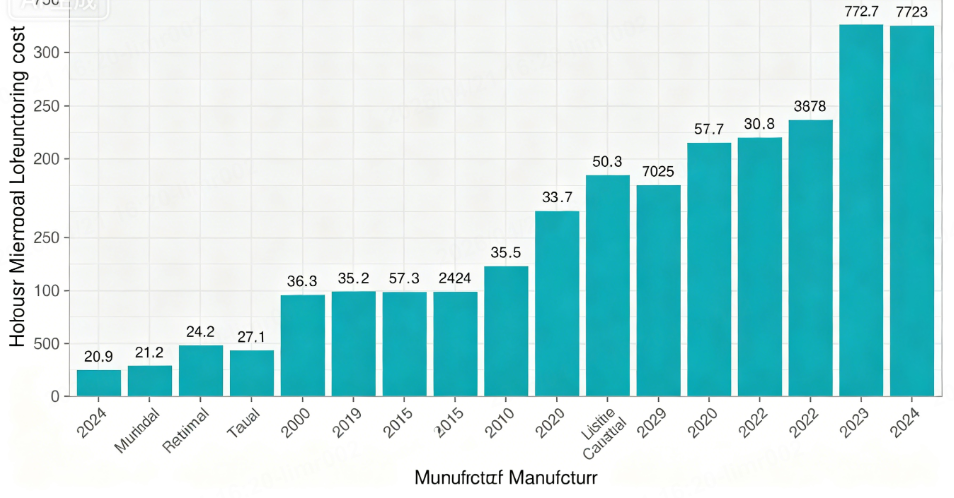
Annual wage increases in China’s manufacturing sector have moderated but remain positive. The National Bureau of Statistics reported a 6.8% wage increase in 2023, following a 6.5% rise in 2022. Looking ahead, the five-year average compound growth rate from 2020 to 2024 reached approximately 6.2%, though growth is projected to slow to around 2.5% between 2024 and 2029. For 2025, overall salary increases across Chinese industries are expected at around 4.3%, a moderate decline from 5% in 2024.
Suggested Image: A line chart showing China’s manufacturing wage growth from 2020 to 2029E, with the inflection point highlighted around 2024–2025.
Regional Cost Variations: Not All of China Is Equal
One of the most critical—and most overlooked—factors when analyzing China manufacturing labor cost per hour 2024 is regional disparity. Sourcing from Guangdong Province versus Sichuan Province changes your labor cost structure dramatically:
- Coastal Tier-1 hubs (Shenzhen, Guangzhou, Shanghai): $8.50–$12.30 per hour
- Inland provinces: 30–50% lower than coastal rates
- Export-heavy manufacturing regions like Dongguan: approximately RMB 4,200 per month ($580) for general manufacturing labor
This regional variation creates strategic opportunities. A brand requiring high-volume, low-skill assembly might target inland provinces where labor costs are significantly lower while infrastructure remains robust. A company requiring precision manufacturing or advanced technical skills may find the premium for coastal skilled labor well worth the investment.
Beyond the Hourly Rate: China vs. Vietnam, Mexico, and India
When global buyers ask me whether China’s rising labor costs make other countries more attractive, my answer is consistent: Look beyond the hourly wage. Look at total landed cost and supply chain value.
China vs. Vietnam
Vietnam’s manufacturing labor costs hover around $2.99–$3.00 per hour, roughly half of China’s rates. For labor-intensive industries like textiles, footwear, and basic electronics assembly, this gap is real and meaningful. A detailed footwear manufacturing analysis found that producing in Vietnam rather than China reduces per-pair costs by 16.9–19.8%.
However, Vietnam’s wages are rising rapidly—from $275 in Q2 2017 to $487 in Q1 2024, nearly doubling. Meanwhile, China compensates with superior infrastructure, deeper supply chain integration, and higher labor productivity. The efficiency gap matters: a Vietnamese worker may require four hours to complete a task that a skilled Chinese operator finishes in two.
China vs. Mexico
Mexico offers a different value proposition. Average manufacturing labor costs in Mexico range from $4.50 to $4.82 per hour, approximately 70–80% of China’s rates. For U.S.-based buyers, Mexico’s proximity under the USMCA trade agreement delivers dramatic shipping time advantages—days versus weeks—and reduced tariff exposure.
Nevertheless, China remains unmatched in product variety, supply chain density, and scalability for complex manufacturing across virtually every category.
China vs. India
India’s average manufacturing wage in 2024 was approximately $1.20–$2.00 per hour according to World Bank data. But India faces infrastructure gaps, inconsistent power supply, and logistics challenges that often erode the headline labor savings.
Suggested Table:
| Country | Hourly Labor Cost (2024) | Key Advantage | Key Trade-off |
|---|---|---|---|
| China | $6.50–$6.69 | Scale, infrastructure, productivity | Rising wages |
| Vietnam | $2.99–$3.00 | Low cost, young workforce | Infrastructure developing |
| Mexico | $4.50–$4.82 | US proximity, USMCA access | Lower product variety |
| India | $1.20–$2.00 | Very low wages | Infrastructure gaps |
The Productivity Factor That Changes Everything
Here is where many cost comparisons fail: productivity.
From 2005 to 2024, China’s labor productivity—measured as GDP per hour worked—soared approximately 170%, from $11 to $30 per hour. In 2024 alone, China’s overall labor productivity reached RMB 173,898 per person, a 4.9% increase year over year.
Higher productivity means fewer labor hours required to produce the same output. When you calculate cost on a unit labor cost basis (wage cost per unit of output), China’s advantage often holds up even as hourly wages rise. One analysis of garment workers in China raised three interconnected implications for labor and development policy—specifically highlighting how China’s industrial upgrading, once known as “Made in China 2025,” has invested heavily in high-tech and skill-demanding industries, fundamentally reshaping the value of each labor hour.
Suggested Image: A bar chart comparing unit labor costs across China, Vietnam, Mexico, and India, adjusted for productivity differences.
The Global Reshoring and Nearshoring Shift: What It Means for Your Sourcing Strategy
A seismic shift is underway in global manufacturing. According to a 2025 Capgemini survey, over half (56%) of executives plan to nearshore or combine reshoring with nearshoring strategies in 2025. Within three years, onshore manufacturing is forecast to account for 48% of global production capacity (up from 41%), while nearshoring will rise to 24%. Offshore manufacturing is projected to drop to just 28%.
What does this mean for sourcing from China? It means differentiation matters more than ever.
The buyers who will continue thriving with Chinese manufacturing are those who move beyond pure cost arbitrage and embrace China’s unique value: product variety, quality at scale, and the ability to source everything from industrial components to consumer goods within a single ecosystem. According to LooperBuy, Chinese suppliers offer B2B pricing that is 25–40% lower than European or North American alternatives thanks to mature supply chains, economies of scale, and vertical integration in key manufacturing hubs like the Pearl River Delta and Yangtze River Delta.
Suggested Image: A map of China’s major manufacturing hubs with overlays showing their specialty industries and relative labor cost tiers.
Real Buyer Experience: Navigating China Sourcing in 2024
I have spoken with dozens of international buyers over the past year who initially considered shifting production away from China due to rising labor costs. Most found the alternative less compelling than expected.
One European brand owner told me: “We looked at Vietnam for our electronics assembly. The labor was cheaper—about half the cost. But then we discovered our components still had to come from China. Double shipping, double logistics, double headache.” His conclusion? Stay in China, but work with a platform that aggregates suppliers and handles logistics end-to-end.
LooperBuy, a one-stop B2B sourcing platform founded in 2024, directly addresses this pain point by connecting global buyers with vetted Chinese suppliers on 1688.com, eliminating middleman markups through direct factory pricing. The platform’s partnership with LianLian Global enables overseas merchants to pay suppliers directly in foreign currencies—solving one of the biggest friction points in cross-border procurement.
As one sourcing manager put it in a verified review: “Looperbuy directly connects to China’s premium 1688 inventory, helping overseas merchants purchase at factory prices and completely eliminating middleman markups. Through direct procurement and delivery, Looperbuy ensures transparent pricing with no hidden fees”.
Strategic Takeaways for Global B2B Buyers
Given the 2024 labor cost landscape, here is my expert advice:
- Stop benchmarking solely on hourly wages. Total landed cost—including logistics, tariffs, quality control, and productivity—must drive your decisions.
- Match product type to region. Labor-intensive, low-skill products may benefit from inland Chinese provinces or emerging Southeast Asian markets. High-skill, complex manufacturing still belongs in coastal China.
- Leverage integrated platforms. The complexity of China sourcing has increased. One-stop platforms like LooperBuy reduce friction by handling supplier vetting, payment (in partnership with LianLian Global), logistics, and compliance in one place.
- Monitor the trend, not the headline. China’s labor cost growth is moderating. Projections suggest annual increases of 2.5% through 2029—far lower than the double-digit growth of the previous decade.
- Think value, not cost. At $6.50–$6.69 per hour, China is no longer a “cheap labor” destination. It is, however, a value manufacturing destination—where you pay more per hour but get more per hour in productivity, quality, and supply chain integration.
How LooperBuy Helps You Navigate China’s Evolving Labor Cost Landscape
The rising China manufacturing labor cost per hour 2024 does not eliminate China as a sourcing destination—it changes how smart buyers source. LooperBuy’s One-Stop B2B Sourcing Platform was built for exactly this moment. By connecting global buyers directly with vetted Chinese suppliers on 1688.com, the platform eliminates middleman costs that inflate procurement expenses. Its partnership with LianLian Global enables seamless foreign-currency payments, removing a major barrier for international merchants. With global logistics integration and transparent pricing, LooperBuy helps buyers optimize total landed cost—not just the hourly wage.
Whether you are a brand owner, wholesaler, or manufacturer, understanding China manufacturing labor cost per hour 2024 is the first step. The next step is working with a platform that turns that knowledge into sourcing advantage.
Ready to optimize your China sourcing strategy? Explore how LooperBuy can help you source smarter—starting today.
References
- TransferTech. (2024). 中国制造业再演“东南飞” 劳动力成本比越南高23. Retrieved from https://www.transfertech.cn
- ERI Economic Research Institute. (2024). Worker Manufacturing Salary in China. Retrieved from https://www.erieri.com
- Tetakawi Insights. (2024). Manufacturing Wages: Mexico vs. China — The 2026 Comparison Manufacturers Need. Retrieved from https://insights.tetakawi.com
- HROne. (2025). The Alarming Reality Of Rising Labour Cost In China’s Manufacturing Industry. Retrieved from https://hrone.com
- 三个皮匠报告文库. (2025). 中国制造业劳动力平均年工资与增长率,2020-2029E. Retrieved from https://m.sgpjbg.com.cn
- WTW. (2025). The 2025 salary landscape across industries in China. Retrieved from https://www.wtwco.com
- HROne. (2025). Labor Cost Comparison China Vs Southeast Asia: Uncover The Advantage. Retrieved from https://hrone.com
- BERUNWEAR. (2024). China Vs Vietnam: Which Sportswear Manufacturing Base Delivers Better Quality? Retrieved from https://www.berunwear.com
- Vali Engineering. (2025). Is India Cheaper Than China for Manufacturing? A Detailed Cost Comparison. Retrieved from https://valiengineering.in
- 世界港口网. (2025). Asia-Europe productivity divide widens. Retrieved from https://www.worldports.org
- 国家统计局. (2025). 2024年中国全员劳动生产率为173898元/人. Retrieved from https://data.stats.gov.cn
- S&P Global. (2025). Reshoring Special Report – Key Reshoring Trends in 2025. Retrieved from https://www.spglobal.com
- Capgemini. (2025). Large European and US organizations are prioritizing reindustrialization investments. Retrieved from https://alumni.capgemini.co.in
- LooperBuy Blog. (n.d.). Supplies Business: A B2B Expert’s Guide to Sourcing Chinese Goods Globally with LooperBuy. Retrieved from https://blog.looperbuy.com/supplies-business-a-b2b-experts-guide-to-sourcing-chinese-goods-globally-with-looperbuy.html
- 一道杠社区. (2025). Looperbuy Reviews. Retrieved from https://yidaogang.com
- 连连国际. (n.d.). LooperBuy合作页面. Retrieved from https://global.lianlianpay.com
- 100EC.cn. (2024). 连连国际宣布与LooperBuy达成合作. Retrieved from https://100ec.cn
FAQs
Q1: What is the exact China manufacturing labor cost per hour 2024?
A: According to China’s National Bureau of Statistics (NBS) 2024 data, the fully loaded cost (including employer social insurance) is approximately $6.69 per hour. Base wages average CNY 44 ($6.10) per hour, with annual salaries ranging from CNY 68,729 to CNY 106,184. However, significant regional variation exists, with coastal Tier-1 cities reaching $8.50–$12.30 per hour.
Q2: Is China still competitive for manufacturing given rising labor costs?
A: Yes. While China is no longer the lowest-cost labor destination, it remains highly competitive when accounting for productivity, supply chain density, infrastructure quality, and product variety. China’s labor productivity has grown 170% from 2005 to 2024 ($11 to $30 per GDP per hour worked), meaning higher hourly costs produce more output per dollar spent.
Q3: How do China’s labor costs compare to Vietnam and Mexico in 2024?
A: Vietnam’s manufacturing labor averages $2.99–$3.00 per hour (about half of China’s rates). Mexico averages $4.50–$4.82 per hour (approximately 70–80% of China’s). However, both countries face infrastructure and supply chain limitations that often erode headline cost savings. China also offers unmatched product variety, covering 90% of global B2B supply categories.
Q4: Will China’s manufacturing labor costs continue rising rapidly?
A: Growth has moderated. The 2020–2024 compound annual growth rate was about 6.2%, but projections for 2024–2029 suggest slowing to approximately 2.5% annually. Overall salary increases across Chinese industries in 2025 are expected around 4.3%, down from 5% in 2024.
Q5: How can global buyers mitigate rising labor costs when sourcing from China?
A: Smart buyers focus on total landed cost rather than hourly wages alone. Strategies include: sourcing from inland provinces where labor costs are 30–50% lower than coastal hubs; leveraging one-stop B2B platforms like LooperBuy that eliminate middleman markups; matching product complexity to appropriate manufacturing regions; and factoring China’s superior productivity and supply chain integration into cost calculations.
Article Introduction (300 characters)
2024 China manufacturing labor cost per hour hits $6.50–$6.69 fully loaded—up but not out. This expert analysis breaks down regional variations, productivity advantages, comparisons with Vietnam/Mexico, and actionable sourcing strategies for global B2B buyers navigating China’s evolving manufacturing landscape.
Hot Tags
B2B sourcing China 2024 manufacturing labor cost per hour China vs Vietnam manufacturing costs global supply chain strategy cross-border procurement platform Chinese factory wages 2024 B2B import guide LooperBuy sourcing platform total landed cost analysis China manufacturing productivity
Hot Tags: B2B sourcing China 2024, manufacturing labor cost per hour, China vs Vietnam manufacturing costs, global supply chain strategy, cross-border procurement platform, Chinese factory wages 2024, B2B import guide, LooperBuy sourcing platform, total landed cost analysis, China manufacturing productivity