Can a sourcing company improve product quality consistency? Learn how supplier selection, product specifications, inspections, AQL sampling, warehouse checks, and corrective actions help B2B sellers reduce defects, returns, and fulfillment errors when sourcing from China.
A capable sourcing company can materially improve product quality consistency, but only when it operates as an active quality-control partner rather than a passive middleman. For B2B sellers purchasing from China, the real value is not simply finding a lower factory price; it is creating a repeatable system that turns product requirements into measurable standards, verifies production at the right stages, and prevents the same defect from appearing in the next order.
For global sellers using a China sourcing and dropshipping partner such as Looperbuy, consistent quality is especially important. A customer who receives a good product in the first shipment but a visibly different, damaged, poorly packed, or non-functioning version in the next shipment will not blame the factory. They will blame your brand.
A sourcing company can help close that accountability gap by coordinating suppliers, documenting requirements, monitoring samples and batches, inspecting products, managing corrective actions, and helping ensure the items shipped to customers match the product standard your business approved.
Table of Contents
What Does Product Quality Consistency Mean?
Product quality consistency means that products continue to meet the same agreed requirements across units, batches, suppliers, and repeat orders.
It is not enough for a supplier to send one excellent sample. The important question is whether the factory can deliver the same level of quality when it produces 500, 5,000, or 50,000 units several months later.
For most B2B sellers, consistency includes more than whether a product works. It may involve:
– Materials: Correct fabric weight, plastic grade, metal finish, color, and component quality.
– Dimensions: Accurate size, fit, weight, tolerance, and assembly alignment.
– Functionality: Stable performance, correct operation, and durability.
– Appearance: Consistent color, printing, logo placement, stitching, coating, and surface finish.
– Packaging: Correct labels, inserts, barcodes, cartons, protective materials, and shipping marks.
– Compliance: Relevant safety, labeling, testing, and destination-market requirements.
– Fulfillment accuracy: The correct SKU, variation, quantity, and packaging sent to the correct destination.
A small quality variation can become expensive when it reaches customers. Returns, refunds, poor marketplace reviews, replacement shipments, chargebacks, and lost repeat purchases can quickly cost more than the original product-saving decision.
The American Society for Quality describes the cost of quality as the cost of resources lost when an organization does not operate efficiently. Its training materials note that unnecessary quality-related expenses can sometimes reach as much as 25% of sales.
How a Sourcing Company Improves Quality Consistency
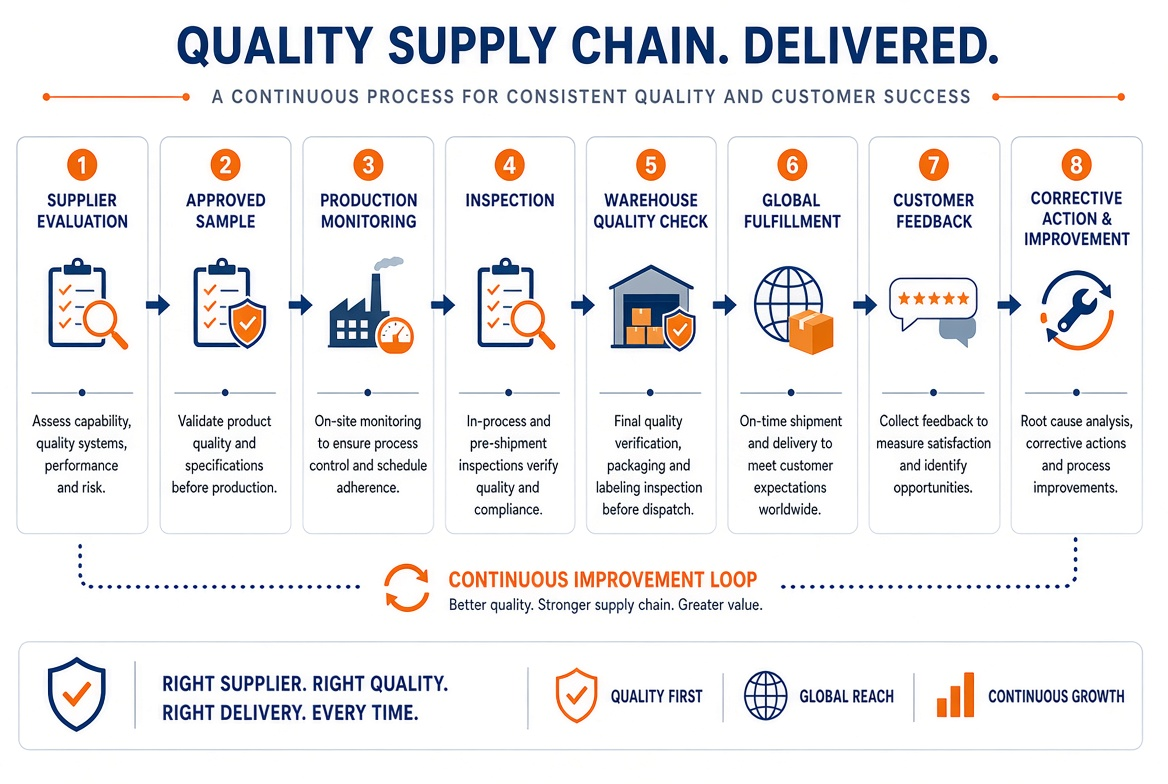
A sourcing company improves product quality consistency by building controls before, during, and after production. The strongest partners do not rely on a supplier’s verbal promise that “quality is good.” They establish evidence, checkpoints, records, and escalation procedures.
1. Converting Expectations Into Clear Specifications
Many quality problems begin before an order is placed.
Buyers often communicate requirements with vague phrases such as:
– “Make it premium.”
– “Use good material.”
– “Same as the sample.”
– “Please check quality carefully.”
– “No defects.”
These instructions are understandable, but they are difficult to inspect objectively. A supplier may believe the order meets expectations while the buyer believes it does not.
A sourcing company can help turn broad expectations into a practical product specification sheet or quality checklist. This document should define what “acceptable” means for the product.
| Quality Area | Weak Instruction | Better Measurable Requirement |
| Color | “Use the same blue” | Match approved color reference; no visible shade variation under standard lighting |
| Size | “Correct dimensions” | Length: 20 cm ± 0.5 cm; width: 10 cm ± 0.3 cm |
| Material | “High-quality plastic” | Use approved ABS material; no sharp edges, odor, cracks, or discoloration |
| Printing | “Logo should look good” | Logo centered within defined placement area; no smudging, missing ink, or color bleed |
| Packaging | “Pack safely” | Each unit in polybag; 20 units per inner carton; carton drop-protection requirements defined |
Quality consistency depends on clarity. If an inspector cannot check it, the requirement is probably not specific enough.
For products sourced through China, this is particularly valuable when the buyer, supplier, warehouse team, and inspection provider are working across different languages, time zones, and commercial expectations. A sourcing partner can help align those parties around the same approved standard.
2. Verifying the Supplier Before Scaling
A strong sourcing company does more than locate factories. It assesses whether a supplier is capable of producing the item consistently at the expected scale.
A supplier may be able to create a good sample manually but struggle with:
– Capacity pressure during peak season.
– Inconsistent raw-material sourcing.
– Poorly trained temporary workers.
– Weak in-process controls.
– Subcontracting without approval.
– Limited equipment calibration.
– Inadequate packaging and final inspection procedures.
Supplier evaluation should examine both product capability and process capability. Relevant checks may include factory background, manufacturing experience, product specialization, production capacity, quality-system practices, sample quality, communication reliability, and previous performance.
ISO 9001:2015 includes Clause 8.4, which addresses control of externally provided processes, products, and services. In practice, this reinforces a core purchasing principle: external suppliers should be evaluated, controlled, and monitored according to the effect their outputs can have on final product quality.
A sourcing company can apply that principle operationally by maintaining a supplier scorecard.
3. Using Supplier Scorecards Instead of Memory
Supplier selection should not depend only on who replied fastest or offered the lowest quotation. A sourcing company can track supplier performance over time and use the record to make better reorder decisions.
Useful supplier scorecard metrics include:
– Defect rate by product and production batch.
– On-time delivery rate against confirmed production dates.
– Sample-to-production match rate.
– Corrective-action response time.
– Reinspection pass rate.
– Packing accuracy.
– Communication and documentation quality.
– Frequency of unauthorized material or process changes.
For example, two factories may quote the same insulated bottle. Supplier A may be 3% cheaper, while Supplier B has a lower defect history, better packaging consistency, and a stronger record of handling corrective actions. Once returns, customer complaints, and replacement shipments are considered, Supplier B may provide the better commercial outcome.
The cheapest unit price is not always the lowest total cost.
Quality Control at Every Production Stage
The most effective sourcing company quality control process is not a single inspection at the end. It is a sequence of controls designed to detect problems when they are still affordable to fix.
Pre-Production: Approve the Standard First
Before mass production starts, the sourcing company should help confirm:
– The approved product sample.
– The bill of materials or component expectations.
– Product dimensions and tolerances.
– Functional requirements.
– Packaging artwork and labeling.
– Carton specifications.
– Product photos or golden samples for visual comparison.
– Inspection criteria and defect classifications.
– Required certifications or test documentation, where applicable.
A golden sample is especially useful. It is the physical or documented reference standard against which later production is compared. Without one, teams may argue about subjective terms such as “close enough” or “similar.”
During Production: Find Problems Early
During-production inspection is valuable for products with higher order quantities, complex assembly, customized branding, tight shipping deadlines, or a history of defects.
An inspection can identify issues such as:
– Incorrect material or component substitution.
– Color variation between production runs.
– Poor stitching, seams, glue application, or assembly.
– Incomplete logo printing.
– Incorrect product dimensions.
– Weak packaging preparation.
– Production delays that threaten launch dates.
Catching a defect at 20% production completion is usually far less disruptive than discovering it after all units are finished, packed, and ready for export.
Pre-Shipment: Confirm the Finished Batch
A pre-shipment inspection checks the finished product before it leaves the factory or enters the fulfillment workflow. It normally reviews:
– Product appearance and workmanship.
– Quantity verification.
– Random functional testing.
– Measurements and weight checks.
– Packaging and labeling.
– Barcode readability.
– Carton condition and shipping marks.
– Assortment accuracy for colors, sizes, and variations.
Many inspection programs use AQL sampling, or Acceptance Quality Limit sampling, to determine how many units should be randomly inspected from a lot and how many defects can be accepted before the lot fails. ANSI/ASQ Z1.4 is a widely used acceptance-sampling framework for attribute inspection and offers normal, tightened, and reduced inspection plans.
However, AQL is not a guarantee that every unit is defect-free. It is a decision tool for assessing whether a production lot meets agreed acceptance criteria. For safety-critical products, high-value products, or products with a high return-risk profile, buyers may need stricter inspection requirements or more extensive testing.
Warehouse and Fulfillment: Protect Quality Until Dispatch
Quality can decline after factory production if products are handled poorly during consolidation, storage, labeling, or shipping.
For a B2B sourcing and dropshipping platform, warehouse controls are part of the quality experience. Looperbuy can add value by helping coordinate:
– SKU and variation verification.
– Label and barcode checks.
– Product-to-order matching.
– Packaging reinforcement where appropriate.
– Consolidation checks.
– Photo documentation for exceptions.
– Dispatch accuracy.
– Clear handling of damaged or nonconforming inventory.
For online sellers, a perfectly manufactured product still creates a poor customer experience if the wrong color, size, SKU, or packaging reaches the buyer.
A Practical Quality Framework for Buyers
The following workflow gives B2B sellers a more reliable way to work with a sourcing company.
Step 1: Define Customer-Critical Requirements
Start with the features your end customer will notice first.
For example, for a branded fitness resistance band, customer-critical requirements may include:
– Resistance level accuracy.
– Latex or material composition.
– Length and width tolerance.
– Seam or molded-joint strength.
– Logo clarity.
– Odor level.
– Carry-bag quality.
– Packaging presentation.
Do not treat every issue equally. A tiny cosmetic mark on an inner carton may be minor. A broken joint, incorrect resistance level, or missing safety warning may be critical.
Step 2: Create a Defect Classification System
Use clear defect categories so suppliers and inspectors know what requires rejection.
| Defect Category | Meaning | Example |
| Critical defect | Creates a safety, legal, or major usability risk | Sharp edge on a children’s product; missing mandatory warning |
| Major defect | Reduces usability, saleability, or customer satisfaction | Product does not function; obvious logo misprint; wrong component |
| Minor defect | Small issue that does not materially affect normal use | Slightly uneven trim; small non-visible packaging imperfection |
A sourcing company can help make the criteria product-specific instead of relying on generic inspection language.
Step 3: Approve a Pre-Production Sample
Never assume a catalog image, quotation photo, or marketplace listing represents the exact product you will receive.
Approve a sample that reflects the actual material, color, logo method, packaging, and configuration. Document any changes between the sample and the production order.
Step 4: Match Inspection Intensity to Risk
Not every product needs the same inspection level. Focus budget and attention where failure would cause the greatest commercial damage.
| Product Risk | Recommended Control Approach |
| Low-risk, standardized accessories | Sample review, supplier checks, pre-shipment sampling |
| Customized branded goods | Approved golden sample, production-stage review, pre-shipment inspection |
| Complex electronic or assembled products | Functional tests, production monitoring, batch verification, packaging tests |
| Child, safety, or regulated products | Compliance-document review, stricter inspection criteria, appropriate third-party testing where required |
| High-return or high-ticket items | Detailed functional checks, photo records, traceable batch documentation |
Step 5: Require Corrective Action, Not Just a Report
An inspection report is useful only if the result changes what happens next.
When a nonconformity is found, ask:
1. What exactly failed?
2. How many units were affected?
3. What is the root cause?
4. What containment action prevents defective items from shipping?
5. What corrective action will prevent recurrence?
6. Who owns the action?
7. When will the fix be verified?
For recurring issues, request a Corrective and Preventive Action (CAPA) record. This turns quality management from repeated firefighting into continuous supplier improvement.
When a Sourcing Company Cannot Solve the Problem
A sourcing company can improve product quality consistency, but it cannot compensate for every upstream weakness.
Quality support becomes less effective when a buyer:
– Changes specifications after production begins.
– Chooses a supplier only because of the lowest price.
– Refuses sample approval or inspections.
– Provides unclear branding, packaging, or technical requirements.
– Expects premium materials at an unrealistic target cost.
– Skips compliance planning for regulated products.
– Treats every defect as equally important.
– Ignores inspection findings because shipment deadlines are tight.
The relationship works best when the buyer provides a clear product brief and the sourcing company provides a disciplined execution process.
Consistency is a shared system—not a promise made by one party.
How Looperbuy Can Support Consistent Product Quality
For global B2B sellers, Looperbuy can serve as a practical coordination layer between product sourcing, supplier communication, quality checking, consolidation, and fulfillment.
Instead of managing multiple factories, payments, inventory locations, packaging requirements, and shipping arrangements independently, sellers can work through a more centralized process. This can reduce operational friction while improving visibility over product requirements and order handling.
A reliable sourcing and dropshipping workflow can help businesses:
– Source products from suitable Chinese suppliers.
– Clarify product, branding, and packaging requirements.
– Review samples before larger purchase commitments.
– Apply relevant inspection procedures.
– Identify quality exceptions before dispatch.
– Consolidate inventory and manage fulfillment steps.
– Reduce the need to hold large volumes of stock.
– Improve order accuracy for global shipments.
The right approach is not “inspect everything forever.” It is to develop a supplier and product-quality system that becomes more reliable with every completed order.
Final Takeaway
A sourcing company can absolutely help improve product quality consistency—but only when it provides structured supplier management, detailed specifications, sample approval, risk-based inspections, transparent reporting, and follow-through on corrective actions.
For B2B sellers, quality consistency is not simply a manufacturing concern. It influences customer satisfaction, return rates, marketplace performance, cash flow, brand trust, and long-term profitability.
If you are sourcing products from China and want to reduce quality surprises across repeat orders, work with a partner that can help define the standard, verify the batch, and manage exceptions before products reach your customers.
Ready to build a more reliable sourcing and fulfillment process? Contact Looperbuy to discuss your product requirements, quality expectations, and global dropshipping needs.
Frequently Asked Questions
1. Can a sourcing company guarantee zero product defects?
No. No sourcing company or factory can realistically guarantee zero defects in every production batch. However, a capable sourcing company can reduce risk by defining specifications, approving samples, conducting inspections, identifying nonconforming products, and requiring corrective action before shipment.
2. What is the difference between quality control and quality assurance?
Quality control focuses on checking products or processes for defects, such as inspecting samples before shipment. Quality assurance is broader: it focuses on building procedures that prevent defects from occurring, including supplier evaluation, production standards, documented specifications, and process monitoring.
3. Is AQL inspection enough for my products?
AQL inspection is useful for many consumer goods because it offers a structured sampling method for deciding whether a lot meets agreed criteria. However, it may not be sufficient for safety-critical, regulated, complex electronic, or high-value products. Those categories may require more detailed functional tests, certification review, or specialized third-party testing.
4. Should I inspect every order from a Chinese supplier?
The answer depends on product risk, order value, supplier history, complexity, and your customer’s tolerance for defects. New suppliers, customized products, and high-risk items usually deserve more frequent inspection. Established suppliers with proven performance may move to a risk-based approach, while still requiring periodic monitoring.
5. How can I make sure a reorder matches the first approved order?
Keep an approved golden sample, product specification sheet, packaging files, inspection checklist, and documented supplier performance record. Ask your sourcing company to compare subsequent batches against the approved standard and flag any proposed changes in material, process, packaging, or components before production begins.
6. Can a sourcing company help with dropshipping quality control?
Yes. In a dropshipping workflow, quality control can extend beyond the factory. A sourcing company can help check SKU accuracy, packaging, labels, consolidation, product condition, and dispatch details before orders are shipped to customers. This is important because fulfillment errors can create the same customer dissatisfaction as product defects.
7. What should I send a sourcing company before requesting a quote?
Provide product photos or drawings, dimensions, material requirements, expected order quantity, target market, branding files, packaging requirements, desired certifications, target price range, and quality expectations. The more specific the brief, the easier it is to identify appropriate suppliers and create an accurate inspection plan.
References
1. American Society for Quality. “[ASQ/ANSI Quality Standards Z1.4 & Z1.9].” Information on acceptance sampling plans, AQL-based inspection, and normal, tightened, and reduced inspection approaches.
2. American Society for Quality. “[Attribute & Variable Sampling Plans and Inspection].” Explanation of attribute sampling, nonconformities, defects, and lot-based acceptance sampling.
3. International Organization for Standardization. “[ISO 9001:2015—Quality Management Systems].” Includes Clause 8.4 on control of externally provided processes, products, and services.
4. American Society for Quality. “[Cost of Quality: Finance for Continuous Improvement].” Overview of quality-related waste and the business impact of poor quality.
5. The 9000 Store. “[Control of External Providers—ISO 9001 Clause 8.4].” Practical examples of supplier controls, including supplier audits, incoming inspections, first article reports, and supplier performance metrics.
6. IQVIA. “[Distinguish Yourself with Risk-Based Supplier Inspections].” Discussion of sampling plans, risk-based inspection, and inspection-state switching rules.