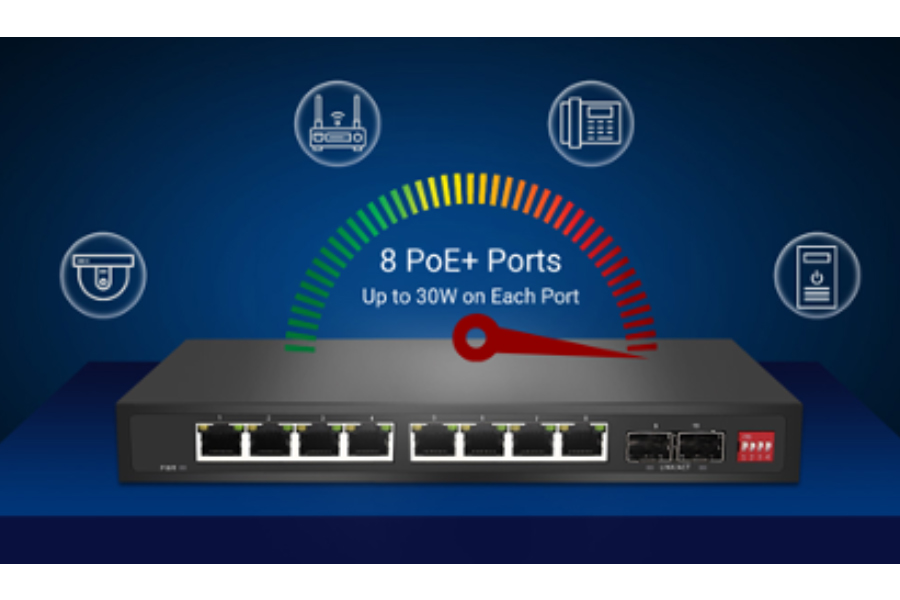
Power over Ethernet (PoE) technology has revolutionized the way we connect devices in networking environments. It allows both data and electrical power to be transmitted over standard Ethernet cables, simplifying installations and reducing the need for additional power sources. However, a common question arises: can a normal data cable be connected to a PoE port? This article will explore this question in detail, discussing the implications, benefits, and technical considerations involved.
Table of Contents
Understanding Power over Ethernet (PoE)
What is PoE?
Power over Ethernet (PoE) is a technology that enables Ethernet cables to carry electrical power along with data. This is particularly useful for devices such as IP cameras, VoIP phones, and wireless access points, which require both data connectivity and power. By using PoE, these devices can be installed in locations without the need for separate power outlets, making installations cleaner and more efficient. The ability to power devices through the same cable that provides data connectivity not only streamlines the installation process but also enhances the flexibility of device placement, allowing for more strategic positioning of networked devices in various environments.
How PoE Works
PoE works by using a technique that allows power to be sent over the same wires that transmit data. This is achieved through two modes: Mode A and Mode B. In Mode A, power is delivered over the data pairs of the Ethernet cable, while in Mode B, power is delivered over the spare pairs. Most modern Ethernet cables, such as Cat5e and Cat6, can support PoE, allowing for distances of up to 100 meters. This capability is particularly advantageous in large installations, where devices may be spread out over considerable distances. The technology ensures that both power and data can be delivered efficiently, reducing the need for additional infrastructure.
Types of PoE Standards
There are several standards for PoE, including:
– IEEE 802.3af (PoE): Provides up to 15.4 watts of power, sufficient for many low-power devices.
– IEEE 802.3at (PoE+): Provides up to 30 watts of power, accommodating devices with higher power requirements.
– IEEE 802.3bt (PoE++): Provides up to 60 watts or even 100 watts, depending on the implementation, making it suitable for more demanding applications.
These standards ensure that devices can receive adequate power while maintaining data integrity. Understanding these standards is crucial for network designers and installers, as it helps them choose the right equipment for their specific needs and ensures compatibility across devices.
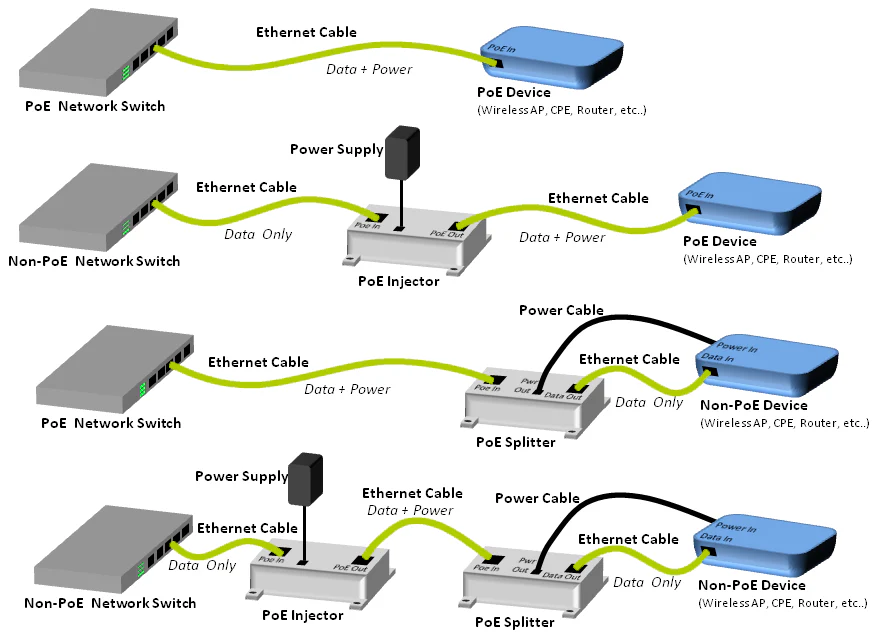
Connecting a Normal Data Cable to a PoE Port
Can You Use a Standard Ethernet Cable?
Yes, you can connect a normal data cable, such as a Cat5e or Cat6 Ethernet cable, to a PoE port. The PoE technology is designed to be backward compatible with standard Ethernet connections. This means that if you connect a non-PoE device to a PoE port, the device will receive data without any power being supplied. The PoE switch or injector will only send power to devices that are PoE-capable. This compatibility is a significant advantage, as it allows for seamless integration of both PoE and non-PoE devices within the same network infrastructure, providing flexibility in device deployment.
Safety Considerations
When connecting a normal data cable to a PoE port, safety is a primary concern. PoE switches are designed to detect whether a connected device is PoE-compatible. If the device is not compatible, the switch will not supply power, thus preventing any potential damage. This feature is crucial for ensuring that non-PoE devices can safely connect to PoE ports without risk. Additionally, the built-in safety mechanisms in PoE technology help to prevent overheating and electrical faults, making it a reliable choice for powering devices in various environments.
Performance Implications
Using a standard Ethernet cable with a PoE port does not affect the performance of the data transmission. The data transfer rates remain the same as they would be with a non-PoE switch. However, it is essential to ensure that the cable used is of good quality and meets the necessary specifications to handle the required data rates. High-quality cables can minimize signal loss and interference, ensuring optimal performance for both data and power transmission. This is particularly important in environments where high bandwidth is required, such as in video surveillance or high-speed internet applications.
Benefits of Using PoE
Simplified Cabling
One of the most significant advantages of PoE is the reduction in cabling complexity. By combining power and data into a single cable, installations become more straightforward, reducing the number of cables needed and simplifying the overall setup. This simplification not only saves time during installation but also reduces clutter, making it easier to manage and maintain the network infrastructure. In addition, fewer cables mean less potential for damage or wear, contributing to a more reliable network.
Flexibility in Device Placement
PoE allows devices to be placed in locations that may not have easy access to power outlets. This flexibility is particularly beneficial for devices like security cameras, which can be installed in remote or outdoor locations without the need for additional electrical work. The ability to position devices strategically can enhance coverage and improve the overall effectiveness of the network. For example, in a security system, cameras can be installed in optimal locations for monitoring without being constrained by the availability of power sources.
Cost-Effectiveness
By eliminating the need for separate power supplies and outlets, PoE can reduce installation costs. This is especially true in large installations where multiple devices are deployed, as the savings on cabling and electrical work can be substantial. Furthermore, the reduced need for electrical outlets can lead to lower energy costs and a smaller carbon footprint, making PoE an environmentally friendly choice. Organizations can also benefit from lower maintenance costs, as fewer components mean less potential for failure.
Common Misconceptions About PoE
PoE is Only for Specific Devices
A common misconception is that PoE can only be used with specific devices. In reality, any device that is compatible with the PoE standards can benefit from this technology. This includes a wide range of devices beyond just IP cameras and phones, such as wireless access points and network switches. Understanding the versatility of PoE can help organizations maximize their investments in networking equipment and infrastructure.
PoE is Complicated to Implement
While the technology behind PoE may seem complex, it is relatively straightforward to implement. Most modern networking equipment supports PoE, and installation typically involves connecting devices to a PoE switch or injector, making it accessible for both professionals and DIY enthusiasts. The user-friendly nature of PoE technology allows for quick deployment and integration into existing networks, making it an attractive option for businesses looking to upgrade their infrastructure.
Conclusion
In summary, connecting a normal data cable to a PoE port is not only possible but also safe and effective. PoE technology enhances the flexibility and efficiency of network installations, allowing for both power and data to be transmitted over a single cable. As the demand for networked devices continues to grow, understanding and utilizing PoE will become increasingly important for both home and business environments. The ability to leverage existing cabling infrastructure while providing power to devices opens up new possibilities for network design and implementation.
Related Questions and Answers
1. What happens if I connect a non-PoE device to a PoE port?
Connecting a non-PoE device to a PoE port will not damage the device. The PoE switch will detect that the device is not PoE-compatible and will not supply power.
2. Can I use a PoE injector with a non-PoE switch?
Yes, a PoE injector can be used with a non-PoE switch to provide power to PoE devices while still allowing data to pass through the switch.
3. What types of cables are compatible with PoE?
Standard Ethernet cables such as Cat5e, Cat6, and Cat6a are compatible with PoE technology.
4. Is there a limit to the distance for PoE?
Yes, the maximum distance for PoE is typically 100 meters (328 feet) from the power source to the powered device.
5. Can I mix PoE and non-PoE devices on the same network?
Yes, you can mix PoE and non-PoE devices on the same network. The PoE switch will only supply power to compatible devices, while non-PoE devices will function normally without power.
How To Purchase:https://looperbuy.com/search?keywords=PoE+Port