Learn how to set profitable dropshipping prices with a practical framework for landed cost, shipping, ads, fees, bundles, discounts, competitor research, and premium positioning. Discover six proven pricing strategies and build offers that protect margins while giving customers clear value.
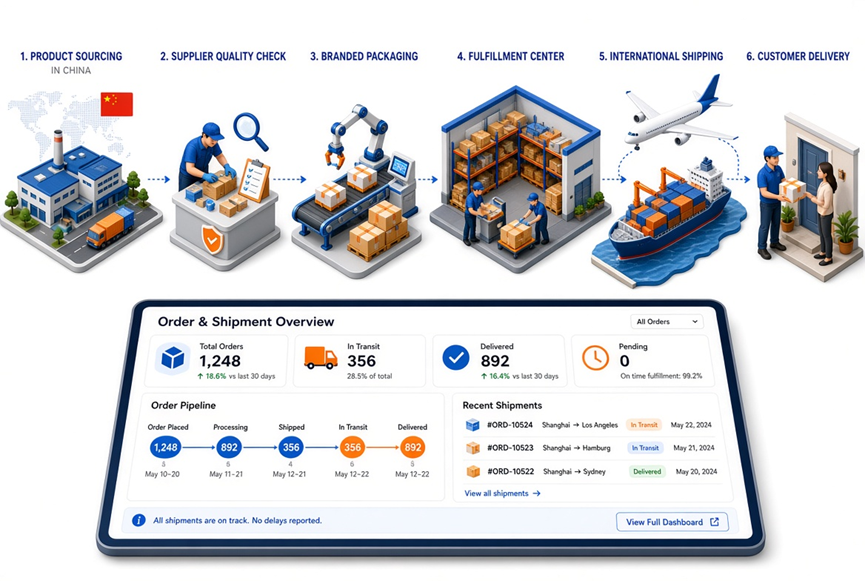
A profitable dropshipping price is not simply your product cost multiplied by two. The best dropshipping pricing strategy accounts for landed cost, payment processing, advertising, returns, delivery expectations, competitor positioning, and the value customers perceive before they reach checkout.
For merchants sourcing products from China and selling worldwide, pricing is especially important because small calculation errors can quickly erase margin. A reliable sourcing and fulfillment partner such as Looperbuy can help reduce inventory exposure, simplify product procurement, and make fulfillment costs more predictable—but the selling price must still be designed around the full economics of each order.
> Key idea: Price for contribution margin, not for markup alone. A high markup can still produce little or no profit when shipping, ads, refunds, and payment fees are ignored.
Table of Contents
Why Dropshipping Pricing Strategy Matters
Your price affects more than revenue. It influences the type of customer you attract, how much advertising you can afford, whether promotions remain profitable, and whether your business can continue operating when supplier or logistics costs change.
A good pricing strategy helps a seller:
– Protect gross and net margins
– Fund customer acquisition through paid ads or creator partnerships
– Cover product sourcing, packaging, shipping, and payment charges
– Reduce customer hesitation by making pricing transparent
– Create room for promotions without turning discounts into losses
– Position a product as affordable, premium, practical, or exclusive
– Scale sales without taking on unnecessary inventory risk
For a global seller, the real question is not “What price can I charge?” but “What price gives me a sustainable profit after every cost required to acquire, fulfill, and support the order?”
Start With Your True Landed Cost
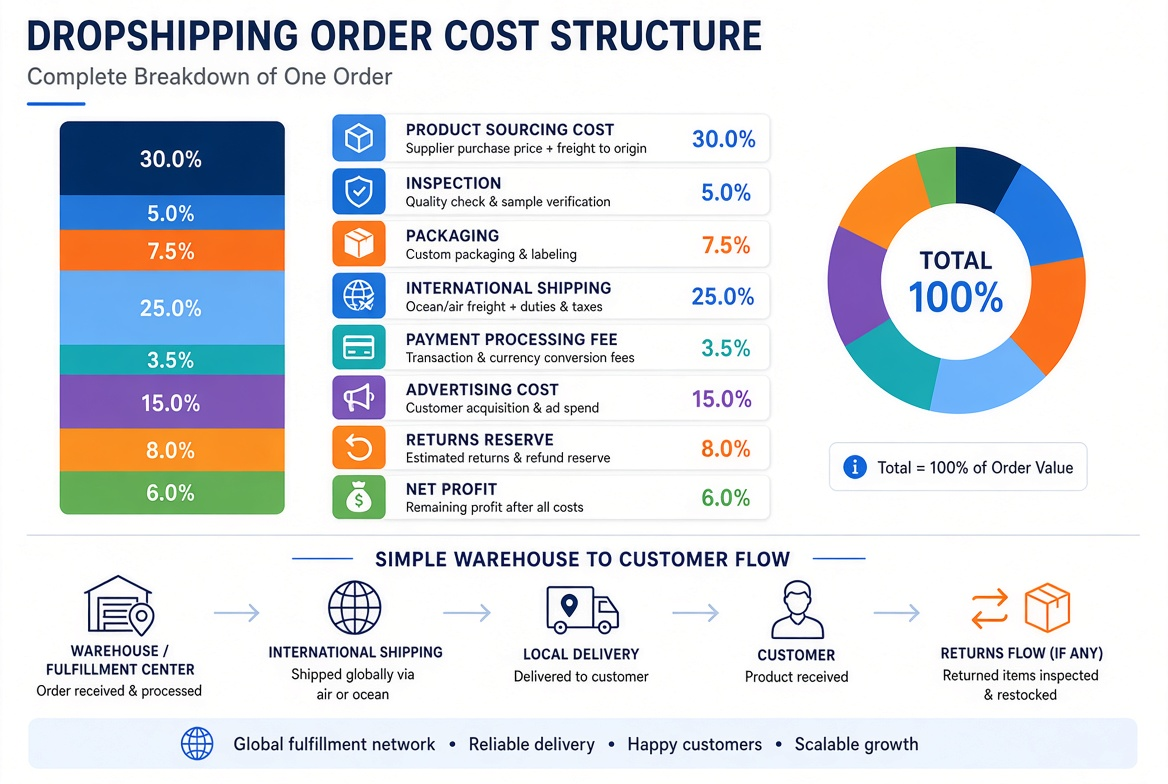
Before choosing a pricing model, calculate the real cost of delivering one order to the buyer. This is your landed cost, and it should be based on actual order-level expenses rather than the supplier’s product quote alone.
The core dropshipping pricing formula
Use this formula as a starting point:
Net Profit Per Order=Selling Price−Total Variable Cost Per Order
Where:
Total Variable Cost=Product Cost+Sourcing Fees+Packaging+Shipping+Payment Fees+Advertising Cost+Returns Reserve
Then calculate your net margin:
Net Margin %=Net Profit Per Order÷Selling Price×100
A pricing decision based only on product cost is incomplete. For example, selling a product that costs $12 for $29.99 may look attractive. But if fulfillment is $6, payment fees are $1.20, and your average ad cost to acquire a sale is $8, your real profit is only about $2.79 before customer service, refunds, software, and taxes.
Example: A more realistic pricing calculation
| Cost or revenue item | Amount |
| Product sourcing cost | $12.00 |
| Product inspection and packaging | $1.50 |
| International fulfillment shipping | $6.50 |
| Selling price | $34.99 |
| Payment processing estimate | $1.35 |
| Average customer acquisition cost | $7.00 |
| Returns and support reserve | $1.25 |
| Estimated profit per order | $5.39 |
| Estimated net margin | 15.4% |
In this example, a 192% markup on the supplier cost does not mean a 192% profit margin. The seller has a 15.4% estimated net margin before fixed operating expenses.
For merchants using Looperbuy, it is useful to build pricing from a consistent order-cost workflow: confirm the product quote, verify shipping methods by destination, include packaging or inspection requirements, and update prices when actual fulfillment data differs from estimates.
Costs sellers commonly forget
Many new sellers underestimate the following expenses:
– Product sourcing and supplier transaction costs
– Sample orders and quality checks
– Branded packaging, inserts, or protective materials
– Shipping differences by country, weight, and delivery speed
– Currency conversion charges
– Payment gateway fees
– Marketplace commissions
– Paid ad spending
– Influencer commissions or affiliate payouts
– Customer service labor
– Refunds, replacements, chargebacks, and reshipments
– Product breakage or delivery exceptions
– Store apps, software subscriptions, and fulfillment tools
Shopify notes that fees can vary by plan, payment method, and whether a merchant uses a third-party payment provider; international transactions can also include currency conversion costs. These costs should be reflected in your pricing model rather than treated as a surprise after the sale.
Six Proven Dropshipping Pricing Strategies
The strongest stores rarely rely on only one model. Instead, they select the appropriate approach based on product category, competition, customer intent, and marketing objective.
1. Keystone pricing for simple margin planning
Keystone pricing means setting the retail price at approximately double the wholesale cost.
Retail Price=Wholesale Cost×2
For instance, a product sourced for $20 would sell for approximately $40.
This is easy to understand and fast to implement, which makes it useful for initial product research or small catalogs. It may work well for distinctive items, giftable products, accessories, niche tools, and products with low direct price comparison.
However, it becomes unreliable when your shipping and advertising costs are high. A 2x multiplier can be too low for a product with expensive customer acquisition—and too high for a commodity product that buyers can compare across dozens of stores.
Best use case: A starting benchmark, not a final pricing decision.
2. MSRP-based pricing for branded products
Manufacturer’s Suggested Retail Price (MSRP) is a recommended retail price established by a brand or manufacturer. It can offer a reference point when selling products with recognized market pricing.
MSRP-based pricing can make a store appear consistent with customer expectations. It is especially useful when buyers already know what a product category should cost.
But MSRP should never replace your own margin analysis. A suggested retail price does not automatically cover your advertising spend, transaction fees, fulfillment method, or return rate.
Best use case: Branded, standardized, or widely recognized products where market pricing is established.
3. Bundle pricing to increase average order value
Bundle pricing combines related products into one package at a price that is lower than buying each product separately.
Examples include:
– A skincare set with cleanser, serum, and facial tool
– A pet grooming kit with brush, nail trimmer, and lint remover
– A travel set with organizer bags, luggage tag, and toiletry bottle kit
– A phone protection package with case, screen protector, and charging cable
Bundles can raise average order value, distribute fulfillment costs across more items, and make comparison shopping harder because the offer is more distinctive.
The key is to create a bundle that solves a complete customer problem. Randomly combining products simply to increase cart value can reduce trust.
Best use case: Complementary products with shared audiences and manageable shipping weight.
4. Penetration pricing for launches and testing
Penetration pricing means offering a lower introductory price to gain early traction, collect reviews, validate demand, or enter a crowded category.
For example, a seller might launch a new product at $24.99 rather than the planned long-term price of $29.99 for the first 100 orders. The offer should have a clear endpoint and a defined business purpose.
Use penetration pricing carefully. If customers see constant discounts, they may wait for the next promotion rather than purchasing at full price. It can also make it difficult to raise prices later without resistance.
Best use case: New product launches, market testing, customer-review campaigns, and strategic short-term promotions.
5. Charm pricing for lower-friction decisions
Charm pricing uses endings such as $19.99, $29.95, or $49.90 instead of round numbers like $20 or $50.
The difference is small, but customers often interpret $19.99 as meaningfully lower than $20. In lower- and mid-priced consumer categories, this can reduce purchase friction without requiring a large discount.
Charm pricing works best when it matches the store’s positioning. A value-oriented or mass-market store may benefit from $24.99. A premium design-led brand may prefer a clean $25 or $48 to communicate confidence and simplicity.
Best use case: Impulse-friendly products, accessories, gifts, and value-driven stores.
6. Premium pricing for differentiated offers
Premium pricing sets prices above direct competitors to communicate higher value. It only works when the customer can see and believe the difference.
Premium positioning may be supported by:
– Better product photography and demonstration videos
– Original packaging or branded inserts
– Faster, trackable shipping options
– Strong product education
– Quality verification before shipment
– Responsive customer support
– More useful product bundles
– Clear warranties or satisfaction policies
– A unique product angle for a specific audience
A premium price cannot compensate for vague product information or poor delivery experience. The customer needs tangible reasons to choose your offer over a lower-priced alternative.
Best use case: Curated products, strong brand storytelling, superior presentation, quality-controlled sourcing, and service-led offers.
Compare Competitors Without Copying Them
Competitor research is necessary, but copying the lowest visible price is often a mistake. The lowest-priced seller may have a completely different cost structure, stock inventory locally, accept lower margins, use lower-quality materials, or rely on a marketplace audience that you do not have.
Instead, compare offers on a like-for-like basis.
| Comparison factor | What to review | Why it matters |
| Product specification | Materials, dimensions, features, variants | Products that look similar may not be comparable |
| Fulfillment promise | Delivery time, tracking, origin country | Faster and clearer delivery can justify a higher price |
| Offer structure | Single item, bundle, bonus, warranty | Bundles change the perceived value |
| Brand presentation | Images, reviews, product pages, support | Trust influences price tolerance |
| Checkout total | Product price, shipping, taxes, fees | The final payable amount matters most |
| Promotion method | Coupon, subscription offer, volume discount | A low listed price may hide other conditions |
Be particularly careful with shipping. Baymard Institute’s research identifies extra costs—such as shipping, tax, and fees—as a major reason shoppers abandon carts; its 2025 statistics list shows 40% of respondents cited these costs as too high.
This does not mean every store must offer free shipping. It means customers should understand the final value proposition early. You can choose one of three clear models:
1. Free shipping built into the product price: Best for simple offers and broad international audiences.
2. Low product price plus clearly displayed shipping: Useful when shipping varies widely by destination.
3. Free-shipping threshold: Effective for bundles and multi-item purchases because it can raise average order value.
The least effective approach is surprising buyers with a large delivery fee at the final checkout step.
Build a Pricing System, Not a One-Time Price
A price should be reviewed regularly because product costs, shipping rates, exchange rates, ad performance, and competitor offers change over time.
A practical pricing workflow
1. Confirm the sellable product.
Verify specifications, quality level, packaging, available variants, and supplier reliability before building a price around an uncertain product.
2. Calculate the landed cost by destination.
Shipping to the United States, Europe, Australia, and other markets may vary significantly. Avoid using one global shipping assumption if actual rates differ substantially.
3. Set a minimum acceptable margin.
Decide the margin below which you will not continue advertising or discounting a product. This threshold should leave room for refunds, support, and operational costs.
4. Choose a primary pricing model.
Select the strategy that fits the product: bundle pricing for complementary items, premium pricing for differentiated offers, or penetration pricing for a controlled launch.
5. Create promotional guardrails.
Define the maximum discount, free-shipping threshold, affiliate commission, and ad cost your margin can support.
6. Test one variable at a time.
Test price, bundle structure, shipping presentation, or landing-page value proposition separately. If everything changes at once, you will not know what improved performance.
7. Review contribution margin weekly.
Track sales volume, conversion rate, average order value, cost per acquisition, refund rate, delivery issues, and actual profit per order—not only revenue.
Expert insight: Price the offer, not just the item
In my experience reviewing ecommerce offers, the most durable pricing advantage usually comes from making the offer more complete—not from undercutting competitors by one or two dollars.
For example, instead of selling a generic pet grooming brush for $18.99, a merchant could create a “Home Grooming Starter Set” for $34.99 that includes the brush, cleaning comb, storage pouch, and a concise usage guide. The merchant is no longer competing only on the price of a single common item. They are selling convenience, completeness, and confidence.
That approach can improve average order value while making customer value easier to communicate.
Use Discounts Without Damaging Profit
Promotions can increase conversion, but only when the original price, discount depth, and margin are credible. A discount is not a strategy if it exists solely because the base price was unrealistic.
When advertising a former price or “was/now” comparison, ensure that the comparison is genuine. U.S. federal pricing guidance warns against deceptive price comparisons and describes former-price claims in the context of a real, bona fide price—not an artificially inflated reference price.
Safer promotional options
– First-order discounts for email or SMS subscribers
– Limited launch offers with a specific end date
– Quantity discounts, such as “Buy 2, save 10%”
– Bundles with a transparent total saving
– Free shipping above a clearly stated cart value
– Loyalty rewards for repeat customers
– Seasonal campaigns tied to real inventory or demand conditions
Before launching a promotion, calculate the lowest price you can offer while still meeting your required profit threshold.
Minimum Promotional Price=(Total Variable Cost)÷(1-Target Net Margin)
If your variable cost is $20 and you want at least a 20% net margin:
20÷(1-0.20)=$25
Your promotional price should not fall below $25 if that is the minimum needed to preserve the target margin.
How Looperbuy Supports Better Pricing Decisions
For a global B2B seller, product pricing becomes more reliable when sourcing and fulfillment information is clear before the product is listed. Looperbuy can support this process by helping merchants source Chinese products, purchase products on demand, consolidate relevant order steps, and arrange shipping without requiring sellers to hold large amounts of inventory.
This model can help merchants:
– Test products without committing capital to bulk stock
– Reduce the risk of paying for storage before demand is proven
– Coordinate sourcing and order fulfillment more efficiently
– Build price calculations around actual procurement and delivery requirements
– Focus more resources on product selection, store conversion, and customer relationships
The best results come from treating Looperbuy as part of a disciplined operating system: source carefully, confirm order-level costs, create a differentiated offer, and adjust retail prices based on actual margins rather than assumptions.
> Ready to build more profitable product offers? Start by requesting a product sourcing and fulfillment quote through Looperbuy, then use the complete landed-cost figure to set a price that supports both customer value and sustainable growth.
Frequently Asked Questions
1. What is the best pricing strategy for dropshipping?
There is no single best strategy for every store. A practical approach is to start with full landed cost, establish a minimum target margin, and then choose a model that fits the product. Bundle pricing can work well for complementary products, penetration pricing can support controlled launches, and premium pricing can work when the offer has genuine differentiation.
2. How much should I mark up dropshipping products?
A markup should not be selected as a fixed rule. Doubling product cost may be a useful early benchmark, but it does not account for shipping, payment processing, advertising, returns, or customer support. Calculate total variable cost first, then set a price that meets your required profit margin.
3. Should I offer free shipping for dropshipping products?
Free shipping can reduce checkout friction, especially when the cost is incorporated transparently into the product price. However, it is not always the best model. If delivery costs vary heavily by country or product weight, clearly displayed shipping or a free-shipping threshold may be more sustainable.
4. How can I compete when other sellers offer lower prices?
Do not compete on price alone. Differentiate through product bundles, quality control, clear delivery expectations, original content, faster support, better packaging, useful product education, and a more complete customer offer. Compare competitors based on the final delivered value, not only the headline price.
5. How often should I review dropshipping prices?
Review high-volume products at least weekly and review the full catalog monthly. Update your calculations whenever supplier prices, shipping rates, exchange rates, payment fees, advertising costs, or return rates change significantly.
6. Can I use discounts without losing money?
Yes, if you establish a minimum promotional price before launching the campaign. Your discounted price must still cover full variable costs and meet your required margin. Avoid permanent discounts or misleading “was/now” claims, as they can weaken brand trust and create compliance risks.
7. Why is landed cost important for global dropshipping?
Landed cost reflects what it actually takes to get a product to the customer. It includes more than the product purchase price: shipping, handling, packaging, payment fees, and other order-level costs. Without this figure, sellers can mistakenly price products that generate revenue but little real profit.
References
1. Doba. “[6 Dropshipping Pricing Strategies That Set You Up for Success].”
2. Baymard Institute. “[50 Cart Abandonment Rate Statistics 2026].”
3. Shopify. “[Shopify Pricing].”
4. Shopify Help Center. “[Fees and Costs].”
5. Electronic Code of Federal Regulations. “[16 CFR Part 233 — Guides Against Deceptive Pricing].”
6. Federal Trade Commission. “[Deceptive Pricing].”