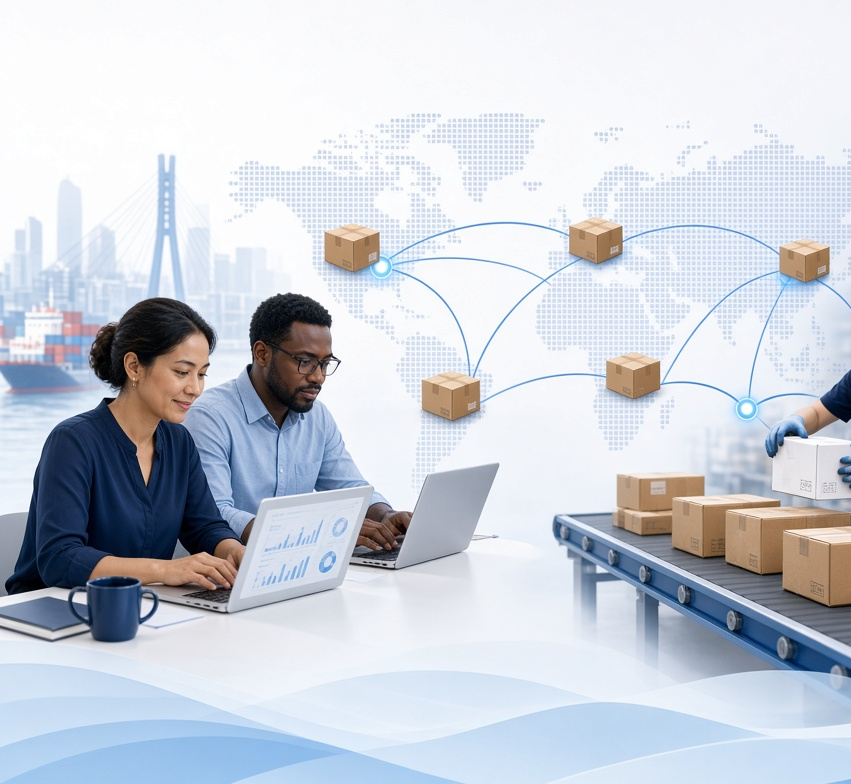
Wholesale eCommerce helps global sellers source products, test demand, and fulfill orders without excessive inventory risk. Learn how a hybrid China sourcing, wholesale purchasing, and dropshipping model can reduce costs, improve delivery control, and create a scalable B2B supply chain with Looperbuy.
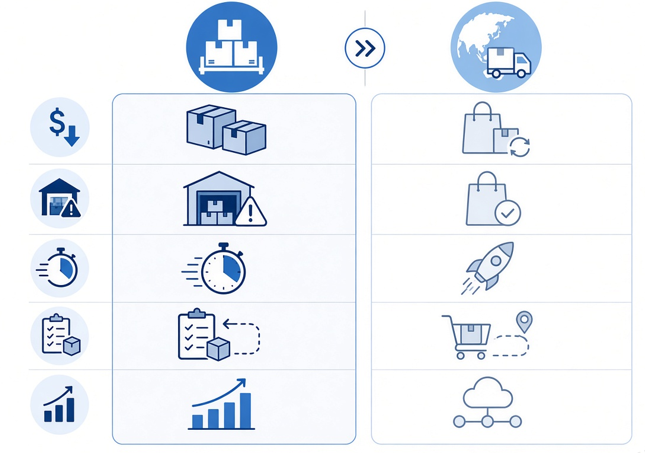
Wholesale eCommerce has evolved from a simple online bulk-ordering channel into a practical operating model for global B2B sellers. For businesses sourcing from China, the opportunity is no longer just to find lower unit prices—it is to build a reliable, low-inventory supply chain that connects product sourcing, supplier coordination, order fulfillment, international shipping, and customer delivery.
For many online sellers, the most effective model combines wholesale purchasing with on-demand fulfillment. Rather than committing capital to large quantities of untested stock, sellers can use a China sourcing and dropshipping partner such as Looperbuy to identify products, purchase from suppliers, inspect orders, consolidate packages, and ship directly to customers or downstream business buyers.
Table of Contents
What Is Wholesale eCommerce?
Wholesale eCommerce is the online sale of goods from one business to another, usually at volume-based prices. A manufacturer, distributor, sourcing agent, or wholesaler sells products to retailers, online stores, brands, resellers, or other commercial buyers rather than directly to individual consumers.
A traditional wholesale transaction often looks like this:
1. A retailer identifies a product category.
2. The retailer purchases inventory in bulk from a manufacturer or wholesaler.
3. The retailer stores the goods in its own warehouse or a third-party fulfillment center.
4. The retailer sells products through online stores, marketplaces, distributors, or physical channels.
5. The retailer manages packaging, delivery, returns, stock replenishment, and customer service.
This model can work well for established businesses with predictable demand. However, it also creates major operational challenges: upfront inventory investment, warehouse costs, slow cash conversion, stockouts, unsold products, and cross-border logistics complexity.
A more flexible version of wholesale eCommerce combines China product sourcing, selective bulk buying, and dropshipping fulfillment. Instead of treating wholesale as an all-or-nothing inventory commitment, businesses can test products in smaller quantities and scale only after demand is proven.
Wholesale eCommerce vs. B2B eCommerce vs. Dropshipping
These terms overlap, but they are not identical. Understanding the differences helps sellers choose the right operating model.
| Model | Primary transaction | Inventory ownership | Typical order size | Best for |
| Wholesale eCommerce | Business sells goods to another business | Usually buyer-owned after purchase | Medium to large | Retailers, distributors, brands |
| B2B eCommerce | Any online business-to-business transaction | Varies by model | Varies | Manufacturers, distributors, procurement teams |
| Dropshipping | Seller markets goods; supplier or agent fulfills orders | Seller may not hold inventory | Usually single-unit orders | New stores, product testing, lean operations |
| Hybrid wholesale + dropshipping | Seller uses bulk pricing and on-demand fulfillment | Partial or flexible | Small tests to larger replenishment orders | Scaling cross-border sellers |
Wholesale eCommerce is a type of B2B eCommerce, but B2B eCommerce is broader. It can include recurring procurement, contract pricing, distributor portals, quote requests, spare-parts ordering, and multi-user corporate accounts.
Dropshipping is different because the seller may never physically receive or store the product. The supplier—or a sourcing and fulfillment partner—ships the order to the end customer after the seller receives a sale.
For global online sellers, a hybrid approach is often the most practical:
– Test products without large inventory exposure.
– Move proven products into small-batch or bulk purchasing.
– Use consolidation and fulfillment services to lower shipping complexity.
– Keep fast-selling SKUs available in a fulfillment warehouse.
– Avoid tying up cash in slow-moving products.
Why Wholesale eCommerce Matters Now
Digital purchasing is no longer a side channel for business buyers. It has become part of the core commercial experience. McKinsey’s 2026 Global B2B Pulse research found that 71% of B2B companies offer eCommerce, and organizations using it report that roughly one-third of revenue flows through digital channels. Buyers also use an average of ten channels during the buying journey, making consistent product information, pricing, and support increasingly important.
For sellers, this means that a product alone is not enough. Buyers expect a buying process that is clear, fast, and dependable:
– Accurate product specifications
– Transparent pricing and shipping options
– Fast access to sourcing support
– Clear delivery expectations
– Reliable order tracking
– Flexible payment and fulfillment choices
– Consistent responses before and after purchase
The broader online commerce environment continues to grow as well. In the United States, retail eCommerce sales in the second quarter of 2026 increased 12.2% year over year, compared with 6.7% growth in total retail sales. While retail and B2B sales are measured differently, the direction is clear: digital buying behavior continues to shape how businesses plan sourcing, distribution, and customer fulfillment.
The Core Benefits of Wholesale eCommerce
Lower operating friction
A well-designed online wholesale process reduces repetitive manual work. Instead of relying on email chains, spreadsheets, scattered supplier messages, and manual order updates, sellers can centralize product sourcing, quotations, purchase orders, shipping coordination, and fulfillment status.
The goal is not merely automation. The real value is fewer preventable errors:
– Fewer incorrect product variations
– Less confusion over quantities and packaging
– More consistent shipping records
– Faster identification of delayed orders
– Better visibility into landed costs
Broader access to Chinese products
China offers extensive manufacturing capacity across consumer goods, accessories, home products, electronics, packaging, tools, pet products, beauty accessories, and many other categories. However, accessing that supply base successfully requires more than finding a low listing price.
An experienced sourcing process should evaluate:
– Product quality and material consistency
– Supplier responsiveness
– Minimum order quantity
– Customization capability
– Production lead time
– Packaging requirements
– Certifications and market compliance needs
– Shipping cost and delivery reliability
A sourcing partner can help bridge the gap between a seller’s commercial requirements and the supplier’s operational reality. This is particularly valuable when sellers are working across languages, time zones, and different trade practices.
Better inventory control
Inventory is often the largest financial risk in eCommerce. A product may look promising in research but fail to convert after advertising costs, competitor pricing, customer reviews, seasonal changes, or shipping delays are considered.
A lean sourcing model lets sellers validate demand before expanding inventory. For example, a store may begin with 20–50 test orders, monitor conversion and return patterns, then place a small bulk order only after it has evidence of repeatable demand.
This approach can help businesses avoid:
– Overstocking low-demand products
– Paying for unnecessary storage
– Discounting unsold inventory
– Running out of working capital
– Managing too many weak SKUs at once
Improved customer delivery experience
Customers often judge a business by the delivery experience, not by its supplier relationship. Late dispatch, poor packaging, unclear tracking, damaged goods, or unexpected shipping fees can weaken trust—even when the product itself is acceptable.
For this reason, sourcing and fulfillment should be treated as a customer-experience function. A reliable fulfillment workflow includes product confirmation, quality inspection, appropriate packaging, address verification, tracking updates, and responsive exception handling.
How to Build a Low-Risk Wholesale Sourcing Workflow
The strongest wholesale eCommerce operations do not begin with a massive catalog. They begin with a repeatable decision process.
1. Select products with operational fit
Choose products based on more than demand. A product should also be suitable for cross-border fulfillment.
Look for items with:
– Stable quality standards
– Low breakage risk
– Reasonable size and weight
– Clear product specifications
– Adequate profit margin after shipping
– Low regulatory complexity
– Reliable replenishment potential
Avoid making decisions based only on supplier price. A cheaper product can become expensive when defects, returns, shipping surcharges, customer complaints, or failed customs clearance are included.
2. Validate suppliers and samples
Before scaling, verify the actual product. Product photos and marketplace listings are useful starting points, but they do not replace samples or inspection.
A practical validation process includes:
1. Confirm materials, dimensions, colors, and included accessories.
2. Check packaging quality and labeling requirements.
3. Review the supplier’s production lead time.
4. Order a sample or request product verification.
5. Identify likely quality risks before customer orders begin.
6. Confirm whether the supplier can maintain consistency at higher volumes.
For sellers building a brand, this is also the stage to discuss private labeling, custom inserts, branded packaging, bundle configurations, and barcode requirements.
3. Calculate landed cost, not unit cost
The unit price is only one component of profitability. Sellers should calculate the full landed cost before setting retail prices or committing to inventory.
Landed Cost=Product Cost+Domestic China Shipping+Inspection+Packaging+International Shipping+Duties/Taxes+Payment Fees
For a more realistic commercial view, add marketing costs, marketplace fees, expected return costs, and customer-service costs.
A product with a $4 factory price may not be viable if it requires $7 in shipping, $2 in packaging and handling, $3 in platform fees, and $5 in advertising to acquire a sale. In contrast, a $9 product with compact packaging and lower return risk may generate healthier margin.
4. Start with a controlled test
A small test order helps answer the questions that product research cannot:
– Does the product arrive as expected?
– Is packaging durable enough?
– Are customers satisfied with the perceived value?
– Does delivery time match the store’s promise?
– Are defects or returns acceptable?
– Can the supplier replenish quickly?
Use early sales data to decide whether to discontinue, improve, bundle, reprice, or scale the SKU.
5. Scale through a hybrid fulfillment model
Once demand is validated, sellers can use different fulfillment paths for different products:
| Product situation | Recommended approach |
| New or uncertain product | On-demand fulfillment or small test orders |
| Proven but moderate-volume product | Small-batch purchasing and warehouse storage |
| High-volume, predictable SKU | Bulk purchasing, branded packaging, dedicated inventory |
| Seasonal product | Conservative inventory with flexible replenishment |
| Large or fragile item | Carefully compare shipping methods and packaging requirements |
This approach keeps capital focused on products that are already earning demand.
What Buyers Expect From a Wholesale Platform
The earlier wholesale eCommerce model emphasized catalog size and transaction capability. Those are necessary, but they are no longer sufficient. Modern buyers expect a purchasing environment that reduces uncertainty.
A strong B2B sourcing and fulfillment platform should provide:
– Clear product information: Specifications, variants, materials, dimensions, and usable images.
– Sourcing support: Help finding products beyond standard marketplace listings.
– Supplier communication: A process for clarifying requirements before purchase.
– Quality checks: Verification before international dispatch where appropriate.
– Order consolidation: Combining products from multiple suppliers into fewer shipments.
– Shipping choices: Delivery options based on speed, cost, destination, and parcel characteristics.
– Order visibility: Status updates, tracking, and exception communication.
– Scalable fulfillment: Support for single-order dropshipping, bulk purchasing, and warehouse fulfillment.
For Looperbuy users, the key advantage is operational simplicity: instead of coordinating many supplier conversations, local deliveries, warehouse handoffs, and international shipping steps independently, sellers can manage sourcing and fulfillment through a more centralized workflow.
Practical Example: From Product Test to Repeatable Supply
Imagine an online retailer selling home-organization products in North America and Europe.
The retailer identifies a compact kitchen-storage accessory with promising demand but does not know whether customers will accept the product quality or delivery time. Rather than ordering 2,000 units immediately, the retailer uses a sourcing partner to confirm available versions, inspect a sample, and begin fulfilling a limited number of customer orders.
After several weeks, the retailer reviews:
– Sales conversion rate
– Customer feedback
– Product defect rate
– Shipping performance by country
– Refund and return reasons
– Profitability after advertising and fulfillment costs
If results are positive, the retailer can shift the SKU from one-by-one fulfillment to a small warehouse batch. This allows faster handling and potentially lower per-unit shipping costs while still avoiding a large inventory commitment.
That is the value of a graduated sourcing model: inventory increases only when evidence supports it.
Common Wholesale eCommerce Mistakes
Even experienced sellers can lose margin when wholesale sourcing decisions are made too quickly. The most common mistakes include:
– Choosing suppliers solely by the lowest price.
– Skipping samples or quality verification.
– Ignoring product weight and shipping-volume calculations.
– Buying too much inventory before demand is validated.
– Offering delivery promises that the supply chain cannot consistently meet.
– Failing to account for packaging, fees, duties, and returns.
– Managing too many suppliers without a consolidation process.
– Using generic product descriptions that do not answer real buyer questions.
– Treating fulfillment as a back-office task instead of a customer-facing experience.
The most resilient sellers create documented workflows. They know who approves products, how quality is checked, what happens when inventory runs low, and how shipping exceptions are handled.
Build a More Flexible Global Supply Chain
Wholesale eCommerce is no longer only about buying large quantities at discounted prices. It is about designing a supply chain that lets sellers source confidently, test products intelligently, protect cash flow, and fulfill customer orders reliably.
For global B2B sellers, Looperbuy can support that process by helping source products from China, coordinate supplier purchasing, inspect and consolidate goods, and ship orders to customers worldwide. This reduces the need to manage separate suppliers, warehouses, payments, and logistics providers on your own.
Start with a product sourcing request, validate the product before scaling, and build inventory only when customer demand proves it deserves your capital.
FAQ
1. What is wholesale eCommerce?
Wholesale eCommerce is the online sale of goods from one business to another, usually in bulk or at volume-based pricing. Buyers may include retailers, distributors, online sellers, procurement teams, and brand owners.
2. Is wholesale eCommerce the same as dropshipping?
No. Wholesale eCommerce typically involves buying inventory at volume, while dropshipping allows a seller to market products without holding the stock directly. A hybrid model can combine wholesale pricing with on-demand fulfillment.
3. How can I source products from China without holding large inventory?
You can begin with product research, supplier verification, samples, and smaller test orders. A China sourcing and fulfillment partner can purchase goods, perform quality checks, consolidate packages, and ship orders as demand develops.
4. What should I check before choosing a wholesale supplier?
Review product quality, sample consistency, minimum order quantity, production lead time, communication quality, packaging capability, customization options, and the total landed cost—not just the factory price.
5. What is landed cost in wholesale sourcing?
Landed cost is the total cost of getting a product ready for sale in its destination market. It can include product price, domestic shipping, inspection, packaging, international freight, duties, taxes, payment charges, and other fulfillment expenses.
6. Can a sourcing agent help with branded packaging?
Yes. Depending on the supplier and product, a sourcing partner may help coordinate private labels, logos, custom packaging, promotional inserts, bundles, barcode labels, and other brand-specific requirements.
7. When should I move from dropshipping to bulk inventory?
Consider moving to small-batch or bulk inventory when a product has demonstrated stable sales, acceptable return rates, predictable replenishment, and sufficient profit margin to justify storage and inventory investment.
References
1. Virto Commerce. “[What Is Wholesale eCommerce & Review of 10 Wholesale eCommerce Platforms in 2024].”
2. McKinsey & Company. “[The surprising economics of B2B growth: The new survival threshold and what it takes to thrive].”
3. U.S. Census Bureau. “[Quarterly Retail E-Commerce Sales Report].”
4. Mordor Intelligence. “[B2B E-commerce Market Size, Share & 2031 Growth].”
5. UN Trade and Development (UNCTAD), cited in Ecommerce Germany. “[Global e-commerce in 2026: Market size, regional trends and what the numbers actually mean].”