How long does it take to make money with dropshipping? Explore a realistic 2–6 week first-sale timeline, a 3–12 month profit roadmap, product and supplier selection tips, unit-economics formulas, compliance essentials, and a 90-day plan to build a sustainable store.
Most new dropshipping stores can generate their first orders within 2–6 weeks, but sustainable profitability commonly takes 3–12 months. The difference is rarely luck alone: it comes down to product economics, supplier execution, delivery transparency, customer trust, and disciplined testing.
For sellers using China sourcing and fulfillment, dropshipping can reduce the capital tied up in inventory and warehouse operations. However, it should be treated as a real retail business—not a shortcut to passive income. You remain responsible for the customer experience, including product claims, shipment expectations, returns, and support.
Table of Contents
The Realistic Dropshipping Profit Timeline
A first sale and a profitable business are not the same milestone. An order can validate initial demand, while profitability requires that your revenue exceeds your combined product, shipping, payment, advertising, refund, and operating costs.
Here is a practical timeline for a new store.
| Stage | Typical period | Main focus | What success looks like |
| Research and setup | Weeks 1–2 | Select products, validate suppliers, build product pages, set policies | A launch-ready store with clear shipping and return information |
| Launch and validation | Weeks 3–6 | Test traffic sources, creative angles, pricing, and product-market fit | First orders and reliable conversion data |
| Optimization | Months 2–6 | Improve product pages, reduce acquisition costs, refine customer service | Repeatable sales and improving contribution margin |
| Scale and systemize | Months 6–12+ | Expand winning products, automate fulfillment, build retention channels | Stable monthly profit and a manageable operating process |
This is just a benchmark, not a commitment. It depends on product selection, marketing, and supplier reliability.
The most important mindset shift is simple:
Do not ask, “How quickly can I make sales?” Ask, “How quickly can I find a repeatable, profitable order?”
A product that sells at a loss is not a winner. It is a signal that your offer, price, shipping method, advertising, or post-purchase process needs work.
What Determines Whether a Store Becomes Profitable?
Dropshipping lowers the need to pre-purchase stock, but it does not remove business risk. Profit depends on the relationship between your selling price and the total cost of acquiring and serving a customer.
1. Product selection and positioning
Avoid building a store around random “viral” products. A better product should have a clear buying reason:
– It solves an identifiable inconvenience or need.
– It is easy to demonstrate in images or short video.
– It has enough perceived value to support a healthy selling price.
– It is not overly fragile, regulated, oversized, or difficult to ship.
– It has room for bundles, accessories, repeat purchases, or upsells.
– It is available from suppliers with consistent specifications and inventory.
For example, a generic kitchen gadget may compete directly with thousands of identical listings. A better approach is to package a product around a specific audience and use case—such as compact meal-prep tools for apartment residents, or travel-friendly pet accessories for frequent road trips.
The goal is not merely to find demand. It is to create an offer that customers can understand and trust quickly.
2. Supplier reliability and fulfillment control
For China-based sourcing, supplier quality is a commercial issue, not simply an operational detail. A late shipment, incorrect variant, inconsistent product quality, or unavailable stock can erase the profit from many successful orders.
Before listing a product, ask suppliers for clear answers on:
– Unit cost at different order volumes
– Processing time before shipment
– Available shipping methods and estimated delivery windows
– Tracking availability and tracking update speed
– Packaging options and branded inserts
– Inventory update frequency
– Defect, reshipment, and refund procedures
– Whether product photos and specifications match the actual item
– Return destination and return-cost responsibility
Order samples before scaling. Review the item as a customer would: packaging, build quality, instructions, dimensions, color accuracy, and delivery experience. A sample order is often cheaper than a wave of refunds and chargebacks.
Supplier reliability is consistently one of the most difficult parts of operating a dropshipping business. Industry summaries commonly place typical dropshipping profit margins at approximately 10%–30%, while suggesting that sustainable operators often target around 15%–25%. That range makes preventable fulfillment mistakes especially expensive.
3. Customer acquisition costs
Many new sellers focus on revenue while ignoring the cost of getting each order. Paid advertising can bring fast data, but it can also consume a budget quickly if the product page or offer is weak.
Track these numbers from the first day:
| Metric | Formula | Why it matters |
| Conversion rate | Orders ÷ visitors | Shows whether visitors find the offer convincing |
| Average order value | Revenue ÷ orders | Higher AOV can improve ad tolerance |
| Customer acquisition cost | Ad spend ÷ new customers | Shows the cost to create each first purchase |
| Gross profit per order | Selling price − product cost − shipping − transaction fees | Reveals the money available for ads and operations |
| Contribution margin | Revenue − variable order costs − ad cost | Shows whether each new sale is helping or hurting |
| Refund rate | Refunds ÷ orders | Identifies product, expectation, or fulfillment issues |
A useful working formula is:
Net Profit=Revenue−Product Cost−Shipping−Payment Fees−Advertising−Refunds−Operating Costs
If you sell a product for $49, pay $16 for the product, $7 for shipping, $2 in payment fees, and $15 to acquire the customer, you have $9 left before refunds, apps, support labor, taxes, and overhead. That may be workable—but only if your actual return and support costs are controlled.
Revenue screenshots can be misleading. Contribution margin is what keeps the business alive.
4. Trust-building on the storefront
Customers do not need to know every detail of your sourcing process. They do need to understand exactly what they are buying, when it is likely to arrive, and what will happen if something goes wrong.
A conversion-ready product page should include:
– Original, high-resolution product images and a short demonstration video
– Accurate dimensions, materials, compatibility details, and care instructions
– A visible delivery estimate by destination
– Clear shipping and return policies
– A realistic FAQ that addresses objections
– Customer support contact details
– Transparent pricing with no surprise fees at checkout
– Reviews or user-generated content only when they are authentic and verifiable
Shopify’s guidance emphasizes that sellers must maintain publicly accessible processing, shipping, and refund information. It also notes that merchants are responsible for meeting legal requirements related to product recalls in the jurisdictions where they sell.
A 90-Day Plan to Reach Profitable Orders
The first 90 days should be a learning system. Your aim is to eliminate weak products early and put more effort behind the products that prove they can generate positive contribution margin.
Days 1–14: Build a testable foundation
1. Select one focused audience and a small product range rather than uploading hundreds of items.
2. Shortlist suppliers based on cost, processing time, product quality, communication, and shipping options.
3. Purchase samples from the strongest candidates.
4. Create product pages based on real product details—not generic supplier descriptions.
5. Publish shipping, return, privacy, and contact pages before launching.
6. Set up order tracking and a support process for delayed parcels, address corrections, and damaged items.
Days 15–45: Test demand without overcommitting
1. Launch a limited number of products and traffic angles.
2. Test different product hooks, images, video formats, and price points.
3. Monitor click-through rate, conversion rate, cost per purchase, and customer questions.
4. Pause products with recurring quality complaints or weak economics.
5. Keep a record of every supplier issue: out-of-stock events, delayed dispatches, tracking failures, and defect reports.
6. Do not scale ad spend until your unit economics are clearly positive.
Days 46–90: Improve the winning offer
1. Increase spend carefully on products with proven contribution margin.
2. Create bundles to raise average order value.
3. Add email flows for abandoned carts, delivery updates, post-purchase education, and reorder reminders.
4. Negotiate better pricing or faster fulfillment as order volume increases.
5. Use customer feedback to improve product descriptions, instructions, and pre-purchase FAQs.
6. Build a backup supplier plan for your top-selling items.
This approach turns dropshipping into a controlled test-and-improve process rather than a gamble on a single product.
Common Myths That Delay Profitability
“Dropshipping is passive income.”
It is not. You may avoid holding inventory, but you still manage product selection, store positioning, marketing, customer communication, exceptions, and supplier performance. The most successful sellers build systems—but systems come after hands-on learning.
“The cheapest supplier creates the highest profit.”
Not always. A lower unit price can be destroyed by slow dispatch, poor packaging, inconsistent product quality, expensive reshipments, and negative reviews. Compare the total fulfillment value, not only the factory price.
“I can promise fast delivery and solve it later.”
Do not make shipping claims that your supplier cannot consistently support. In the United States, sellers soliciting online orders must have a reasonable basis to expect they can ship within the stated time; if no time is stated, the rule generally sets a 30-day expectation after receipt of a properly completed order.
Accurate expectations are often better for long-term conversion than unrealistic delivery promises.
“Every product needs to go viral.”
Sustainable stores can be built around evergreen demand. Products related to home organization, pet care, beauty routines, hobbies, replacement parts, and problem-solving accessories may create steadier opportunities than short-lived trends—provided you differentiate the offer and validate quality.
How Looperbuy Can Support a Stronger Model
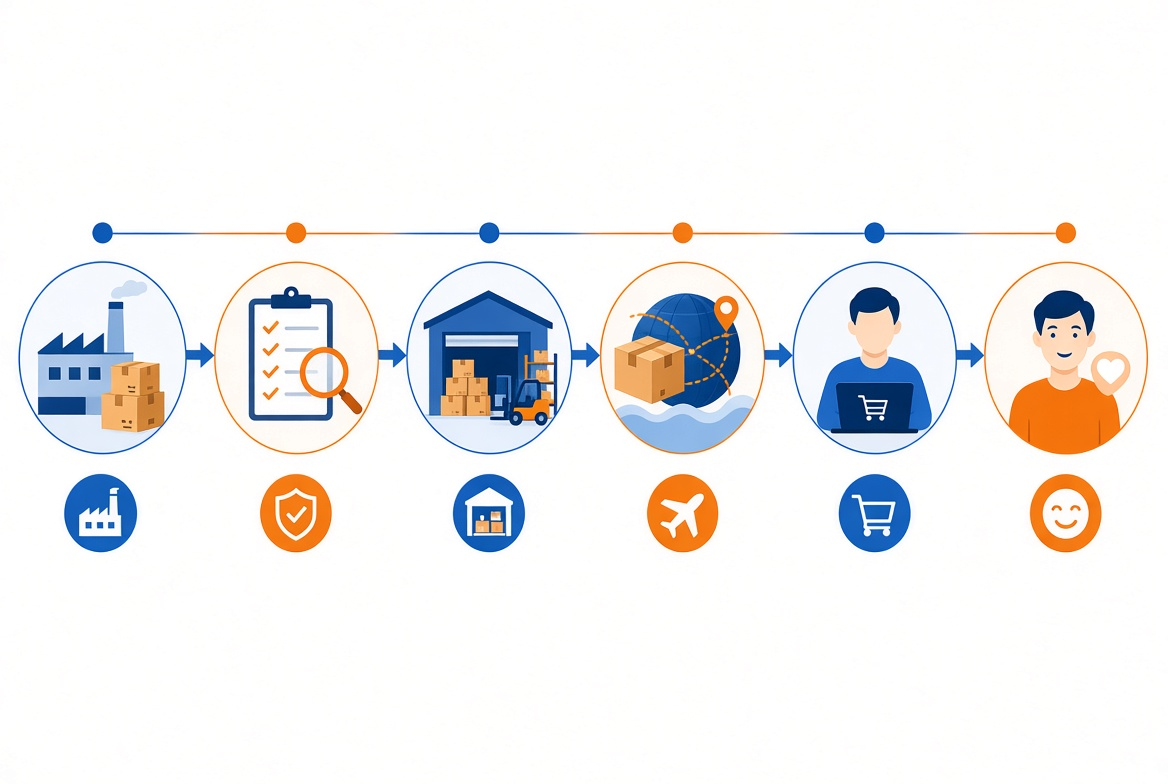
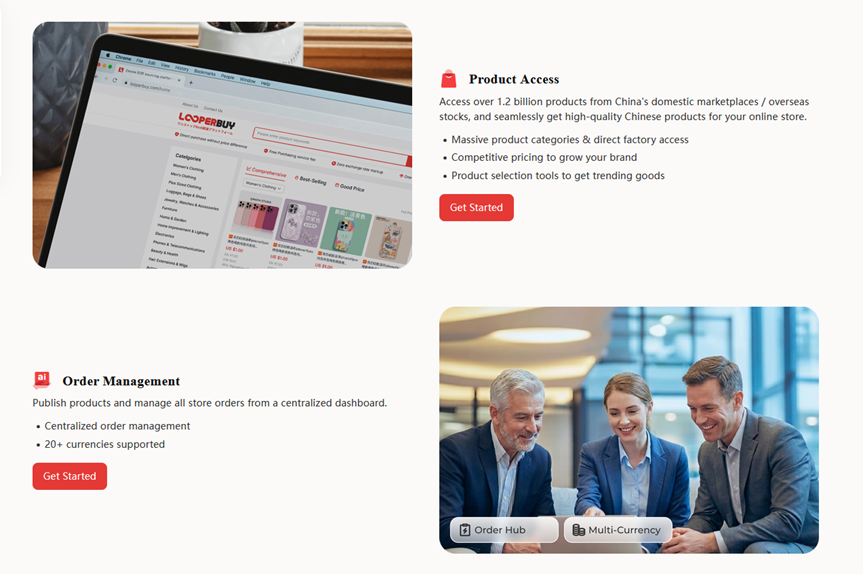
For sellers sourcing from China, the operational advantage is not simply “access to more products.” It is having a dependable process that connects product sourcing, supplier communication, order handling, quality checks, and international fulfillment.
Looperbuy can position its service around the operational outcomes that matter most to growing sellers:
– Sourcing support for products that match your specifications and target price.
– Supplier coordination that reduces communication gaps and sourcing uncertainty.
– Quality inspection options before products enter the delivery chain.
– Order fulfillment and international shipping without the seller needing to manage separate warehouse operations.
– Consolidation and packaging support that can help improve parcel presentation and potentially reduce unnecessary logistics complexity.
– Inventory-light operations that allow merchants to test products before committing to bulk stock.
The strongest partnership model is collaborative: sellers own the brand and customer relationship, while a sourcing and fulfillment partner helps make the promised experience operationally achievable.
Ready to test products without committing to costly inventory? Use Looperbuy to source product samples, compare supplier options, verify fulfillment details, and build a shipping plan before you increase marketing spend. A carefully validated supply chain gives your store a better chance to turn early orders into durable profit.
Frequently Asked Questions
1. How long does it take to get the first dropshipping sale?
Many new sellers may see their first sale in approximately 2–6 weeks, but this varies widely based on traffic quality, pricing, product appeal, store trust, and marketing execution. Treat the first sale as initial validation, not proof of a profitable business.
2. How long does it take to become profitable with dropshipping?
A realistic planning range is 3–12 months. Profitability depends on whether your product margin can cover advertising, shipping, payment fees, refunds, and operating expenses consistently.
3. What is a good dropshipping profit margin?
Industry estimates commonly place dropshipping margins in the 10%–30% range, with many sustainable businesses targeting around 15%–25%. Actual results differ by product category, supplier terms, shipping cost, traffic source, and customer return rate.
4. Do I need to buy inventory before starting?
No. The core dropshipping model allows you to purchase from a supplier after a customer places an order. However, buying samples before promoting a product is strongly recommended so you can verify product quality, packaging, and delivery performance.
5. Who handles refunds in a dropshipping business?
The store owner is the customer’s point of contact and should maintain a clear return and refund policy. You may negotiate reimbursement or return arrangements with suppliers, but customers will generally hold your store accountable for the experience. Shopify advises sellers to make shipping and refund information publicly accessible.
6. Is dropshipping legal?
Dropshipping is a legitimate retail fulfillment model, but sellers must follow the laws, marketplace rules, tax obligations, product standards, and consumer-protection requirements that apply in their selling markets. Delivery claims must be accurate and supportable.
7. What is the biggest mistake new dropshippers make?
The most costly mistake is scaling before validating the full order experience. Test the product, supplier, shipping route, product page, support workflow, and unit economics before committing a large advertising budget.
References
1. Doba. “[Earning Money with Dropshipping: How Long Until You See Profits?]”
2. Shopify Help Center. “[Dropshipping: Legal and compliance considerations].”
3. Cornell Law School, Legal Information Institute. “[16 CFR § 435.2 — Mail, Internet, or telephone order sales].”
4. Carro. “[80+ Ecommerce & Dropshipping Statistics for 2026].”
5. Purolator. “[Pros and Cons of Dropshipping: How to Generate Success].”