Discover the top stationery trade shows for global buyers and learn how to source reliable Chinese suppliers with greater confidence. This practical guide covers event selection, supplier verification, sample testing, MOQ negotiation, customization, compliance checks, and flexible fulfillment strategies for B2B sellers.
For stationery brands, wholesalers, marketplace sellers, and office-supply distributors, the right trade show can accelerate product discovery—but the real value comes from turning exhibition contacts into a tested, repeatable supply chain. This guide covers leading stationery trade shows, how to evaluate suppliers beyond the booth, and how to move from samples to flexible fulfillment without overcommitting to inventory.
According to the latest data from Mordor Intelligence, the global stationery and supplies market is projected to grow from US$152.43 billion in 2025 to US$160.22 billion in 2026, and is expected to reach US$205.64 billion in 2031, with a compound annual growth rate (CAGR) of approximately 5.11% during the forecast period. Market growth is primarily driven by the continued increase in global education demand, office procurement demand, increased consumption of creative and personalized stationery, and rising demand from businesses and consumers for environmentally friendly and sustainable materials. The Asia-Pacific region remains a significant growth market, expected to maintain strong growth potential due to its large population, increased investment in education, and the evolving trends in cultural and creative consumption.
Table of Contents
Why Stationery Trade Shows Still Matter
A stationery trade show is not simply a place to collect catalogs. It is a practical environment for comparing products, assessing suppliers face to face, spotting retail trends, and beginning negotiations with better context than an online inquiry alone can provide.
For buyers sourcing from China and Asia, an in-person visit makes it easier to evaluate details that product listings often conceal:
– Writing performance: ink flow, smudge resistance, grip comfort, refill compatibility, and color consistency
– Paper quality: opacity, ruling accuracy, binding strength, page count, and ink bleed-through
– Packaging execution: barcode placement, retail readiness, carton marks, inserts, and display options
– Manufacturing capability: customization methods, production lines, material sourcing, quality procedures, and capacity
– Commercial fit: minimum order quantity (MOQ), sample cost, tooling fees, lead times, payment terms, and export experience
Trade shows are particularly useful in a category where small differences matter. A notebook cover may look premium in a photo but warp in humid conditions. A gel pen can have an attractive barrel design but inconsistent ink output. A supplier may offer a low unit price but lack the ability to apply your private-label packaging accurately.
My sourcing rule: treat a booth visit as the first stage of supplier qualification, not the final decision. A polished display is valuable, but it does not replace samples, written specifications, inspections, and production follow-up.
Best Stationery Trade Shows to Consider
The best event depends on your product category, sourcing region, order volume, and business model. A retailer looking for artistic greeting cards needs a different event from a private-label seller sourcing school stationery, office products, or low-MOQ gift sets.
| Trade Show | Location | Main Value for Buyers | Best For |
| National Stationery Show | New York, United States | Greeting cards, custom invitations, journals, gift wrap, and lifestyle gifts | Independent retailers and design-led brands |
| Hong Kong International Stationery & School Supplies Fair | Hong Kong | Asian stationery, office products, school supplies, and business matching | Importers seeking export-ready suppliers |
| China Stationery Fair | Shanghai, China | Broad stationery and office-supply supplier access | Buyers sourcing at factory scale |
| China International Stationery & Gifts Exposition | Ningbo, China | Writing tools, paper products, art supplies, school products, OEM/ODM | Private-label and product-development buyers |
| Paperworld Middle East | Dubai, UAE | Paper, office supplies, stationery, creative products, and regional distribution | Buyers targeting Middle East, Africa, and South Asia |
| Yiwu International Commodities Fair | Yiwu, China | Small commodities, gifts, school supplies, and flexible assortment sourcing | Small and medium-sized sellers needing variety |
National Stationery Show
The National Stationery Show is a leading North American event for greeting cards, custom invitations, gift wrap, journals, and lifestyle gifts. It has a long history in the sector and is positioned for creative businesses, designers, specialty retailers, and brand buyers.
This event is most relevant if your product strategy depends on:
– Original illustration and licensed design
– Premium gifting and paper goods
– Boutique retail positioning
– Seasonal collections and curated assortments
– Direct relationships with independent brands
It is less suitable as a primary destination for buyers whose priority is large-scale China factory sourcing, low unit cost, or mass-market OEM production.
Hong Kong International Stationery & School Supplies Fair
For international buyers, Hong Kong remains a practical meeting point between Asian manufacturers and overseas markets. The Hong Kong International Stationery & School Supplies Fair has traditionally brought together stationery, office-product, and school-supply suppliers, while Hong Kong’s transport, financial, and trade infrastructure can make meetings and follow-up easier for global buyers.
Look for suppliers offering:
– Pens, markers, pencils, erasers, rulers, and correction products
– Notebooks, planners, memo pads, and paper stationery
– School bags, art materials, and classroom accessories
– Office organization, filing, desk accessories, and consumables
– Licensed, customized, recycled, and gift-ready product lines
When assessing an exhibitor, ask for a product catalog with export pricing, not just a showroom brochure. Confirm whether the displayed items are existing models, customer-exclusive designs, or products available for private labeling.
China Stationery Fair in Shanghai
The China Stationery Fair (CSF) in Shanghai is a leading professional trade fair for China’s stationery and cultural products industry, bringing together manufacturers, brand owners, exporters, wholesalers, retailers, and professional buyers in the fields of stationery, office supplies, and gift/cultural creative products. The 120th China Stationery Fair (CSF Cultural Fair) will be held from June 26th to 28th, 2026 at the Shanghai New International Expo Centre, concurrently with the China Gift Fair. The fair will cover approximately 92,000 square meters, spanning multiple specialized halls, attracting nearly a thousand brands and companies, and welcoming tens of thousands of professional visitors.
For a global buyer, the benefit of a Shanghai-based event is not only show-floor sourcing. It can also support a broader supplier trip across major manufacturing clusters, especially when combined with factory visits and sample reviews.
Use CSF to compare suppliers across categories such as:
– Writing instruments and refills
– Paper products and notebooks
– School supplies and educational products
– Art and craft materials
– Office supplies and desk organization
– OEM and ODM manufacturing services
Ningbo Stationery and Gifts Exhibitions
Ningbo is an important sourcing location for stationery and gifts. Global Sources’ trade-show guide identifies the China International Stationery Fair in Ningbo as a significant platform for office supplies, writing instruments, paper products, school and art supplies, lifestyle stationery, and OEM/ODM cooperation.
For buyers, Ningbo can be particularly valuable when you need suppliers that understand export packaging, customization, and container consolidation. It is also a useful place to compare specialized factories against trading companies.
Before placing an order, determine whether the supplier is:
1. A direct manufacturer
2. A trading company with a stable factory network
3. A design-focused brand owner
4. A mixed business that manufactures some lines and outsources others
There is no universally “best” model. The correct choice depends on your need for price control, product development, assortment breadth, logistics support, and order flexibility.
How to Prepare for a Stationery Trade Show
A well-prepared buyer can obtain more usable supplier data in one day than an unprepared visitor gets in an entire event. Start planning at least several weeks before your trip.
Build a Clear Product Brief
Create a one-page brief for every product group you plan to source. It should include:
– Target product: for example, A5 hardcover dotted journal
– Target retail market and customer profile
– Material requirements: FSC paper, recycled paper, PP cover, vegan leather, etc.
– Color, size, page count, and packaging requirements
– Desired branding method: foil stamp, embossing, UV print, sleeve, belly band, or custom box
– Target landed-cost range
– Estimated opening order and repeat-order volume
– Required compliance or labeling needs for your destination market
A vague question such as “What is your best price?” rarely produces a useful result. A defined brief allows suppliers to quote accurately and shows that you are a serious buyer.
Make a Supplier Scorecard
Use the same supplier scorecard for every booth. This prevents decisions based purely on attractive samples or a friendly sales conversation.
| Evaluation Area | Questions to Ask | Why It Matters |
| Product quality | Can you provide samples and technical specifications? | Confirms that the product can meet expectations consistently |
| MOQ | What is the MOQ by SKU, color, and customized packaging? | Protects cash flow and helps test demand |
| Lead time | What is the sample lead time and mass-production lead time? | Supports realistic launch planning |
| Customization | Which parts can be customized in-house? | Reveals true OEM/ODM capability |
| Quality control | What checks happen before packing and before shipment? | Reduces defects and claims |
| Compliance | Which test reports or certifications can you provide? | Helps meet destination-market requirements |
| Export capability | Which countries do you currently export to? | Indicates documentation and logistics experience |
| Communication | Can you confirm all commitments in writing? | Reduces misunderstandings after the show |
Trade-fair guidance for Asian buyers consistently emphasizes checking company background, manufacturing capability, compliance, product range, MOQ, sample cost, lead time, quality control, and communication ability—not just product appearance.
Questions to Ask Stationery Suppliers
The most productive conversations go beyond price. Ask precise questions, take notes, and request evidence where appropriate.
Product and Manufacturing Questions
– Which models are your best-selling export products?
– Which products are developed in-house, and which are sourced from partner factories?
– Can you provide the exact material specification and bill of materials?
– How do you control paper weight, color matching, print registration, and binding quality?
– Can you share examples of comparable custom projects?
– What is the standard defect rate, and how do you handle quality claims?
Commercial and Operational Questions
– What is the MOQ for stock items, customized colors, private labels, and custom packaging?
– Can I combine multiple SKUs to meet a total order minimum?
– What are the sample fee, artwork fee, plate fee, and tooling fee?
– What is your production capacity during peak back-to-school and holiday seasons?
– What are your usual payment terms for a first order and repeat orders?
– Can you arrange labeling, kitting, barcodes, carton marks, and export carton consolidation?
Sustainability and Compliance Questions
Buyers increasingly ask for materials and production transparency, especially when selling to markets with stricter consumer-product and packaging requirements.
Ask suppliers to clarify:
– Whether paper is recycled, responsibly sourced, or supported by relevant chain-of-custody documentation
– The materials used in inks, coatings, adhesives, plastics, and packaging
– Available test reports and the scope, date, and product coverage of each report
– Whether they can support your country-specific labeling, safety, and packaging requirements
– How they reduce excess packaging, production waste, or non-recyclable components
Do not use generic “eco-friendly” claims in product listings unless you can substantiate them with supplier documentation and product-specific evidence.
From Trade Show Sample to Reliable Fulfillment
The traditional sourcing workflow often creates a costly gap: a buyer finds products at a fair, places a large order to secure pricing, and then carries inventory while demand remains uncertain. For emerging online sellers, this can tie up capital and create storage risk.
A more controlled process is to separate supplier discovery from inventory commitment.
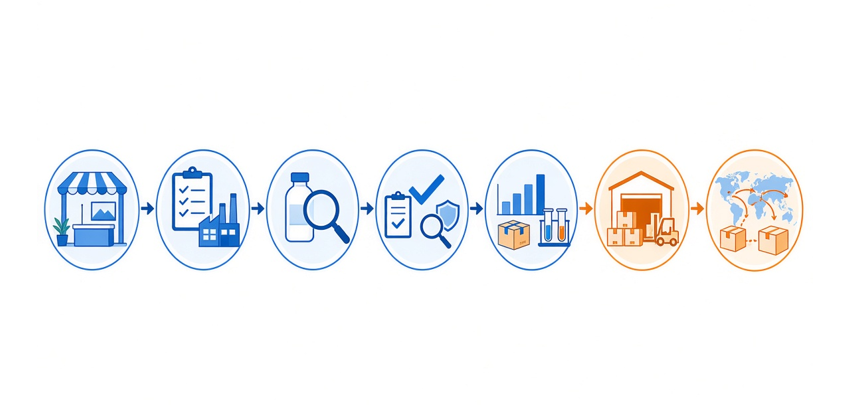
A Practical Seven-Step Workflow
1. Shortlist suppliers at the show.
Select a manageable group based on product fit, responsiveness, price range, and customization potential.
2. Request samples with written specifications.
Confirm the exact SKU, materials, dimensions, colors, packaging, and sample delivery date.
3. Test products in real conditions.
Check writing quality, durability, packaging, shipment resistance, and buyer appeal before committing.
4. Compare total landed cost.
Include product price, customization, packaging, inspection, domestic transport, international shipping, duties, taxes, marketplace fees, and returns risk.
5. Run a small market test.
Start with a limited assortment or low-volume purchasing model when possible. Validate product-market fit before scaling.
6. Create a reorder plan.
Confirm lead time, safety stock logic, peak-season capacity, and backup supplier options.
7. Use a sourcing and fulfillment partner when needed.
A China-based partner can help consolidate items from multiple suppliers, verify orders, manage packaging requests, and ship individual orders or bulk replenishment shipments.
For online B2B sellers, the last step is often where operational complexity grows. Looperbuy can support this transition by helping businesses source products in China and arrange fulfillment without requiring them to manage every supplier conversation, warehouse process, payment step, or logistics handoff independently.
The commercial advantage is flexibility: you can test a broader product assortment, reduce the pressure to pre-purchase large quantities, and build a supply chain around actual sales signals rather than forecasts alone.
Turn Trade Show Leads Into Scalable Sourcing
The best stationery trade show is the one that matches your sourcing strategy—not necessarily the largest event on the calendar. Design-led brands may prioritize the National Stationery Show. Buyers seeking Asian factory access may focus on Hong Kong, Shanghai, Ningbo, and Yiwu. Businesses selling broad assortments online may need a mix of product discovery, supplier validation, consolidation, and flexible shipping.
Do not leave a trade show with only a stack of catalogs. Leave with a structured shortlist, sample requests, written commitments, and a clear next action for every promising supplier.
Ready to source stationery and office products from China without taking on unnecessary inventory and fulfillment complexity? Contact Looperbuy to discuss supplier sourcing, product consolidation, quality coordination, and flexible global order fulfillment for your B2B business.
Frequently Asked Questions
1. What is the best stationery trade show for sourcing Chinese suppliers?
For buyers focused on Chinese supply chains, events in Hong Kong, Shanghai, Ningbo, and Yiwu are generally the most relevant. The right choice depends on whether you need specialized stationery manufacturing, broad small-commodity assortment sourcing, private-label customization, or export-ready suppliers.
2. How do I verify a stationery supplier I met at a trade show?
Start with samples and written specifications. Then assess the supplier’s business background, production capability, export experience, quality-control process, compliance documentation, MOQ, lead time, and communication quality. If the order value justifies it, arrange a factory audit or independent inspection before mass production.
3. What is a typical MOQ for custom stationery?
MOQ varies widely based on the product, materials, customization method, packaging, and factory setup. Stock products may support smaller quantities, while custom molds, printing, colors, or retail packaging usually require higher minimums. Always ask whether multiple SKUs can be combined toward a total MOQ.
4. Should I place an order at the trade show?
You can negotiate terms and reserve samples at the show, but avoid rushing into a substantial first order solely because of show-floor pricing. Confirm samples, specifications, payment terms, lead time, and quality requirements in writing first.
5. What should I bring to a stationery trade show?
Bring business cards, a product brief, target price ranges, a supplier scorecard, product samples or visual references, a tablet or notebook, measuring tools if relevant, and a method for organizing supplier contacts and photos. Also prepare questions about MOQ, customization, quality control, compliance, and lead time.
6. How can Looperbuy help after I find a supplier?
Looperbuy can help B2B sellers manage China-based sourcing and fulfillment workflows, including product sourcing, communication coordination, order consolidation, packaging handling, and global shipping arrangements. This can reduce the operational burden of handling inventory, warehousing, payment coordination, and logistics across multiple suppliers.
References
1. Global Sources. “[Top Stationery Trade Shows for 2024 and 2025].” Accessed August 21, 2026. The original source article used as the basis for the trade-show overview, market context, event selection criteria, and trade-show preparation framework.
2. Global Sources. “[Asia’s Premier Trade Shows 2026: Wholesale Sourcing Guide].” Published January 22, 2026. Used for current context on Asian sourcing events, Yiwu’s role in small-commodity sourcing, Canton Fair category coverage, and trade-show preparation practices.
3. Global Sources. “[Global Sources Lifestyle].” Accessed August 21, 2026. Used for information on lifestyle-category sourcing, including stationery, gifts, and verified supplier positioning.
4. Eastwise. “[Buyer Trade Shows in Asia: How to Find Reliable Suppliers].” Published January 30, 2026. Used for supplier-evaluation criteria, including manufacturing capability, compliance, MOQ, samples, lead times, quality control, and communication.
5. ExpoCaptive. “[China Stationery Fair 2026 Attendees List & Exhibitors List].” Published April 23, 2026. Used as a third-party reference for stated CSF 2026 dates, location, exhibitor count, attendance estimate, and represented industry categories. Event dates and figures should be confirmed through official organizer announcements before travel.