Learn how to find low-MOQ manufacturers for private label dropshipping, evaluate suppliers, and leverage China-based sourcing platforms like Looperbuy to launch branded products with minimal risk, flexible batches, and streamlined global fulfillment.
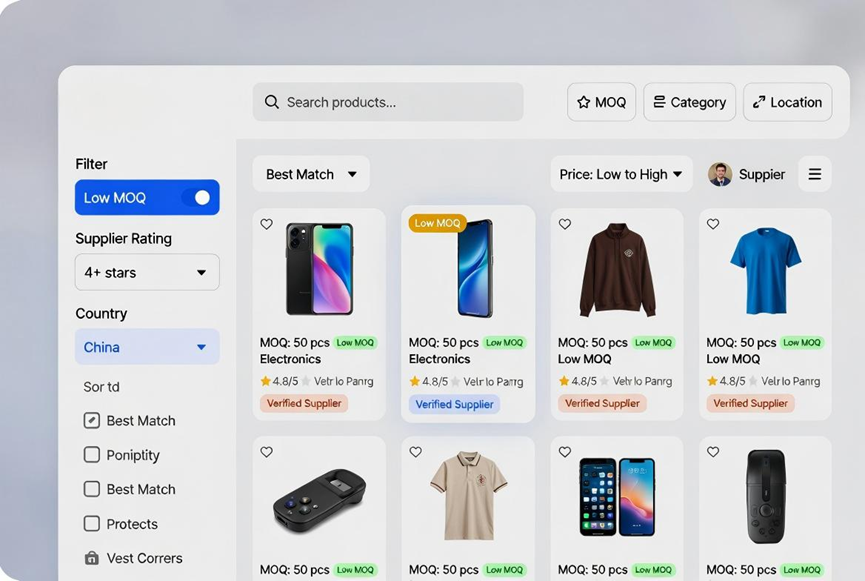
Finding low-MOQ manufacturers for private label dropshipping is the fastest way to test products, build a brand, and protect your cash flow—especially when you’re sourcing from China and working with an agent or platform like Looperbuy that can handle procurement and fulfillment for you.
Table of Contents
What “Low MOQ” Really Means in Private Label
In private label dropshipping, MOQ (Minimum Order Quantity) is the smallest number of units a manufacturer requires you to order in one production run. [qallix]
– For many traditional factories, MOQs start at 500–1000 units per SKU, especially when custom packaging or molds are involved. [qallix]
– In the last few years, more suppliers (and agents) have started offering low or flexible MOQs—sometimes 10–50 units or even MOQ=1 via print-on-demand or on-demand labeling. [nichedropshipping]
For private label sellers, low MOQ is usually any quantity that lets you:
– Test demand without tying up too much capital
– Iterate quickly on branding, packaging, or product specs
– Avoid long-term storage or warehouse commitments
When you integrate this with dropshipping fulfillment (especially via a Chinese sourcing platform), you can keep inventory close to zero while still offering branded products and fast dispatch.
Why Low-MOQ Manufacturers Matter for Your Brand
From both an operator’s and a strategist’s perspective, low-MOQ manufacturing is less about “cheap stock” and more about risk management and speed of learning. [doba]
Key advantages:
– Lower upfront risk – You validate products before committing to large orders.
– Faster product testing – You can launch multiple SKUs in micro-batches, then double down on winners.
– Cash flow flexibility – Capital stays available for ads, creatives, and customer acquisition instead of sitting in inventory. [qallix]
– Brand agility – You can refine packaging, logo placement, and inserts based on real customer feedback.
For B2B sellers or brand owners using Looperbuy, this model also means you can delegate sourcing, QC, and fulfillment, while you focus on product-market fit and marketing.
Core Strategy: How to Approach Low-MOQ Sourcing
Before you start hunting for suppliers, define your product scope and brand constraints.
Ask yourself:
– What category am I in (home & kitchen, beauty, tools, apparel, etc.)?
– How much customization do I need at launch (full custom packaging vs. simple logo print)?
– What’s my target landed cost per unit at low MOQ?
– Which core markets do I ship to (US, EU, Middle East, etc.)?
A practical approach for most brands is to start simple: prioritize logo application and basic packaging with low MOQs, then gradually move into deeper customization (custom molds, unique formulations, etc.) once SKUs prove themselves.
Where to Find Low-MOQ Manufacturers for Private Label
1. Global B2B Marketplaces (With Filters)
Platforms like Alibaba and similar B2B marketplaces remain the largest pools of manufacturers and trading companies. [alibaba]
Tactics that work:
– Use MOQ filters (e.g., set filters to “≤50 units”) where available. [doba]
– Search with combinations like:
– “private label + your niche + low MOQ”
– “OEM/ODM + your product + small order”
– Look for suppliers explicitly mentioning “dropshipping,” “small batch,” or “no MOQ branding” in their company profile. [alibaba]
Once you shortlist suppliers, move beyond the platform chat by asking explicit questions about:
– Private label capabilities (logo options, packaging, inserts)
– Minimum order quantities for branding vs. plain stock
– Whether they can store stock and fulfill orders per-piece (or integrate with a fulfillment partner like Looperbuy)
2. Specialized Private Label Dropshipping Suppliers
There are dedicated private label dropshipping suppliers that focus on flexible MOQs and branding for e-commerce merchants. [pbfulfill]
Common patterns they follow:
– Warehouse inventory in China, with on-demand logo application or packaging
– Support for Shopify, Amazon, WooCommerce via app integrations
– Printing, engraving, embroidery, or labeling with very low or no MOQs [youtube]
Examples (for reference patterns):
– Platforms that offer print-on-demand (POD) allow effectively MOQ = 1, since products are produced only after orders are placed. [nichedropshipping]
– China-based fulfillment centers often promote no-MOQ private label customization, focusing on packaging, labels, and small visual customizations instead of full product redesign. [youtube]
In practice, a platform like Looperbuy can mirror this model by:
– Sourcing base products from multiple factories
– Negotiating shared stock for multiple clients
– Applying brand-specific labels and packaging per order
– Fulfilling globally from Chinese warehouses
3. Local or Regional Low-MOQ Options
Although your primary base is China, some brands mix in regional suppliers (e.g., USA, EU) for specific categories where shipping speed and trust signals matter more than absolute price. [doba]
Platforms like Doba, Faire, ThomasNet, and Shopify’s Handshake are known for connecting merchants with low-MQ wholesalers and manufacturers in the US and other regions. [doba]
While their costs are higher, they can complement your China-based supply by:
– Serving time-sensitive products (e.g., consumables, seasonal goods)
– Acting as a benchmark for quality and packaging standards you expect from your Chinese partners
How to Evaluate Low-MOQ Manufacturers (Step-by-Step)
Selecting the right manufacturing partner is where your risk shrinks or explodes. Below is a practical framework you can reuse.
1. Shortlist and Pre-Qualify Suppliers
Once you’ve collected potential manufacturers (via marketplaces, directories, or an agent), pre-qualify them using a simple checklist. [qallix]
Check for:
– Clear company identity (business license, address, website)
– Experience in your category (portfolio, export markets, certifications)
– Willingness to share test reports or compliance documents (e.g., for cosmetics, electronics)
– Transparent MOQ tiers for:
– Plain (unbranded) stock
– Branded packaging
– Customized product features
2. Order Samples and Pilot Runs
Never skip samples. This is where you verify whether “factory photos” match reality. [doba]
– Start with 2–5 suppliers and order:
– Standard product samples
– One or two branded versions (logo on product or packaging)
– Evaluate:
– Material, finish, and durability
– Print quality (logos, labels)
– Packaging resilience during shipping
– Delivery time and communication quality
If you’re using Looperbuy or a similar platform, you can consolidate sample ordering through them, letting them handle communication, local QA, and comparison.
3. Negotiate Flexible MOQs and Pricing Tiers
From my experience with B2B manufacturing content and negotiations, MOQs are often more flexible than they look on paper, especially when you signal long-term intent. [qallix]
Negotiation levers:
– Ask for a “test batch MOQ” (e.g., 50–100 units) with higher per-unit cost, then a lower price for future reorders at higher quantities.
– Propose a tiered roadmap:
– Batch 1: 50 units (full price)
– Batch 2: 200 units (modest discount)
– Batch 3: 500+ units (target price)
– Discuss stock sharing: the factory produces a bigger run but only ships your share; the rest may be used for other clients if they keep products generic.
Platforms like Doba and similar directories explicitly mention flexible MOQs as a selling point—use that as a benchmark when negotiating with Chinese factories. [doba]
4. Evaluate Operational Fit (Not Just Price)
Price matters, but operational compatibility is what keeps your brand scalable. [qallix]
Use questions like:
– Can they integrate with your dropshipping or fulfillment partner (e.g., API, CSV, or platform-based workflows)?
– Can they handle SKU-level labeling for Amazon FBA, Shopify, or other marketplaces?
– Are they comfortable with small but frequent production cycles?
This is where a partner like Looperbuy adds value—by standardizing labeling, QC, storage, and order dispatch across multiple manufacturers, so you don’t need to re-engineer each supplier’s workflow.
Using an Agent or Platform (Like Looperbuy) to Access Low-MOQ Manufacturing
Why Work Through a Sourcing & Fulfillment Platform
Many factories in China are not set up to handle one-by-one dropshipping, small MOQs, and international logistics directly. [e7dropshipping]
An intermediary (agent or platform) solves this by:
– Aggregating demand from multiple merchants
– Negotiating lower MOQs because of pooled volume
– Providing centralized warehouses for storage and fulfillment
– Handling global logistics, customs, and payment aggregation
This model is widely used by China-based fulfillment centers supporting private label Shopify and marketplace sellers. [e7dropshipping]
How a Platform Like Looperbuy Fits Into the Stack
Within this ecosystem, Looperbuy plays the role of:
– Product sourcer – Finding competitive factories for your niche, comparing price/quality.
– MOQ negotiator – Using aggregated demand to unlock low or flexible MOQs that a single small brand might not get directly.
– Branding coordinator – Managing logo printing, packaging, inserts, and labeling according to your brand assets.
– Dropship fulfillment center – Storing stock in China and shipping per order, so you avoid warehousing and overstock risk.
This allows private label dropshippers to focus on brand-building, content, and customer experience, while Looperbuy handles supplier relationships and operations.
Practical Criteria for Choosing Low-MOQ Partners
Key Evaluation Table
| Criterion | What to Look For | Why It Matters |
| MOQ for branded units | 10–100 units for initial runs | Enables testing without heavy capital |
| Customization options | Logo printing, labels, branded packaging, inserts | Lets you build a real brand, not just generic products |
| Lead time | 7–25 days for production plus shipping window | Impacts launch timelines and restock planning |
| Quality control | In-house QC or third-party QC via agent | Reduces defective orders and returns |
| Fulfillment compatibility | Ability to ship to your fulfillment partner or direct dropshipping | Keeps your operations integrated and automated |
| Communication & responsiveness | Clear English communication, fast replies, structured quotations | Signals professionalism and lower risk of misalignment |
Data from platforms and directories shows that lead times and MOQ thresholds vary heavily by category, but the pattern above is broadly consistent across private label suppliers. [nichedropshipping]
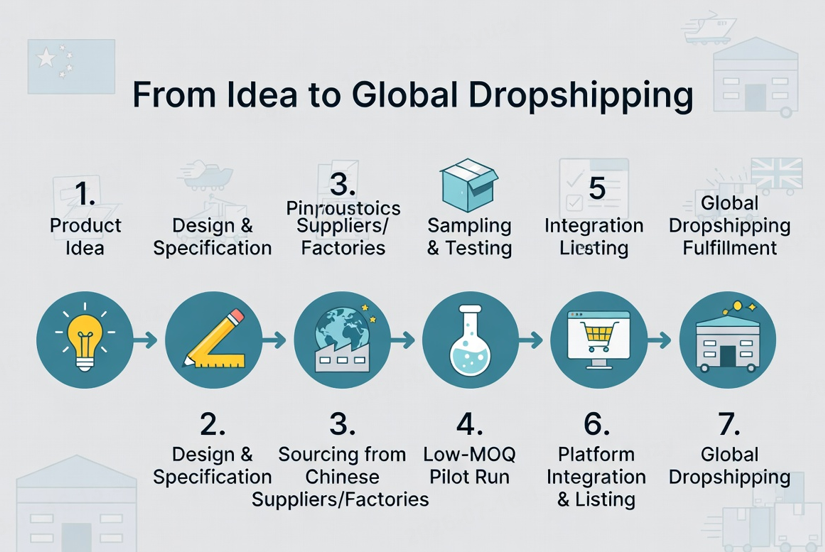
Example Workflow: From Idea to Low-MOQ Private Label Launch
Let’s walk through a simplified end-to-end workflow you can model internally.
1. Market & product research
– Analyze demand, competition, and pricing in your niche.
– Identify product specs that matter (materials, sizing, certifications).
2. Brief Looperbuy or your sourcing partner
– Share a clear requirements document (category, budget, target MOQ, branding needs).
– Emphasize low-MOQ testing and your scaling plan.
3. Supplier sourcing & comparison
– Your partner identifies multiple factories, collects quotes, MOQs, and sample lead times.
– You receive a shortlist with pros/cons per manufacturer.
4. Sample ordering & evaluation
– Approve 2–3 suppliers for samples.
– Test products and packaging yourself, or use the partner’s QC report.
5. Pilot batch (low MOQ)
– Launch with 50–100 units per winning SKU, branded via your partner’s network.
– Ship initial orders via Looperbuy’s dropshipping or fulfillment operation.
6. Data-driven scaling
– Once you see consistent conversion and repeat orders, gradually raise MOQs to lower per-unit costs and improve margins.
– Standardize SKUs and packaging across suppliers for smoother operations.
Advanced Tactics to Get Better Low-MOQ Deals
1. Consolidate Product Families
Instead of treating each SKU as a separate battle, negotiate at the product family level.
For example:
– One factory produces 3 sizes of a storage box.
– You negotiate a combined MOQ of 150 units across all sizes, instead of 150 per size, in exchange for committing to a specific total volume.
This gives the factory production efficiency while giving you assortment flexibility at low volume.
2. Use Shared Components to Reduce MOQs
Many manufacturers can reuse molds, packaging structures, or internal components across products.
If you accept:
– A standard bottle shape for different formulations
– A standard box size for several SKUs
…the factory can justify lower MOQs because they’re not retooling for each item, and they may already use those components for other clients. [nichedropshipping]
3. Combine Fulfillment Volume Across Brands or Channels
If you operate multiple stores, regions, or brand lines, you can consolidate volume at the fulfillment level even when manufacturing is separate.
Platforms like Doba showcase how centralizing logistics across many SKUs and suppliers improves logistics efficiency and reduces per-order costs. [doba]
You can mirror this by:
– Using Looperbuy as a central fulfillment node
– Shipping multiple brands’ products into the same warehouse
– Leveraging unified picking, packing, and shipping processes across your portfolio
Turn Low-MOQ Sourcing into a Competitive Edge
If you’re serious about building a long-term brand, low-MOQ private label manufacturing is not just a shortcut—it’s your experimentation engine.
Instead of gambling on massive bulk orders, you can:
– Test multiple product ideas with small, branded batches
– Learn quickly from real customers
– Scale only the SKUs that prove their profitability
With a platform like Looperbuy handling sourcing, negotiation, branding, and dropship fulfillment from China, you get the benefits of low-MOQ manufacturing without having to manage dozens of factories, freight partners, and warehouses yourself.
Next step:
Define your first test batch brief (category, budget, MOQ, branding needs) and hand it to your sourcing partner. Within a few weeks, you can have real branded products in customers’ hands—without ever renting a warehouse or tying up heavy capital in stock.
FAQ: Low-MOQ Private Label Dropshipping
1. Can I really launch private label products with no MOQ?
In some cases, yes—especially with print-on-demand or suppliers who offer on-demand logo application and packaging. However, true “no MOQ” often means higher per-unit costs, so it’s best suited for early testing rather than long-term scale. [nichedropshipping]
2. How much should I budget for a low-MOQ private label test?
Most brands allocate enough to cover samples plus a 50–100 unit pilot run, including logo printing and packaging. The exact amount depends on your category, but this approach keeps risk manageable while still providing meaningful data. [qallix]
3. Do low-MOQ manufacturers compromise on quality?
Not necessarily. Many factories offer the same production lines for low-MOQ and high-MOQ clients but adjust pricing to reflect smaller runs. The key is to verify quality via samples and QC, and to work through a partner that enforces consistent standards. [nichedropshipping]
4. How long does it take to launch a low-MOQ private label product?
A realistic timeline is 4–8 weeks from supplier selection to shipping the first orders: 1–2 weeks for sourcing, 1–2 weeks for samples, and 2–4 weeks for production and branding. Using an established sourcing and fulfillment partner can compress this timeline. [doba]
5. Why use a platform like Looperbuy instead of going directly to factories?
Direct factory relationships work once you have volume, but for most new brands, a platform or agent offers better access to low MOQs, centralized fulfillment, and risk control. You effectively plug into a ready-made supply chain instead of building one from scratch. [youtube]
References
1. Qallix – “Low MOQ Suppliers for Small eCommerce Businesses”[qallix]
2. Doba – “How to Find Low MOQ Suppliers in the USA for Your Dropshipping Business”[doba]
3. Alibaba – “Private Label Dropshipping Shopify” (supplier listing patterns and capabilities)[alibaba]
4. PB Fulfill – “How to Start Private Label Dropshipping on a Budget?”[pbfulfill]
5. NicheDropshipping – “15+ Best Private Label Dropshipping Suppliers in 2025″[nichedropshipping]
6. BSDropshipping (YouTube) – “Shopify Private Label With No MOQ | China Fulfillment Centre”[youtube]
7. E7 Dropshipping – “Amazon Supplier”[e7dropshipping]