Discover how multi-store ecommerce empowers global B2B sourcing platforms like Looperbuy to run multiple localized storefronts from a single backend. Learn key features, benefits, challenges, and integration strategies for scalable, secure international growth.
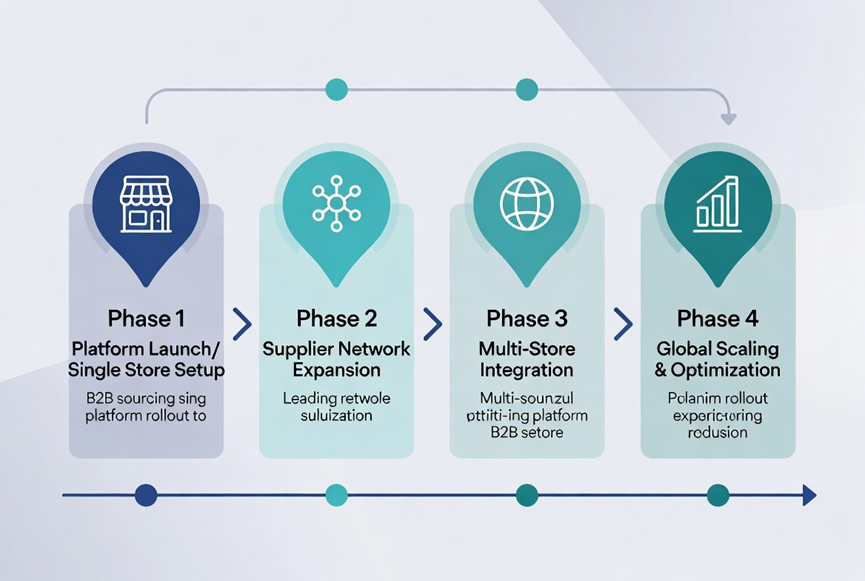
A multi-store ecommerce strategy is one of the most powerful ways for global B2B platforms like Looperbuy to scale into new regions, brands, and customer segments while keeping operations lean and centralized. When you combine centralized control with localized experiences, you can reduce inventory risk, simplify logistics, and deliver a smoother buying journey for international merchants. [salesforce]
Table of Contents
What Is a Multi-Store Ecommerce Platform?
Multi-store ecommerce means running several independent online storefronts from a single underlying platform and admin backend. Each storefront can target a different audience, country, or brand, while sharing core data such as products, inventory, pricing rules, and customer records. [commercev3]
For a B2B sourcing and dropshipping platform, this model is especially valuable:
– You can build separate storefronts for different regions, industries, or sourcing models, all powered by one core system. [scayle]
– You keep inventory, catalog, and order management centralized, which prevents data silos and reduces operational overhead. [commercev3]
– You enable multi-vendor and marketplace scenarios, where suppliers have their own presence but buyers experience a unified ecosystem.
Why Multi-Store Matters for Global B2B Sourcing
From Single Storefront to Global Network
Traditional ecommerce setups treat each store as an isolated project, with separate tech stacks, teams, and integrations. As you add more stores, complexity grows quickly: duplicate integrations, inconsistent catalogs, and fragmented analytics. [sellerscommerce]
In a multi-store architecture, all storefronts sit on one platform, so you:
– Maintain one product catalog and push tailored assortments to each store.
– Manage centralized pricing policies with localized overrides.
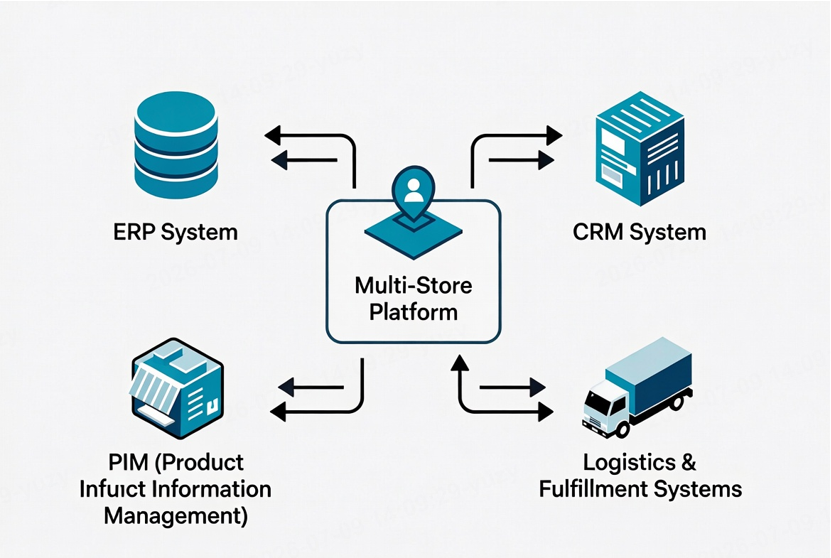
– Integrate with ERP, CRM, and PIM once, then reuse those integrations across stores. [dynamicweb]
For Looperbuy, that means you can operate one global sourcing backbone and spin up regional or thematic storefronts (for example, “Looperbuy EU Industrial”, “Looperbuy North America Dropship”, “Looperbuy OEM & ODM Hub”) without rebuilding your stack each time. [scayle]
Aligning With Modern Buyer Expectations
Large brands like Nestlé and L’Oréal already use multi-store ecommerce to deliver country-specific sites and brand-specific experiences while keeping operations unified. Their approach proves that buyers expect:
– Local languages and currencies.
– Region-specific assortments and compliance.
– Brand-consistent experiences that still feel tailored. [scayle]
Global B2B buyers using Looperbuy have similar expectations. They want local trust signals with global reliability: local payment methods, tax-compliant invoicing, and logistics options that match their reality. [znode]
Core Features of a High-Performance Multi-Store Platform
Unified Admin with Multiple Storefronts
The foundation of multi-store ecommerce is a single admin console that orchestrates all sites. [salesforce]
Key capabilities include:
– Centralized management of catalogs, customers, orders, and promotions.
– Configuration of store-specific templates, navigation, content, and checkout flows. [commercev3]
– Ability to grant different roles and permissions per store (for regional managers, category owners, and supplier admins). [mindspacetech]
For Looperbuy, this makes it possible to run global operations with a compact team: one central product team curates SKUs, while regional teams adjust assortments, content, and pricing without spinning up new systems. [dynamicweb]
Deep Personalization and Localization
Multi-store platforms enable you to turn each storefront into a dedicated buying environment. [scayle]
You can:
– Localize language, currencies, tax rules, and legal notices by region.
– Tailor catalog filters, category structures, and product bundles to specific industries.
– Provide client-branded storefronts for key accounts, letting large buyers shop a curated catalog under their own brand umbrella.
For a B2B dropshipping model, localized stores also help reduce friction: buyers see delivery estimates, shipping options, and payment methods that align with their geography and typical order patterns. [theretailexec]
Multi-Vendor and Marketplace Capabilities
Modern multi-store platforms are increasingly built as marketplaces, where multiple suppliers coexist under one umbrella. [znode]
This typically includes features such as:
– Vendor-specific catalogs, pricing, and service-level agreements.
– Shared checkout, unified invoicing, and buyer-friendly dispute workflows.
– Configurable rules for fulfillment, routing orders to the best supplier by region, stock, or lead time. [commercev3]
Looperbuy can leverage this approach to become a multi-vendor sourcing hub, offering buyers consolidated access to verified Chinese suppliers while simplifying cross-border logistics and payments. [znode]
Operational Benefits for B2B Buyers and Sellers
Benefits for Buyers
From the buyer’s perspective, multi-store ecommerce delivers a smoother, more predictable experience across all storefronts. [salesforce]
Typical buyer-side benefits:
– Convenient ordering via bulk add-to-cart, saved lists, reordering, and multi-line RFQs.
– Consistent login credentials across all stores, with a shared cart and unified order history.
– Automatic catalog filtering to show only approved products and suppliers based on buyer-specific policies. [dynamicweb]
For global B2B merchants using Looperbuy, this means they can explore different product categories or regions while staying within one ecosystem, one account, and one consolidated order pipeline. [salesforce]
Benefits for Store Owners and Platform Operators
On the operator side, multi-store ecommerce makes scaling more structured. [commercev3]
Common advantages include:
– Support for both B2B and B2C models, which is useful if you serve distributors and small retailers simultaneously.
– Full visibility into customer data, including account hierarchies, order patterns, and wishlist activity. [dynamicweb]
– Flexible product configuration, templates, and navigation schemes per store, without duplicating the core system. [commercev3]
– Easier regulatory compliance, such as PCI DSS for payment data and country-specific invoicing rules.
Operating Looperbuy as a multi-store platform allows you to launch new verticals or regions without rebuilding workflows. You align catalog structure, fulfillment, and post-sale support under one operational model. [commercev3]
Key Challenges of Multi-Store Ecommerce (and How to Solve Them)
Extension and Upgrade Complexity
Not all stores share the same features, so upgrades can cause friction when each storefront relies on a different set of extensions. [sellerscommerce]
An API-native platform that uses modular or atomic design helps here:
– Each functional block (catalog, checkout, promotions) acts as a separate module that can be updated independently.
– Changes roll out gradually across storefronts, reducing risk and downtime. [commercev3]
Payment, Tax, and Compliance Complexity
Multi-regional ecommerce multiplies complexity around currencies, taxes, and local compliance. [znode]
Best practices include:
– Integrating with specialized regional payment providers that understand local regulations.
– Maintaining clear tax rules and invoicing formats per market, driven by configuration rather than custom code.
– Regularly reviewing data protection requirements to keep buyer and supplier information secure. [dynamicweb]
Data Security and Fraud Prevention
Multi-store platform operators must protect a larger attack surface, as data flows between stores and multiple payment gateways. [shopify]
Typical protection measures:
– Strong encryption of sensitive data and hardened access controls.
– Up-to-date SSL certificates and strict certificate management processes. [shopify]
– Proactive monitoring for fake clones, phishing sites, and credential stuffing attempts, combined with buyer education. [shopify]
Integrations: The Backbone of Multi-Store Performance
High-performing multi-store platforms live or die by their integration strategy. [dynamicweb]
Typical integration priorities include:
– ERP integrations to synchronize inventory, pricing, and invoicing across all stores.
– CRM integrations to manage account hierarchies, pipelines, and marketing touchpoints.
– PIM (product information management) integrations to centralize product data and feed consistent information to each storefront. [dynamicweb]
– API-first architecture to connect additional systems (WMS, TMS, analytics) without disruptive rewrites. [commercev3]
For Looperbuy, a strong integration layer ensures that sourcing data, factory updates, and logistics events flow seamlessly, so buyers get accurate lead times and availability regardless of which storefront they use. [dynamicweb]
How to Choose the Right Multi-Store Ecommerce Solution
Selecting the right platform is a strategic decision that shapes how fast—and how safely—you can scale. [znode]
Important evaluation criteria:
– Budget model: Whether multi-store capabilities are available out-of-the-box or require separate modules, and how licensing scales per store.
– Architecture openness: Open-source or API-first platforms offer more flexibility for customization and long-term evolution. [commercev3]
– Feature coverage: Advanced catalog management, multi-currency support, regional localization, and marketplace capabilities should align with your roadmap. [salesforce]
– Usability: Admin interfaces need to be easy enough for non-technical teams while still supporting complex configurations. [mindspacetech]
Below is a simplified view of typical platform positioning based on public information and industry analysis. [salesforce]
| Platform | Primary Focus | Scalability | Marketplace-ready |
| Virto Commerce | B2B | High | Yes |
| BigCommerce | Retail/B2C | Medium | Limited |
| Adobe Commerce | B2B/B2C | Medium | Extensions-based |
| Shopify Plus | SMB/Omni | Low–Medium | Apps-based |
| StoreHippo | Mid-market | Medium | Yes (limited) |
Real-World Example: Virto Commerce and Enterprise-Grade Multi-Store
Virto Commerce is one example of a multi-store platform built specifically with complex, global B2B models in mind. It uses an API-first, open-code architecture and supports unlimited SKUs, multi-currency, and multi-language deployments. [commercev3]
Enterprise users often cite:
– The ability to deploy multi-country and multi-brand storefronts from one core platform.
– Marketplace capabilities that let distributors and manufacturers onboard their own vendor stores under one umbrella. [salesforce]
– Strong security posture, including SOC 2 certification, combined with flexible integration options. [shopify]
The Bosch Thermotechnik case, for example, shows how a large industrial player launched a marketplace operating in 25 countries with a single customizable platform, improving customer engagement and turnover.
Strategic Recommendations for Looperbuy
From a practitioner’s perspective, here are priority moves for a global B2B sourcing and dropshipping platform planning or evolving a multi-store strategy:
– Define store archetypes: For example, “Regional sourcing store,” “Industry-specific store,” and “VIP client-branded store,” each with clear audience and catalog rules.
– Centralize inventory and logistics data: Ensure all stores rely on one source of truth for stock, lead times, and shipping options.
– Standardize integrations: Connect ERP, CRM, and logistics providers once, then scale those integrations across every new storefront.
– Prioritize security and compliance early, especially around vendor onboarding, payment gateways, and data export.
– Create governance for content and configuration so regional teams can adapt experiences without fragmenting the core platform.
As Looperbuy expands, this approach lets you add new markets and categories while protecting margins by minimizing technical debt and operational duplication. [commercev3]
Frequently Asked Questions
1. What is the main advantage of a multi-store ecommerce platform for global B2B sourcing?
The main advantage is the ability to run multiple localized or brand-specific storefronts from a single platform, which centralizes operations while still delivering tailored experiences to different buyer segments. [salesforce]
2. How does multi-store ecommerce improve the buyer experience?
It enables buyers to use one account across several stores, access curated catalogs that match their policies, and enjoy consistent ordering, invoicing, and support workflows regardless of region. [dynamicweb]
3. What role do integrations play in multi-store ecommerce?
Integrations with ERP, CRM, and PIM systems synchronize inventory, pricing, customer data, and product information across all stores, reducing manual effort and error. [dynamicweb]
4. How can multi-store platforms support marketplace and multi-vendor models?
They allow suppliers to manage their own catalogs and pricing while buyers use a unified checkout and order management experience, creating a scalable, trust-based sourcing hub. [znode]
5. What are the biggest risks in multi-store ecommerce, and how can they be mitigated?
Major risks include security breaches, fraud, inconsistent extensions, and compliance gaps; these can be mitigated through strong encryption, SSL management, API-first architecture, and region-specific regulatory review. [shopify]
References
1. Virto Commerce – Multi-Store Ecommerce: Platforms, Features, Examples Explains the fundamentals of multi-store ecommerce, key features, and enterprise use cases, including multi-country and marketplace scenarios. [virtocommerce]
2. Salesforce – Multi-Store Ecommerce: A Complete Guide Overview of multi-store ecommerce concepts, benefits of running multiple storefronts from a single backend, and strategies for scaling. [salesforce]
3. CommerceV3 – Architecting a Scalable Multi‑Store eCommerce Platform Discusses data models, integrations, and operational best practices for building and managing scalable multi-store ecommerce systems.[commercev3]
4. SCAYLE – Multi-Site eCommerce: How to Scale Multiple Shops Covers strategies for quickly building multiple shops targeting specific markets or audiences from a single back end. [scayle]
5. SellersCommerce – Everything You Need To Know About A Multi-Store ECommerce Platform Introduces the concept of multi-store platforms and explains how to run multiple ecommerce stores effectively. [sellerscommerce]
6. Dynamicweb – 5 Tips for Managing a Multi-Store eCommerce Business Provides guidance on consolidating functionality, streamlining data management, and integrating systems for multi-store operations.[dynamicweb]
7. Mindspace Tech – The Developer’s Guide to Multi-Store E-commerce Platforms Technical perspective on building and managing multi-store platforms, focusing on key features, integrations, and development best practices.[mindspacetech]
8. Znode – The Definitive Guide to Understanding Multi-Store Ecommerce Explores how complex business models use multi-store ecommerce, including feature criteria and management of multiple sites. [znode]
9. The Retail Exec – How to Manage Multiple Stores Offers practical advice for managing multiple retail stores, including operations, staffing, and process simplification that parallel multi-store ecommerce challenges.[theretailexec]
10. Shopify – Strategies to Manage Multiple Retail Stores for Growth Discusses multi-location retail operations, separate storefronts, and how to maintain consistent experiences across stores. [shopify]