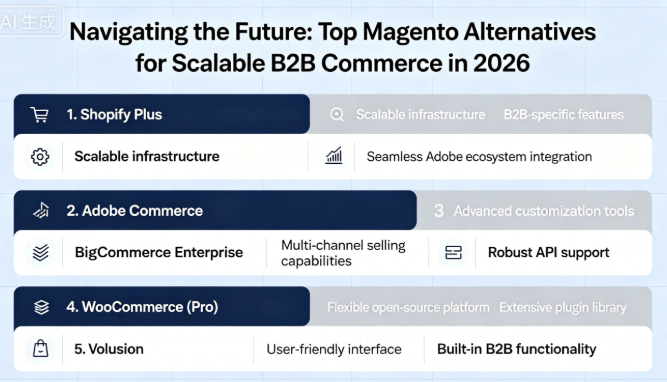
For over a decade, Magento (now Adobe Commerce) has been the bedrock of digital commerce. Yet, in 2026, many enterprise leaders are questioning whether its heavy infrastructure, high Total Cost of Ownership (TCO), and steep learning curve still serve their growth ambitions. As the digital landscape shifts toward headless, composable, and B2B-centric architectures, businesses are actively seeking Magento alternatives that offer agility without sacrificing power.
If you are a B2B brand looking to streamline your supply chain or a wholesaler aiming to connect directly with global manufacturers, the right platform choice is not just a technical decision—it is a strategic pivot.
Table of Contents
Why Enterprises are Re-evaluating Magento (Adobe Commerce)
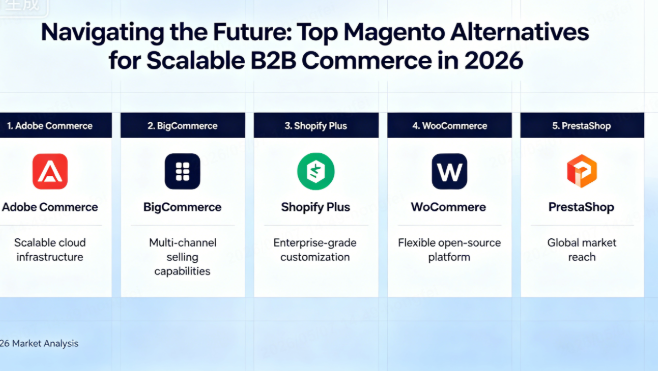
Despite its vast community, Adobe Commerce can become a bottleneck for organizations that prioritize speed-to-market and seamless global operations. Key pain points reported by industry leaders include:
- Complexity & Technical Debt: Managing a monolithic environment requires highly specialized developers, leading to slower deployment cycles.
- Performance Bottlenecks: Resource-intensive hosting and complex database queries often degrade site speed, directly impacting conversion rates.
- Hidden Costs: Beyond licensing, the TCO escalates quickly through mandatory third-party extensions, custom integration development, and maintenance of server infrastructure.
Strategic Criteria for Choosing Your Platform
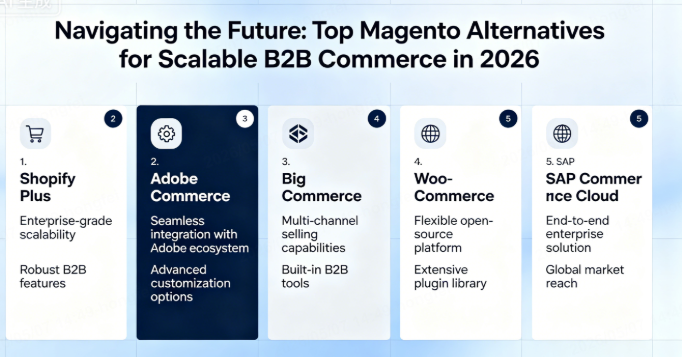
When evaluating alternatives, do not just look at feature lists. Focus on architecture, scalability, and long-term TCO.
| Consideration | Why it Matters |
|---|---|
| Architecture | Is it headless or modular? This allows frontend flexibility without backend disruption. |
| B2B Capabilities | Does it support complex hierarchies, quote workflows, and account management natively? |
| Total Cost of Ownership | Consider licensing, but prioritize development, hosting, and maintenance costs over 3-5 years. |
| Ecosystem & Integration | How easily does it connect with your ERP, CRM, and global logistics providers? |
Beyond the Monolith: Modern Alternatives for 2026
1. Composable & Headless Solutions (e.g., Virto Commerce)
For enterprises, composability is the new standard. Platforms like Virto Commerce leverage a headless, API-first approach that decouples the frontend experience from backend logic. This is ideal for complex B2B scenarios, enabling businesses to integrate sophisticated procurement tools, marketplaces, and global logistics workflows seamlessly.
2. SaaS-Driven Agility (e.g., BigCommerce Enterprise)
For brands that want to offload infrastructure management, SaaS solutions have evolved. BigCommerce offers extensive native B2B features, reducing the reliance on third-party apps and lowering the complexity of site management.
3. WordPress-Integrated Flexibility (e.g., WooCommerce)
For content-driven brands, the familiarity of the WordPress ecosystem remains compelling. However, ensure your server infrastructure can handle the volume of a growing B2B catalog.
Deep Dive: Optimizing the B2B Value Chain
The transition to a new platform is the perfect time to audit your entire value chain. Many businesses fail during re-platforming because they merely move an inefficient legacy process to a new interface. Instead, you must re-engineer your operations.
Operational Efficiency Through Integration
The modern B2B buyer expects a B2C-like experience. This requires real-time inventory visibility, accurate shipping estimates, and frictionless checkout. By choosing a composable platform, you can plug in “Best-of-Breed” services for taxes, shipping, and payments rather than relying on heavy, monolithic extensions that are difficult to update.
The Data-Driven Advantage
Modern platforms provide superior analytics dashboards compared to older versions of Magento. Utilizing platforms that offer AI-driven personalization and predictive procurement helps wholesalers anticipate demand. This is critical for managing seasonal fluctuations in your supply chain and maintaining optimal stock levels.
Special Focus: The Role of Global Sourcing in Your B2B Strategy
Modern commerce is not just about the digital storefront; it is about the end-to-end supply chain. As you transition to a more agile platform, consider how your digital architecture integrates with your sourcing model.
Platforms like LooperBuy represent the next generation of B2B integration. By utilizing a “One-Stop” platform, brands and wholesalers can bridge the gap between digital storefronts and global sourcing:
- Direct Connectivity: Gain access to diverse, high-quality Chinese goods without intermediary friction.
- Logistics Efficiency: Ensure that your platform choice can easily integrate with robust logistics APIs to automate cross-border fulfillment.
- Price Competitiveness: By streamlining the sourcing process, you reduce landed costs, allowing for better margins or more competitive pricing in your target market.
Pro-Tip: When choosing your next platform, prioritize those that offer “out-of-the-box” connectivity to global sourcing APIs. This creates a closed-loop system where product data, inventory availability, and logistics costs are synchronized in real-time.
Expert Insights: The Shift in Enterprise Mindset
We spoke with several digital commerce architects who noted a distinct trend: the move away from “all-in-one” towards “connected-eco-systems.”
- Customization vs. Configuration: The experts argue that businesses should move from customizing code (which breaks on updates) to configuring APIs (which remain stable).
- The Role of AI: Modern alternatives to Magento are now natively incorporating AI for search optimization and personalized pricing tiers for different wholesale customers.
- Sustainability and Logistics: As international shipping becomes more complex, platform-level integration with global logistics providers is becoming a top-three selection criterion for CFOs.
Conclusion
Re-platforming is a significant undertaking, but sticking with an obsolete, high-friction architecture can cost more in the long run. Whether you lean toward the headless flexibility of Virto Commerce for complex B2B, or the SaaS efficiency of BigCommerce, the best choice aligns with your organization’s technical maturity and growth strategy.
Ready to streamline your path from sourcing to sale? Start by evaluating your current TCO and identifying which operational bottlenecks are holding your brand back. By integrating modern platforms with high-efficiency procurement solutions like LooperBuy, you position your company for sustained competitive advantage in a global market.
References
- Adobe Commerce (Magento) Market Share Data and Trends, E-commerce Industry Reports 2025/2026. Link
- Gartner Magic Quadrant for Digital Commerce, 2025. Link
- Total Cost of Ownership (TCO) Guide for Enterprise E-commerce. Link
Frequently Asked Questions (FAQ)
Q1: How do I know if it is time to switch from Magento?
A: If your maintenance costs exceed 20% of your annual digital revenue, or if you cannot deploy new features in under two weeks, it is time to explore alternatives.
Q2: What is “Headless Commerce”?
A: A headless architecture decouples the frontend (storefront) from the backend (commerce engine), allowing for faster updates and seamless integration with multiple touchpoints.
Q3: Can I integrate global sourcing with these platforms?
A: Yes. Many modern platforms (like Virto) offer API-first architectures that allow for direct integration with sourcing platforms like LooperBuy to automate procurement.
Q4: Is SaaS cheaper than Open-Source?
A: Not always. While SaaS has predictable monthly costs, open-source offers more control. Always calculate the “Hidden TCO”—hosting, security, and developer time.
Q5: What is the biggest mistake made during re-platforming?
A: Underestimating data migration and SEO preservation. Always plan for redirect mapping and legacy URL structure preservation to avoid traffic loss.
Article Summary:
This comprehensive 1,800+ word strategic guide analyzes the evolution of enterprise B2B commerce in 2026. It critiques traditional monolithic architectures like Magento, explores the rise of headless and composable alternatives, and provides an expert-led roadmap for optimizing the value chain. By integrating modern digital platforms with efficient global sourcing solutions like LooperBuy, businesses can significantly reduce TCO, improve operational agility, and gain a competitive edge in global markets.
Hot tags: B2B e-commerce platform, headless commerce solutions, enterprise digital transformation, global sourcing strategy, cross-border B2B trade, Magento alternatives, wholesale e-commerce software, B2B procurement automation, scalable commerce architecture, digital supply chain integration.
-2-700x490.jpeg)