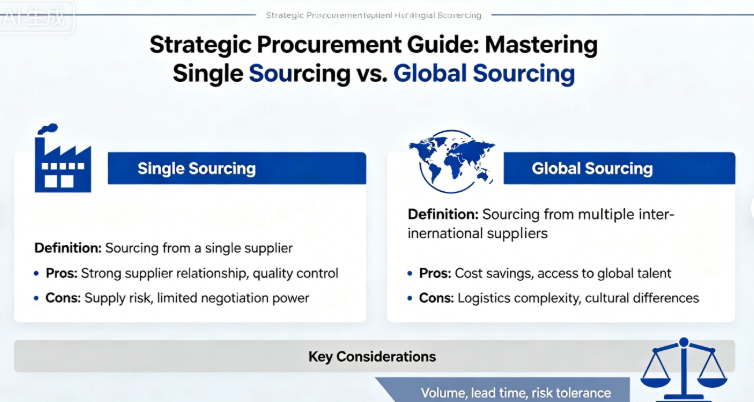
Navigating the complex landscape of supply chain management requires more than just operational efficiency—it requires a profound understanding of your sourcing strategy. As a business owner, your choice between single sourcing and global sourcing serves as the foundation for your risk management, cost control, and growth potential.
In this comprehensive guide, we dissect these two distinct procurement methodologies, leveraging industry insights to help you decide which approach aligns best with your long-term business objectives.
Table of Contents
Understanding Single Sourcing: Strategic Focus
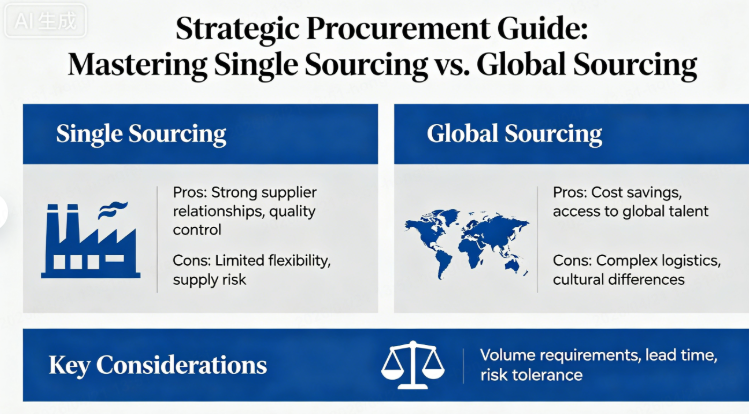
Single sourcing is a procurement strategy where a company consciously decides to rely on a single supplier for all goods or services required for a specific product line or production process.
- The Philosophy: It is often described as putting all your eggs in one basket—but with a strategic intention to cultivate an exclusive, high-trust partnership.
- The Core Advantage: The primary benefit is operational synergy. By funneling all volume to one vendor, you gain immense bargaining power, simplified logistics, and reduced administrative overhead.
- The Risk Factor: The most significant downside is dependency. Any disruption at the supplier’s facility—such as machinery failure, labor strikes, or financial instability—directly halts your production chain, potentially leading to critical order fulfillment delays.
Global Sourcing: Diversification for Stability
In contrast, global sourcing involves procuring goods from a dispersed pool of suppliers, often spanning multiple international regions.
- The Philosophy: This strategy embraces the “don’t put all your eggs in one basket” mantra by dividing your supply volume among various vendors.
- The Core Advantage: Risk mitigation is the defining benefit. If one factory fails to meet your requirements, you have pre-vetted alternatives ready to pick up the slack. Furthermore, it fosters a competitive environment that naturally pushes vendors to maintain high quality standards.
- The Trade-off: You sacrifice the intense, relationship-driven pricing leverage of single sourcing. Managing relationships with multiple international vendors requires significantly more resources and time.
Comparative Analysis: Which Strategy Wins?
Choosing between these strategies isn’t a “one-size-fits-all” scenario. Your decision should be dictated by your product’s lifecycle, market volatility, and risk appetite.
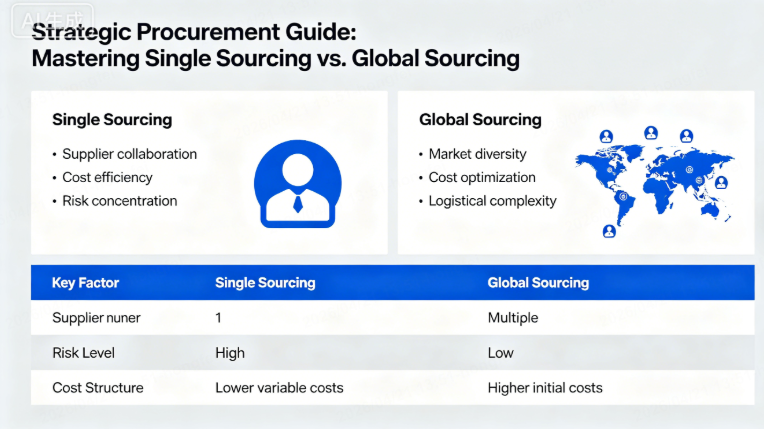
| Feature | Single Sourcing | Global Sourcing |
|---|---|---|
| Relationship | Deep, long-term collaboration | Transactional or diversified |
| Bargaining Power | High (volume concentration) | Lower per vendor |
| Risk Exposure | High (Single point of failure) | Low (Distributed risk) |
| Quality Control | Easier to monitor (One source) | Requires robust oversight |
| Logistics | Simplified (One hub) | Complex (Multiple channels) |
New Perspectives: Modernizing Your Sourcing Strategy
To compete in today’s market, relying solely on legacy definitions is insufficient. Here are three critical considerations for modernizing your approach:
1. The Emergence of the “Hybrid Sourcing” Model
Industry leaders are increasingly adopting a hybrid strategy. This involves maintaining a primary single source for the majority of core components to maximize volume discounts and stability, while simultaneously utilizing a secondary global sourcing network for emergency contingencies or capacity scaling.
2. Leveraging Technology for Transparency
The rise of B2B Sourcing Platforms (such as LooperBuy) has revolutionized how businesses source from China. Previously, companies struggled with fragmented data; now, platforms provide centralized dashboards, real-time logistics tracking, and verified supplier audits. Utilizing a professional platform mitigates the traditional risks associated with global sourcing, such as quality variance or language barriers.
3. Data-Driven Decision Making
Don’t choose a strategy based on intuition. Conduct a Procurement Risk Audit annually:
- Identify the top 20% of your products that generate 80% of your revenue.
- Assign a risk score to every supplier involved in those products.
- If a supplier’s risk score is high, immediately transition that component to a global sourcing model to ensure redundancy.
Actionable Steps for Sourcing Success
Regardless of your chosen strategy, executing it correctly requires a rigorous process:
- Define Requirements Clearly: Before sending an RFQ (Request for Quote), establish exact technical specifications.
- Verify Suppliers: Never rely solely on a website profile. Look for third-party audit reports or platform-verified badges.
- Optimize Logistics: If sourcing from China, leverage established one-stop platforms that handle end-to-end logistics. This drastically lowers costs and complexity compared to managing individual shipping providers.
- Continuous Evaluation: Your supply chain is dynamic. Conduct quarterly reviews of supplier performance against KPIs like delivery time, quality rate, and cost fluctuations.
Conclusion
The debate between single sourcing and global sourcing is not about which is “better” in a vacuum, but which is more effective for your specific business goals. While single sourcing offers deep cost and relationship advantages, global sourcing provides the security necessary for scaling. Modern businesses should look toward hybrid models and B2B sourcing platforms to capture the benefits of both while minimizing the associated risks.
Frequently Asked Questions (FAQ)
1. Is single sourcing always more cost-effective?
Not necessarily. While it offers better unit pricing through volume, it lacks the competitive market pressure that global sourcing provides to keep prices in check.
2. How do I mitigate risks in global sourcing?
Use a one-stop B2B sourcing platform that performs supplier verification, quality inspections, and consolidates logistics to ensure consistent quality and timely delivery.
3. When should I switch from single to global sourcing?
Consider the switch if your current supplier is struggling to scale with your growth, or if your product has become critical enough that a single point of failure could bankrupt your operations.
4. Does global sourcing mean lower quality?
No. In fact, global sourcing often improves quality because suppliers know they are being benchmarked against international competitors.
5. What is the most important factor in a sourcing strategy?
Total Cost of Ownership (TCO). Don’t just look at the unit price; include logistics, quality control costs, lead time, and the potential cost of supply chain disruption.
References
Article Summary:
This article provides a deep dive into procurement strategies, contrasting the high-trust, cost-focused nature of single sourcing with the risk-mitigating, competitive advantages of global sourcing. It challenges readers to adopt a hybrid approach, utilizing modern B2B sourcing platforms to centralize operations, reduce logistics costs, and manage supply chain risks effectively. The content is tailored for business leaders seeking a data-driven, actionable framework for competitive advantage.
Hot tags: B2B sourcing platform, global sourcing strategy, single sourcing benefits, supply chain risk management, wholesale procurement, international supplier management, manufacturing in China, supply chain diversification, procurement cost reduction, hybrid sourcing model.