As a B2B sourcing strategist who has spent over a decade helping international brands, wholesalers, and manufacturers navigate Chinese supply chains, I have witnessed firsthand how the global procurement landscape has transformed. Today, one question dominates nearly every conversation with my clients: which platform should I use for the 1364 Chinese market — Alibaba, AliExpress, or a specialized sourcing partner like LooperBuy?
The answer, as with most things in cross-border trade, depends entirely on your business model. In this guide, I will break down the key distinctions between these platforms, share real user feedback, and explain why a One-Stop B2B Sourcing Platform may be the smarter choice for serious buyers in 2026 and beyond.
Table of Contents
Why the “1364 Chinese Market” Matters for Global Sourcing
Before diving into platform comparisons, let us understand what the 1364 Chinese market represents. Within China’s vast B2B ecosystem, product categories are systematically organized, and the 1364 category sits at the intersection of industrial supplies, consumer goods, and specialty manufacturing — a segment that has grown exponentially as global demand for diversified Chinese products continues to surge.
According to a November 2025 Shopify industry report, the global B2B e-commerce market will continue its rapid expansion through 2026, with cost-effectiveness and ROI becoming the primary factors for platform selection. China remains at the center of this growth, with its manufacturing ecosystem covering approximately 90% of global B2B supply categories — from industrial components and electrical supplies to consumer goods and custom manufacturing parts.
But accessing this vast supply network profitably requires choosing the right sourcing channel.
Alibaba vs AliExpress: The Fundamental Difference
Let me be clear about the core distinction between these two Alibaba Group-owned platforms:
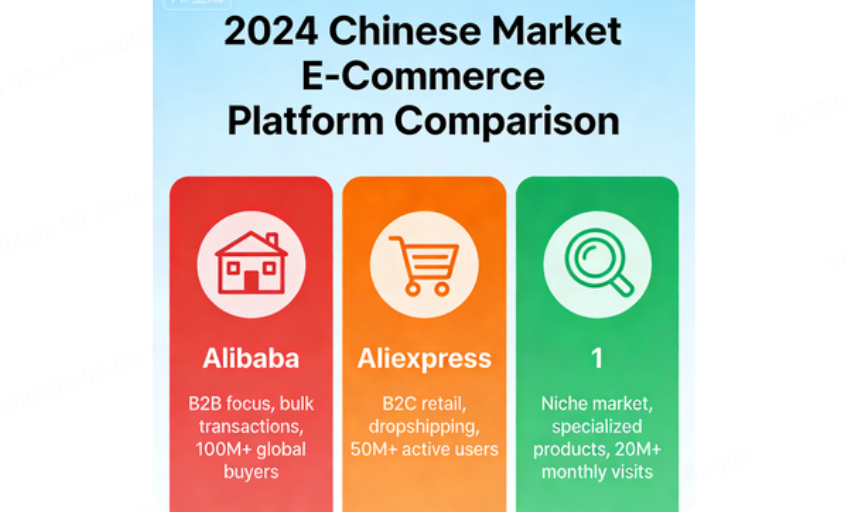
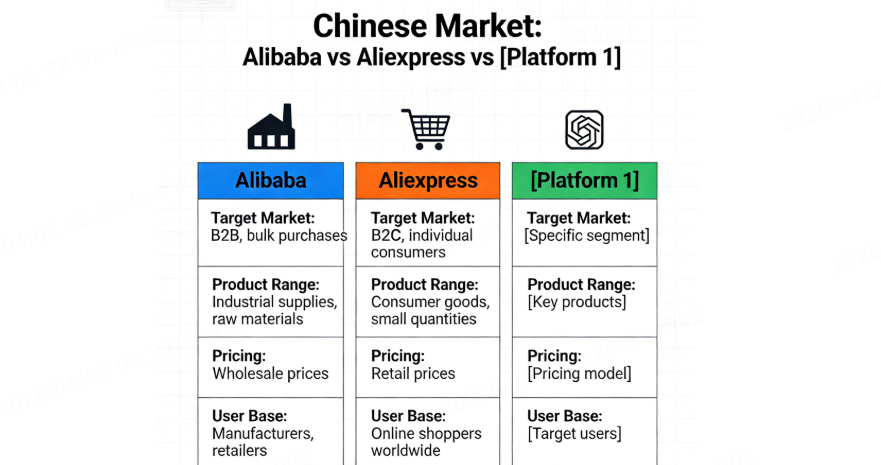
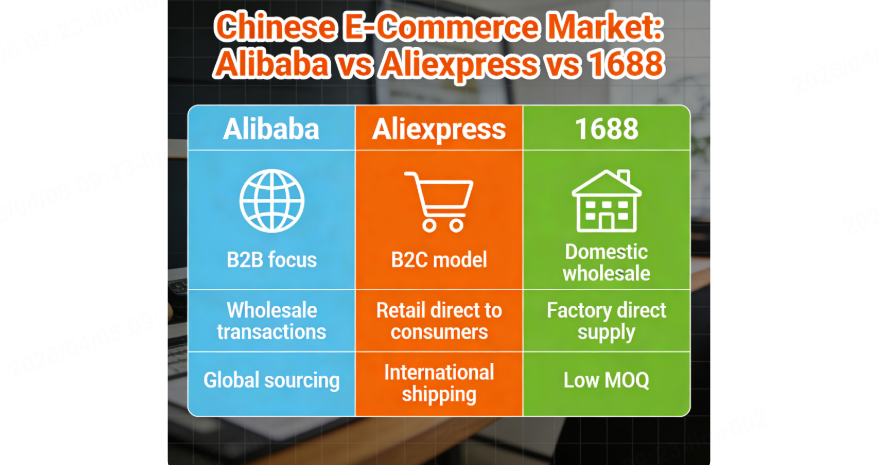
Alibaba is a B2B (Business-to-Business) wholesale marketplace. It connects manufacturers and wholesalers with businesses looking to purchase inventory in large quantities. Buyers can negotiate prices, request product samples, customize products with private labeling, and build long-term manufacturing relationships. Minimum order quantities (MOQs) are typically required.
AliExpress is a B2C (Business-to-Consumer) retail platform. It allows individual customers to buy single items directly from suppliers, often without any minimum order requirements. Think of it as an international version of Amazon or eBay — perfect for testing products or small-scale purchases, but not designed for serious B2B procurement.
Expert takeaway: If you are running a legitimate business that requires consistent inventory, product customization, or volume pricing, Alibaba is your starting point. If you are an individual shopper or a beginner testing a niche, AliExpress makes more sense.
Side-by-Side Comparison: Alibaba vs AliExpress
| Feature | Alibaba (B2B) | AliExpress (B2C) |
|---|---|---|
| Target Audience | Businesses, wholesalers, retailers | Individual consumers, dropshippers |
| Order Size | Bulk / wholesale (MOQ typically required) | Single items or small quantities |
| Per-Unit Price | Lower (due to volume) | Higher (retail pricing) |
| Price Negotiation | Yes, custom pricing available | No, prices are fixed |
| Customization | Private label, OEM/ODM available | Ready-made products only |
| Shipping | Buyer arranges or negotiates | Platform handles via postal services |
| Payment Protection | Trade Assurance | Escrow-based buyer protection |
The Hidden Challenges of Alibaba That No One Talks About
Here is where my years of sourcing experience come in. While Alibaba is undoubtedly a powerful platform, it comes with significant risks that many first-time buyers overlook:
Supplier Quality Fluctuations. Not every supplier listed on Alibaba meets consistent quality standards. Despite verification badges like “Gold Supplier,” some buyers report receiving products that don’t match samples or descriptions. In fact, over 20% of buyers report quality discrepancies.
Price Transparency Concerns. The initial quoted price often diverges significantly from the final cost once shipping, MOQs, hidden fees, and import schedules are factored in. One Reddit user posted: “Even with the ‘Gold Supplier’ badge, I encountered quality declines after initial orders”.
Payment Risks. Some suppliers pressure buyers to pay outside Alibaba’s protected system, then disappear after receiving deposits. A Reddit user shared their experience where a supplier vanished after payment, leaving them with no product or refund.
Communication and Logistics Barriers. Language misunderstandings, time zone differences, and uncoordinated logistics frequently disrupt inventory planning — especially for small to medium-sized enterprises.
Real User Pain Points: What Overseas Buyers Are Saying
I have spoken with dozens of international buyers struggling with exactly these issues. Here are their actual concerns:
- “I have no Chinese ID, so I can’t register on 1688, but I want to source Chinese goods for distribution in Vietnam — what options do I have?”
- “I don’t have a Chinese bank account or RMB. I’ve already selected my products — how can I pay for Chinese goods directly in foreign currency?”
- “From Yiwu to Jakarta, it’s not that far, but I’ve run into logistics issues multiple times. Finding a reliable logistics provider is really difficult.”
These frustrations highlight a critical gap in the traditional B2B sourcing model. And this is exactly where a modern One-Stop B2B Sourcing Platform like LooperBuy changes the game.
Introducing LooperBuy: The Smarter Alternative for Global B2B Sourcing
LooperBuy is a One-Stop B2B Sourcing Platform founded in 2024, designed specifically to help global merchants source high-quality, affordable Chinese goods from 1688.com — China‘s largest domestic B2B platform — without the barriers that plague traditional sourcing.
Unlike Alibaba, which connects you directly with individual suppliers (with all the vetting risks that entails), LooperBuy serves as a trusted intermediary that streamlines the entire procurement process: sourcing, payment, logistics, and quality assurance.
How LooperBuy Addresses the Four Biggest Sourcing Pain Points
Pain Point #1: High Costs and Hidden Fees
Customer feedback: “When sourcing Chinese goods overseas, prices are much higher than buying directly on 1688 — it’s hard to maintain profits.”
LooperBuy connects directly with 1688.com‘s premium supplier network, helping overseas merchants purchase at factory-direct prices, eliminating middleman markups and hidden fees.
Pain Point #2: Registration Barriers
Customer feedback: “I have no Chinese ID, so I can’t register on 1688. Isn’t there another way?”
LooperBuy provides overseas merchants with a convenient gateway to access 1688‘s platform without requiring a Chinese ID or 1688 account. Simply use LooperBuy to source directly.
Pain Point #3: Cross-Border Payment Obstacles
Customer feedback: “I’ve already chosen my products, but I don’t have a Chinese bank account or RMB — how can I pay for Chinese goods directly in foreign currency?”
LooperBuy supports multiple foreign currencies (USD, EUR, GBP, etc.) for direct transactions. No Chinese bank account or RMB conversion required. The platform has partnered with LianLian International (a Hong Kong-listed company serving over 4.9 million merchants) to provide secure, seamless cross-border payment solutions.
Pain Point #4: Logistics and Shipping Hassles
Customer feedback: “I need to arrange transshipment to my local destination, but I don’t know how — it’s incredibly frustrating.”
LooperBuy partners with leading international logistics providers to offer air, sea, and land shipping options, along with one-stop transshipment services and real-time order tracking.
A Sourcing Strategy That Works: My Expert Recommendation
After years of advising B2B buyers, here is the strategy I recommend:
For testing products or small-volume purchases, AliExpress is acceptable. You can buy single units, assess quality, and validate market demand with minimal upfront investment.
For established businesses scaling their operations, Alibaba offers the supplier network you need — but only if you invest significant time in supplier vetting, sample testing, and payment security measures.
For businesses that want the best of both worlds — factory-direct pricing from 1688 without the barriers of registration, payment, and logistics — LooperBuy provides the most streamlined, cost-effective solution available today.
The global B2B e-commerce market is projected to reach approximately $36 trillion by 2026. Chinese manufacturing remains the engine driving this growth. The question is not whether to source from China, but how to source from China profitably and safely.
With LooperBuy, you eliminate the guesswork, reduce your costs by up to 25-40% compared to traditional channels, and focus on what matters most: growing your business.
Ready to Transform Your Sourcing Strategy?
Stop navigating the complexities of cross-border procurement alone. LooperBuy handles everything from supplier sourcing to payment processing to global logistics — so you can concentrate on building your brand and serving your customers.
[Start sourcing with LooperBuy today — factory-direct pricing, global logistics, zero hidden fees.]
Frequently Asked Questions (FAQs)
Q1: Can I buy a single item on Alibaba?
Typically, no. Alibaba focuses on B2B wholesale with minimum order quantities (MOQs) required. Most suppliers on Alibaba expect bulk purchases, making it unsuitable for single-item buying.
Q2: Which is cheaper — Alibaba or AliExpress?
Alibaba offers significantly lower per-unit prices due to bulk ordering. AliExpress has higher per-item prices but allows single-unit purchases without MOQs. For businesses buying in volume, Alibaba is the more cost-effective choice.
Q3: Do I need a Chinese bank account to use LooperBuy?
No. LooperBuy supports multiple foreign currencies including USD, EUR, and GBP. You can complete transactions directly without a Chinese bank account or RMB conversion.
Q4: Is LooperBuy safe for large purchase orders?
Yes. LooperBuy partners with LianLian International, a trusted global payment provider serving over 4.9 million merchants worldwide. All transactions are secured through their verified payment network.
Q5: How does LooperBuy compare to using a traditional sourcing agent?
Traditional sourcing agents typically charge service fees of 10-15% and may have conflicts of interest. LooperBuy offers transparent, zero-markup pricing directly from 1688‘s factory network, with integrated logistics and payment — all in one platform.
Article Summary (300 chars): This expert guide compares Alibaba, AliExpress, and LooperBuy for the 1364 Chinese B2B market. Learn key platform differences, real user pain points, and why a One-Stop Sourcing Platform delivers factory-direct pricing, seamless global logistics, and lower costs for international brands and wholesalers in 2026.
10 High-Volume B2B Keywords:
Hot tags: B2B sourcing platform, China wholesale marketplace, Alibaba alternatives 2026, cross-border procurement, 1688 sourcing agent, factory direct China, global logistics B2B, Chinese supplier directory, overseas buying from China, LooperBuy review
References
- LooperBuy Blog. (n.d.). Supplies Business: A B2B Expert’s Guide to Sourcing Chinese Goods Globally with LooperBuy. Retrieved from https://blog.looperbuy.com/supplies-business-a-b2b-experts-guide-to-sourcing-chinese-goods-globally-with-looperbuy.html
- Shopify. (2025, May 12). AliExpress vs. Alibaba: How Do They Compare? Retrieved from https://www.shopify.com/my/blog/aliexpress-vs-alibaba
- Spocket. (2025). Alibaba vs AliExpress: Key Differences & Which One is Best for You. Retrieved from https://www.spocket.co/blogs/alibaba-vs-aliexpress
- AMZScout. (2026, February 27). Alibaba vs AliExpress: Which is Better for Product Sourcing? Retrieved from https://amzscout.net/blog/alibaba-vs-aliexpress
- XOOBAY. (2026). 2026 Global Top 10 B2B Marketplace Trends and ROI Analysis. Retrieved from http://test.xoobay.com/news/2026-global-top-10-b2b-marketplace-trends-and-roi
- Shulex Insight. (2025, December 19). Alibaba Alternatives in 2025: Finding the Best B2B Sourcing Platforms. Retrieved from https://insight.shulex.com/blog/alibaba-alternative
- DSers Blog. (2025). Is Alibaba Safe in 2025? Buyer Tips to Avoid Scams. Retrieved from https://www.dsers.com/blog/is-alibaba-safe
- TechSir. (2025, April 1). 国外企业线上采购中国货源,会遇到哪些问题?推荐Looperbuy平台. Retrieved from https://techsir.com/a/202504/90676.html
- Kuajingren. (2025). 连连国际牵手LooperBuy,解锁跨境B2B寻源新时代. Retrieved from https://kuajingren.com/27141.html
- Hupun. (n.d.). LooperBuy全球B2B寻源平台介绍. Retrieved from https://hupun.com/articles/mZBCIZEA.html
- Bluehost. (2026, January 9). eCommerce Statistics: Trends and Insights for Your Business. Retrieved from https://www.bluehost.com