Vendor vs. distributor is a critical distinction for B2B buyers, importers, and ecommerce sellers. This guide explains how each role affects product ownership, inventory risk, pricing, logistics, and market reach. Learn when to source directly from Chinese vendors, when to use distributors, and how a flexible fulfillment model can reduce upfront inventory costs.
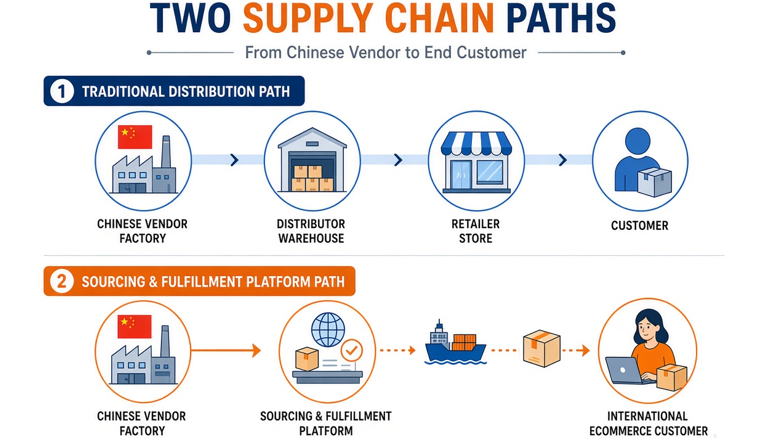
Understanding the difference between a vendor and distributor helps B2B buyers choose the right sourcing model, control inventory exposure, and build a more reliable path from Chinese factories to international customers. While vendors generally sell goods or services, distributors typically purchase, own, store, and resell goods through established sales and logistics channels.
For online sellers, wholesalers, and import businesses, the choice is not simply “vendor vs. distributor.” The more practical question is: Who should own the inventory, manage fulfillment, absorb logistics complexity, and carry the risk at each stage of the supply chain?
At Looperbuy, we see this decision shape cash flow, speed to market, customer experience, and scalability. A business that wants factory-level product access may work directly with vendors. A business seeking local stock availability, market coverage, and predictable replenishment may prefer a distributor. A third option—China sourcing combined with dropshipping or order-based fulfillment—can help businesses test demand without buying deep inventory upfront.
> Key takeaway: A vendor creates or sells the product. A distributor buys, owns, and resells inventory while helping move products into a market.
Table of Contents
Vendor vs. Distributor at a Glance
The table below provides a practical comparison for B2B buyers, ecommerce sellers, importers, and sourcing teams.
| Comparison Area | Vendor | Distributor |
| Primary role | Sells goods or services to another business or customer | Buys goods and resells them to retailers, businesses, or end users |
| Product creation | May manufacture, assemble, source, or sell products | Usually does not manufacture the product |
| Inventory ownership | May retain ownership until goods are sold or transferred | Normally takes title to and owns inventory before resale |
| Main focus | Product development, production, supply, and initial sale | Market access, stocking, order fulfillment, transportation, and resale |
| Geographic reach | Often limited by factory capacity, export capability, or direct-sales resources | Often broader due to local warehousing, retailer networks, and market expertise |
| Customer relationship | Often works with importers, wholesalers, distributors, retailers, or direct buyers | Often works closely with retailers, dealers, resellers, and local customers |
| Revenue model | Earns from the selling price less production or procurement costs | Earns from the resale margin after purchasing inventory |
| Key risks | Product quality, capacity planning, production delays, compliance, and overproduction | Unsold stock, warehousing, damaged goods, local delivery, credit, and demand changes |
| Best for | Buyers seeking product customization, direct factory pricing, or private labeling | Buyers seeking local availability, established channels, and faster domestic fulfillment |
A distributor is specifically defined in U.S. wholesale-trade reporting as a wholesaler that buys and takes title to products before reselling them. That ownership distinction matters because it determines who carries stock-related risk.
What Is a Vendor?
A vendor is a person or business that sells a product or service. In B2B sourcing, the term can describe a manufacturer, factory, trading company, service provider, wholesaler, marketplace seller, or supplier that sells finished goods to another organization.
The exact meaning depends on the transaction. For example:
– A Shenzhen electronics factory producing private-label Bluetooth speakers can be a vendor.
– A trading company that sources kitchenware from several factories can also be a vendor.
– A software company selling inventory management tools can be a vendor.
– A packaging supplier selling custom boxes to an ecommerce brand is a vendor.
In real procurement work, it is important not to assume that every vendor is the original manufacturer. Some vendors own factories. Others coordinate production through partner factories. Others buy finished products and resell them.
What Vendors Usually Handle
A vendor’s responsibilities often include:
– Manufacturing or procuring goods
– Providing product specifications and quotations
– Managing raw materials and production capacity
– Conducting product inspections or arranging quality control
– Packaging products for export or domestic delivery
– Meeting agreed order quantities and lead times
– Supporting customization, branding, or private-label requirements
– Supplying invoices, packing lists, and product documentation
For B2B buyers sourcing from China, direct vendor relationships can create clear advantages. They may offer better customization, lower unit costs at scale, and closer access to product development. However, the buyer may also need to manage more tasks independently, including factory verification, sampling, inspections, freight booking, customs documentation, and storage.
Vendor Advantages for Buyers
Working directly with a vendor can be attractive when your business needs:
– Custom products: Colors, materials, packaging, logos, molds, or product features.
– Lower unit costs at scale: Factory-direct purchasing can reduce intermediary markups.
– Better control: Buyers can communicate directly about specifications and quality requirements.
– Product differentiation: Private-label and OEM/ODM projects often require close vendor collaboration.
– Long-term procurement leverage: Consistent order volume can improve negotiating power over time.
Vendor Risks to Manage
The direct-vendor route is not automatically the lowest-risk option. Buyers should plan for:
– High minimum order quantities, especially for customized products
– Production delays caused by material shortages or capacity constraints
– Quality variation between approved samples and mass production
– Communication gaps over technical specifications
– Upfront deposits and payment risk
– Export documentation errors
– Inventory tied up in transit or warehouses
– Limited flexibility if consumer demand changes quickly
From a sourcing perspective, the biggest mistake is treating a vendor quotation as the final landed cost. Your decision should account for the full cost of goods, including sample charges, tooling, product testing, inspection, export packing, freight, duties, local delivery, returns, and storage.
What Is a Distributor?
A distributor is an intermediary that purchases products from manufacturers or vendors, takes ownership of those products, and resells them to retailers, resellers, businesses, or sometimes end customers.
Unlike a vendor that may focus primarily on creating or supplying a product, a distributor specializes in getting products into a market. This often includes warehousing, replenishment, sales coverage, local delivery, and relationships with downstream buyers.
A distributor may work with one brand or many brands. Some operate as broad-line distributors with extensive catalogs. Others focus on a narrow category, such as automotive parts, consumer electronics, medical supplies, industrial fasteners, or beauty products.
What Distributors Add to the Supply Chain
A capable distributor may provide much more than product resale. Its value can include:
– Purchasing inventory in bulk from manufacturers
– Holding stock in local or regional warehouses
– Breaking large orders into smaller quantities for retailers
– Managing domestic delivery and replenishment
– Providing sales representation in a local market
– Offering credit terms to qualified business customers
– Supporting returns, warranties, and after-sales service
– Sharing market feedback with manufacturers
– Helping brands comply with local channel requirements
Distributors can be especially valuable when a manufacturer lacks a sales network in a target country. Instead of building hundreds of retailer relationships one by one, the manufacturer can work through a distributor that already understands local pricing, channel dynamics, buyer preferences, and delivery expectations.
The Distributor’s Inventory Risk
The defining commercial feature of a distributor is inventory ownership. Once a distributor buys goods, it generally takes on the risk that those goods may sell slowly, become obsolete, be damaged, or require markdowns.
This can be a substantial commitment in categories with seasonal demand, rapidly changing trends, short product life cycles, or high return rates.
For example, a distributor that purchases 10,000 units of a consumer accessory before holiday season may achieve strong margins if demand is accurate. But if the market shifts, the distributor may have to discount remaining stock, pay longer warehouse fees, or write off obsolete inventory.
The World Bank’s logistics benchmarking work emphasizes that international supply-chain performance is not only about transportation. It also depends on the speed, reliability, and connectivity of goods movement across trade networks. These operational factors directly affect how much inventory businesses need to hold as a buffer.
Vendor vs. Distributor: The Core Differences
Although the two roles overlap in some transactions, the differences become clear when you examine product ownership, customer access, price control, operational responsibility, and risk.
Product Creation vs. Product Movement
A vendor often participates in creating, sourcing, or initially selling the product. A manufacturer-vendor may control materials, production methods, quality standards, customization, and initial wholesale pricing.
A distributor focuses on moving and monetizing products after purchase. It may not influence how the item is designed, but it can strongly influence where the item is sold, how quickly it is replenished, and what final price the market accepts.
Inventory Ownership and Cash Flow
This is usually the most important difference for a growing B2B seller.
– A direct buyer purchasing from a vendor may need to pay deposits, purchase in bulk, and arrange storage.
– A distributor purchases stock and typically carries the inventory on its own balance sheet.
– An order-based sourcing and fulfillment model allows a seller to purchase only after receiving customer orders, reducing the need to pre-buy inventory.
For businesses with uncertain demand, inventory ownership is not merely an accounting issue. It affects working capital, warehouse exposure, cash conversion cycles, and flexibility.
Market Reach and Local Knowledge
A vendor may have excellent products but limited market reach. It may be highly skilled at manufacturing, yet have little experience with overseas retail channels, local customer expectations, or domestic delivery networks.
A distributor typically has stronger local reach. It may already have retailer accounts, sales staff, warehouse infrastructure, and experience with country-specific regulations. That network can accelerate market entry, but it may reduce the manufacturer’s direct control over brand positioning and pricing.
Pricing and Margins
Vendors determine their initial selling price based on production costs, materials, labor, overhead, order volume, and desired margin. Distributors then add a margin to cover their own costs and profit requirements.
Those distributor costs may include:
– Warehouse rent and labor
– Local transportation
– Sales commissions
– Credit risk
– Product returns
– Insurance
– Marketing support
– Inventory financing
– Obsolescence and markdowns
This means a product that appears inexpensive at the factory can become significantly more expensive by the time it reaches a local retailer or end customer. That price difference is not automatically excessive; it may reflect legitimate market-access and fulfillment services.
Customer Insights and Demand Signals
Distributors are closer to retailers and sometimes to consumers. They can see which SKUs sell, which products get returned, which colors or sizes are requested, and how competitors are priced.
Vendors, especially overseas factories, may receive this information later or indirectly. Strong vendor-distributor relationships therefore create a valuable feedback loop:
1. The distributor captures retailer and consumer demand signals.
2. The distributor shares sales and product feedback with the vendor.
3. The vendor adjusts design, packaging, price, or production volume.
4. Both parties improve sell-through and reduce inventory waste.
When Should You Buy From a Vendor?
Buying from a vendor is often the better choice when you want direct control over your product, supply, and brand. This approach fits businesses with a clear product strategy and enough operational capability to manage international procurement.
Choose a vendor when you need:
– Custom manufacturing or proprietary product development
– Private-label packaging and branding
– Better pricing for repeat high-volume purchasing
– Direct visibility into production specifications
– Product samples and factory-level quality discussions
– Long-term supplier partnerships
– A differentiated product that distributors do not already carry
Practical Example: Private-Label Home Goods Brand
Imagine an ecommerce business selling reusable food-storage containers in the United States.
A distributor can provide ready-made products quickly, but the business may have limited ability to change material quality, colors, packaging, or product bundle design.
By working directly with a Chinese vendor, the business can request:
– BPA-free material documentation
– Custom lid colors
– Branded retail packaging
– A bundle designed for its target customer
– Barcode labeling for marketplace fulfillment
– Product inserts and instruction cards
The direct-vendor route may require higher minimum order quantities and more coordination, but it gives the brand stronger differentiation.
When Should You Work With a Distributor?
Working with a distributor may be the right choice when speed, local availability, and channel access matter more than product customization.
Choose a distributor when you need:
– Fast access to existing inventory
– Smaller purchase quantities than a factory requires
– Local warehouse fulfillment
– Established retailer or reseller networks
– Local-language customer service
– Domestic returns and warranty support
– Market intelligence in a new region
– Lower complexity for import logistics and customs
For small retailers or businesses testing an unfamiliar category, a distributor can reduce operational workload. The trade-off is typically a higher unit cost and less control over the product.
A Third Model: Sourcing and Dropshipping Without Deep Inventory
The traditional vendor-versus-distributor choice assumes that someone must purchase and store inventory in advance. That is not always necessary.
For online merchants, a sourcing and fulfillment platform can provide a more flexible model:
1. You identify products from Chinese vendors or factories.
2. You confirm product quality, options, branding needs, and pricing.
3. You list products in your online store, marketplace, or B2B catalog.
4. When a customer places an order, the sourcing partner procures, checks, packs, and ships the product.
5. You avoid holding large volumes of stock before demand is proven.
This approach can be useful for cross-border ecommerce sellers, niche retailers, wholesalers testing new SKUs, and businesses expanding into new markets.
Benefits of Order-Based Fulfillment
– Lower upfront investment: You do not need to buy a full container or deep inventory position immediately.
– Faster product testing: Test products, descriptions, prices, and market demand before scaling.
– Reduced warehousing costs: Inventory does not need to sit in your local warehouse.
– Broader catalog potential: Add more products without purchasing every SKU in advance.
– Operational support: Product sourcing, inspection, packing, and shipping can be coordinated through one workflow.
– More flexibility: Remove slow-moving products before they consume significant capital.
However, this model still requires strong supplier vetting and transparent communication. You should know who is responsible for product checks, stock confirmation, processing time, shipping method, packaging, tracking, returns, and customer-service escalation.
How to Evaluate a Vendor or Distributor
The best partner is not always the one offering the lowest unit price. A lower quote can create larger costs later if quality fails, lead times slip, products arrive without proper documentation, or inventory becomes difficult to sell.
Use the following evaluation checklist before committing to a supplier relationship.
1. Confirm the Business Role
Ask directly:
– Are you the manufacturer, trading company, wholesaler, or authorized distributor?
– Do you own the factory or work with multiple production partners?
– Who owns the inventory at each stage?
– Are products made to order, kept in stock, or sourced after purchase?
– Can you provide authorization documentation for branded goods?
This prevents a common sourcing issue: assuming that a vendor is a factory when it is actually an intermediary.
2. Verify Product and Quality Capability
Request and review:
– Product specifications
– Materials and component information
– Certifications relevant to the destination market
– Samples from the proposed production line
– Quality-control procedures
– Inspection reports, where available
– Packaging specifications
– Defect-rate or claim-handling processes
For regulated categories—such as electrical goods, children’s products, cosmetics, food-contact items, medical devices, or batteries—confirm compliance requirements before placing an order.
3. Compare the Real Landed Cost
Do not compare only the ex-factory price. Calculate:
Landed Cost=Product Cost+Packaging+Inspection+Freight+Insurance+Duties+Taxes+Local Delivery+Storage
For dropshipping, include per-order picking, packing, shipping, payment processing, return handling, and customer-support costs.
4. Define Delivery, Risk, and Responsibilities
International trade terms should be written clearly in the purchase agreement. Incoterms® are recognized rules that help clarify the allocation of tasks, costs, and risks between buyers and sellers in international transactions.
For example:
– EXW: The buyer takes extensive responsibility from the seller’s premises.
– FOB: The seller handles export loading onto the vessel; risk transfers once the goods are on board.
– DDP: The seller takes more responsibility for delivery, including import-related obligations, subject to the agreed terms and local feasibility.
Do not select an Incoterm simply because it sounds convenient. Match it to the product, shipping mode, customs capability, and party that can realistically manage each responsibility.
5. Test Before Scaling
Start with a controlled pilot order. Measure:
– Product quality against approved specifications
– Communication speed
– Accuracy of packing and labeling
– Processing time
– Shipment tracking quality
– Damage rate
– Customer feedback
– Return rate
– Actual landed margin
A pilot order gives you evidence before you place a high-value production order or commit to a distributor agreement.
Choosing the Right Model for Your Business
The right path depends on your current stage, capital, product strategy, and operational resources.
| Your Business Situation | Best Starting Option | Why It Fits |
| You need a custom private-label product | Direct vendor or manufacturer | Greater control over product design, packaging, and production |
| You want to test many products with limited capital | Sourcing and dropshipping fulfillment | Minimizes inventory commitment while demand is uncertain |
| You need domestic stock quickly | Distributor | Faster access to locally held inventory |
| You sell through local retailers | Distributor or exclusive distributor | Existing channel relationships can accelerate market entry |
| You have stable, high-volume demand | Direct vendor plus planned inventory | Supports better scale economics and stronger supplier leverage |
| You are entering a foreign market for the first time | Distributor or hybrid sourcing partner | Reduces the burden of local logistics, storage, and market access |
| You need broad catalog variety | Sourcing platform or multiple vendors | Allows wider SKU testing without committing to one distributor’s catalog |
A practical strategy is to evolve over time. Many successful sellers start with low-inventory product testing, identify proven winners, then move top-selling SKUs into bulk purchasing or private-label manufacturing.
That approach can protect capital while still creating a route toward higher margins and stronger brand control.
Build a Supply Chain That Matches Your Growth
A vendor and distributor are not interchangeable. A vendor gives you access to products, production capability, and customization. A distributor gives you inventory ownership, market reach, and local fulfillment capacity. Neither model is universally better.
The best choice is the one that aligns with your customer demand, cash-flow position, product requirements, and logistics capabilities.
If you want to source products from China without taking on heavy inventory, warehousing, payment coordination, and cross-border shipping complexity, Looperbuy can help streamline the process. We support global B2B sellers with product sourcing, supplier communication, quality checks, order fulfillment, and international delivery coordination—so you can focus on growing your store and serving customers.
Ready to reduce sourcing complexity and test products with less inventory risk? Contact Looperbuy to discuss your product requirements, target markets, and fulfillment needs.
Frequently Asked Questions
1. Is a vendor the same as a manufacturer?
Not always. A manufacturer makes products, while a vendor sells products or services. A factory can be a vendor when it sells directly to buyers, but a trading company, wholesaler, or service provider can also be a vendor without owning a factory.
2. Does a distributor own the products it sells?
Usually, yes. A distributor generally purchases and takes title to products before reselling them. This means the distributor normally carries inventory-related risks, including slow sales, damage, storage expense, and product obsolescence.
3. Is it cheaper to buy from a vendor or a distributor?
Buying directly from a vendor or manufacturer can offer a lower unit price, particularly for larger orders. However, the total cost may be higher after shipping, inspections, duties, warehousing, and inventory carrying costs. A distributor may charge more per unit but reduce logistics and operational complexity.
4. Should an ecommerce seller use a distributor?
An ecommerce seller may benefit from a distributor when fast local delivery, smaller purchase quantities, domestic returns, and readily available stock are important. Sellers looking for custom products, private labels, or lower factory pricing may prefer to work directly with vendors.
5. What is the difference between a vendor and a supplier?
The terms are often used interchangeably, but “supplier” is broader. A supplier may provide raw materials, components, finished goods, or services. A vendor is typically described as the party selling a product or service to a buyer.
6. Can I work with both vendors and distributors?
Yes. Many businesses use both. You may buy custom, high-volume products directly from vendors while purchasing urgent, low-volume, or locally required items from distributors. This hybrid model can balance cost efficiency and supply reliability.
7. How can I reduce inventory risk when sourcing from China?
Start with smaller test orders, validate demand before scaling, inspect products before shipment, calculate landed costs, diversify critical suppliers, and consider an order-based sourcing and fulfillment model instead of pre-purchasing large quantities.
References
1. Global Sources. “[Vendor vs. Distributor: What’s the Difference?]”
2. U.S. Census Bureau. “[Monthly Wholesale Trade Definitions]”
3. U.S. Census Bureau. “[Monthly Wholesale Trade]”
4. World Bank. “[Logistics Performance Index]”
5. World Bank. “[Connecting to Compete 2025: The New Logistics Performance Indicators]”
6. International Trade Administration. “[Know Your Incoterms]”