Learn what MOQ means in wholesale, why Chinese suppliers set minimum order quantities, and how global sellers can calculate inventory risk, negotiate lower MOQs, test products, manage cash flow, and scale sourcing efficiently with practical supplier and fulfillment strategies.
MOQ, or Minimum Order Quantity, is the smallest quantity of a product that a supplier is willing to manufacture or sell in one order. For wholesale buyers, Amazon sellers, Shopify merchants, and growing brands sourcing from China, MOQ directly affects product cost, inventory risk, cash flow, customization options, and fulfillment planning.
In my experience working with cross-border sourcing workflows, MOQ is rarely just a number on a supplier quotation. It is a reflection of factory setup costs, raw-material purchasing requirements, labor allocation, packaging rules, quality-control processes, and the supplier’s willingness to invest in a new buyer relationship.
For a business that wants to test products, launch a private-label line, or avoid tying up capital in slow-moving inventory, understanding how to assess and negotiate MOQ can make the difference between a scalable product launch and an expensive inventory mistake.
> Key takeaway: A low MOQ is not automatically the best deal. The right MOQ is the quantity that gives your business acceptable unit economics without creating excess stock, storage expense, or cash-flow pressure.
Table of Contents
What Is MOQ in Wholesale?
MOQ stands for Minimum Order Quantity. It is the minimum number of units, minimum order value, weight, carton count, or material volume a supplier requires before accepting an order.
For example:
– A manufacturer may require an MOQ of 500 water bottles.
– A clothing supplier may require 100 pieces per color and size.
– A packaging company may require a minimum order value of US$2,000.
– A fabric supplier may require 300 kilograms per color.
– A private-label supplier may accept 100 units for an existing product but require 1,000 units when custom molds, colors, or packaging are involved.
MOQ is common in wholesale because factories must cover the fixed costs of producing, preparing, inspecting, packing, and shipping an order. A factory may need to buy raw materials in bulk, configure machinery, create packaging files, prepare print plates, or assign workers to a production line. Small orders can consume nearly the same operational effort as large orders, but generate less revenue.
Global Sources describes MOQ as the smallest number of units a supplier is prepared to sell in a single transaction. It may be defined by units, order value, weight, time period, or a combination of requirements.
For buyers, MOQ is a purchasing constraint. For suppliers, it is a profitability and operations tool.
Why Suppliers Set Minimum Order Quantities
Suppliers do not set MOQs simply to make purchasing difficult. In most cases, the requirement is based on the economics of production.
Fixed production and setup costs
Many products require costs before the first sellable unit is made. These can include:
– Machine setup and calibration
– Mold preparation or tooling
– Material cutting and preparation
– Printing plates or embroidery files
– Factory labor scheduling
– Sample approval and production documentation
– Quality inspections
– Inner-box, master-carton, and export packaging setup
If a supplier spends US$500 preparing a production run, spreading that cost over 50 units adds US$10 per unit before materials and labor. Spread across 1,000 units, the same setup cost is only US$0.50 per unit.
Raw-material purchasing requirements
Factories often need to purchase materials from upstream suppliers that have their own minimum requirements. A supplier may be able to manufacture 100 custom bags, for example, but may need to purchase fabric, zipper components, labels, and packaging in much larger volumes.
This is why a supplier may offer:
| Order Type | Typical MOQ Logic |
| Ready-to-ship product | Lower MOQ because stock or standard materials already exist |
| Standard product with logo | Medium MOQ due to printing, labels, or branded packaging |
| Custom color or specification | Higher MOQ because materials must be purchased or produced specifically |
| New mold or fully custom product | Highest MOQ because of tooling, engineering, testing, and production setup |
Unit-cost efficiency
Larger orders often reduce the unit price because suppliers can improve production efficiency, reduce material waste, and spread overhead across more products. However, buyers should not focus only on the factory unit price.
A lower unit cost can become more expensive overall if it results in:
– Overstocked inventory
– Higher warehouse fees
– More capital tied up in slow sellers
– Product obsolescence
– Seasonal stock that misses its sales window
– Additional customs, freight, and insurance exposure
A sound purchasing decision compares the total landed cost and inventory risk, not just the product price.
Common Types of MOQ
MOQ structures vary widely by supplier, product category, and production model. Before you negotiate, clarify exactly what the supplier means by “MOQ.”
Unit-based MOQ
A unit-based MOQ requires a buyer to purchase a specific number of items.
Example: MOQ 500 units of a portable blender.
This is common for consumer goods, accessories, electronics, home products, and standard manufactured items.
Minimum order value
A minimum order value requires buyers to spend a specific amount rather than purchase a fixed number of units.
Example: Minimum order value: US$1,500.
This structure can be helpful when buyers want to mix multiple SKUs from one supplier. Instead of buying 500 units of one item, they may purchase different products until the total order reaches the supplier’s value threshold.
MOQ per SKU, color, or variation
A supplier may accept 1,000 units in total but require a minimum quantity for every variation.
Example:
– 1,000 units total
– Minimum 200 units per color
– Minimum 100 units per size
This matters especially in fashion, footwear, beauty products, packaging, and custom consumer goods. A buyer may believe they can order 1,000 units across 10 variants, only to discover the factory requires 200 units for each variant.
Material or weight-based MOQ
Products such as textiles, chemicals, metals, food ingredients, and bulk packaging may use weight or volume instead of piece count.
Example: MOQ 500 kilograms of fabric or 1,000 meters of cable.
Time-based or purchase-commitment MOQ
Some suppliers lower the MOQ per shipment if the buyer agrees to purchase a total quantity over a defined period.
Example: 3,000 units per quarter, delivered in three scheduled batches.
This can reduce storage pressure, but the buyer should make sure delivery timing, payment terms, quality standards, and cancellation conditions are documented.
MOQ vs. EOQ: Know the Difference Before You Buy
MOQ and EOQ are often confused, but they answer different questions.
| Term | What It Means | Who Usually Sets It | Main Purpose |
| MOQ | Minimum Order Quantity | Supplier | Ensures an order is operationally and financially worthwhile for the supplier |
| EOQ | Economic Order Quantity | Buyer | Identifies the order quantity that minimizes ordering and inventory-holding costs |
EOQ is an inventory-planning concept used to balance how often you order against how much inventory you carry. It aims to minimize the combined cost of purchasing, ordering, storing, and replenishing inventory.
In simple terms:
– MOQ asks: “What is the smallest order the supplier will accept?”
– EOQ asks: “What quantity is financially optimal for my business to order?”
The challenge appears when the supplier’s MOQ is higher than the buyer’s EOQ.
Example: When MOQ creates inventory risk
Imagine that your business estimates it can sell 100 units per month. Your inventory model suggests that ordering 300 units at a time is financially sensible. However, the supplier requires a 1,000-unit MOQ.
At 100 units per month, the inventory may take approximately 10 months to sell. That may be acceptable for an evergreen product, but risky for seasonal goods, trend-driven products, electronics, beauty items with expiration concerns, or products with rapidly changing consumer preferences.
Before accepting the 1,000-unit MOQ, ask:
1. Can I realistically sell the inventory within my target time frame?
2. How much cash will remain available after payment?
3. What are my storage and fulfillment costs?
4. What happens if demand is 30% lower than forecast?
5. Can I diversify the order into multiple variations?
6. Can I arrange staggered deliveries or supplier-held inventory?
How to Calculate Whether an MOQ Makes Financial Sense
Buyers should not approve an MOQ based solely on a supplier’s quoted price. A better approach is to evaluate the full commercial impact.
Step 1: Forecast realistic demand
Start with conservative sales projections, not best-case assumptions.
Use data such as:
– Historical sales by SKU
– Store traffic and conversion rate
– Marketplace demand
– Competitor pricing
– Seasonality
– Advertising budget
– Repeat-purchase rate
– Product launch history
For a new product, build at least three scenarios:
| Scenario | Monthly Sales Forecast | Purpose |
| Conservative | Low expected sales | Protects cash flow if demand is weaker than expected |
| Base case | Most likely sales level | Supports normal purchasing decisions |
| Upside case | Strong sales growth | Helps prepare replenishment and stockout planning |
Step 2: Calculate total landed cost
Your product cost is only one part of the purchase decision. Include:
– Factory unit price
– Customization fees
– Sample charges
– Packaging costs
– Quality inspection fees
– Domestic China shipping
– International freight
– Import duties and taxes
– Payment-processing costs
– Warehouse and fulfillment fees
– Product photography, advertising, and launch costs
– Expected returns or defects
A US$3.00 product is not necessarily a US$3.00 inventory decision. Its landed cost may be significantly higher after logistics, compliance, and fulfillment expenses.
Step 3: Estimate inventory carrying cost
Inventory carrying cost is the cost of holding products before they are sold. It can include warehousing, insurance, financing costs, damage, shrinkage, obsolescence, and the opportunity cost of cash tied up in stock.
NetSuite notes that suppliers evaluating MOQ should consider demand, holding costs, break-even performance, labor, setup expenses, storage, and other production and delivery costs.
For buyers, a practical question is:
Inventory Carrying Cost=Average Inventory Value×Annual Carrying Cost Rate
For example, if your average inventory value is US$10,000 and your estimated annual carrying cost rate is 25%, the yearly cost of carrying that inventory is approximately US$2,500.
Step 4: Test the downside case
Do not approve an MOQ until you have tested a slower-than-expected sales outcome.
If you expect to sell 500 units per month, test what happens if sales fall to 250 units per month. Can you still pay for marketing, shipping, payroll, platform fees, and replenishment? Does the product remain relevant six months later?
This simple discipline prevents a large share of avoidable overstock problems.
How to Negotiate a Lower MOQ With Chinese Suppliers
MOQ negotiation is most successful when it addresses the supplier’s operational concerns instead of simply asking for a lower number.
A message such as “Can you reduce MOQ?” provides little reason for a supplier to make an exception. A stronger request shows that you understand the supplier’s situation and presents a commercially workable alternative.
1. Start with a clear, professional inquiry
Share the information a supplier needs to evaluate you:
– Product specifications
– Target quantity
– Customization requirements
– Packaging needs
– Target market
– Expected reorder schedule
– Product launch date
– Forecasted annual volume
Suppliers are more likely to offer flexibility when they see credible repeat-order potential.
2. Ask for a phased order plan
Instead of requesting 100 units when the MOQ is 1,000 units, propose a structured commitment.
Example:
> We understand that your standard MOQ is 1,000 units. For our first launch, we would like to begin with 300 units for market validation. If the product meets our agreed quality standard and sales target, we plan to reorder 1,000 units within 60–90 days. Could you support this first order at a trial MOQ, possibly with a slightly higher unit price?
This approach recognizes that lower quantities may cost the supplier more per unit.
3. Accept a higher unit price for a lower initial MOQ
A supplier may be willing to reduce the MOQ if you accept a higher unit price. For a first order, this can be preferable to purchasing too much inventory at a lower price.
The goal is not always to secure the cheapest quote. The goal is to buy enough inventory to validate demand while protecting capital.
4. Use existing colors, materials, and packaging
Customization usually increases MOQ because it creates more setup work and material requirements.
To lower MOQ, consider:
– Stock colors rather than custom Pantone colors
– Existing product molds
– Standard packaging
– Simple logo printing rather than custom structures
– Shared or generic accessories
– Existing carton configurations
Once sales are proven, move to deeper customization.
5. Consolidate related SKUs
Ask whether the MOQ can be met across a product family.
For instance, instead of ordering 500 units of one color, ask whether you can order:
– 200 black units
– 150 white units
– 150 blue units
This only works if the supplier’s production process allows variation mixing without adding excessive complexity.
6. Negotiate delivery timing, not only quantity
If the factory cannot reduce the total MOQ, ask whether production can be completed in full but released in batches.
For example:
– Produce 1,000 units
– Ship 300 units immediately
– Hold 700 units temporarily
– Release the balance based on a pre-agreed schedule
Be careful: confirm whether the supplier charges storage fees, how long the stock can remain in storage, who owns the goods, and what happens if quality issues are found later.
7. Use a sourcing and fulfillment partner
For businesses sourcing from multiple Chinese suppliers, a sourcing and fulfillment partner can help combine products, coordinate supplier communication, arrange inspections, consolidate parcels, and ship orders internationally.
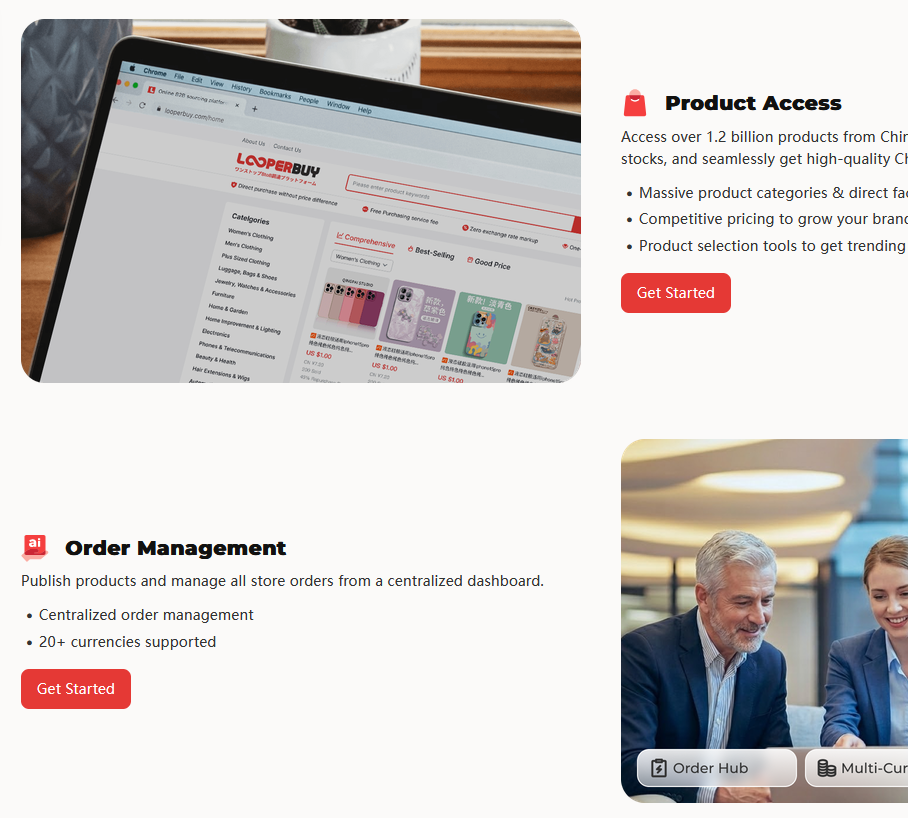
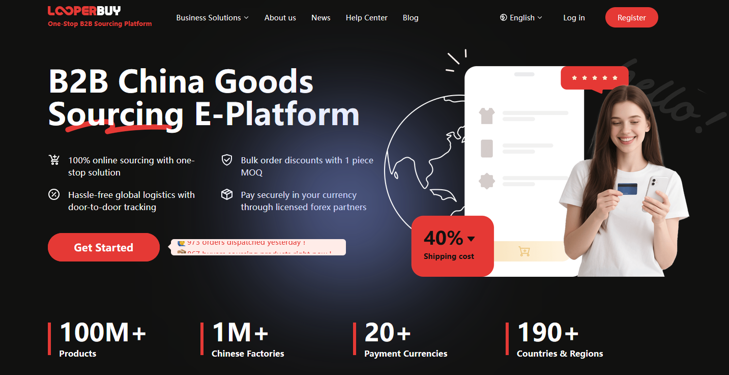
Looperbuy positions its service as an integrated China sourcing and fulfillment platform that connects global merchants with Chinese supply sources, including 1688, and supports sourcing, order management, quality inspection, warehousing, and international shipping.
For sellers with limited storage capacity, this model can reduce the need to import a large amount of inventory before confirming demand. It can also simplify supplier coordination and cross-border logistics.
MOQ Strategies for Dropshipping and Small B2B Sellers
A traditional wholesale MOQ can be difficult for dropshippers and small B2B sellers because the business model depends on keeping inventory exposure low.
The right approach depends on the stage of your business.
| Business Stage | Recommended MOQ Approach |
| Product testing | Use ready-to-ship items, small trial quantities, or single-SKU validation |
| Early growth | Negotiate lower MOQ with a higher unit price and limited customization |
| Established seller | Use sales data to negotiate tiered pricing and rolling purchase commitments |
| Private-label brand | Start with proven products, then move into custom packaging, colors, and product improvements |
| Multi-store operator | Consolidate sourcing, inspection, storage, and international fulfillment workflows |
A practical low-risk launch model
A disciplined launch process may look like this:
1. Source 3–5 supplier options and compare product specifications, pricing, MOQ, lead times, and communication quality.
2. Order samples from the strongest candidates.
3. Inspect product quality, packaging, dimensions, functionality, and branding options.
4. Launch a small validation order using stock materials or standard packaging.
5. Measure conversion rate, returns, customer reviews, ad efficiency, and reorder demand.
6. Negotiate larger-volume pricing only after the product demonstrates consistent sales.
7. Add custom packaging, private labels, bundles, or product improvements after validation.
This approach is slower than immediately placing a large order, but it is usually more resilient. It turns MOQ from a purchasing obstacle into a phased investment decision.
Final Thoughts: Treat MOQ as a Business Decision, Not a Supplier Rule
MOQ is one of the most important terms in wholesale sourcing because it affects more than product quantity. It influences your capital requirements, unit economics, product-testing strategy, inventory turnover, logistics plan, and ability to scale.
The best MOQ is not always the smallest number a supplier will accept. It is the quantity that fits your realistic demand, available cash, fulfillment capacity, and growth plan.
Before placing an order, verify the supplier’s MOQ by SKU, color, size, material, customization level, packaging format, and shipment schedule. Put all agreed terms in writing, including unit price, payment terms, quality standards, production lead time, delivery arrangements, and defect-resolution procedures.
Ready to source products from China without carrying unnecessary inventory? Looperbuy can help global B2B sellers source suitable products, coordinate purchasing, inspect goods, manage warehousing, and fulfill orders internationally—so you can test demand and scale with more control.
Frequently Asked Questions
1.What does MOQ 500 mean?
MOQ 500 means the supplier requires you to purchase at least 500 units of that product in one order. However, confirm whether this applies to the total product quantity or separately to each color, size, SKU, or customization option.
2.Can MOQ be negotiated?
Yes. MOQ can often be negotiated, particularly when you offer a higher unit price, use standard materials, commit to repeat purchases, accept mixed variations, or agree to a phased purchase plan. The likelihood of flexibility depends on the product, supplier capacity, customization level, and expected long-term order volume.
3.Is a low MOQ always better?
No. A low MOQ can be useful for testing products and protecting cash flow, but it may come with a higher unit cost. The best decision depends on your demand forecast, margins, storage costs, product life cycle, and ability to reorder quickly.
4.What is the difference between MOQ and minimum order value?
MOQ usually refers to a minimum number of units. Minimum order value refers to a minimum spending amount. A supplier may require, for example, a US$1,000 total order while allowing you to combine several SKUs to meet that threshold.
5.How can dropshippers avoid high MOQs?
Dropshippers can focus on ready-to-ship products, select suppliers that support small orders, use standard product configurations, validate demand before adding customization, and work with a sourcing and fulfillment partner that can manage purchasing, warehousing, and direct international shipping.
6.Why do custom products have higher MOQs?
Custom products often require unique materials, colors, printing, packaging, molds, design files, production setup, and quality-control procedures. Suppliers set higher MOQs to recover these fixed costs and reduce the risk of holding unusable custom materials or inventory.
7.Should I pay more per unit to get a lower MOQ?
Often, yes—especially for a first order. Paying a modestly higher unit price can be less risky than tying up significant cash in inventory that has not been validated. Compare the increased unit cost with the cost of storage, slow sales, discounting, and potential unsold stock.
References
1. [Global Sources — What Does MOQ Mean in Wholesale? Understanding Minimum Order Quantities] — Definitions, MOQ types, negotiation approaches, inventory and supply-chain considerations.
2. [NetSuite — Minimum Order Quantity: Formula, Tips, and Benefits] — MOQ calculations, break-even analysis, demand planning, and carrying-cost considerations.
3. [Netstock — What Is Minimum Order Quantity and How to Calculate It?] — Explanation of MOQ, EOQ, ordering costs, demand forecasting, and inventory considerations.
4. [Alibaba Seller — What Is Minimum Order Quantity (MOQ)?] — Low-MOQ sourcing context and buyer filtering methods.
5. [Looperbuy — Top 10 Global Sourcing Platforms in China] — Looperbuy service context, including sourcing, quality inspection, warehousing, and cross-border shipping.
6. [Looperbuy — Top 10 Private Label Dropshipping in China] — Context on MOQ differences by customization level and supplier negotiation support.