Compare eBay vs. Shopify for dropshipping: costs, traffic, branding, compliance, fulfillment, and scaling strategies. Learn when to use eBay, Shopify, or both—and how reliable China sourcing and global order fulfillment can support long-term ecommerce growth.
Choosing between eBay vs. Shopify for dropshipping is not simply a choice between two selling channels. It determines where your traffic comes from, how much control you have over the customer journey, what costs you carry, and whether you are building a short-term sales channel or a long-term brand asset.
For many new sellers, eBay is the faster route to marketplace demand. For merchants aiming to build a recognizable store, collect first-party customer data, and create a repeat-purchase business, Shopify offers more control. The strongest operating model often combines both—while using a reliable China sourcing and fulfillment partner such as Looperbuy to keep inventory, order processing, packaging, and international delivery under control.
Table of Contents
eBay vs. Shopify for Dropshipping at a Glance
| Comparison factor | eBay | Shopify |
| Platform type | Online marketplace | Independent ecommerce platform |
| Built-in traffic | Yes—buyers already search and buy on the marketplace | No—merchants must attract traffic |
| Store customization | Limited | Extensive control over design, content, checkout, and brand |
| Setup speed | Fast | Requires store setup, product pages, and marketing foundations |
| Customer relationship | Controlled largely by the marketplace | Merchant owns the store experience and customer data |
| Main costs | Listing-related and final value fees; fees vary by category | Subscription, payment processing, apps, advertising, and operational tools |
| Brand-building potential | Moderate to limited | High |
| Suitable for | Product testing, fast entry, marketplace-oriented selling | Brand development, retention, content-led growth, long-term scaling |
| Supply-chain requirements | Accurate inventory and dependable handling times are essential | Reliable product data, fulfillment speed, and post-purchase visibility are essential |
eBay charges a final value fee when an item sells, calculated as a percentage of the total sale amount plus a per-order fee. The exact rate depends on category and seller setup. Shopify uses subscription plans with separate payment, app, and operating costs depending on the merchant’s configuration.
What eBay Offers Dropshipping Sellers
eBay is a demand-rich marketplace. Instead of first convincing people to visit your website, you place products where millions of buyers already search by category, price, condition, shipping promise, and seller reputation.
That makes eBay attractive for sellers who need early sales signals before committing heavily to paid advertising, web design, or a large catalog.
Why sellers start with eBay
– Built-in buyer intent: Customers visit eBay to compare and purchase products, not merely browse brand stories.
– Faster product validation: You can test demand for a product category with listings before building a complete standalone store.
– Lower technical barrier: You do not need to create a custom ecommerce website before listing products.
– Marketplace trust: Reviews, buyer protections, and the established platform can reduce friction for first-time shoppers.
– Straightforward catalog launches: Sellers can publish listings relatively quickly when product data, images, shipping terms, and pricing are ready.
For a seller importing a curated range of China-sourced home organization items, small tools, accessories, or niche lifestyle products, eBay can reveal which product types receive impressions, watchlist activity, clicks, and conversions. That insight is valuable before investing in a larger branded product line.
The trade-off: less control
The same marketplace structure that creates early visibility also limits differentiation. Your product listing sits beside similar offers, and buyers often compare based on price, delivery estimate, review history, and title relevance.
You also have less ownership over the shopping environment. You cannot fully control:
– The broader marketplace experience
– The rules governing product listings and communication
– The visibility of your listings in marketplace search
– The degree to which buyers remember your brand instead of the marketplace
– The customer relationship after the transaction
In practical terms, eBay is excellent for discovering demand, but it can be difficult to create a durable advantage if the product is easy to copy and several sellers offer similar listings.
eBay Dropshipping Rules: The Compliance Issue Many Sellers Miss
A common operational mistake is treating marketplace dropshipping as a simple “buy it elsewhere after receiving an order” workflow. That approach can create serious account risk.
eBay allows dropshipping when an order is fulfilled directly by a wholesale supplier. However, listing an item on eBay and then purchasing it from another retailer or marketplace that ships directly to the customer is not allowed. The seller remains responsible for safe delivery within the stated timeframe and for the buyer’s satisfaction.
What compliant eBay fulfillment requires
– Work with a legitimate wholesale supplier, manufacturer, or sourcing partner.
– Keep stock information and product availability accurate.
– State realistic handling and delivery timeframes.
– Remain the accountable seller for customer service, refunds, delivery failures, and disputes.
– Make sure the customer does not receive confusing third-party invoices, retail receipts, or supplier marketing materials.
– Use shipping and tracking processes that reliably update the buyer.
This is where a China sourcing and fulfillment partner can make a meaningful operational difference. Instead of relying on retail arbitrage, a seller can source from Chinese factories or wholesale channels, inspect products, consolidate orders, use neutral packaging, and ship under a process designed for cross-border ecommerce.
> Expert perspective: Platform selection is important, but fulfillment reliability is more important. A well-performing listing can quickly become a loss-maker if stock data is wrong, delivery promises are unrealistic, or returns are not managed professionally.
What Shopify Offers Dropshipping Sellers
Shopify is not a marketplace. It is infrastructure for building and operating your own online store. You decide how the storefront looks, how product collections are organized, what messages appear on the page, how bundles are presented, and how customers move from first visit to checkout.
This makes Shopify the better fit for sellers who see dropshipping as the beginning of a business—not the final business model.
Why sellers choose Shopify
– Complete storefront ownership: Control your domain, page layouts, product descriptions, navigation, landing pages, and brand presentation.
– Customer experience flexibility: Build product bundles, upsells, post-purchase offers, email flows, loyalty programs, and targeted promotions.
– First-party customer relationships: Build your own email list and customer database, subject to applicable privacy and marketing rules.
– Marketing integration: Connect social channels, search campaigns, email platforms, analytics tools, and influencer campaigns.
– Long-term brand value: A consistent brand can create repeat purchases, better margins, stronger referrals, and opportunities for private-label development.
Shopify’s app ecosystem also enables merchants to connect sourcing, inventory, order routing, fulfillment, customer service, analytics, and marketing systems. However, a Shopify store does not automatically receive buyer traffic simply because it is published.
The central challenge: traffic acquisition
A Shopify store needs a deliberate customer-acquisition plan. That may include:
– Organic content and product-led guides
– Short-form video and creator partnerships
– Search advertising and shopping campaigns
– Social advertising
– Email capture and lifecycle campaigns
– Affiliate programs
– Community partnerships
– Retargeting campaigns
This means Shopify can have a higher learning curve and a greater upfront investment than eBay. But it also gives merchants more ways to improve conversion rate, average order value, and customer lifetime value.
Cost Comparison: Look Beyond Platform Fees
A platform with a lower visible cost is not always less expensive. The right comparison is total cost to acquire, fulfill, support, and retain one customer.
| Cost area | eBay | Shopify |
| Store access | Seller account and optional store plans | Monthly subscription plan |
| Transaction-related costs | Final value fee plus per-order fee, depending on category and setup | Payment processing; possible third-party transaction fees depending on configuration |
| Traffic costs | Marketplace exposure is built in, but competition can reduce visibility | Merchant funds traffic through content, ads, partnerships, or other channels |
| Apps and automation | Third-party tools may be needed for inventory, listing, or fulfillment workflows | Apps can add functionality but may increase recurring monthly costs |
| Branding investment | Relatively limited | Store design, content, creative assets, and customer retention systems may require more investment |
| Operational risk | Inventory and delivery performance can affect seller status | Marketing spend, site conversion, and fulfillment quality directly affect profitability |
eBay’s official fee structure includes one final value fee per sold item, calculated from the total sale amount plus a per-order fee of $0.30 for orders of $10 or less and $0.40 for orders above $10.
The practical lesson is simple: calculate contribution margin before publishing products.
A basic margin formula
Contribution Margin=Selling Price−Product Cost−Shipping Cost−Platform Fees−Payment Fees−Advertising Cost−Expected Return Cost
Example: Why a “profitable” product may not be profitable
Imagine a product sells for $35:
| Cost item | Estimated amount |
| Product sourcing cost | $10 |
| Quality check and packing | $2 |
| International shipping | $7 |
| Marketplace/platform and payment fees | $5 |
| Refund, reshipment, or defect reserve | $2 |
| Advertising cost per order | $4 |
| Estimated contribution margin | $5 |
A $5 contribution margin may look acceptable until refunds, delayed parcels, currency movements, support time, and customer acquisition volatility are considered. Sellers should test multiple price points and shipping methods before scaling.
The Best Strategy: Start on eBay, Build on Shopify, Fulfill Through One Backend
The choice does not need to be permanent. In my experience working with cross-border ecommerce operations, a phased approach is often safer than committing entirely to one channel.
A practical three-stage model
1. Validate products on eBay.
Start with a focused catalog. Watch demand, conversion, price sensitivity, buyer questions, return reasons, and delivery-related feedback.
2. Move proven products into a Shopify store.
Build better product pages, bundles, guides, comparison content, and brand-led offers around products that have demonstrated demand.
3. Centralize sourcing and fulfillment.
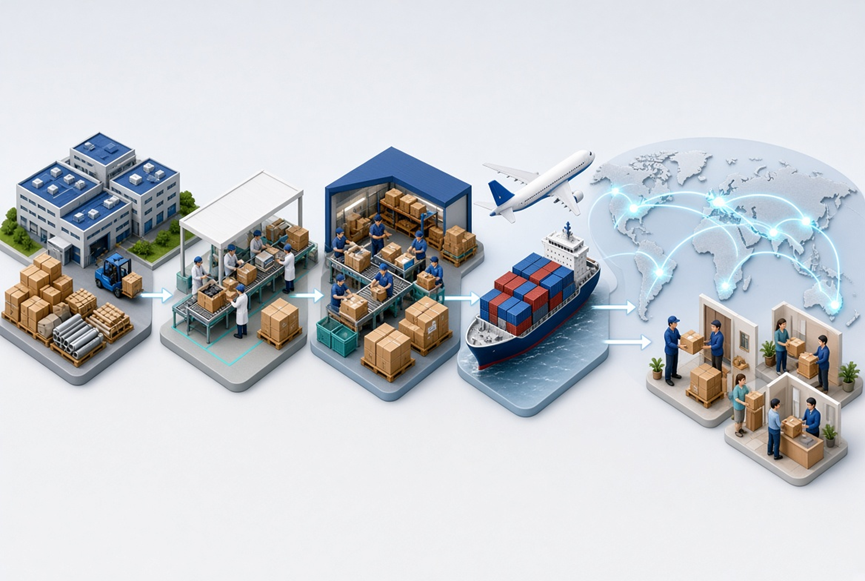
Use one dependable supply-chain workflow for inventory checks, quality control, order processing, packaging, tracking, and international delivery across both channels.
For Looperbuy, this model creates a strong value proposition: global sellers can source China-made goods without carrying large amounts of stock, managing a warehouse, handling fragmented supplier payments, or coordinating individual international shipments themselves.
A centralized sourcing and fulfillment workflow can help merchants:
– Reduce the risk of selling products that are unavailable.
– Consolidate products from multiple suppliers into one shipment process.
– Check product condition before dispatch.
– Use custom, neutral, or branded packaging where available.
– Improve consistency in tracking and order-status communication.
– Expand product testing without committing to large inventory purchases.
– Support multichannel selling without running separate manual workflows for every order.
How to Choose Between eBay and Shopify
Choose eBay dropshipping if you:
– Need access to existing buyer traffic.
– Want to test a niche or product category quickly.
– Have limited resources for advertising and web development.
– Prefer a marketplace structure with established buyer trust.
– Can meet marketplace standards for shipping, service, and inventory accuracy.
Choose Shopify dropshipping if you:
– Want to build a business under your own domain and brand.
– Plan to invest in content, paid media, email, creators, or social commerce.
– Need greater control over product presentation and checkout experience.
– Want to create bundles, subscriptions, upsells, or loyalty systems.
– See repeat purchase and customer lifetime value as strategic priorities.
Choose both eBay and Shopify if you:
– Have a reliable sourcing and fulfillment partner.
– Can maintain accurate inventory across multiple channels.
– Want marketplace demand plus direct-to-consumer brand growth.
– Need to diversify revenue rather than depending entirely on one platform.
Start Selling With a More Reliable Supply Chain
The best platform cannot compensate for poor sourcing, inaccurate stock data, slow processing, or inconsistent international delivery. Whether you sell through eBay, Shopify, or both, your ability to deliver the promised product on time is what protects reviews, repeat purchases, and long-term profit.
Looperbuy helps global B2B sellers source products from China, purchase without excessive stock commitments, coordinate fulfillment, and ship orders internationally. If you are ready to test products, expand your catalog, or simplify your cross-border operations, build your selling strategy around a sourcing and fulfillment process that can scale with you.
Start by selecting a focused product category, validating demand, and creating a dependable fulfillment workflow before increasing ad spend or listing volume.
FAQs
1. Is eBay or Shopify better for beginners in dropshipping?
eBay is often easier for beginners who need immediate access to marketplace shoppers and want to test product demand quickly. Shopify is usually better for beginners who are prepared to build a store, learn traffic generation, and develop a long-term brand. The better option depends on whether your first priority is marketplace sales or brand ownership.
2. Is dropshipping allowed on eBay?
Yes, eBay permits dropshipping when the seller fulfills orders directly through a wholesale supplier. However, buying a product from another retailer or marketplace after an eBay sale and having that retailer ship directly to the buyer is not allowed. The seller remains responsible for delivery performance and buyer satisfaction.
3. Can I sell on eBay and Shopify at the same time?
Yes. Many sellers use eBay for marketplace discovery and Shopify for brand building. The critical requirement is accurate inventory synchronization and a fulfillment process that can reliably process orders from both channels.
4. Do I need inventory to sell on Shopify?
Not necessarily. A dropshipping model lets you sell products without purchasing and storing all inventory in advance. However, you still need a reliable supplier or sourcing partner that can confirm stock, prepare orders, conduct quality checks when needed, and arrange delivery to customers.
5. Which platform gives me more control over my brand?
Shopify provides significantly more brand control. You can manage your domain, store design, product pages, content, promotions, customer experience, and marketing channels. eBay gives you access to an existing marketplace audience but offers less control over the overall customer environment.
6. What is the biggest risk in cross-border dropshipping?
The biggest risk is promising customers a product, price, or delivery timeline that your supply chain cannot consistently support. Sellers should verify supplier reliability, stock availability, packaging requirements, delivery routes, tracking quality, return procedures, and product compliance before scaling.
7. How can Looperbuy support an eBay or Shopify seller?
Looperbuy can support the operational side of selling by helping merchants source China-made products, reduce the need for large inventory purchases, coordinate order fulfillment, consolidate supplier workflows, and arrange international shipping. The exact process should be aligned with the seller’s product category, target country, packaging requirements, and sales channels.
References
1. Doba. “[Comparing eBay vs Shopify for Dropshipping: Key Differences & Choosing the Best].” Provides the foundation for comparing listing control, marketplace traffic, automation, sourcing, costs, and multichannel selling.
2. eBay. “[Store Selling Fees].” Explains that eBay charges a final value fee based on the total sale amount plus a per-order fee.
3. eBay Community. “[Understanding Dropshipping (Product Sourcing) Policy with eBay].” States that wholesale-supplier dropshipping is allowed, while purchasing from another retailer or marketplace to ship directly to an eBay buyer is not allowed.
4. Shopify Help Center. “[Pricing Plans].” Provides official guidance on Shopify plans, plan costs, and transaction-fee considerations.
5. Wix. “[How Much Does It Cost to Sell on eBay?].” Offers additional context on category-dependent final value fees and per-order charges.
6. Nventory. “[eBay Dropshipping Guide: Start & Scale].” Provides supplementary discussion of seller responsibility, handling times, supplier requirements, and customer-service obligations.