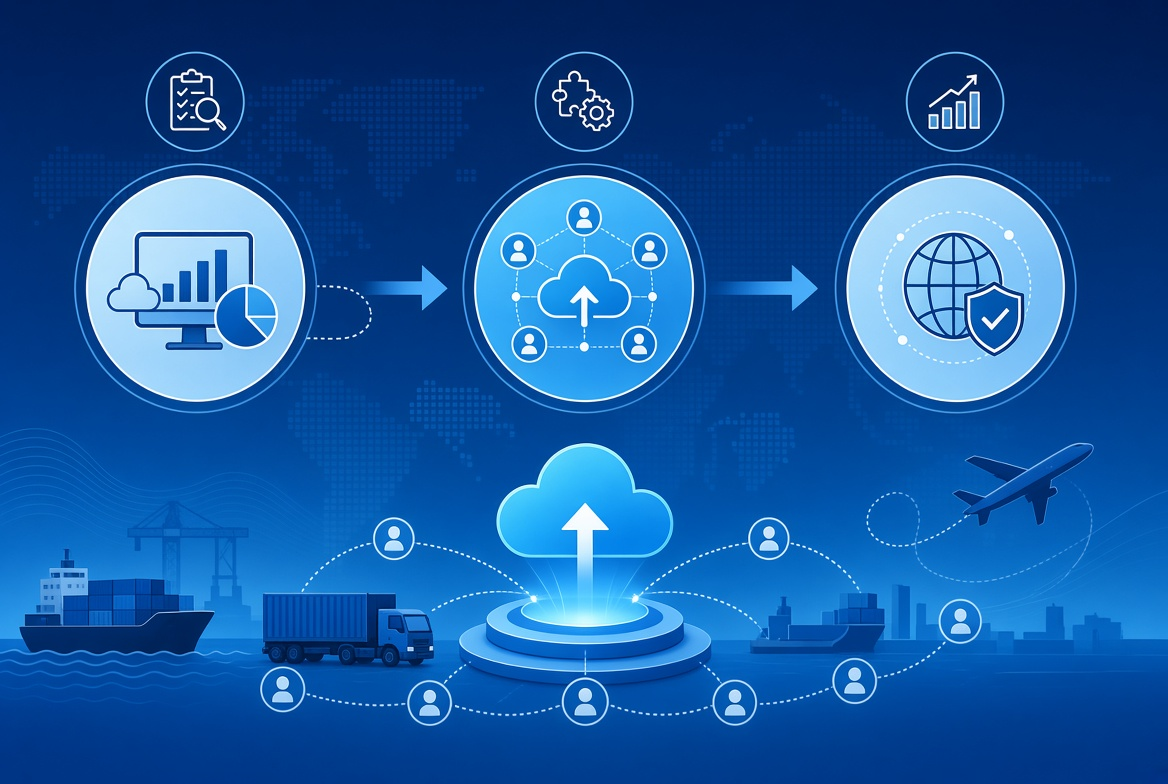
A B2B multicloud platform can help global commerce businesses improve reliability, fulfillment visibility, data control, and operational flexibility. This practical guide explains multicloud architecture, implementation risks, platform-selection criteria, security priorities, and a 90-day plan for sourcing and cross-border fulfillment operations.
For global B2B sellers, a multicloud platform is no longer only an IT decision. It is a practical way to keep procurement, inventory visibility, order fulfillment, payments, and customer-facing systems available as the business scales across markets.
From an operations perspective, the goal is not to use more cloud providers for its own sake. The goal is to build a reliable digital foundation that helps merchants source products from China, manage orders efficiently, and fulfill international demand without carrying unnecessary inventory or managing fragmented logistics workflows.
Table of Contents
What Is a B2B Multicloud Platform?
A B2B multicloud platform is a technology environment that uses services from more than one cloud provider to run applications, store data, process transactions, and support business operations.
Cloud computing allows organizations to access configurable computing resources—such as servers, storage, applications, and networks—on demand through the internet. The standard NIST definition also emphasizes rapid provisioning and release of resources with minimal management effort.
In a B2B commerce setting, those resources may support:
– Supplier and product information management
– Buyer accounts and negotiated pricing
– Order management and payment workflows
– Inventory synchronization
– Warehouse and fulfillment connections
– Shipping-label generation and tracking
– Customer support and reporting
– Data analytics and forecasting
For a platform such as Looperbuy, the business value is clear: the underlying infrastructure should help global sellers purchase Chinese products and arrange fulfillment without having to build their own warehousing, payment, or logistics-management stack.
Multicloud vs. Hybrid Cloud
These terms are often used together, but they are not identical.
| Model | What it means | Example in B2B commerce |
| Single cloud | One cloud provider hosts most applications and data | A seller portal, database, and analytics tools all run on one provider |
| Multicloud | Two or more cloud providers are used | One provider supports core applications, while another supports analytics, AI, or regional delivery |
| Hybrid cloud | Public cloud services connect with private cloud or on-premises infrastructure | A company keeps sensitive customer data in a private environment while using public cloud services for storefront traffic |
| Hybrid multicloud | Multiple public clouds plus private infrastructure | A large platform combines private data controls with services from several public-cloud providers |
The original multicloud discussion correctly identifies flexibility, performance, resilience, cost management, and security as potential benefits. However, the more important operational question is whether each cloud service has a defined role, owner, cost center, and recovery plan.
Why Multicloud Matters for B2B Sellers
Cross-border B2B commerce creates operational pressure that many domestic businesses never face. Orders may come from multiple countries, suppliers may use different data formats, shipping carriers operate on separate systems, and buyers expect real-time updates.
A well-designed multicloud environment can reduce friction across those moving parts.
Improve Business Continuity
A single provider outage can affect order creation, fulfillment status, product availability, or customer access. A multicloud architecture can reduce dependency on one environment by separating critical workloads.
For example, a B2B sourcing platform might keep its buyer-facing portal in one cloud environment while using another provider for backups, analytics, or notification services. If one system is disrupted, the entire operation is less likely to become unavailable.
This does not mean every application must be duplicated across several clouds. That approach can be expensive and difficult to maintain. Instead, businesses should identify their critical customer journeys:
1. Product discovery
2. Quote or order submission
3. Payment confirmation
4. Supplier processing
5. Shipment tracking
6. Customer communication
Then they should decide which services must remain available at each stage.
Support Regional Performance
Global sellers need fast, reliable access from different markets. Latency can make a portal feel slow, delay inventory updates, or create timeouts during checkout and order processing.
Different cloud providers have different regional strengths, infrastructure footprints, and services. A multicloud strategy may allow a business to locate workloads closer to users or integrate specialized delivery and edge services where they matter most.
The principle is simple: place workloads near the people, systems, and data they serve.
Avoid Operational Lock-In
Vendor lock-in occurs when moving an application, dataset, or workflow away from one provider becomes too difficult or expensive. It can limit negotiating power and slow down future expansion.
For B2B platforms, avoiding lock-in does not require avoiding all proprietary cloud services. It requires documenting dependencies before they become business risks.
A practical approach includes:
– Using API-first integrations between major business systems
– Keeping data models portable where possible
– Documenting custom integrations and workflows
– Maintaining export procedures for operational data
– Reviewing exit options during vendor selection
– Testing backup restoration rather than assuming it works
The Real Multicloud Challenge: Operational Complexity
Multicloud can improve flexibility, but it also introduces complexity. This is where many projects underperform.
The biggest risk is not usually a lack of cloud technology. It is a lack of governance across technology, finance, security, and operations.
Common Implementation Problems
– Different teams deploy services without shared standards
– Costs are reported separately by provider, making total spend unclear
– Identity permissions are inconsistent across environments
– Data is copied between systems without clear ownership
– Integrations become fragile as suppliers, carriers, and tools change
– Backup plans exist on paper but have not been tested
– Teams cannot identify which system supports a specific customer journey
A multicloud environment should therefore be treated as an operating model, not merely an infrastructure purchase.
A Practical Architecture for Sourcing and Fulfillment
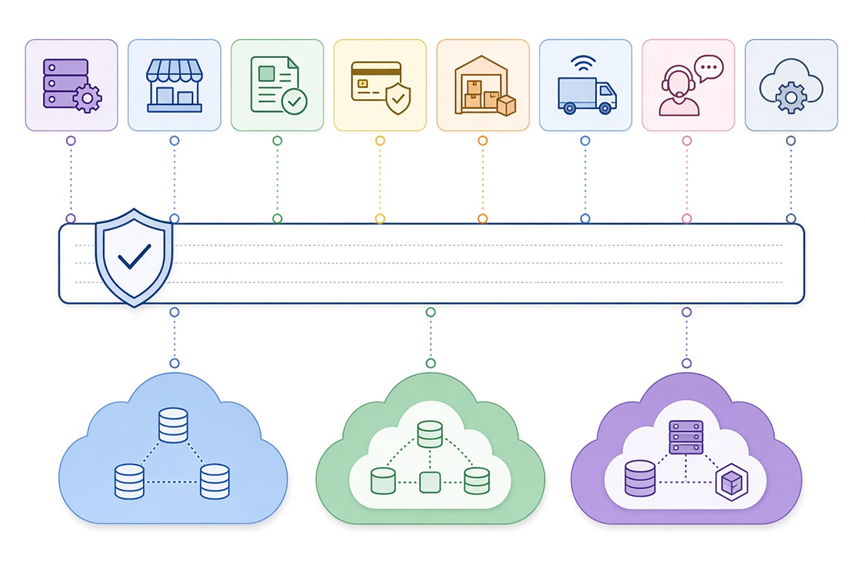
For a global sourcing and dropshipping platform, the best architecture is usually modular. Each component should perform a clear function and exchange data through controlled integrations.
Core Commerce Layer
The commerce layer manages the buyer experience. It may include customer accounts, product catalogs, pricing rules, quotes, order placement, and account-level permissions.
For B2B sellers, this layer should support more than a standard retail checkout. It should accommodate bulk orders, repeat purchases, negotiated terms, product variations, and business-specific approval workflows.
Product and Supplier Data Layer
Supplier data is often inconsistent. Product titles, specifications, images, packaging information, compliance documents, and stock signals may come from different sources.
This makes data normalization essential. Before product information reaches global buyers, the platform should apply consistent standards for:
– Product attributes and variants
– Minimum order quantities
– Packaging and carton details
– Lead times
– Quality-control requirements
– Shipping restrictions
– Country-specific documentation
For Looperbuy’s users, accurate product and fulfillment information is not just a content issue. It helps sellers make better purchasing decisions and communicate realistic delivery expectations to their customers.
Order, Warehouse, and Logistics Layer
This layer connects the commercial order to physical execution. It should manage order routing, supplier confirmation, quality checks, consolidation, packaging, shipping methods, tracking updates, and exceptions.
A platform becomes more valuable when merchants do not have to manually coordinate each step. The goal is to replace fragmented spreadsheets, messages, and carrier portals with one visible workflow.
Analytics and Decision Layer
Analytics should do more than report revenue. It should help teams identify operational bottlenecks.
Useful metrics include:
| Area | Questions to measure |
| Procurement | Which suppliers have the most reliable lead times? |
| Catalog | Which products generate interest but low conversion? |
| Fulfillment | Where do order delays occur most frequently? |
| Logistics | Which routes create the highest cost or longest transit time? |
| Customer service | What questions or complaints repeat most often? |
| Finance | Which costs are rising by supplier, country, or shipping method? |
How to Choose a B2B Multicloud Platform
Choosing a platform should begin with business requirements, not a vendor feature list.
The 2025 Flexera cloud research indicates that organizations continue to use multiple environments: 70% of surveyed respondents reported a hybrid-cloud strategy, and the average organization used 2.4 public-cloud providers. That adoption pattern makes governance and workload placement more important than simply selecting a popular provider.
Step 1: Map Your Business-Critical Workloads
List the systems that directly affect revenue, customer trust, and fulfillment.
For a sourcing platform, that may include:
– Buyer portal and product search
– Order creation and payment handling
– Supplier purchase-order workflows
– Warehouse management
– Shipping integrations
– Customer notifications
– Financial reporting and reconciliation
For each workload, define its acceptable downtime, data sensitivity, performance requirements, geographic needs, and recovery objective.
Step 2: Create a Data Ownership Map
Every important data category needs an owner and a source of truth.
For example:
– Product specifications: supplier-data team
– Buyer account data: customer platform
– Inventory status: warehouse or inventory service
– Order status: order-management system
– Shipment events: logistics integration layer
– Financial records: finance system
Without this map, teams can end up with conflicting versions of stock, pricing, shipment status, or customer information.
Step 3: Evaluate Integration Before Features
A platform may look strong in a demo but become difficult to operate if it does not integrate cleanly with existing systems.
Ask vendors:
1. Which APIs are available, documented, and actively maintained?
2. Can the platform exchange data in real time and in batches?
3. How are failed integrations monitored and retried?
4. Can we export our data in a usable format?
5. How are identity, permissions, and audit logs managed?
6. What support is available during an incident?
7. What service-level commitments apply to critical functions?
Step 4: Build Cost Visibility from Day One
Cloud spending can become unpredictable when each team launches services independently. FinOps research shows that organizations are expanding cost-management practices beyond public cloud to include SaaS, software licensing, private cloud, and data-center costs.
For B2B operators, this means viewing costs across the complete service chain:
– Cloud infrastructure
– Software subscriptions
– Data transfer
– Payment services
– Warehouse systems
– Carrier integrations
– Customer-support tools
– Security and monitoring services
Tag resources by product, team, customer region, or workflow. This makes cost decisions operational rather than speculative.
Security and Compliance by Design
Security in a multicloud environment depends on consistency. A secure provider does not automatically create a secure platform.
The most important controls include:
– Centralized identity and access management
– Multi-factor authentication for privileged users
– Least-privilege access policies
– Encryption in transit and at rest
– Security logging across all environments
– Regular vulnerability and configuration reviews
– Tested backup and recovery procedures
– Documented incident-response roles
Sensitive buyer data, payment-related information, supplier agreements, and operational reports should be classified before systems are integrated. The business should know where that data is stored, who can access it, how long it is retained, and what happens if a provider relationship ends.
A 90-Day Multicloud Action Plan
A full migration is not the best starting point for most B2B businesses. A focused 90-day program can produce a clearer roadmap with less disruption.
Days 1–30: Assess
– Inventory current applications, integrations, and data stores
– Identify critical customer and fulfillment journeys
– Document cloud providers, contracts, and service-level agreements
– Review monthly cost reports and unexplained expenses
– Identify major security and recovery gaps
Days 31–60: Design
– Define workload-placement principles
– Establish data ownership and integration standards
– Create identity, logging, and monitoring requirements
– Select one high-value pilot workflow
– Set baseline metrics for performance, costs, and errors
Days 61–90: Pilot and Improve
– Launch the pilot with clear rollback procedures
– Monitor availability, speed, errors, and cost
– Test backup restoration and incident escalation
– Collect feedback from operations, customer support, and users
– Document lessons before expanding to more workloads
A good pilot might focus on synchronizing supplier inventory, automating shipment-status notifications, or consolidating fulfillment reporting. The right choice is the workflow that currently creates the most manual work or customer uncertainty.
Build a More Resilient Commerce Operation
A B2B multicloud platform should make commerce operations easier to run, not harder to understand. The strongest strategy connects technology choices to measurable business outcomes: reliable ordering, better supplier coordination, clearer costs, faster fulfillment visibility, and a better experience for global sellers.
Looperbuy helps B2B merchants source goods from China and arrange fulfillment without taking on unnecessary inventory, warehouse operations, payment complexity, or logistics administration. If your business needs a more flexible procurement and fulfillment workflow, start by mapping the systems that affect your orders today—and identify where a connected platform can remove friction.
Ready to simplify your China sourcing and dropshipping workflow? Explore how Looperbuy can support product procurement, order fulfillment, and global delivery coordination for your B2B business.
FAQ
1. What is a B2B multicloud platform?
A B2B multicloud platform uses services from two or more cloud providers to support business functions such as commerce, data management, analytics, fulfillment, and customer service.
2. Is multicloud the same as hybrid cloud?
No. Multicloud means using multiple cloud providers. Hybrid cloud means connecting public-cloud services with private or on-premises infrastructure. A business can use both approaches together.
3. Why would a B2B sourcing platform use multicloud?
It can improve resilience, support regional performance needs, enable specialized services, reduce reliance on one provider, and create flexibility as supplier, fulfillment, and buyer operations expand.
4. Does multicloud always reduce costs?
Not automatically. It can create savings through better workload placement and vendor choice, but it can also increase costs through data transfer, duplicate tools, integration work, and fragmented billing. Cost governance is essential.
5. What should global sellers prioritize first?
Start with workflows that directly affect buyers: product data accuracy, order processing, payment confirmation, shipment tracking, and customer communication. Technology choices should strengthen these experiences.
6. How can Looperbuy help sellers avoid inventory risk?
Looperbuy’s sourcing and fulfillment model can help sellers purchase products from China and arrange order fulfillment without building their own warehouse operation or holding large volumes of inventory in advance.
References
1. Virto Commerce. “[Learn How to Use B2B Multicloud Platform for Your Business].” Accessed August 2026.
2. National Institute of Standards and Technology. “[SP 800-145: The NIST Definition of Cloud Computing].”
3. Flexera. “[The Latest Cloud Computing Trends: Flexera 2025 State of the Cloud Report].”
4. SoftwareOne. “[Making Sense of Multi-Cloud: Flexera 2025 State of the Cloud Recap].”
5. FinOps Foundation. “[The State of FinOps Report 2025].”