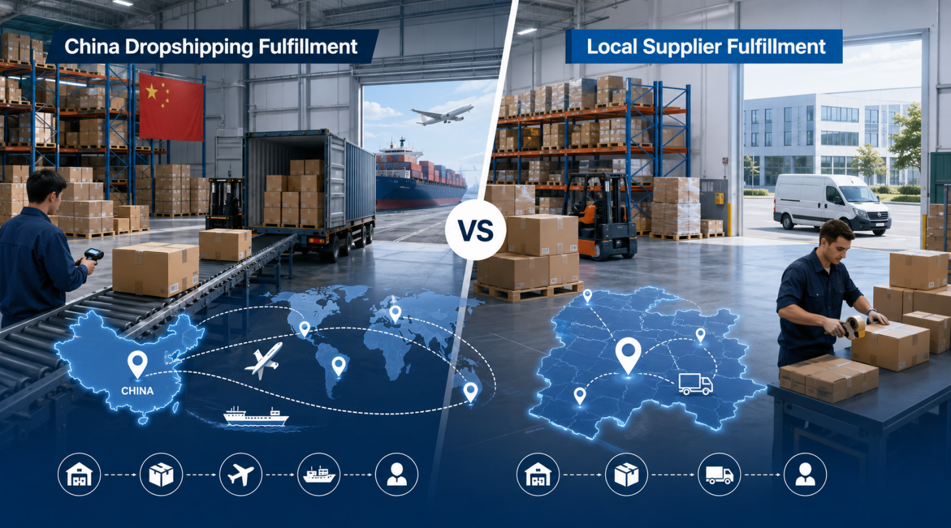
China dropshipping suppliers and local suppliers each have clear advantages in 2026. Local suppliers are usually faster, but China suppliers offer lower costs, wider product selection, and better scaling potential. This article compares both models with practical shipping benchmarks and expert guidance.
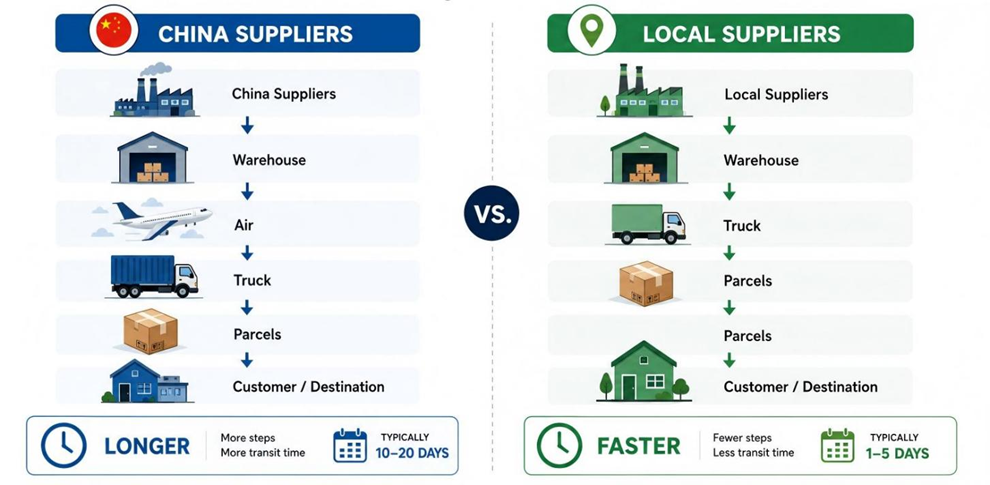
If you sell to global customers, shipping speed is no longer a small operational detail. It affects conversion rate, refund rate, customer trust, and ad performance.
That is why the question “China dropshipping suppliers vs local suppliers: which is faster in 2026?” matters so much. In simple terms, local suppliers are usually faster for domestic orders, while China dropshipping suppliers can be competitive when they use overseas warehouses or premium shipping lines.
For B2B sellers and cross-border merchants, the real decision is not only about speed. It is about speed, margin, product variety, inventory risk, and the ability to scale.
Table of Contents
Short Answer: China VS Local
If your top priority is fast delivery, local suppliers usually win. Most U.S.-based dropshipping suppliers ship within 2–5 business days, while standard cross-border shipping from China is often much slower.
However, China suppliers are still powerful in 2026 because they offer:
– Lower unit costs.
– Huge product variety.
– Stronger customization options.
– Better scalability for testing and sourcing.
– Faster delivery than before when using regional warehouses or priority lines.
So the fastest option depends on your setup. If a China supplier has stock in a U.S. or EU warehouse, it may rival or even beat a weak local supplier.
What “Fast” Means
Many sellers compare supplier speed too narrowly. In 2026, “fast” includes more than transit time.
It includes:
– Processing time.
– Warehouse location.
– Carrier handoff speed.
– Customs clearance.
– Tracking accuracy.
– Inventory stability.
A supplier that ships in 5 days but needs 3 days to process orders is not truly fast. That is why experienced sellers measure the entire fulfillment chain, not just the shipping label.
Clearest Comparison: China vs Local
| Factor | China Dropshipping Suppliers | Local Suppliers |
| Delivery speed | Medium to fast, depending on route and warehouse | Usually fastest |
| Product cost | Lower | Higher |
| Product variety | Very wide | More limited |
| Branding/customization | Strong | Varies |
| Customs friction | Higher if shipping direct | Lower |
| Customer trust | Can be weaker if shipping is slow | Usually stronger |
| Scaling potential | Excellent | Good, but often more expensive |
The takeaway is simple: local suppliers win on speed, but China suppliers win on sourcing leverage.
Why Local Suppliers Are Faster
Local suppliers are usually faster because the product is already inside the customer’s market. That reduces distance, customs risk, and delivery handoffs.
Speed advantages of local suppliers
– Shorter shipping distance.
– Fewer customs delays.
– Faster domestic carrier delivery.
– More predictable delivery windows.
– Simpler returns and exchanges.
This is why local suppliers often create a better customer experience in mature markets like the U.S. and EU. In many cases, customers are willing to pay more when they see 2–5 day delivery instead of waiting 2–3 weeks.
Where local suppliers can fall short
Local suppliers are not always the best strategic choice. They may offer:
– Higher product prices.
– Smaller SKU depth.
– Less OEM/ODM flexibility.
– Fewer niche product options.
– Less sourcing power for scaling brands.
For many brands, local sourcing is great for speed, but not always ideal for margin or product innovation.
Why China Suppliers Still Matter
China remains one of the most important sourcing hubs in global commerce. In 2026, many China dropshipping suppliers are no longer limited to slow standard shipping. More of them now use regional warehouses, priority shipping lines, and improved logistics networks.
China supplier strengths
– Lower sourcing cost for many categories.
– Massive product selection.
– Direct access to manufacturers.
– Better private-label and branding opportunities.
– Flexible fulfillment models for global sellers.
From a strategist’s point of view, China is often the best place to test products, source winning SKUs, and build supplier relationships.
Real Shipping Benchmarks
The real-world speed gap in 2026 looks more like this:
| Supplier type | Typical shipping time | Best use case |
| Local suppliers | 2–5 days | Domestic eCommerce, premium CX |
| China supplier with overseas warehouse | 4–10 days | Faster cross-border fulfillment |
| China supplier with priority line | 6–12 days | Global scaling and product testing |
| Standard China shipping | 10–30+ days | Low-cost testing and price-sensitive products |
China shipping is improving, but standard direct shipping is still usually slower than domestic fulfillment. Priority lines and stocked warehouses are the reason many China-based suppliers can now offer 7–15 day delivery to major markets.
When China Can Be Fast
China suppliers can be surprisingly fast when the fulfillment model is optimized.
China can compete on speed when you use:
– U.S., EU, or UK warehouses.
– Dedicated shipping lines.
– Pre-stocked bestsellers.
– Hybrid fulfillment models.
– Reliable sourcing agents or fulfillment partners.
In practice, a China supplier with stock in Los Angeles or New Jersey can be faster than a local supplier with poor warehouse processes. So the real comparison is often well-run fulfillment vs weak fulfillment, not just China vs local.
Best Model by Business Type
Choose China suppliers if you need:
– Lower cost per unit.
– More product variety.
– Branding and customization.
– Factory access.
– Product testing at scale.
Choose local suppliers if you need:
– Fast domestic delivery.
– Simpler returns.
– Higher customer trust.
– Better conversion for time-sensitive products.
– Premium brand positioning.
Choose a hybrid model if you want:
– Low sourcing cost and fast delivery.
– Better control over bestsellers.
– Safer scaling.
– Multiple market coverage.
For many Looperbuy users, the hybrid path is the smartest one: source from China, then move winners closer to the customer.
Expert Framework
Here is a practical way to decide.
1. Define your target market
Are you selling mainly in the U.S., EU, or globally?
2. Set your delivery promise
Are you promising 3–5 days, 7–10 days, or 2–4 weeks?
3. Check warehouse location
Where is the stock actually stored?
4. Order samples
Do not trust claims without testing.
5. Compare landed cost
Include product price, shipping, duties, packaging, and refund risk.
6. Measure customer experience
Speed only matters if it improves conversion and reduces complaints.
This framework prevents the common mistake of choosing the cheapest supplier and paying for it later through bad reviews and lost ad efficiency.
Industry Insight for 2026
The market in 2026 is moving toward faster expectations and tighter fulfillment discipline. Domestic suppliers are still the easiest way to guarantee quick delivery, but China suppliers are closing the gap through better logistics infrastructure and regional warehousing.
From an operations perspective, that means:
– Local suppliers are the safest choice for speed.
– China suppliers are often the best choice for sourcing power.
– Hybrid supply chains are the best choice for scale.
This is especially relevant for B2B sellers serving multiple regions.
Practical Speed Checklist
Before choosing a supplier, confirm these items:
– Processing time.
– Real warehouse location.
– Tracking method.
– Average delivery time by destination.
– Inventory stability.
– Return and refund policy.
– Shipping line quality.
– Customs handling method.
If a supplier cannot answer these questions clearly, it is a warning sign.
If your business wants both speed and margin, the best move is not choosing one model forever. It is building a supply chain that lets you test with China, validate with data, and scale with local or hybrid fulfillment.
FAQ
1. Are China dropshipping suppliers always slower than local suppliers?
No. Standard direct shipping from China is usually slower, but China suppliers with overseas warehouses or fast shipping lines can be highly competitive.
2. Are local suppliers always more expensive?
Usually yes. But if local suppliers reduce refunds, chargebacks, and customer complaints, the total cost may actually be lower.
3. Which is better for a new store in 2026?
If speed is your top goal, start local. If you want lower costs and wider product variety, start with China and move winners to faster fulfillment later.
4. Can a China supplier deliver in 7 days?
Yes, if stock is already in a regional warehouse or the supplier uses a premium shipping line.
5. What is the best strategy for scaling?
Use China for sourcing and testing, then shift best-selling products into local or hybrid fulfillment once demand is proven.
6. How do I reduce shipping complaints?
Be transparent about delivery times, use tracked shipping, test sample orders, and choose suppliers with stable inventory and clear processing times.
References
1. Ichiba OnePlatform Team. 17 Fastest Dropshipping Suppliers for 2026. [ichiba]
2. FFOrder Team. 11 Best Dropshipping Suppliers in 2026: China, US & EU Compared.[fforder]
3. Importify. Best Dropshipping Suppliers in 2026: 25+ Compared. [importify]
4. Dropship China Pro. Dropshipping from China Guide: Find Reliable Suppliers. [dropshipchinapro]
5. Easync. 14 Best China Dropshipping Suppliers in 2026, Verified & Reviewed. [easync]
6. TopDawg. Best U.S. Dropshipping Suppliers (2026). [topdawg]
7. Inventory Source. Best Dropshipping Platforms in 2026 – Full Comparison. [inventorysource]
8. CJdropshipping. How To Start Dropshipping From China? (2026). [cjdropshipping]