Learn how Temu really treats dropshipping, why accounts get banned, and how serious B2B sellers can safely use Temu only for product research while shifting fulfillment to professional sourcing and logistics partners for long-term stability.
Temu is not designed or officially approved for dropshipping, and many sellers have seen their accounts restricted or banned because they treated Temu like a “normal” supplier instead of a consumer-facing marketplace. From my own experience supporting B2B brands and sourcing teams, I see Temu as a short-term testing ground at best—and only if you’re very deliberate about how you manage risk, accounts, and logistics. [cjdropshipping]
Table of Contents
What This Guide Covers
In this guide, I will walk you through:
– How Temu really treats dropshipping (beyond the marketing hype) [autods]
– The main reasons Temu accounts get restricted or banned [reddit]
– Practical tactics to minimize risk if you still use Temu in your workflow [salehoo]
– Why serious B2B sellers eventually move to professional sourcing and fulfillment partners (such as Looperbuy) instead of relying on Temu for order fulfillment [que-dalle]
Along the way, I will share the perspective of a B2B procurement and logistics strategist, translating platform rules into operational steps your team can actually implement.
Is Temu Dropshipping Allowed?
Temu’s official documentation and support materials make one point clear: Temu is a consumer marketplace, not a wholesale dropshipping supplier. [youtube]
– Temu doesn’t provide an official “dropshipping mode” or business account specifically designed for resellers. [cjdropshipping]
– Some sources note that while Temu does not explicitly mention “dropshipping” as a supported model, its policies and risk controls flag behavior that looks like reselling as suspicious. [autods]
From a risk management perspective, this means:
– You can technically place orders and ship to different addresses (including your customers), but Temu may treat that pattern as abnormal and apply stricter checks. [reddit]
– You must assume that your account, coupons, and even pending orders can be frozen at any time if their systems detect unusual behavior. [youtube]
Key takeaway: Temu is useful as a product research and price benchmarking tool, not as the backbone of a B2B dropshipping business. [salehoo]
Why Temu Accounts Get Banned
Most sellers who lose their Temu accounts experience a mix of policy misunderstandings and aggressive scaling. Based on platform policies and user reports, the main triggers include: [youtube]
– Abnormal ordering patterns
– Many small orders shipped to many different addresses in a short time window. [cjdropshipping]
– Sudden spikes in order volume without a prior history.
– Misuse of coupons and referral rewards
– Stacking promotions, creating multiple accounts, or abusing referral programs. [youtube]
– Suspicious payment activities
– Frequent declines, chargebacks, or mismatched billing details. [globalsources]
– Excessive refunds and returns
– High rates of disputes, refund requests, or “item not received” claims. [youtube]
– Use of risky IPs or devices
– Logging in via public proxies, low-quality VPNs, or dynamic IP pools that Temu already tags as high-risk.
Once an account is flagged, users report:
– Orders being cancelled or delayed without clear notice. [reddit]
– Temporary or permanent suspension, along with frozen rewards or coupons. [youtube]
The Hidden Risks of Relying on Temu for Fulfillment
From a B2B buyer’s standpoint, the bigger issue is not just getting banned—it’s the operational instability that comes with building your business on a retail platform. [salehoo]
1. Unpredictable lead times
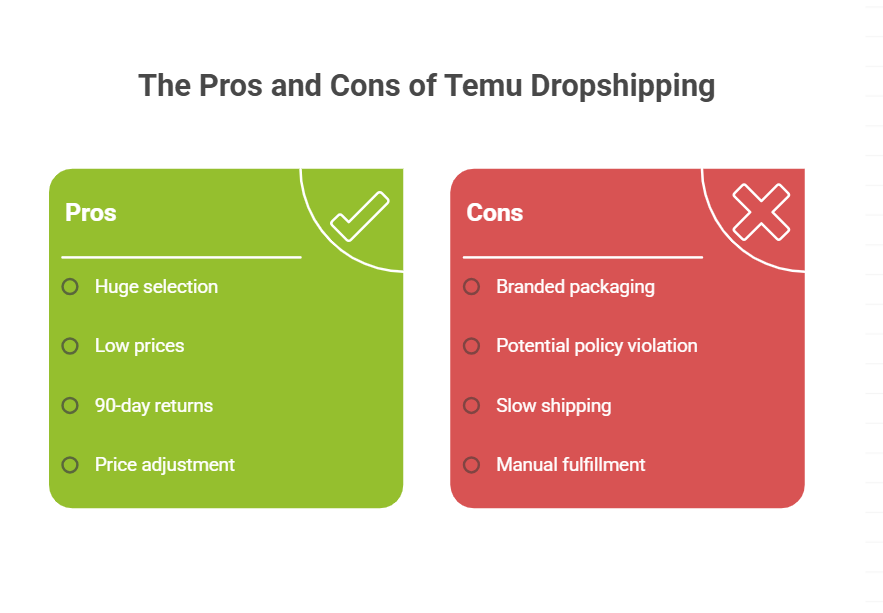
– Temu shipping times can vary significantly by product, warehouse, and season. [que-dalle]
– This makes it hard to offer reliable delivery promises to your customers.
2. Branding and customer perception
– Temu-branded packaging or invoices can reveal your product cost and source, eroding trust with customers who realize they could buy directly. [dailyfulfill]
3. Limited control over quality
– You rely on third-party sellers with variable quality standards and packaging. [globalsources]
– Inconsistent quality translates directly into returns, negative reviews, and support overhead for your own store.
4. Compliance and tax complexity
– Policy changes around import thresholds and de minimis rules have already reshaped the economics of low-cost imports in some markets. [globalsources]
– A model that “works” one quarter may be unprofitable the next if shipping, duties, or taxes shift.
For long-term B2B growth, this is the opposite of what you want.
Safer Use Case: Temu as a Product Research Tool
Many experienced sellers now treat Temu as a market intelligence tool, not as their primary supplier. [que-dalle]
You can:
– Scan Temu for trending items, price points, and customer sentiment (especially negative reviews). [salehoo]
– Use filters to identify products with strong ratings and consistent demand, then look for equivalent or better options from professional suppliers. [que-dalle]
Once you identify a winning product, the next step is to transition to a reliable B2B procurement partner instead of continuing to ship from Temu.
Practical Ways to Reduce Temu Account Risk
If you still decide to incorporate Temu into your workflow, you need a clear operational framework to minimize account issues.
1. Keep Your Temu Profile “Normal”
Temu’s risk systems are built to detect non-consumer behavior. To stay under the radar: [52by]
– Avoid creating multiple accounts on the same device or IP.
– Keep your name, address, and payment details consistent and real.
– Do not aggressively rotate IPs using free proxies or shared VPNs; these are often flagged as “high-risk” segments.
2. Avoid Aggressive Coupon and Referral Tactics
Temu’s promotional system is designed for genuine shoppers, not resellers. [cjdropshipping]
– Don’t use automated scripts or fake accounts to farm coupons or referral credits.
– Avoid patterns that look like system gaming—for example, repeated small orders just to trigger promo benefits. [youtube]
3. Control Order Volume and Frequency
Large bursts of small, multi-address orders are one of the strongest red flags. [reddit]
– Cap daily orders on a single Temu account and avoid sudden jumps in volume.
– If you need to fulfill many orders, consider consolidating them into bulk purchases sent to a warehouse or 3PL instead of direct-to-customer shipments. [pipiads]
In practice, this means:
– Use Temu to buy test batches (for example, 25–100 units) delivered to a central location. [pipiads]
– Re-ship from a warehouse or fulfillment partner under neutral or custom branding.
4. Use Stable Devices, IPs, and Payment Methods
Platform-level risk engines rely heavily on device and network signals. [52by]
– Access Temu from a limited set of trusted devices and networks.
– Use established payment methods with consistent billing details. [globalsources]
– Avoid logging in through public Wi-Fi, cybercafés, or random VPN endpoints.
5. Monitor Orders and Disputes Proactively
High refund and dispute rates are strong signals of unusual behavior. [cjdropshipping]
– Carefully set customer expectations for delivery times and product quality.
– Handle customer issues through your own policies first when appropriate, rather than pushing all disputes back to Temu.
– Track your refund patterns; if you see a spike, slow down orders until you stabilize.
The Professional Alternative: Dedicated B2B Sourcing and Fulfillment
For global B2B sellers who want to scale without living in fear of account bans, the more strategic path is to build your supply chain around professional partners, not retail marketplaces. [dailyfulfill]
A dedicated sourcing and fulfillment platform (such as Looperbuy) typically offers:
– Verified factories and suppliers instead of anonymous marketplace sellers. [ileeline]
– Consolidated procurement from multiple Chinese vendors into a single, managed workflow.
– Warehouse-based fulfillment where products are stored, inspected, and shipped in neutral or customized packaging. [dailyfulfill]
– Order-level tracking, multi-channel integration, and stable logistics options matched to your target markets. [dailyfulfill]
Operationally, this is what a more resilient setup looks like:
1. Use platforms like Temu only to identify product ideas and reference price ranges. [salehoo]
2. Work with a sourcing partner to find equivalent or better products from Chinese manufacturers or wholesalers.
3. Ship in bulk to a central warehouse or China-based 3PL for consolidation, quality checks, and neutral packaging. [pipiads]
4. Fulfill orders globally with consistent transit times and predictable cost structures.
You’re no longer fighting against platform rules; you’re building on infrastructure that was actually designed for B2B use.
Case Study: Moving from Temu-Based Orders to a Stable Supply Chain
To illustrate how this transition works in real life, let’s walk through a simplified scenario based on typical B2B clients.
Phase 1 – Temu as a test channel
– A seller uses Temu to identify a trending gadget with strong demand and low cost. [que-dalle]
– They place a small number of test orders direct-to-customer and quickly discover inconsistent delivery times and Temu-branded packaging.
Phase 2 – Controlled bulk buying
– The seller orders a batch of 50–100 units from Temu to their own address or a 3PL warehouse. [pipiads]
– They inspect products, photograph them, and ship to customers under their own brand.
Phase 3 – Transition to B2B sourcing
– Using the validated product data (conversion rates, return rates, customer feedback), the seller works with a sourcing partner to find a manufacturer or stable Chinese supplier. [ileeline]
– Orders are now consolidated, packaging is neutral, and logistics are optimized per destination.
At this point, Temu has served its purpose as a validation tool, and the business is no longer at the mercy of its account policies.
How a Platform Like Looperbuy Fits Into This Strategy
From a B2B perspective, the friction points you face with Temu—unstable rules, consumer-focused policies, lack of branding control—are exactly what a procurement platform like Looperbuy is built to solve. [dailyfulfill]
With a dedicated sourcing partner, you can:
– Reduce inventory and warehousing risk by leveraging just-in-time procurement and fulfillment.
– Lower total logistics cost through route-optimized shipping and consolidated packaging.
– Protect your brand by eliminating marketplace packaging and invoices from your customers’ orders. [reddit]
– Scale safely because your supply chain is aligned with B2B needs rather than consumer app rules.
If your goal is to build a sustainable international business—not just test a side project—this shift from retail marketplaces to professional procurement is the real inflection point.
Action Checklist for B2B Sellers
To wrap up the practical side, here is a concise checklist you can apply:
1. Use Temu only for product and price discovery, not as your primary fulfillment engine. [salehoo]
2. If you still place orders, keep patterns as close to normal consumer behavior as possible.
3. Avoid coupon abuse, multi-account setups, and high-risk IP or device practices. [52by]
4. Shift validated products to bulk procurement and warehouse-based fulfillment as early as possible. [pipiads]
5. Partner with a dedicated B2B sourcing and fulfillment platform to build a stable, scalable supply chain. [que-dalle]
FAQs
1. Can I legally use Temu to fulfill orders for my own store?
Temu is built for consumer purchases, and its policies explicitly discourage using the platform as a dropshipping supplier, so you must accept elevated risk if you use it for order fulfillment. [youtube]
2. Why do some sellers still use Temu for dropshipping?
Some sellers take advantage of Temu’s low prices and catalog to quickly test product ideas, but most experienced operators move successful products to more stable suppliers once they see traction. [dailyfulfill]
3. How can I reduce the chances of my Temu account being banned?
Avoid abnormal ordering patterns, coupon abuse, risky IPs or devices, and excessive refund behavior, and keep your account details consistent and realistic.
4. What are better long-term alternatives to Temu for B2B sellers?
Professional sourcing platforms, verified Chinese suppliers, and 3PL-based fulfillment solutions provide more predictable logistics, better branding control, and fewer account-related risks. [globalsources]
5. When should I move from Temu to a dedicated sourcing partner?
As soon as a product proves demand and repeat sales, shifting to bulk procurement and warehouse-based fulfillment protects margins, brand perception, and operational stability. [pipiads]
References
1. Temu Dropshipping Guide 2026 – CJ Dropshipping[cjdropshipping]
2. Temu Dropshipping: A Step-by-Step Guide – SaleHoo[salehoo]
3. Cracking the Dropshipping Rules on Temu – Pipiads [pipiads]
5. Temu Dropshipping Policy Discussion – Reddit /r/dropship [reddit]
6. Ultimate Guide 2024: How to Dropship from Temu – Global Sources[globalsources]
7. Dropshipping From Temu In 2026 – DailyFulfill[dailyfulfill]
8. How to Succeed in Dropshipping with Temu – Que Dalle [que-dalle]
9. Temu Account Ban Explanation – Daily Tech Tutor (YouTube)[youtube]
10. Temu Dropshipping Overview – AutoDS[autods]