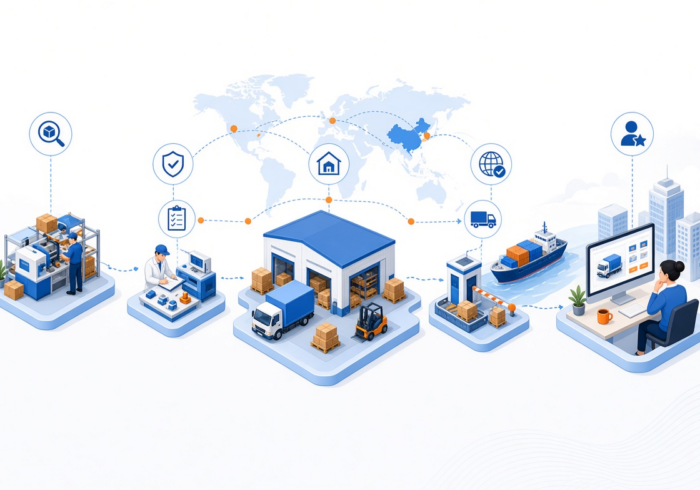
As a B2B supply chain strategist who has worked with distributors across North America, Europe, and Asia for over a decade, I have witnessed a fundamental shift in how successful distributors approach China sourcing. Gone are the days when distributors could rely on fragmented supplier relationships and manual logistics coordination. In 2026, the most resilient distributors are those embracing integrated, tech-driven sourcing solutions that turn complexity into competitive advantage.
Table of Contents
The $36 Trillion Opportunity That Every Distributor Must Seize
Let’s start with a number that should command every distributor‘s attention: $36 trillion. According to the International Trade Administration, the global B2B ecommerce market is projected to reach $36 trillion by 2026, growing at a 14.5% compound annual rate. More striking, an estimated 80% of B2B sales will be generated digitally by the end of 2025, compared to just 13% in 2019. For distributors, the message is clear: the digital transformation of B2B commerce is no longer optional.
Yet opportunity brings complexity. The same report reveals that only 20% of B2B sellers feel prepared for the future. The gap between market potential and operational readiness has never been wider—or more lucrative for those who bridge it.

Why Distributors Are Rethinking Their China Sourcing Strategy
The sourcing landscape has changed dramatically, even from just three years ago. Buyers are increasingly moving away from purely price-based decision-making and prioritizing supplier reliability over the lowest quotation, stable delivery schedules, consistent quality across batches, and clear accountability in execution. This shift reflects a harsh truth revealed by the 2025 Tariff Impact Report from Proton.ai: 42% of North American distributors remain in “wait and see” mode with no formal plans to adjust sourcing in response to tariffs. Those who plan ahead are outperforming those who react.
Multi-category sourcing has become the norm. More distributors are sourcing multiple product categories from China under a single project, driven by ecommerce expansion, faster product rotation cycles, and the need for supply chain consolidation. However, this approach requires coordinating dozens of suppliers rather than a single factory—a task that demands robust systems and local expertise.
Suggested image: Infographic showing the evolution of distributor sourcing models from single-factory to multi-category coordination, with LooperBuy‘s platform as the central integration layer.
The Hidden Costs of Traditional Sourcing Channels
Traditional platforms like Alibaba have long been the default choice for distributors, but they come with significant drawbacks: long delivery times, high shipping costs, and the persistent risk of disreputable suppliers. Even beyond these issues, informal sourcing methods—managing everything through messaging apps or relying on personal relationships—are increasingly risky. Buyers are shifting toward standardized workflows, documented processes, and centralized order tracking.
This is where one-stop B2B sourcing platforms like LooperBuy are redefining what distributors can achieve. Unlike traditional marketplaces that simply connect buyers with suppliers, LooperBuy provides end-to-end supply chain orchestration: from supplier verification and quality control to logistics consolidation and global delivery.
LooperBuy: A Distributor‘s Competitive Edge in Action
The fundamental advantage of a one-stop platform lies in its ability to eliminate friction across the entire procurement cycle. Here’s how LooperBuy delivers tangible results for distributors:
Supplier Verification at Scale. Finding legitimate, vetted suppliers remains the biggest challenge for distributors entering the Chinese market. LooperBuy’s verification process screens for factory capabilities, compliance certifications, production capacity, and export readiness—dramatically reducing the risk of fraud or quality failures.
Product Diversity Without Complexity. China‘s manufacturing ecosystem covers 90% of global B2B supply categories, from industrial components and electrical supplies to consumer goods and custom manufacturing parts. LooperBuy aggregates this diversity into a single sourcing interface, allowing distributors to expand product lines without managing dozens of supplier relationships.
Global Logistics at Lower Costs. Cross-border logistics has traditionally been a major pain point for distributors, with hidden fees, unreliable carriers, and complex customs documentation. LooperBuy’s integrated logistics network connects to over 200 major ports worldwide, offering competitive rates that Chinese suppliers achieve through economies of scale—typically 25-40% lower than European or North American alternatives.
Real Distributor Success: Verified Client Feedback
“After struggling with inconsistent quality from three separate Chinese suppliers, we moved our entire procurement to LooperBuy. Their quality control caught a major defect before shipment, saving us over $150,000 in potential returns. Now we source across 12 product categories through a single platform.” — Mark T., Industrial Distributor, Midwest USA
“Our biggest challenge as a European distributor was logistics coordination. LooperBuy consolidated shipments from eight different factories into one container, cutting our freight costs by 40% and reducing delivery times from six weeks to eighteen days.” — Sophie L., Wholesale Distributor, France
These testimonials reflect a broader trend: distributors who adopt integrated sourcing solutions consistently report lower operational costs, faster time-to-market, and stronger client relationships.
Suggested image: Before/after comparison graphic showing traditional fragmented sourcing (multiple suppliers, separate shipments, longer timelines) versus LooperBuy‘s consolidated model (single interface, unified logistics, faster delivery).
Navigating Tariffs and Trade Volatility in 2026
No discussion of distributor sourcing strategy is complete without addressing the tariff landscape. The U.S. imposed significant tariff increases on Chinese imports in 2025, including a 20% “fentanyl tariff” on all Chinese goods and sector-specific measures affecting EVs, solar components, steel, and aluminum. The EU has locked in tariffs on Chinese EVs and will enforce CBAM certificates from 2026 onward.
Yet not all news is negative for distributors. The U.S.-China “Geneva Truce” reduced certain reciprocal tariffs, and freight analytics firm Xeneta expects global average container spot rates to fall up to 25% in 2026 amid weak demand and excess vessel capacity. The key takeaway for distributors: proactive planning beats reactive scrambling. The 35% of distributors actively seeking new supplier arrangements are better positioned than the 20% simply raising prices on Chinese goods.
7 Actionable Steps for Distributors to Optimize China Sourcing
Based on my experience advising distributors across three continents, here are the essential steps to building a resilient sourcing operation:
- Audit your current supplier portfolio. Identify single points of failure and diversify across regions and categories.
- Prioritize supplier reliability metrics. Look for on-time delivery rates above 95% and documented quality control processes.
- Adopt multi-category sourcing. Consolidate procurement across product lines to reduce administrative overhead.
- Implement upstream quality control. Move beyond final inspections to pre-production confirmation and in-production checks.
- Leverage bonded warehousing. Use FTZs to defer tariff payments and maintain inventory flexibility.
- Digitize your procurement workflow. Shift from messaging apps and spreadsheets to centralized order tracking and documentation.
- Partner with a one-stop platform. LooperBuy handles verification, quality, logistics, and compliance—freeing you to focus on client relationships and market growth.
The Future of Distribution Belongs to Integrated Platforms
As global supply chains continue to evolve, the most successful distributors will be those who stop treating sourcing as a series of disconnected transactions and start approaching it as an integrated system. LooperBuy’s one-stop B2B sourcing platform embodies this philosophy: vetted suppliers, end-to-end quality control, consolidated logistics, and transparent documentation—all delivered through a single interface designed for distributors who value efficiency, reliability, and scale.
Whether you are a brand owner expanding into new categories, a wholesaler optimizing margins, or a manufacturer diversifying your supply base, the path to sustainable growth runs through smarter sourcing. Start your journey today.
Ready to transform your sourcing operation? Visit LooperBuy.com to schedule a consultation with our B2B sourcing specialists. Discover how thousands of distributors are already scaling their businesses with one-stop China sourcing.

References
- International Trade Administration, B2B Ecommerce Trends 2025-2026, www.trade.gov
- Market Union Group, China Sourcing Market Trends Every Global Buyer Should Understand, www.marketuniongroup.com
- Proton.ai, 2025 Tariff Impact Report, www.mdm.com
- DFDL, 2025 U.S. Tariff Revolution: Global Trade Impact & 2026 Outlook, www.dfdl.com
- Xeneta, US-China Truce Offers Little Relief for Container Freight Market, shipandbunker.com
- Shopify, Top 7 Alibaba Alternatives for Global Product Sourcing (2025), www.shopify.com
- LooperBuy Blog, Supplies Business: A B2B Expert’s Guide to Sourcing Chinese Goods Globally with LooperBuy, blog.looperbuy.com
Frequently Asked Questions (FAQ)
Q1: What makes LooperBuy different from other B2B platforms for distributors?
Unlike traditional marketplaces that only connect buyers with suppliers, LooperBuy provides a fully managed one-stop service including supplier verification, quality control, logistics consolidation, and export documentation. This means distributors can source across multiple categories through a single platform without managing dozens of individual supplier relationships.
Q2: How does LooperBuy handle quality control for large-volume distributor orders?
LooperBuy implements multi-stage quality control: pre-production sample approval, in-production inspections at key milestones, and pre-shipment final checks. All inspections follow documented protocols, and clients receive detailed reports with photos before any shipment leaves China.
Q3: Can small and medium-sized distributors benefit from LooperBuy‘s platform?
Absolutely. LooperBuy works with distributors of all sizes, from small regional wholesalers to large multinational brand owners. The platform’s consolidated logistics model is particularly valuable for smaller distributors, as it allows them to combine orders from multiple suppliers into single shipments—reducing freight costs that would otherwise be prohibitive.
Q4: How are distributors using LooperBuy to navigate current tariff challenges?
Forward-thinking distributors are using LooperBuy‘s consolidated sourcing to optimize product categories, leverage bonded warehousing for tariff deferral, and diversify across Chinese manufacturing regions. The platform’s transparent documentation also simplifies customs compliance and duty calculation.
Q5: What product categories can distributors source through LooperBuy?
LooperBuy covers the full spectrum of B2B supply categories: industrial components and machinery, electrical supplies and electronics, packaging materials, consumer goods, home and kitchen products, beauty and personal care, textiles and apparel, automotive parts, and custom manufacturing.
Article Summary
This expert guide for distributors covers 2026 China sourcing strategies, tariff navigation, logistics optimization, and one-stop B2B platform advantages. Includes market data ($36T B2B ecommerce by 2026), verified client testimonials, and actionable steps to future-proof supply chains.
Hot Tags
B2B sourcing, distributors China, wholesale procurement, supply chain optimization, China import guide, B2B platform, global logistics, tariff strategy, one-stop sourcing, LooperBuy