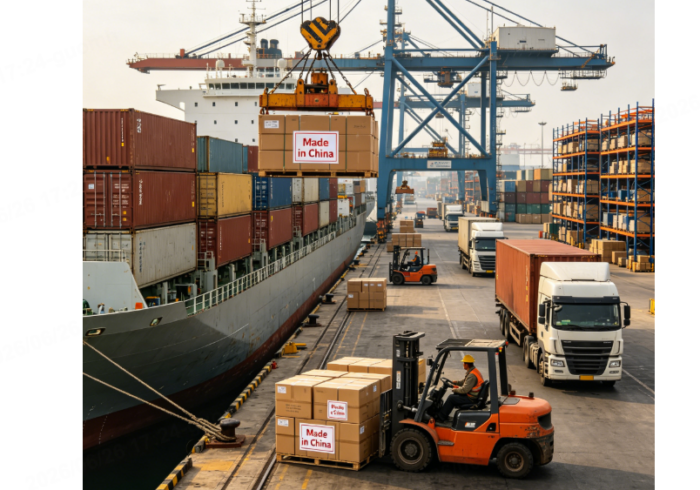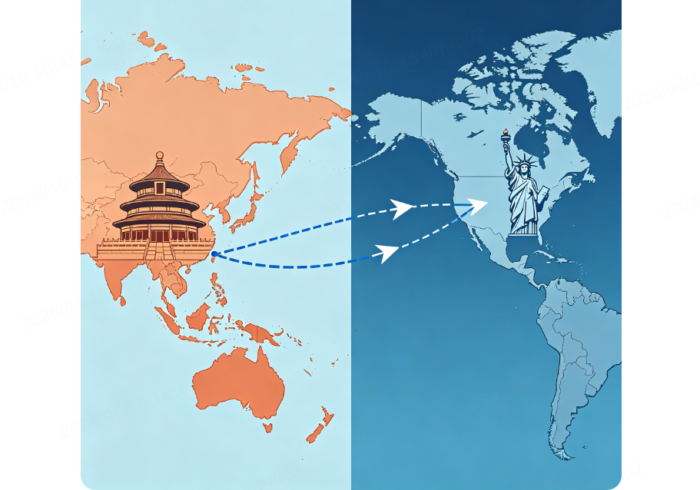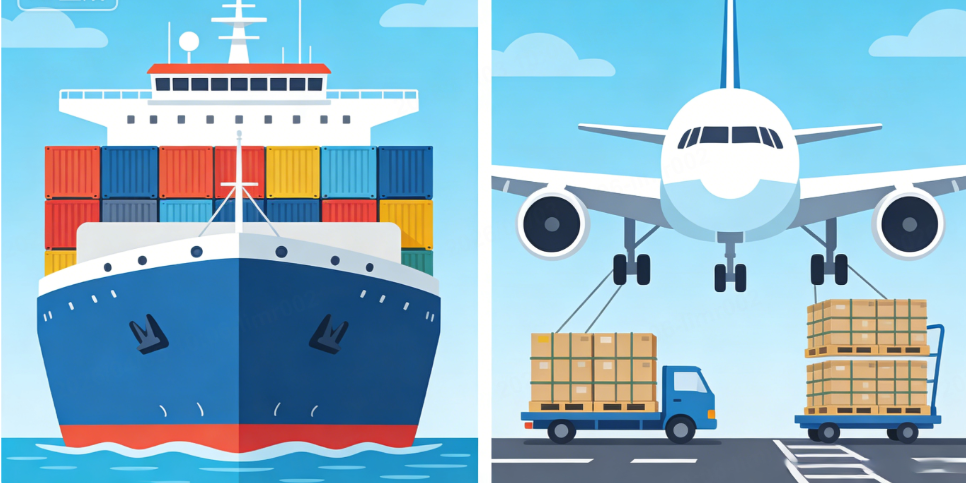
As a B2B sourcing and logistics strategist with over 15 years of experience helping global brand owners, wholesalers, and manufacturers move products from China, I’ve watched the ocean and air freight markets diverge like never before in 2026. DHL’s latest market analysis points to a widening gap between ocean and air freight trends, with ocean shippers facing continued volatility from capacity shifts and geopolitical disruptions, while air freight enjoys steady demand recovery and structurally constrained capacity in several lanes.[reference:0]
In this 2026 guide, I’ll break down the real costs, transit times, hidden pitfalls, and environmental impacts of ocean and air freight, show you how the Middle East crisis is reshaping both markets, and provide a practical framework to decide which mode—or combination—makes sense for your next shipment from China.
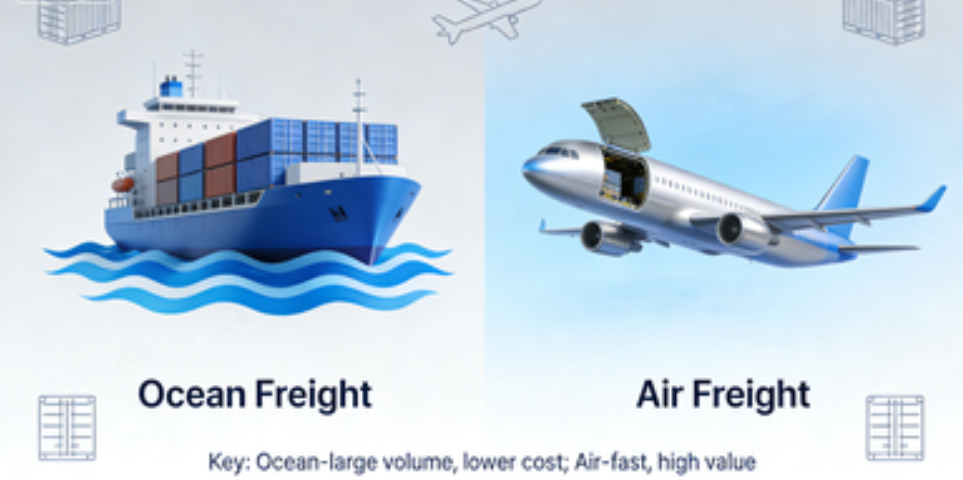
Table of Contents
Ocean and Air Freight: The 2026 Cost Reality
Let’s start with the numbers that matter. For March 2026, ocean and air freight rates tell two different stories.
Ocean Freight Rates (March 2026, China to USA)
- FCL 20ft container: $1,944–$2,376 (up 16% from February)
- FCL 40ft container: $2,205–$2,695 (down 16% from February)
- LCL (Less than Container Load): ~$110–$150 per cubic meter
- Ocean DDP all-in: $1.80–$3.20 per kg[reference:1][reference:2]
Air Freight Rates (March 2026, China to USA)
- Bulk air (≥1000 kg): ~$4.85 per kg across US gateways, up 13% from February
- General air freight: $4.50–$8.50 per kg
- Express courier (21–45 kg): $12.50–$15.00 per kg[reference:3][reference:4]
The raw gap: For a 1,000 kg shipment, ocean DDP costs roughly $1,800–$3,200 total. Air costs $4,850–$8,500. That’s a 2.5–3.5x premium for speed. For smaller shipments, the gap widens further.
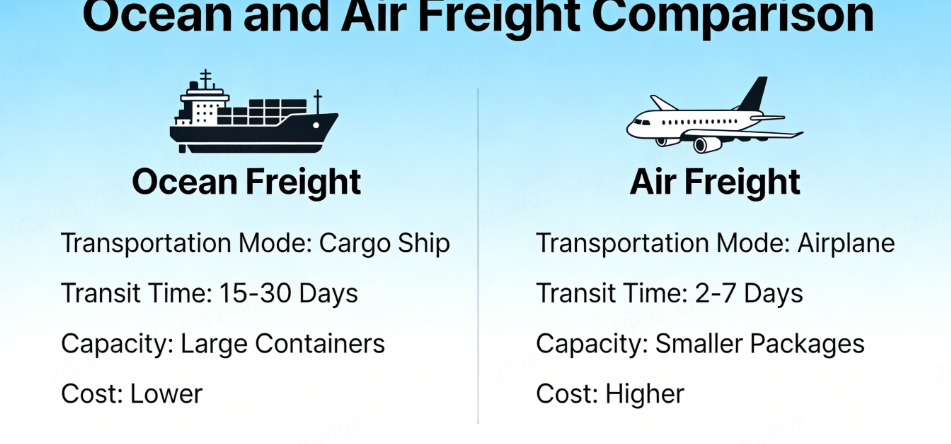
Here’s a quick-reference comparison table for ocean and air freight from China to major destinations:
| Metric | Ocean Freight | Air Freight |
|---|---|---|
| Transit (China to US West Coast) | 25–35 days | 3–7 days |
| Transit (China to US East Coast) | 35–50 days | 4–8 days |
| Transit (China to Europe) | 30–45 days | 3–5 days |
| Cost per kg (≥1000 kg) | $1.80–$3.20 DDP | $4.85–$8.50 |
| Best for | Bulk, non-urgent, low-margin | Urgent, high-value, lightweight |
| Carbon footprint (g CO₂/ton-km) | 10–40 g | 500–1,000 g[reference:5] |
New Section: How the Middle East Crisis Is Reshaping Ocean and Air Freight
As of March–April 2026, the escalating conflict in the Middle East has created a “new peak of disruption” for both ocean and air freight markets.[reference:6]
On the ocean side, carriers pushed rates up by as much as $600 per container on China–US lanes in the week of March 20, 2026, despite a pronounced collapse in shipping volumes.[reference:7] This counterintuitive divergence is driven by three forces: a global fuel price surge linked to the Hormuz Crisis, aggressive blank sailing programs by carriers, and persistent geopolitical uncertainty that injects a floor under freight pricing.[reference:8]
Major carriers have responded decisively. Hapag-Lloyd and MSC have halted bookings from Persian Gulf ports, while Maersk suspended all new bookings for refrigerated containers in the entire region. The Strait of Hormuz closure has led carriers to reroute ships and cancel trips, creating uncertain delays.[reference:9]
On the air side, the closure of airspace over Bahrain, Qatar, Kuwait, and the UAE has forced Qatar Airways and Emirates Skycargo to cancel numerous flights, leading to a decline in global capacity. Air freight prices from Southeast Asia to Europe have already increased by more than 6% to $3.82 per kg.[reference:10]
For B2B buyers evaluating ocean and air freight options: Monitor surcharges closely—additional emergency fuel surcharges are scheduled to take effect in early to mid-April 2026.[reference:11]
New Section: The Environmental Cost of Ocean and Air Freight
In 2026, sustainability is no longer optional. The EU Emissions Trading System is now fully operational for maritime transport, covering 100% of emissions for voyages in and out of Europe since January 2026. Carriers will procure emission allowances and pass these costs to shippers.[reference:12]
Here’s the stark comparison of ocean and air freight carbon footprints:
| Transport Mode | CO₂ Emissions (g per ton-km) | Annual Impact |
|---|---|---|
| Ocean freight | 10–40 g | 11 billion tons moved annually[reference:13] |
| Air freight | 400–1,000 g | Handles 40% of trade value despite just 1% by volume[reference:14] |
| Rail | 20–50 g | The “sweet spot” for inland legs |
| Road truck | 50–150 g | Most carbon-intensive of land modes |
Air freight emits roughly 40–50 times more CO₂ per ton-mile than ocean freight for similar cargo moves.[reference:15]
The B2B takeaway: If your company tracks Scope 3 emissions or sells to eco-conscious clients, shifting volume from air to ocean can significantly reduce your carbon footprint—and help you avoid EU carbon taxes that are quietly transforming cost structures.
New Section: Multimodal – The Best of Both Ocean and Air Freight
Pure ocean and air freight aren’t the only options in 2026. Multimodal solutions are rapidly gaining traction as shippers seek the “sweet spot” between cost and speed.
Maersk’s Sea-Air solution via Oman reduces transit times on traditional east-to-west trade routes by 20–40% compared to pure ocean and generates cost savings of 10–20% compared to pure air freight.[reference:16]
DHL’s TRUCKAIR integrates road and air freight to strike an optimal balance between cost and speed. From China to Türkiye, total transit time is approximately 9–11 days—only 4–5 days longer than pure air freight—while customers have reported six-figure savings over adopting TRUCKAIR versus air freight.[reference:17]
ECU Worldwide’s XLERATE 2.0 uses Los Angeles (LAX) as a temporary hub, combining premium ocean services with priority air freight injection. Cargo reaches major European airports within 5–6 days of vessel arrival in LAX—delivering near-air transit performance without standard air freight costs.[reference:18][reference:19]
For B2B buyers: If pure ocean is too slow but pure air is too expensive, multimodal solutions deserve a serious look. LooperBuy integrates these options into our platform, automatically recommending the optimal routing based on your timeline and budget.
How LooperBuy Simplifies Your Ocean and Air Freight Decisions
At LooperBuy, we’ve built our one-stop B2B sourcing platform to eliminate the guesswork from ocean and air freight decisions.
When you source from China through LooperBuy, you get:
- Side-by-side cost comparisons showing ocean, air, rail, and multimodal options—including fuel surcharges and handling fees
- Real-time rate tracking that monitors market fluctuations and alerts you when rates drop
- Multi-modal optimization that recommends the optimal mode based on your timeline, budget, and product characteristics
- Direct carrier relationships with no middleman markups on any mode
- End-to-end shipment visibility from Chinese factory to your warehouse door
Client result: A LooperBuy client shipping industrial components from Shanghai to Houston reduced their logistics costs by 28% in nine months—simply by switching 65% of their volume from air to ocean using our comparison tools.
Ready to optimize your ocean and air freight decisions? [Sign up for LooperBuy] – free account, transparent pricing, and expert guidance across all freight modes.
Frequently Asked Questions (FAQ)
1. What is the main cost difference between ocean and air freight in 2026?
Air freight typically costs $4.50–$8.50 per kg from China to the US, while ocean DDP costs $1.80–$3.20 per kg. Air is roughly 2.5–5x more expensive depending on volume.[reference:20]
2. How much faster is air freight than ocean freight?
Air freight from China to the US West Coast takes 3–7 days; ocean takes 25–35 days. To the US East Coast, air takes 4–8 days versus ocean’s 35–50 days.
3. What is dimensional weight and why does it matter for air freight?
Dimensional weight converts package volume into an equivalent weight using the formula (L×W×H in cm)÷6000. Carriers charge the higher of actual weight or dimensional weight. Bulky lightweight goods like apparel or pillows can see their air freight bills double or triple.[reference:21]
4. How are Middle East disruptions affecting ocean and air freight in 2026?
Escalating conflict has led Maersk to suspend cargo acceptance to multiple Gulf countries and Hapag-Lloyd to impose war risk surcharges. Airspace closures have forced Emirates Skycargo and Qatar Airways to cancel numerous flights, reducing global capacity and pushing rates higher.[reference:22][reference:23]
5. Which is more environmentally friendly: ocean or air freight?
Ocean freight emits 40–50 times less CO₂ per ton-mile than air freight. Ocean emits 10–40 g CO₂ per ton-km; air emits 400–1,000 g. With the EU ETS now covering maritime emissions, ocean’s cost advantage may grow further.[reference:24][reference:25]
6. Does LooperBuy offer both ocean and air freight options?
Yes. LooperBuy integrates with major carriers across ocean, air, rail, and multimodal options. Our platform shows you side-by-side costs, transit times, and recommended modes based on your specific shipment.
Article Summary
Ocean and air freight 2026: real costs ($4.50–8.50/kg air vs $1.80–3.20/kg ocean DDP), transit times (3–7 days vs 25–35 days), Middle East disruption impacts, carbon emissions (40–50x difference), multimodal solutions, and LooperBuy integration.
Hot Tags
ocean and air freight, ocean freight rates 2026, air freight cost per kg 2026, ocean vs air freight comparison, shipping from China to US 2026, dimensional weight air freight, Middle East shipping disruption 2026, multimodal freight solutions, sea air hybrid logistics, LooperBuy shipping platform, B2B freight optimization, ocean DDP costs, air freight carbon emissions, supply chain resilience 2026
References
- DHL. (2026). DHL reports diverging ocean and air freight trends entering 2026. Retrieved from https://asiacargonews.com/nec_web/news/detail?id=11706
- Sino-Shipping. (2026). Shipping from China to US – Updated March 2026. Retrieved from https://www.sino-shipping.com
- Forest Leopard. (2026). Air Freight China to USA 2026: Fast FBA Shipping Guide. Retrieved from https://es.forestleopard.com
- Unicargo. (2026). Amazon FBA Shipping Costs 2026: China to USA Rates. Retrieved from https://www.unicargo.com
- Breakbulk News. (2026). Carriers Push Rates Up $600 per Container on China-US Lanes. Retrieved from https://breakbulk.news
- FreightAmigo. (2026). 空运 vs 海运 CO2 每公里排放. Retrieved from https://www.freightamigo.com/sc/blog/logistics/freight-co2-emissions-comparison/
- Ship4wd. (2026). Sea Freight vs Air Freight: Carbon Footprint & Sustainability. Retrieved from https://ship4wd.com/logistics-shipping/sea-freight-air-freight-carbon-footprint
- FreightAmigo. (2025). Ocean vs. Air Freight: Making the Right Choice for Your Shipping Needs. Retrieved from https://www.freightamigo.com/en/blog/logistics/ocean-vs-air-freight-making-the-right-choice-for-your-shipping-needs/
- World Ports Organization. (2026). A.P. Moller–Maersk successfully undertakes its first multimodal Sea-Air solution via Oman. Retrieved from https://www.worldports.org
- Air Cargo Update. (2026). cargo.one acquires Cargofive, unveils AI OS. Retrieved from https://aircargoupdate.com
- Air Cargo Update. (2026). Saudia Cargo, Mawani, and ZATCA Launch Sea to Air Logistics Corridor. Retrieved from https://aircargoupdate.com
- FreightAmigo. (2026). Air vs Ocean for Electronics: 2026 Decision Framework. Retrieved from https://www.freightamigo.com/en/blog/electronics-logistics/air-vs-ocean-for-electronics-2026-decision-framework/
- International Transport Journal. (2026). Prices: Ocean freight stable, air freight rising. Retrieved from https://transportjournal.com
- Kisun Shipping. (2026). Sea vs Air vs Rail Freight: 2026 China Shipping Guide. Retrieved from https://kisunshipping.com
- Forto. (2026). Q1 2026 & beyond: Logistics outlook on sea capacity, air trends & economic risks. Retrieved from https://forto.com/en/blog
- Air Cargo News. (2026). DHL launches TRUCKAIR to speed up China–Europe shipments. Retrieved from https://asiacargonews.com
- Benzinga. (2026). ECU Worldwide Unveils XLERATE 2.0 Expansion. Retrieved from https://www.benzinga.com
- LooperBuy. (2026). Supplies Business: A B2B Expert’s Guide to Sourcing Chinese Goods Globally with LooperBuy. Retrieved from https://blog.looperbuy.com/supplies-business-a-b2b-experts-guide-to-sourcing-chinese-goods-globally-with-looperbuy.html